de Lucinière Castle: A Historic Estate in France


Site at a Glance
- Rating
- 4.4
- Popularity
- Very Low
- Country
- France
- Primary era
- Early Modern
- Eras represented
- Medieval, Early Modern
- Civilizations
- Duchy of Brittany, French
- Site type
- Domestic
- Remains
- Castle
On this page8 sections
History
de Lucinière Castle is a historic castle in Joué-sur-Erdre, France, whose estate developed from a fortified residence into a château complex altered between the seventeenth and nineteenth centuries. Its history includes links to the Montfort-Laval and Cornulier families, a royal military camp in 1487, religious refuge, destruction, and wartime rescue.
From Roche-en-Nort to the Cornulier estate
Lucinière was originally a fortified castle. In 1485, the Montfort-Laval family sold it to Pierre Landais, and the seigneurial estate then took the name Roche-en-Nort. At that time, it depended on the lordship of La Roche-Bernard. On 13 August 1487, after the failed siege of Nantes, Charles VIII, king of France from 1483 to 1498, and his elder sister Anne de Beaujeu camped with their troops near the castle in the parish of Joué.
The estate later passed to Landais’s nephew, Cardinal Robert Guibé, and then to Guibé’s nephew, François Hamon, Bishop of Nantes. The surrounding fortifications were demolished in 1589. The Council of the League had ordered the castle’s demolition, but the Cornulier family secured the cancellation of that decision through the Duchess of Mercœur.
Seventeenth- and eighteenth-century transformation
Three modifications took place in 1681 and 1682. The Renaissance residence with its flanking towers was enlarged, and the estate’s avenues were laid out by André Le Nôtre, the principal designer associated with the formal gardens of Versailles. This tradition used planned avenues, geometric arrangements, and strong axial layouts.
Under Anne-Marie de Gennes, Countess of Roche-en-Nort, Lucinière also became a refuge for persecuted Jansenists. Jansenism was a rigorist movement within early-modern Catholicism that stressed human sinfulness, divine grace, and strict religious discipline. The castle was described as a kind of branch of Port-Royal des Champs, the movement’s principal intellectual and religious center in France. Almost all those sheltered there belonged to the Benedictine convent of Blancs-Manteaux in Paris.
Destruction, later use, and protection
At the end of the eighteenth century, the castle was looted and burned. Its construction nevertheless extended from the seventeenth through the nineteenth centuries. Adolphe Le Gualès de Mézaubran came to Lucinière through his marriage in 1884 to Marie-Thérèse de Cornulier. During the nineteenth century, the castle housed a thoroughbred horse-breeding establishment.
During the German Occupation, the Count and Countess Le Gualès de Mézaubran protected several Jewish families and individuals, including children. Yad Vashem, Israel’s national Holocaust remembrance institution, awarded them the Medal of the Righteous on 10 October 1999. Lucinière remains privately owned. The site was classified as a protected site in 1949, and parts of the château complex were registered as historic monuments in 1985.
Remains
Château and surviving residence
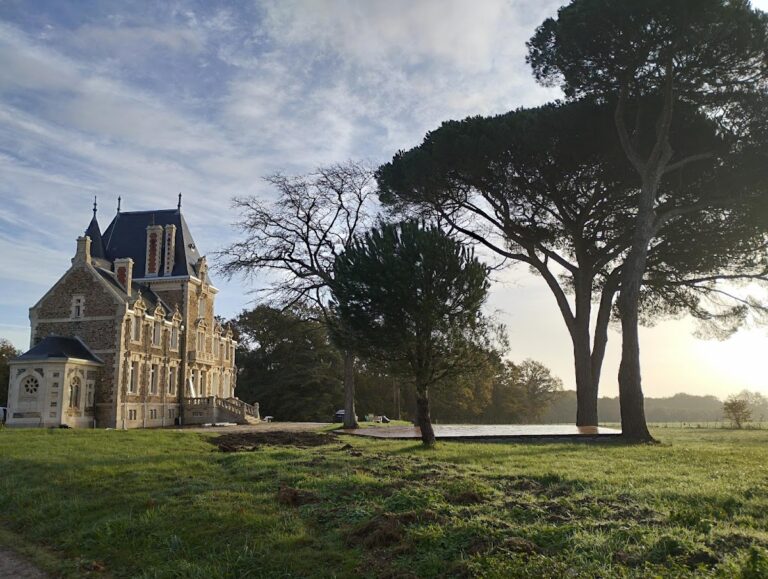
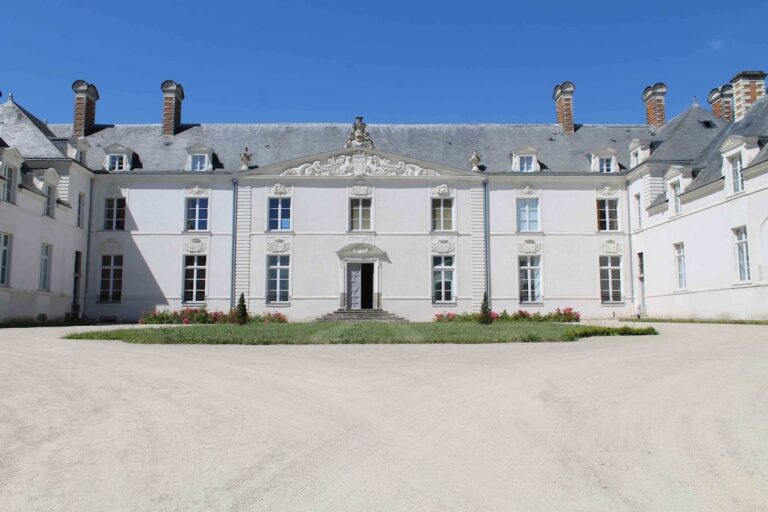
The present château preserves a Renaissance core flanked by towers. A central residential wing was added during the modifications of 1681 and 1682, together with a pediment oriented toward the Erdre. The late-eighteenth-century destruction left three turrets from the former residence incorporated into the present building, preserving elements of the earlier fortified complex within the later château.
Chapel and estate buildings
A small chapel survives within the complex and contains several family tombs. The protected group also includes an orangery and a dining room with wood-panelled decoration. These buildings and interiors form part of the château complex registered as historic monuments in 1985, with the chapel, orangery, dining room, and its wood-panelled decoration specifically registered on 9 December that year.
Formal grounds
The grounds retain avenues laid out by André Le Nôtre during the same period as the château’s late-seventeenth-century enlargement. Their planned arrangement belongs to the formal French garden tradition associated with his work.