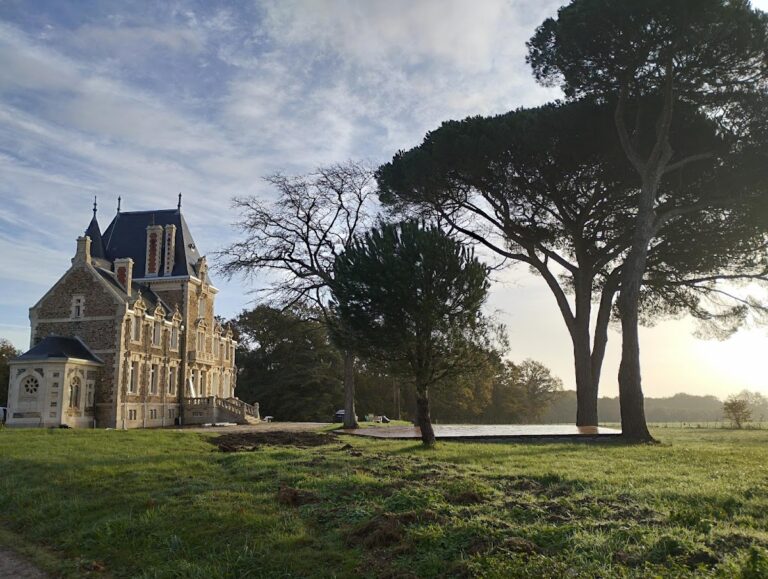
Tour Saint-Clair: The Ruined Keep of Château de Derval

Site at a Glance
- Rating
- 4.2
- Popularity
- Very Low
- Country
- France
- Primary era
- Medieval
- Eras represented
- Medieval
- Civilizations
- Duchy of Brittany
- Site type
- Military
- Remains
- Castle
On this page8 sections
History
Tour Saint-Clair is the surviving keep of the former Château de Derval in Derval, France, a fortified castle founded in the thirteenth century. The ruin preserves the last standing part of a castle whose medieval history is closely associated with Breton nobles, English military power, and the conflicts of late medieval France.
The Castle in the Fourteenth Century
The first known historical mention of Château de Derval concerns the siege of 1373. The English knight Robert Knowles held the castle after being entrusted with it by Jean de Montfort, Duke of Brittany. Bertrand du Guesclin, a leading French commander who served the crown during the Hundred Years’ War, besieged the stronghold that year. Knowles retained possession until 1380. Earlier ownership records place the castle with Bonabes IV de Rougé de Derval until 1365, followed by Knowles from 1365 to 1380.
The siege was described by Jean Froissart, a fourteenth-century chronicler of political and military events, and later represented in a miniature by Pierre Le Baud, a late-medieval Breton chronicler and historian. Created in the late fifteenth century, the miniature is the earliest known image of Château de Derval and shows its appearance at the end of the Middle Ages while depicting the events of 1373.
Later Lords and Destruction
The castle remained connected with the Derval family and, during the fifteenth century, was associated with Jean de Malestroit, a Breton nobleman, and his wife, Hélène de Laval. Jean de Derval is recorded as holding it from 1435 to 1482. The castle was destroyed at the end of the sixteenth century during the Wars of the Catholic League, a period of civil and religious conflict in France.
Quarrying and Protection
After its destruction, the site was used as a stone quarry into the twentieth century, leaving the ruins difficult to see. The surviving keep received protection as a historic monument in France in 1925. In November 2021, that protection was extended to the entire site, including its built and unbuilt areas, moats, surrounding space, and buried remains.
Remains
The ruins stand in woodland at the Bas Château site, about 2.5 kilometres north-northeast of the town of Derval in Loire-Atlantique. Their layout preserves a fortified complex arranged through successive enclosures, terraced defensive works, courts, ditches, and a water-filled landscape.
Surviving Fortifications
Tour Saint-Clair
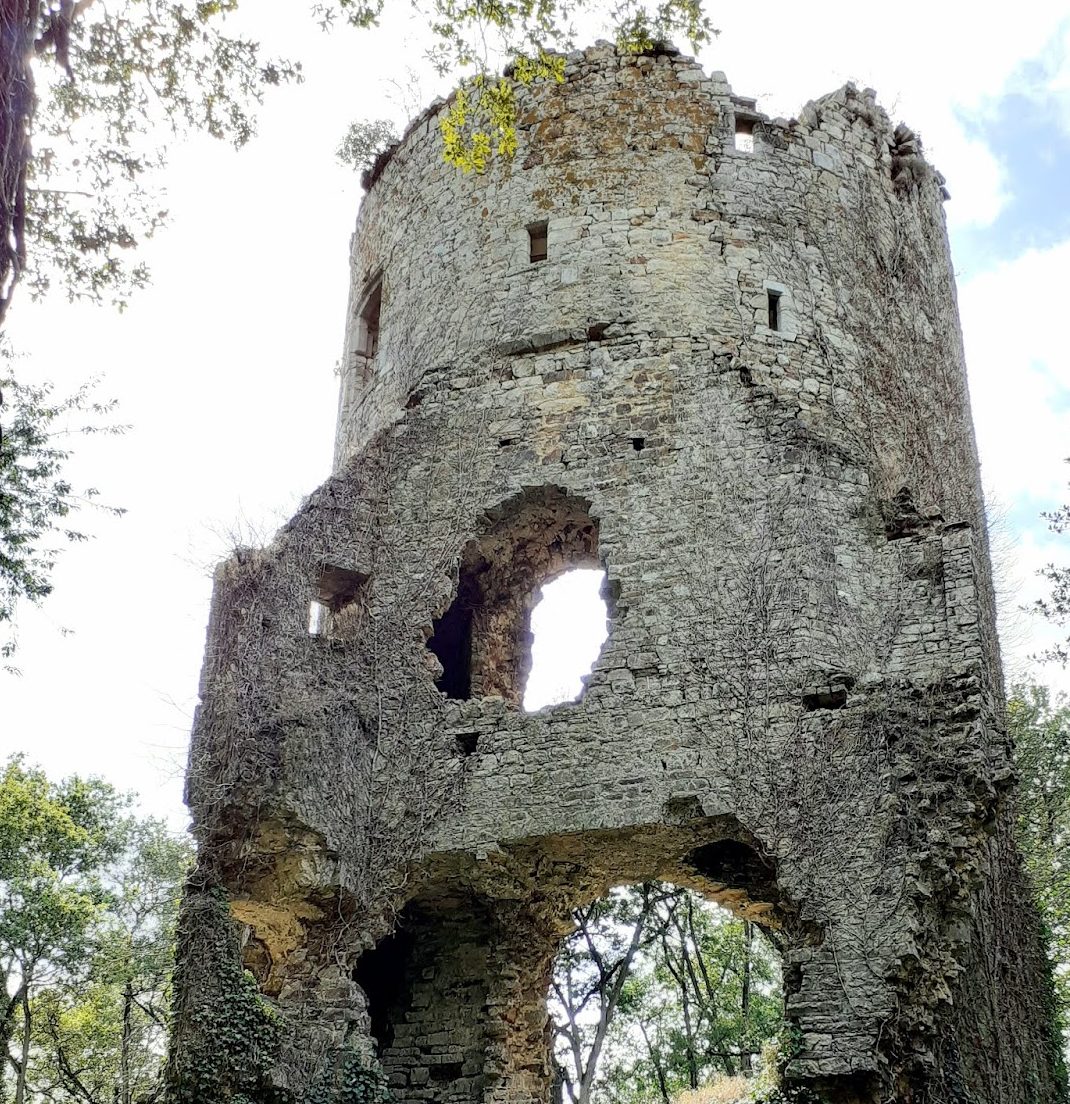
The principal surviving structure is the main tower known as Tour Saint-Clair. It rises approximately 24 metres and has collapsed across half of its diameter. It is the sole part of the castle that remains standing above ground, giving the ruin its defining vertical element.
Courts, Moats, and Enclosures
The upper court is preceded by a quadrangular lower court. Successive moats enclose the castle complex, and some still contain water. Terraced defensive works mark several stages of enclosure. An eighteenth-century description refers to nine large and small towers, ditches, and a pond supplied by running water. Small sluices controlled the retention and release of that water.
The same description identifies two further enclosing walls. The first was insubstantial, while the second was formed by buildings that had to be crossed to reach a third bridge and the principal entrance. Together with the late-medieval miniature showing the siege of 1373, these descriptions provide evidence for the castle’s former scale and arrangement beyond the surviving tower.