Castle of Ragogna: A Medieval Fortress in Italy


Site at a Glance
- Rating
- 4.4
- Popularity
- Low
- Country
- Italy
- Primary era
- Medieval
- External website
- Open
- Eras represented
- Classical, Medieval
- Civilizations
- Holy Roman Empire, Lombard, Roman
- Site type
- Military
- Remains
- Castle
On this page10 sections
History
The Castle of Ragogna is a high-medieval fortified complex in San Pietro di Ragogna, Italy, whose construction began in the tenth century and was completed in the second half of the twelfth century. Built on elevated ground above the Tagliamento, it occupied a strategic position overlooking the river at the Pinzano gorge and developed from an earlier fortified settlement associated with Reunia.
Reunia and the early fortifications
Reunia was first recorded around 565 by Venantius Fortunatus, a Christian writer and cleric, in his Vita Sancti Martini, a work about Saint Martin of Tours. The settlement stood beside the Roman Via Germanica, which connected Concordia Sagittaria with the Via Julia Augusta near Gemona and continued toward Noricum, a Roman province in the eastern Alps and nearby Danubian region. By avoiding Aquileia, this route shortened travel toward the Po Valley, while Reunia controlled movement along the road and the crossing of the Tagliamento.
The Romans incorporated Reunia into a defensive system at the outlet of the valleys near the Prealpine arc. The Lombards, who established a kingdom in Italy during the early medieval period, strengthened this system. Paul the Deacon, an eighth-century Lombard historian, described the defensive area in his Historia Langobardorum, written after 790. He stated that the Castrum Reuniae sheltered local people during an Avar incursion in 610. The Avars were a steppe-based power that conducted military raids across Central and Eastern Europe.
Paul the Deacon also related the attempted seizure of the Duchy of Friuli by the noble Arimann Hansfrit, also called Ansfrido. An Arimann was a free Lombard military landholder. Hansfrit was defeated by King Cunipert, blinded after his capture, and exiled under Lombard law.
Medieval lordship and conflict
The castle does not appear in the surviving records of the tenth and eleventh centuries. Its apparent decline has been connected with the loss of its strategic role and the diversion of commercial traffic from the old Roman road. During the tenth century, however, the fortress again served as a refuge during repeated Hungarian raids.
In 1122, Ragogna was held by Henry III, Duke of Carinthia, of the Eppenstein family. After his death without direct heirs, the castle passed to Leopold of Traungau, Margrave of Styria. Bertoldo, first recorded member of the Ragogna family, appears in 1138. The Traungau family probably granted the fief to this family of German origin, whose descendants later divided into the Ragogna, Toppo, and Pinzano branches.
By the fourteenth century, a second fortress, the Castello Inferiore, stood on the plain below the church. A severe earthquake in 1348 caused extensive damage, including the collapse of two towers. During the war between the Patriarchate of Aquileia, a major ecclesiastical and territorial authority in northeastern Italy, and the Austrian dukes from 1359 to 1365, the Ragogna family supported Austria and endured several sieges. The siege of 5 November 1365 ended with the family’s surrender to patriarchal forces.
In 1390, Giovannino di Ragogna transferred the castle to John Sobieslaus of Moravia, Patriarch of Aquileia, in exchange for Torre di Pordenone. The Ragogna family then permanently left the old castle. The Castello Inferiore continued to resist the patriarch until its capture and demolition after a long siege in 1397.
Venetian administration and the Counts of Porcia
From 1397 to 1420, captains administered the castle first for the Patriarchate of Aquileia and later for the Republic of Venice. Poor administration contributed to the decline of the fortified complex, and Venice enfeoffed it to the Counts of Porcia in 1503.
Under the Counts of Porcia, the castle’s condition improved for several years. It became a summer residence and a setting for hunting, fishing, and festivities. In early 1532, Count Antonio di Porcia held a reception there for Marco Grimani, Patriarch of Aquileia. An earthquake in 1511 and a fire in 1560 later caused irreparable damage. The restoration that followed was relatively rough, and in 1567 Girolamo di Porcia described the castle as ruined, although it still retained several towers, peasant houses, the church, and a tower containing the lords’ room.
Abandonment, destruction, and preservation
The Counts of Porcia gradually reduced their stays at Ragogna and abandoned it permanently from 1650. Lack of maintenance, disputes among the owners, the isolated location, and the passage of time accelerated the ruin. Inhabitants of San Pietro di Ragogna subsequently quarried the remains for building material.
In 1878, Count Ermes di Porcia ordered the dismantling of the castle and the sale of everything that could be removed, beginning with the roof. Further damage occurred during the fighting of 1917 associated with the Twelfth Battle of the Isonzo and during the resistance of the Bologna Brigade against German and Austro-Hungarian forces at Monte di Ragogna.
After Count Alfonso di Porcia died in 1932, his heirs sold his remaining properties in Ragogna to private buyers. The castle became municipal property in 1952 under the will of Countess Irene. The 1976 Friuli earthquake severely damaged the complex. The surviving tower and defensive wall collapsed completely, while the church of San Pietro and part of the wall were heavily damaged. The Municipality of Ragogna now owns the site, which has been partly restored as a historical and architectural monument with an associated museum route.
Remains
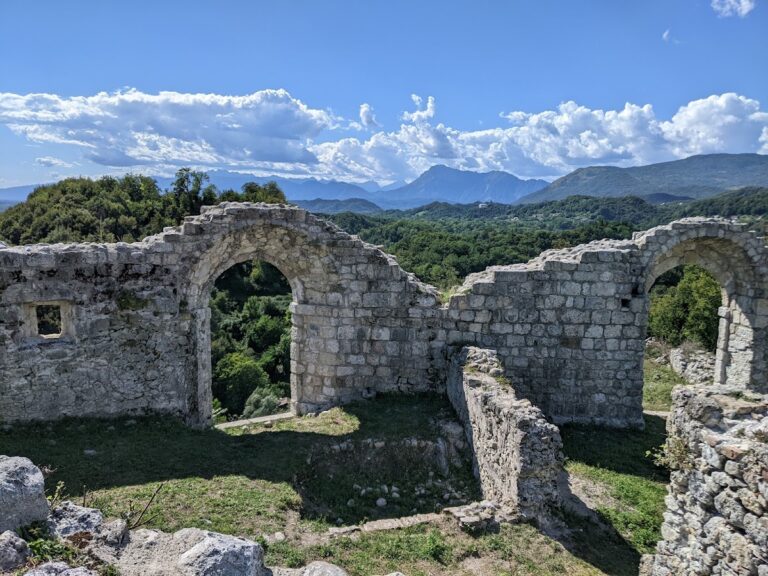
The castle occupies elevated ground above the Tagliamento where the river passes through the Pinzano gorge. It is a hillside fortress built primarily from rubble stone, including pebbles set in mortar. The surviving complex is a partially restored ruin formed by the upper fortress, the separate lower fortress, and the old church of San Pietro.
Castello Superiore
The Castello Superiore occupies the highest plateau within the first circuit of walls. This enclosure contains the earliest identified settlement and the former castrum, or fortified settlement. Excavations revealed two towers and the original western entrance, which faced toward the river. The present approach from the road passes the church before reaching the southern gate and the inner courtyard.
Keep and inner courtyard
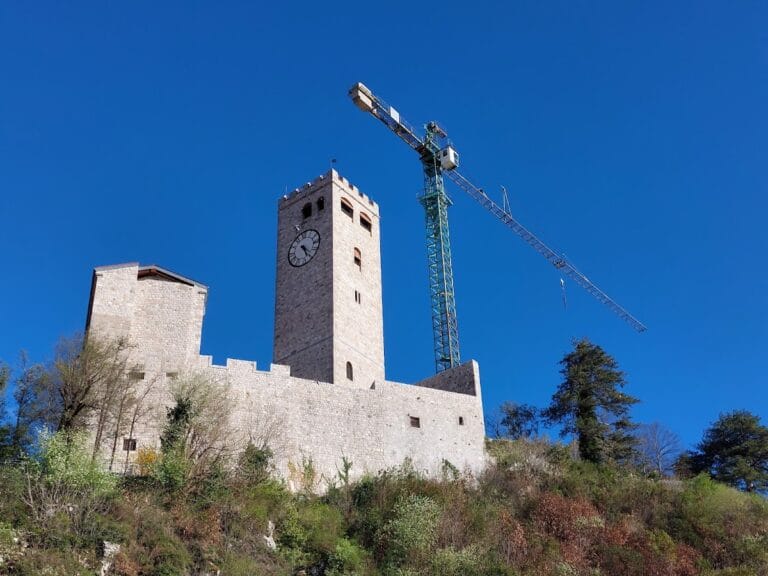
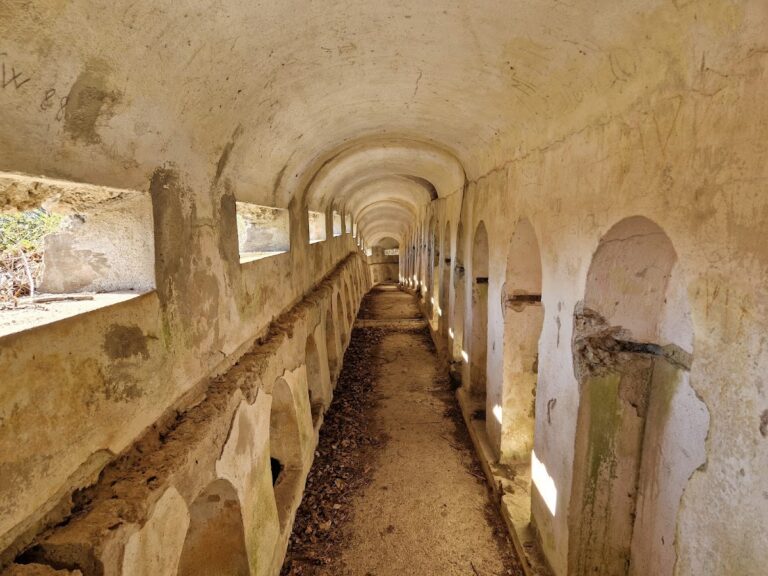
The upper fortress consists of a keep, the principal fortified tower, identified with the former palacium, or main residential building, together with an inner courtyard. Storehouses, cellars, and former kitchens adjoin the northern wall and open onto this courtyard. The keep and defensive wall collapsed in the 1976 earthquake. The restored keep now contains exhibition spaces, including a permanent display dedicated to the Tagliamento River. Its first floors also accommodate periodic exhibitions of painting, sculpture, decorative art, and photography.
Church of San Pietro
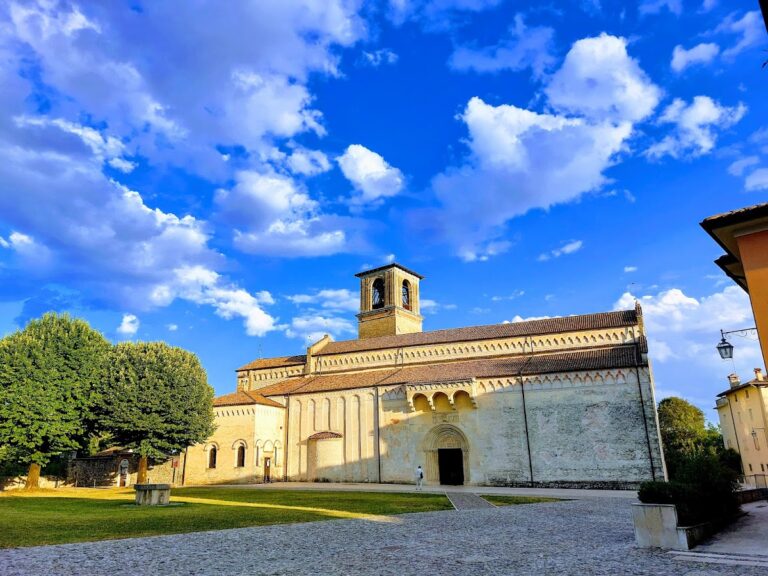
The old church of San Pietro forms part of the castle complex. It includes a bell tower and a cemetery arranged on two levels. The church was heavily damaged by the 1976 earthquake and remains part of the partially restored fortified site.
Castello Inferiore
The Castello Inferiore was a separate lower fortress on the plateau below the church. Its surviving remains include the surrounding wall and the remains of a tower. Archaeological excavations in the late 1980s, led by Dr Antonio Cerutti and the Gruppo Archeologico Reunia, revealed the towers and the original western entrance within the first circuit of walls associated with the upper complex.