Castle Campbell: The Lowland Seat of the Earls of Argyll
Site at a Glance
- Rating
- 4.7
- Popularity
- Low
- Country
- United Kingdom
- Primary era
- Medieval
- External website
- Open
- Eras represented
- Medieval, Early Modern
- Civilizations
- Kingdom of Scotland
- Site type
- Military
- Remains
- Castle
On this page10 sections
History
Castle Campbell is a medieval castle above Dollar in Scotland, built around 1430 as a residence for John Stewart, Lord Lorne, or one of his kinsmen. From the fifteenth to the nineteenth century, it served as the lowland seat of the earls and dukes of Argyll, the leading branch of Clan Campbell, and remained the clan’s principal seat until the mid-seventeenth century. The site may have contained a motte, a raised earthwork mound for a fortified residence or tower, during the twelfth century.
From Castle Gloom to Castle Campbell
The castle was originally known as Castle Gloom, or the Place of Glom. The name may come from the Scottish Gaelic word glom, meaning a chasm, referring to the narrow gorges on either side of the site. Its earliest surviving historical record dates from the 1460s, when Pope Paul II issued a bull concerning Walter Stewart, Lord Lorne’s son, who had attacked and damaged the Place of Glom. The tower was rebuilt after this episode, although parts of it also reflect construction from the earlier part of the fifteenth century.
In the mid-fifteenth century, Colin Campbell, 1st Earl of Argyll, acquired the property through his marriage to Isabel Stewart, Lord Lorne’s daughter. The acquisition extended Campbell influence from Argyll into central Scotland. It also suited Colin Campbell’s position as Master of the Household to James III, an office that required regular attendance at court. Colin later petitioned the newly crowned James IV to replace the name Castle Gloom with Castle Campbell. Parliament approved the change through the Castle Campbell Act in 1489–90.
Expansion and the Scottish Reformation
The castle grew during the late fifteenth and sixteenth centuries. The east range was probably built first, followed after the 2nd Earl of Argyll came to power in 1493 by the substantial south range. Its design was influenced by contemporary work at Stirling Castle, reflecting the family’s increasing resources and connections at the royal court.
Archibald Campbell, 4th Earl of Argyll, adopted the Protestant cause during the Scottish Reformation, the sixteenth-century transformation through which Scotland adopted Protestant forms of worship and organization. He supported John Knox, a leading Protestant preacher and reformer, who preached at Castle Campbell in 1556 and returned in February 1564 to meet the earl.
Mary, Queen of Scots, stayed at the castle for three days in January 1563 during the marriage celebrations of Margaret Campbell, sister of the 5th Earl of Argyll, and James Stewart, Lord Doune. Courtiers and musicians performed a masque dressed as shepherds, while Knox disapproved of the dancing. During the Chaseabout Raid of 1565, a conflict arising from opposition to Mary’s rule, Mary and her husband, Lord Darnley, received the surrender of Castle Campbell. The Earl of Moray and the Earl of Argyll were said to have planned to capture the royal couple and imprison them there.
Household and political turmoil
In 1584, Colin Campbell, 6th Earl of Argyll, and his wife Agnes Keith decorated the castle with eighteen pieces of tapestry. During the 1590s, Archibald Campbell, 7th Earl of Argyll, rebuilt the east range and linked it with refurbished guest chambers in the tower. An inventory from 1595 lists furnishings, tapestries, carpets, and other contents, including forty-seven beds, illustrating the scale of the household maintained at the castle.
The castle also functioned as a place of authority. In 1590, James VI objected when Alexander Menteith, the castle captain and Chamberlain of Campbell, released Henry Mersair, who had been condemned for fire-raising, murder, slaughter, and other crimes. Agnes Douglas, Countess of Argyll, imprisoned Thomas Alexander of Balruidy there on an accusation of sheep rustling. In 1605, the Earl of Argyll arranged for tenants to bring coal from pits at Sauchie to heat the castle.
In 1645, troops commanded by James Graham, 1st Marquess of Montrose, devastated the surrounding lands, including Dollar and Muckhart, during the campaign that preceded the Battle of Kilsyth. Castle Campbell was not besieged and escaped damage. Argyll retaliated by ordering the destruction of the Royalist castles of Menstrie and Airthrie.
Fire, abandonment, and preservation
Archibald Campbell, 8th Earl of Argyll, initially supported Charles II but submitted to Oliver Cromwell’s Commonwealth in 1652. The Commonwealth was the republican government that ruled England, Scotland, and Ireland after Charles I was executed, with Cromwell as its dominant political and military leader. Cromwell’s forces garrisoned Castle Campbell in 1653. Royalist rebels attacked and burned it over two nights in July 1654.
After the Restoration of the monarchy, Archibald Campbell, 8th Earl of Argyll, was executed in 1661. His son chose to establish Argyll’s Lodging in Stirling rather than rebuild Castle Campbell. The castle was briefly garrisoned during the Jacobite rising of 1715 and was later abandoned.
The 6th Duke of Argyll sold the castle in 1805 to Crauford Tait of the adjoining Harviestoun estate. Sir Andrew Orr acquired both Harviestoun and Castle Campbell in 1859, and his son commissioned excavations in the 1870s. In 1948, the owners of the Harviestoun estate transferred Dollar Glen to the National Trust for Scotland, which arranged for the castle to be cared for by the Ministry of Works. Management later passed to Historic Scotland and then Historic Environment Scotland. Excavations in the 1980s exposed charred timbers connected with the 1654 fire, while restoration included a new roof for the tower.
Castle Campbell was designated a scheduled monument on 2 December 2015. The castle and its designed landscape have also been included in Scotland’s Inventory of Gardens and Designed Landscapes since 2007.
Remains
Castle setting and tower house
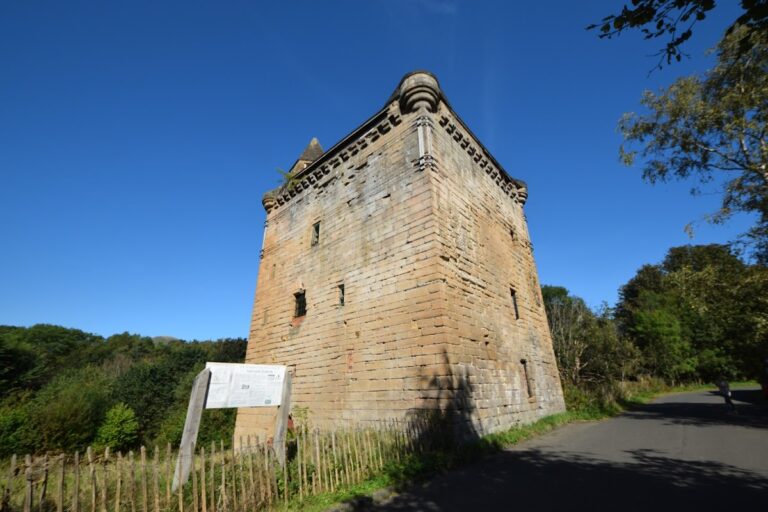
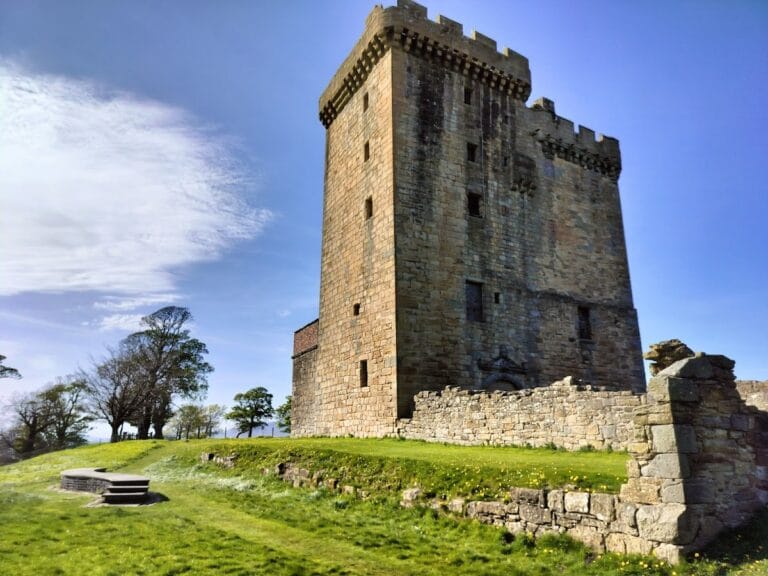
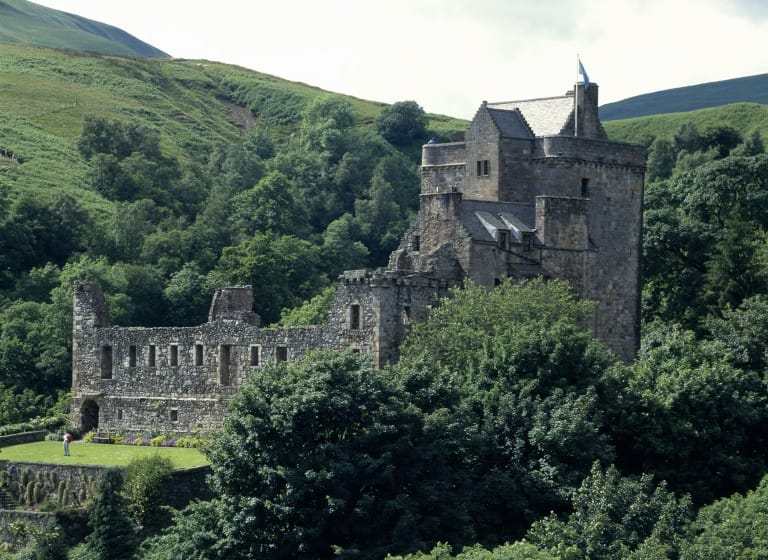
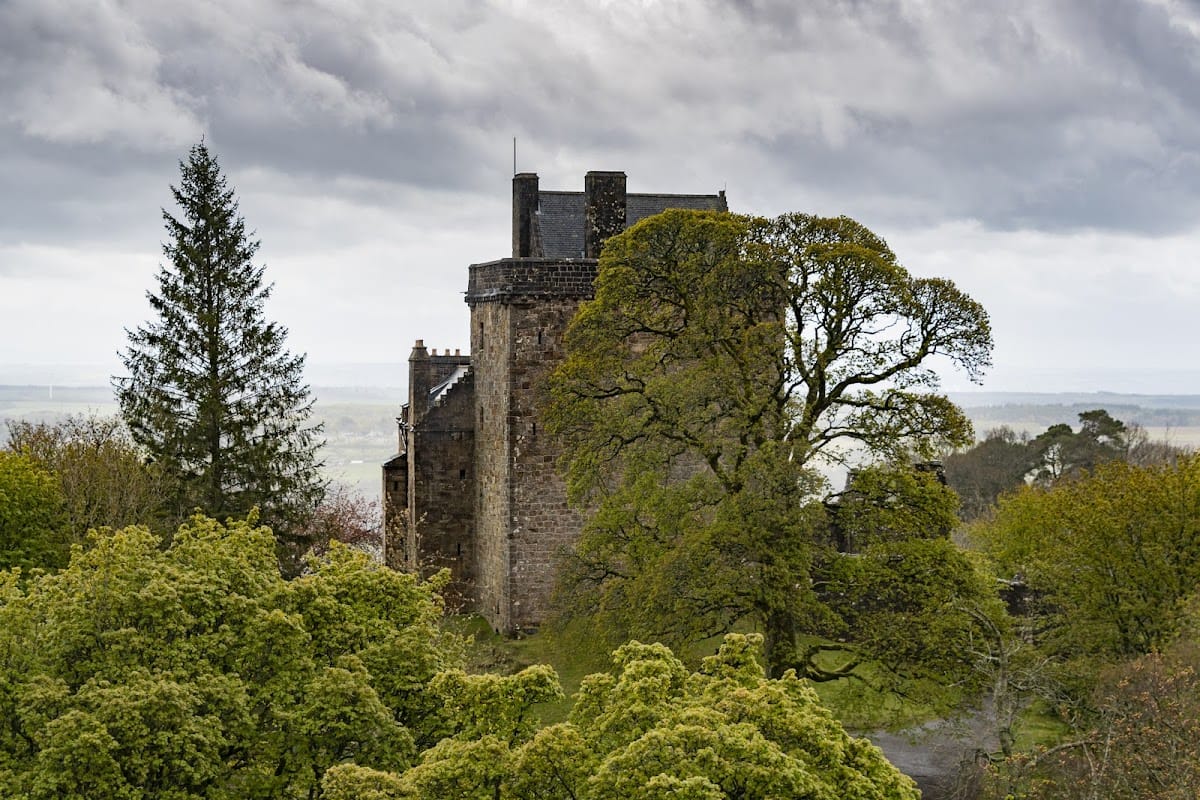
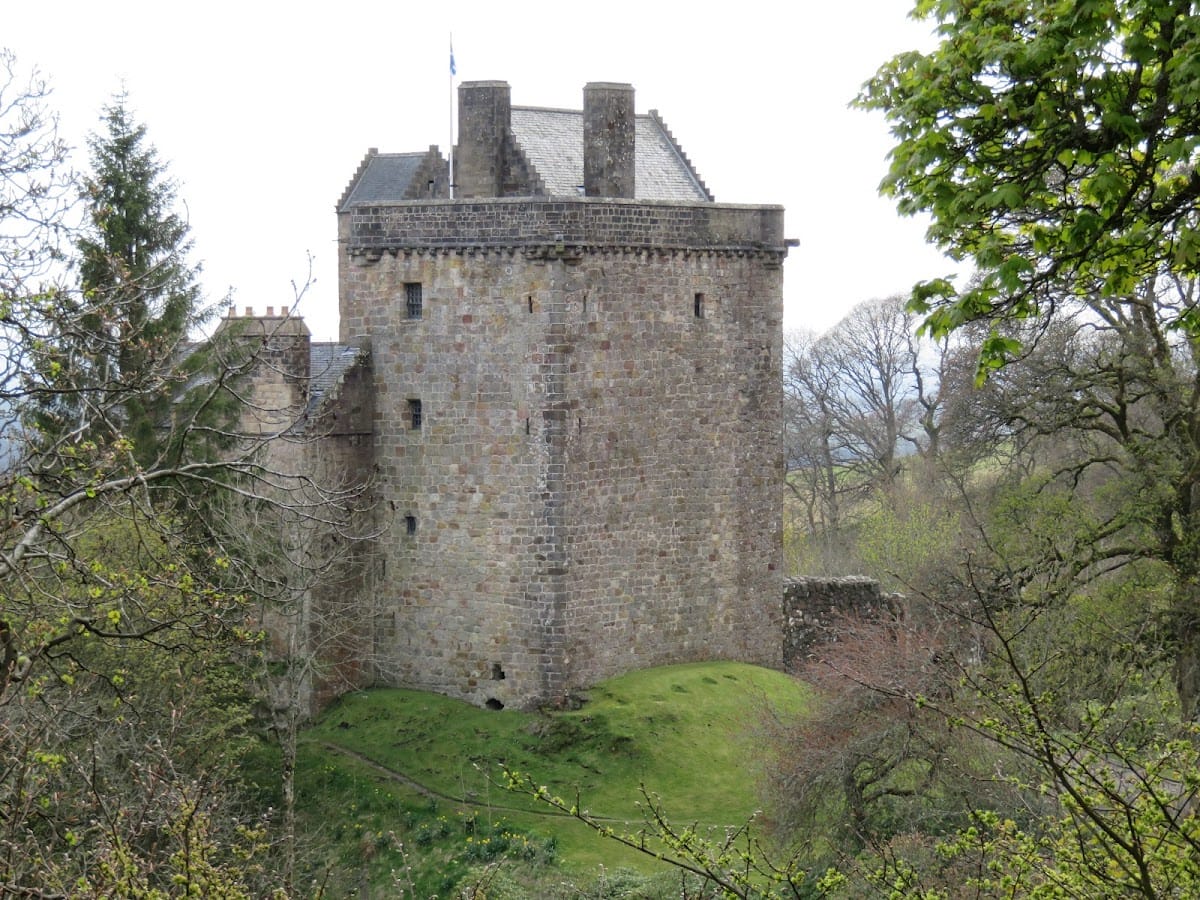
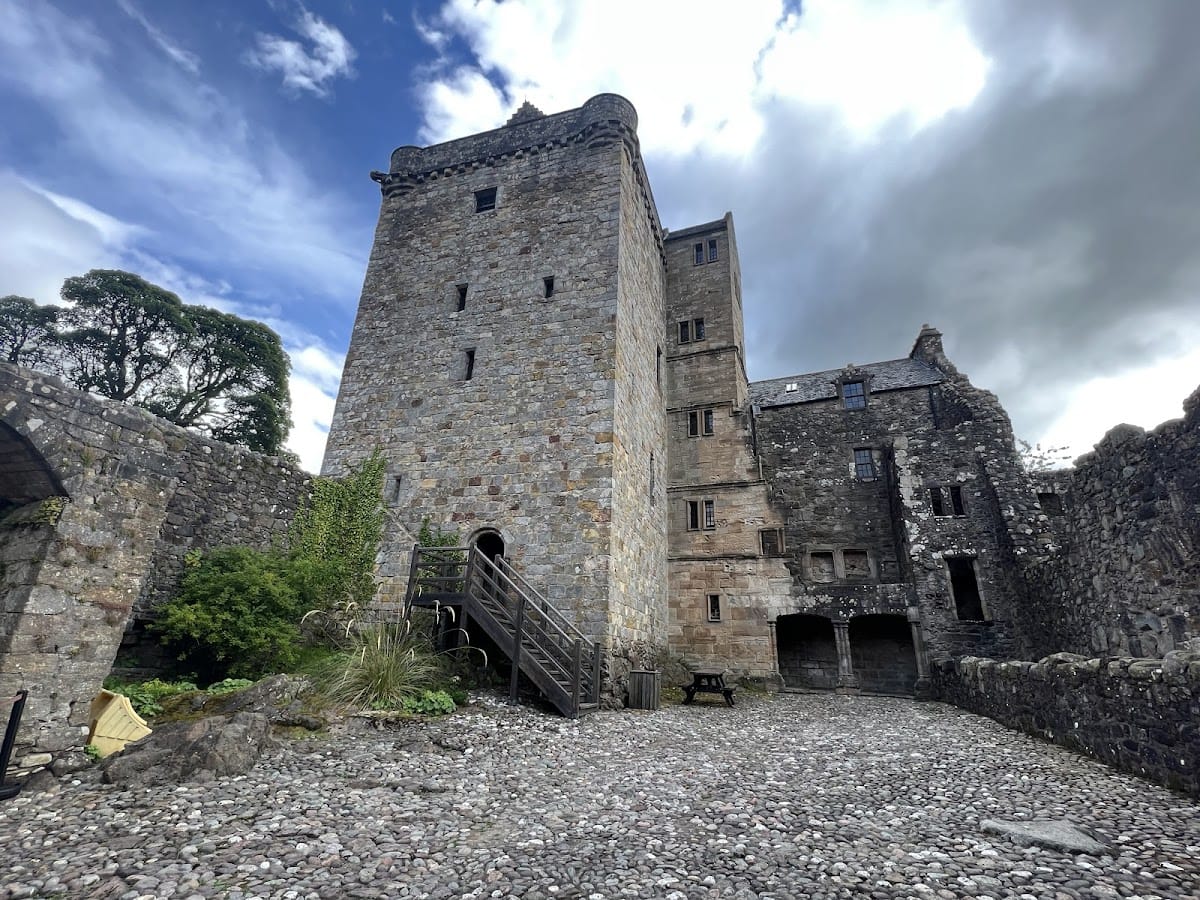
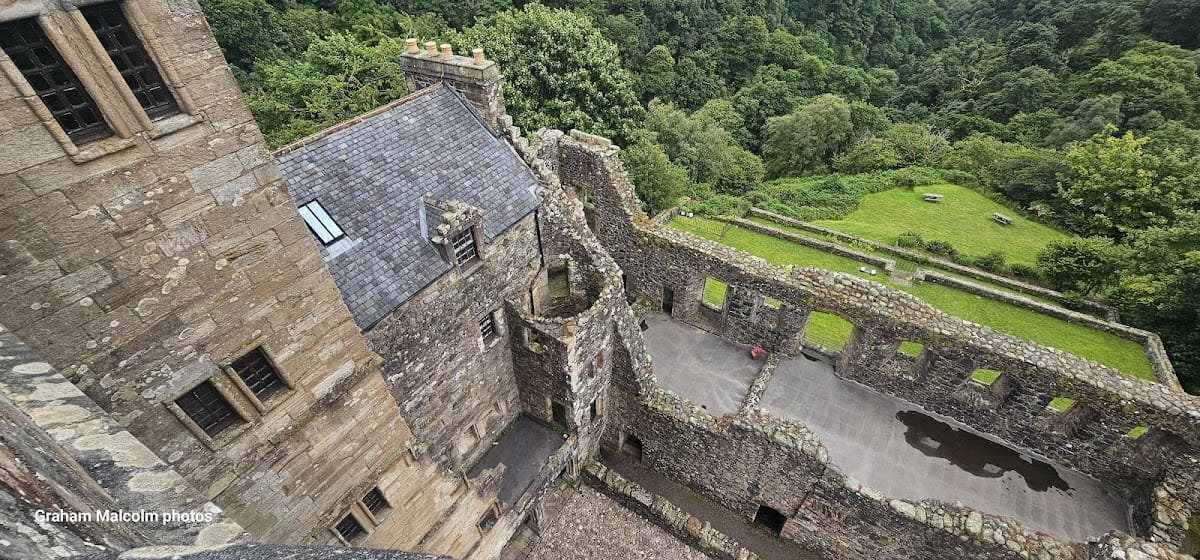
Castle Campbell occupies a naturally defended position above Dollar, with narrow gorges on both sides. Its buildings were arranged around a courtyard, while gardens extended beyond the main complex. The principal surviving building is a tower house of mid-fifteenth-century origin. It contained four residential floors, along with storage cellars, a kitchen, and a prison.
The tower’s north side has windows only at the uppermost floor because this side was regarded as the castle’s weakest defensive approach. Around 1600, the internal arrangement was changed by inserting a new spiral staircase and turning the former staircase into cupboard space. A stone ceiling added on the third floor carries two Green Man masks, foliage-associated faces used in European architectural decoration, from which chandeliers were suspended.
South and east ranges
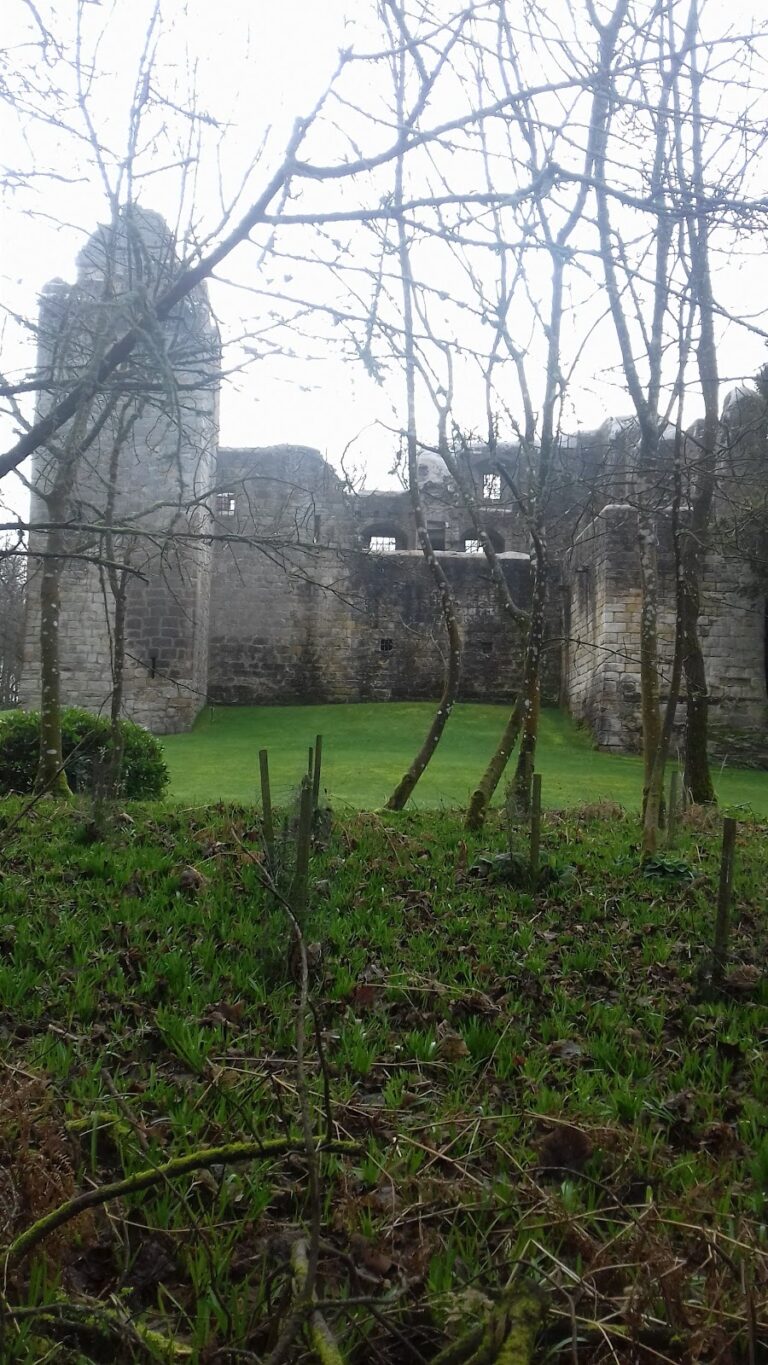
The south range contained a hall, an outer chamber, a bedchamber, further private lodgings, and a kitchen. Its state apartment had large windows facing south over the gardens and the Devon Valley. Access from the courtyard was provided by two symmetrically placed stairways. The range’s construction and arrangement were influenced by the contemporary King’s Old Building at Stirling Castle.
Rebuilt during the 1590s or around 1600, the east range joined the south range to refurbished guest chambers in the tower. It included a two-arched loggia, a roofed gallery or arcade open on one side, facing the courtyard. Its façade used polished ashlar masonry, made from regularly cut and finished stone blocks. Galleries and new stairways were arranged to the north and south. The open ground-floor arcade was unusual in Scotland, with comparable traces noted at St Andrews Castle and Huntly Castle.
Walls, entrance, and gardens
A high wall enclosed the buildings. A gate added in the late sixteenth century led into the courtyard and had gun loops on both sides for additional defence. These fortifications could resist a light attack but were not designed to withstand an artillery siege.
The gardens extended across several terraces. In the southwestern corner, a rocky area is traditionally identified as John Knox’s Pulpit, associating the feature with Knox’s preaching at the castle. The gardens formed part of the wider designed landscape connected with the castle.
Archaeological evidence and restoration
Excavation in the 1870s recovered fragments of stained glass from the south range. Further work in the 1980s uncovered charred structural timbers left by the burning of 1654. The castle has been restored while retaining ruined and excavated elements, and the tower has received a new roof. Coloured window-glass fragments from the south range provide evidence for its former glazed decoration.