Alloa Tower: A Medieval Scottish Tower House of the Erskines


Site at a Glance
- Rating
- 4.4
- Popularity
- Low
- Country
- United Kingdom
- Primary era
- Medieval
- External website
- Open
- Eras represented
- Medieval, Early Modern
- Civilizations
- Kingdom of Scotland
- Site type
- Military
- Remains
- Castle
On this page9 sections
History
Alloa Tower is an early Scottish tower house in Alloa, United Kingdom, built as a fortified residence for the Erskine family, later Earls of Mar. It formed part of a line of defenses along the northern shore of the Firth of Forth and helped control an old ferry across the estuary. Its traditional date is 1223, but archaeological investigations in the early 1990s placed the original fortified house in the early fourteenth century, with construction also proposed around 1368. The first tower house represented by the surviving structure is separately dated to 1497.
Medieval stronghold and aristocratic residence
The original fortified house was enlarged by the middle of the fourteenth century, when a great hall was added and the building became three storeys high. During the fifteenth century, it was raised to four or five levels while retaining its entrance on the first floor. A separate entrance at ground level was probably introduced in the late sixteenth century. These changes reflect the tower’s dual purpose as a defensible stronghold and a residence for a powerful Scottish noble family.
Alloa’s position gave it a role in royal and political affairs. Margaret Tudor, daughter of Henry VII of England and wife of James IV of Scotland, met Chancellor James Beaton there on 11 July 1524 to discuss the transfer of authority from Regent Albany to the young James V. James V and Mary of Guise arrived by boat on 7 April 1540.
Visits by Mary, Queen of Scots
Mary, Queen of Scots visited John, Lord Erskine, and his wife, Annabell Murray, at Alloa on 16 June 1562 and again in May 1565. She returned on 28 July 1566, shortly after the birth of her son, Prince James, who later became James VI of Scotland and James I of England. The French ambassador Michel de Castelnau may have accompanied the Bishop of Ross to congratulate her, although this association is uncertain.
During the July 1566 visit, Mary announced plans to travel to Jedburgh to hold justice courts and wrote to the Laird of Abercairney on behalf of the widow of an evicted tenant. The circumstances of her journey to Alloa remain disputed. One chronicle describes ordinary sailors as the crew of her boat, while George Buchanan and the Book of Articles identify them as pirates associated with the Earl of Bothwell. Claude Nau described Mary’s companions at Alloa as her ladies-in-waiting and the Earl of Mar, while Darnley made only a brief visit. Mary was also said to have danced at Alloa and travelled to Stirling in disguise.
The Erskines in the sixteenth and seventeenth centuries
James VI stayed at Alloa for four days in August 1580. In December 1592, the widower John Erskine, Earl of Mar, married Marie Stewart, daughter of Esmé Stewart, 1st Duke of Lennox. The marriage took place at Holyroodhouse, but the celebrations continued at Alloa. James VI and Anne of Denmark provided clothing for the bride, and Anne joined a masque, a staged performance combining music, costume, dance, and spectacle. The festivities were interrupted by news of the political crisis surrounding the discovery of the Spanish blanks, blank sheets bearing the signatures of Scottish nobles.
John Erskine, 2nd Earl of Mar, became involved in a 1596 trial concerning Margaret Crawford, who was accused of practising Catholic worship, and was asked to establish a commission for the case. In 1613 and 1614, the Erskine of Dun siblings were convicted of conspiring with Janet Irvine to poison their nephews and obtain their inheritance.
Between May and August 1658, the local kirk session, a Presbyterian church court, conducted a witch-hunt involving several residents. Margaret Duchell was arrested and confessed to making a pact with the Devil, harming others, and attending supposed witches’ sabbaths with six other people. She died in prison in May. Margaret Taylor, Bessie Paton, Janet Black, and Katherine Rainie were arrested between June and August.
Alloa House and later restoration
Additional buildings were erected beside the tower from the seventeenth century, although they later disappeared. In 1710, John Erskine, 6th Earl of Mar, built the adjoining Alloa House and used the tower as an annexe. He planned to remodel its interior, but the extent of the work is uncertain. Alloa House burned down in 1800, after which the tower was occupied again until a replacement mansion was completed for the 9th Earl of Mar between 1834 and 1838. The new mansion was built by George Angus and was demolished sometime after 1868.
The tower remained in ruins until restoration in the late twentieth century. Work in the 1990s restored the building and sought to recover its probable appearance in 1712, including the arrangement associated with its early-eighteenth-century use. The tower was designated a scheduled monument in 1960, although that protection was later withdrawn, and it was placed in Scotland’s highest listed-building category, Category A, in the same year. The National Trust for Scotland took ownership in 1960 and remains its owner.
Remains
Stone tower and medieval structure
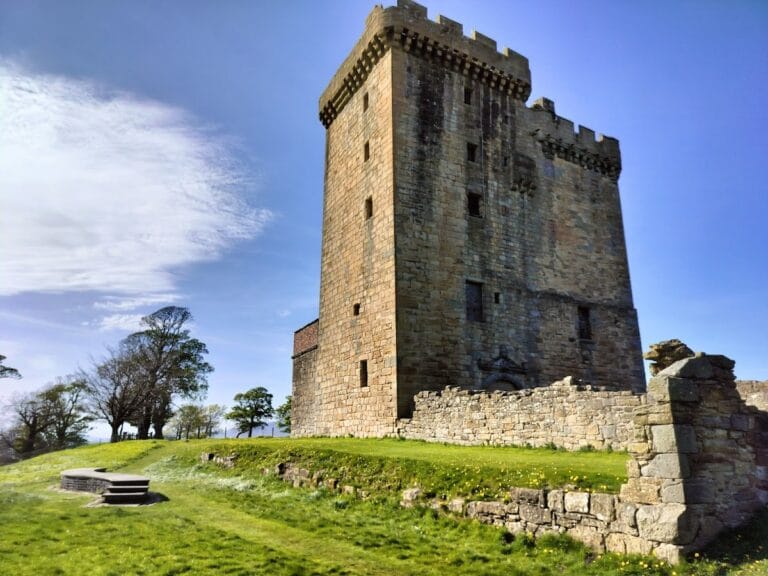
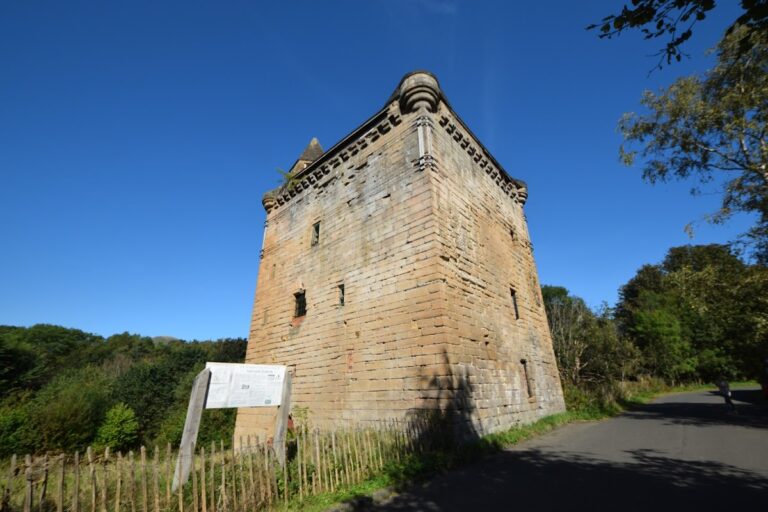
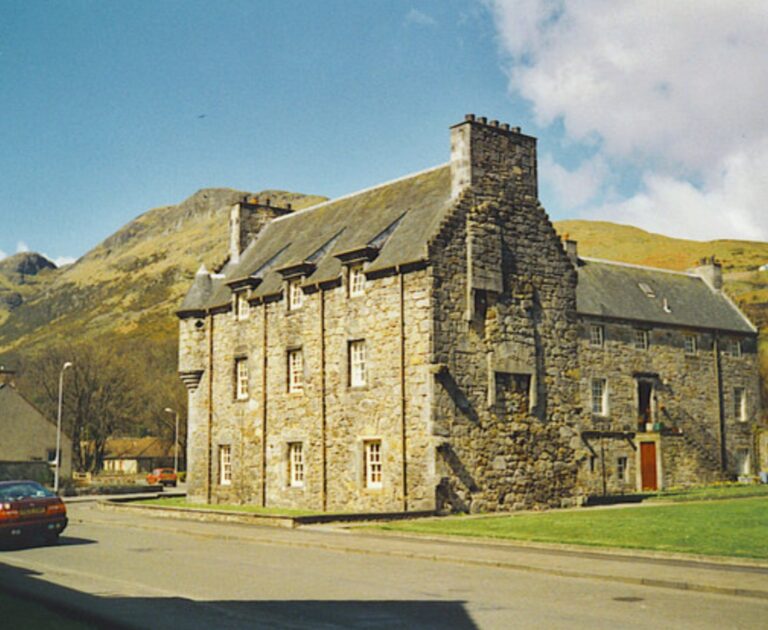
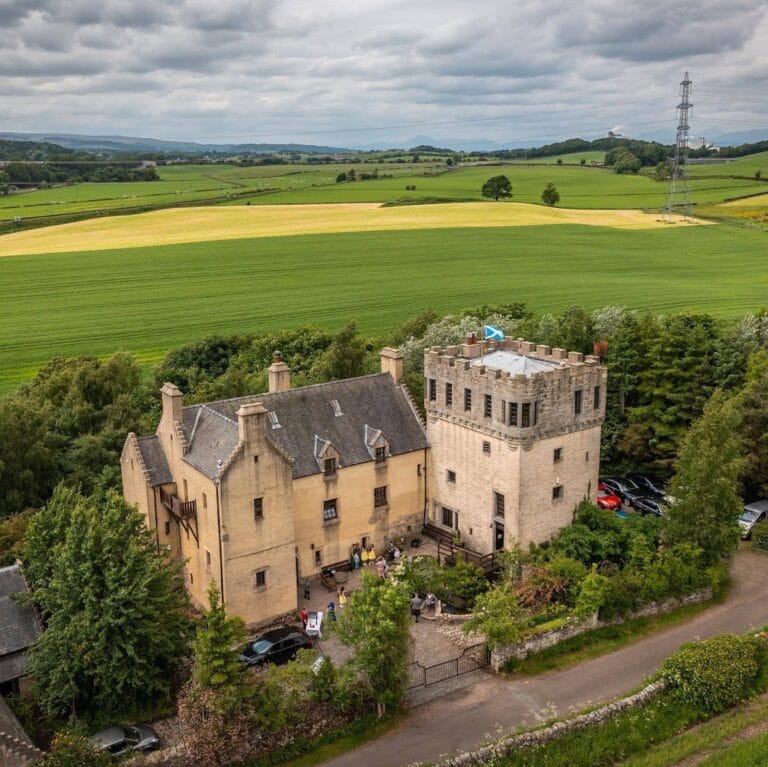
Alloa Tower is a stone defensive tower house built of coursed rubble, masonry formed from roughly shaped stones laid in fairly regular horizontal layers. It rises approximately 68 feet, or 21 metres, excluding the attic, and measures about 62.5 by 39.5 feet, or 19.1 by 12.0 metres, at its base. Descriptions give it four storeys excluding the attic and also describe it as a five-storey structure. Its exceptionally thick walls, original timber roof, and battlements survive, placing it among the earliest and largest Scottish tower houses.
Entrances and interior features
The tower originally admitted people through an entrance on the first floor, an arrangement retained when the building was enlarged in the fifteenth century. A separate ground-floor entrance was probably added in the late sixteenth century. The cellar sometimes served as a pit prison, a basement confinement space. Although the building has been extensively re-fenestrated, meaning that its windows have been altered or replaced, some medieval interior features remain.
Eighteenth-century alterations
Alloa Tower was incorporated into Alloa House as an annexe in the early eighteenth century. Restoration associated with this phase recovered a probable 1712 interior arrangement and included a large Italian-style staircase. The tower is the surviving part of the medieval Erskine residence at Alloa, while the adjoining mansion and other later buildings have been demolished.