Château des Baux: A Medieval Fortress in Provence


Site at a Glance
- Rating
- 4.6
- Popularity
- High
- Country
- France
- Primary era
- Medieval
- External website
- Open
- Eras represented
- Medieval, Early Modern
- Civilizations
- French
- Site type
- Military
- Remains
- Castle
On this page16 sections
History
Château des Baux is a ruined medieval fortress above Les Baux-de-Provence in France, developed by the lords of Baux on a rocky outcrop in the southern Alpilles. The site had been inhabited since at least the Bronze Age and served successively as a refuge during the Neolithic and as a fortified settlement during the Iron Age. Its medieval fortress was first recorded as castrum Balcium in the late 10th century.
The rise of the lords of Baux
The fortress was established for the lords of Baux, a powerful Provençal feudal dynasty whose family name came from the castle and its associated lordship. Their control of the fortress and settlement lasted for approximately five centuries. The weakening of royal authority in Provence under Conrad the Peaceful and Rudolph III encouraged local feudal lords to build and hold castles, and Château des Baux became one of these regional strongholds.
Its position allowed the fortress to control routes toward Tarascon and Arles, the area between the Alpilles and the Mediterranean, and the region around the confluence of the Rhône and Durance rivers. During the 12th and 13th centuries, Les Baux developed into an important political and cultural center of medieval Provence. The family’s authority was challenged during the Baussenque Wars of 1142 to 1162, a conflict over the succession to Provence. The site was also connected with the courtly culture of Provençal minstrels and troubadours.
Raymond de Turenne and the siege of 1393
From 1372 to 1399, Raymond de Turenne, a late-medieval viscount and military leader, was the effective lord of the site as the uncle and guardian of Alix des Baux. His prolonged conflict with the counts of Provence and the Avignon papacy brought warfare directly to the fortress. In 1393, military action was led by Jean de Vienne, a French admiral, in opposition to Raymond’s position.
Jean de Vienne reached Château des Baux on 7 June 1393 with approximately 6,000 troops. Arles supplied twenty-five lances and twenty-five crossbowmen, while Tarascon later sent 100 men-at-arms under four captains. Three wooden defensive or siege towers made at Tarascon were positioned around Les Baux to block relief and restrict the movement of people and provisions. By early October, the operation had become a blockade. It was lifted on 4 October, although troops remained in the surrounding woods.
The conflict also involved the Avignon pope Clement VII, one of the rival papal claimants during the Western Schism, when competing figures contested authority in the Latin Church. On 13 December 1393, Clement VII anathematized Raymond de Turenne and his supporters, formally excluding them from the Church, demanded the return of lands and property he considered usurped, and summoned them before the papal consistory. The struggle placed heavy financial burdens on Provence, the Comtat, and the papal administration.
On 23 December 1393, Raymond de Turenne’s daughter Antoinette married the French marshal Boucicaut in the castle’s castral chapel, a chapel belonging to a fortified lordly residence. Supported by the French royal court despite papal opposition, the marriage formed part of the political effort surrounding Raymond’s conflict and connected his family with the French royal circle.
Incorporation into Provence and royal rule
In the 15th century, the lords of Baux were replaced by the House of the Counts of Provence. After the death of Alix des Baux, the last representative of the senior Baux line, Louis III of Anjou seized the castle. Les Baux was incorporated into the County of Provence in the late 1420s, and Provence, together with the castle, subsequently passed to the French crown in the late 15th century.
Louis XII appointed a regional governor with the title Baron of Baux in 1513. Anne de Montmorency, a French constable who held the kingdom’s highest military office, occupied that position from 1528 to 1567. Captains known as viguiers administered the castle itself during this period.
Religious conflict and decline
The fortress was used by the Huguenots during the French Wars of Religion, the conflicts between Catholics and Protestants that affected France from 1562 to 1598. Château des Baux was consequently drawn into the religious and political struggles of the period. It was dismantled in the early 1630s and then fell into neglect.
Archaeology and preservation
Archaeological investigation and restoration have recovered parts of the ruined fortress and made its surviving structures presentable as a museum. Work in the northern sector began in October 1991 and continued with the clearance of the middle Terras area and the Château des Grimaldi. The Château des Baux, together with its walls, dependencies, towers, donjon, adjoining buildings, and former Sainte-Catherine chapel, was placed on the French historic-monument list in 1875 and designated by an order of 9 June 1904. The municipality is the current owner.
Remains
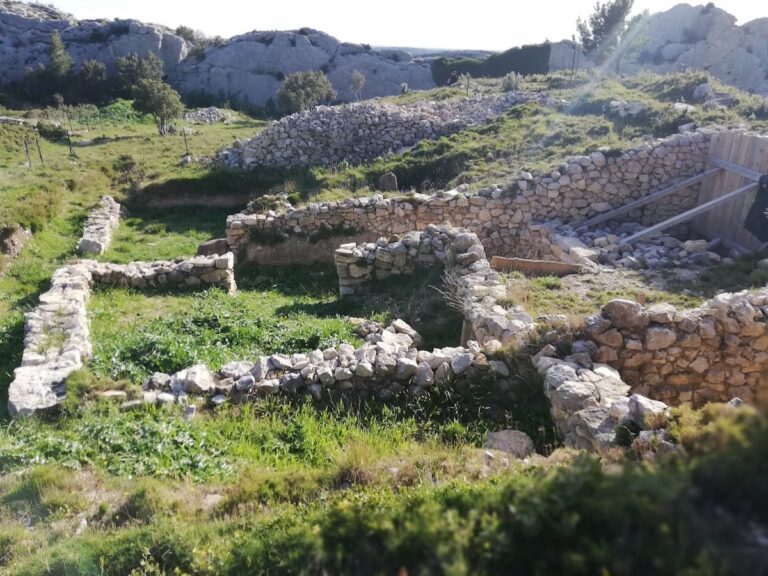
The fortress occupies a rocky outcrop on the southern flank of the Alpilles, above the village. It is a ruined, semi-troglodytic medieval complex, with parts of its residential area cut directly into the rock. Its height made it difficult for medieval siege engines to capture, so conquest generally depended on starving the defenders. The surviving layout combines rock-cut rooms, defensive walls, towers, chapels, domestic buildings, and the principal fortified tower.
Fortress and defensive structures
The donjon and residential area
The most complete surviving structure is a rectangular donjon from the 13th century. A donjon is the principal fortified tower of a medieval castle. Buildings adjoining the tower, a pigeon loft at its foot, and rooms cut into the rock form part of the castle’s residential area. Together they show how the fortified settlement combined living spaces with strongly defended elements.
The surrounding towers and enceinte
The fortress is enclosed by a large outer enceinte, an enclosing defensive wall or circuit. Its defenses include the Sarrazine Tower, the Paravelle Tower, also written Parravelle, and the Tour des Bannes, whose Provençal name translates as “Horns.” Sections of the walls, dependencies, and additional neighboring towers survive around these structures, preserving parts of the castle’s defensive perimeter.
The chapels
The remains include a castral chapel and the former Sainte-Catherine chapel. The castral chapel was the setting for the marriage of Antoinette de Turenne and Boucicaut in 1393, while Sainte-Catherine formed part of the wider group of buildings associated with the fortress. Both are among the structures included in the protected historic-monument complex.
Archaeological areas and hospital architecture
The northern sector and middle Terras
Clearance in the northern sector and the middle Terras area has exposed additional remains within the fortress. Archaeological work also brought the Château des Grimaldi into the area presented and restored as part of the site. These interventions have made it possible to understand and preserve sections of the settlement beyond the main defensive tower.
The Quiqueran Hospital
The Hospital of Les Baux, known as the Quiqueran Hospital, was restored in preparation for work in the southern sector. It is an important example of Renaissance hospital architecture and, together with the hospital at Brignoles, is described as one of the rare examples of this architectural type in Provence.
Reconstructed siege machines
Projectile and gate-breaking weapons
The site contains full-scale reconstructions of medieval siege machines, including a trebuchet, a ballista or catapult, and the projectile-throwing machines known as a bricole and a couillard. A trebuchet, ballista, bricole, and couillard throw projectiles, while a battering ram attacks fortifications and gates. The reconstructed trebuchet is described as the largest functioning model in Europe.
From the elevated fortress, the surrounding landscape includes olive groves, scrubland, the Alpilles, and nearby villages. The Mediterranean can also be seen in clear weather, connecting the physical setting of the castle with the wider territory that its position once helped control.