Roman Aqueduct of Barbegal: Water Supply and Milling Complex in France

Site at a Glance
- Rating
- 4.5
- Popularity
- Medium
- Country
- France
- Primary era
- Classical
- External website
- Open
- Eras represented
- Classical
- Civilizations
- Roman
- Site type
- Infrastructure
- Remains
- Aqueduct
On this page8 sections
History
The Roman Aqueduct of Barbegal is a Roman water-supply and milling complex in France, developed from an aqueduct system established around the middle of the first century and adapted for milling during the second century. It formed part of the hydraulic works serving Arelate, the Roman city now known as Arles, and powered an installation described as the greatest known concentration of mechanical power in the ancient world.
The aqueduct system of Arelate
The water system for Arelate brought spring water from the Alpilles to the city through two branches. The southern Caparon aqueduct extended for about 10 kilometres, while the northern Saint-Rémy or Eygalières aqueduct reached Fontvieille after passing through Ernaginum. The northern branch eventually became the principal supply for Arles.
During the second century, the southern aqueduct was diverted toward Barbegal. From Fontvieille, a canal running for about 12 kilometres connected with the wider system leading toward Arles. Its route included underground sections and aqueduct structures, while a lead-pipe siphon north of Arles carried water across the Rhône to the right bank.
Construction and operation of the mills
Evidence from the eastern outlet and the upstream basin at Vallon des Arcs places the construction of the milling complex at the beginning of the second century. It continued operating into the third century. The owner was probably the proprietor of the nearby Roman villa at La Mérindole.
The mills produced flour for Arles and the Roman Empire. One estimate gives a daily output of about 4.5 tonnes, enough to provide bread for approximately 10,000 to 12,500 people. Other calculations reach as much as 25 tonnes per day, a quantity that could have served between 30,000 and 40,000 inhabitants. A 2018 study of calcareous deposits on the water wheels proposed that the flour may instead have supported large-scale bread production for ships. This interpretation followed the rejection of an earlier proposal after excavations in the 1990s.
Fernand Benoit, a French archaeologist and historian, dated the complex to late antiquity and attributed it to Q. Candidius Benignus, a Gallo-Roman engineer associated with the body of carpenters in Arles. The proposal drew partly on an inscription from Benignus’s sarcophagus, which praised his abilities in mechanical works and in directing watercourses. His connection with Barbegal remains an attribution rather than a confirmed identification.
Protection and reconstruction
Parts of the aqueduct have been protected as a historic monument since 1886, with additional sections registered in 1937. Archaeological investigation has helped clarify the relationship between the water supply and the mills. Between 2017 and 2020, a multidisciplinary team working under Philippe Leveau reconstructed one of the mill wheels. The wheel is displayed at the Château de Montauban alongside the surviving remains at Barbegal.
Remains
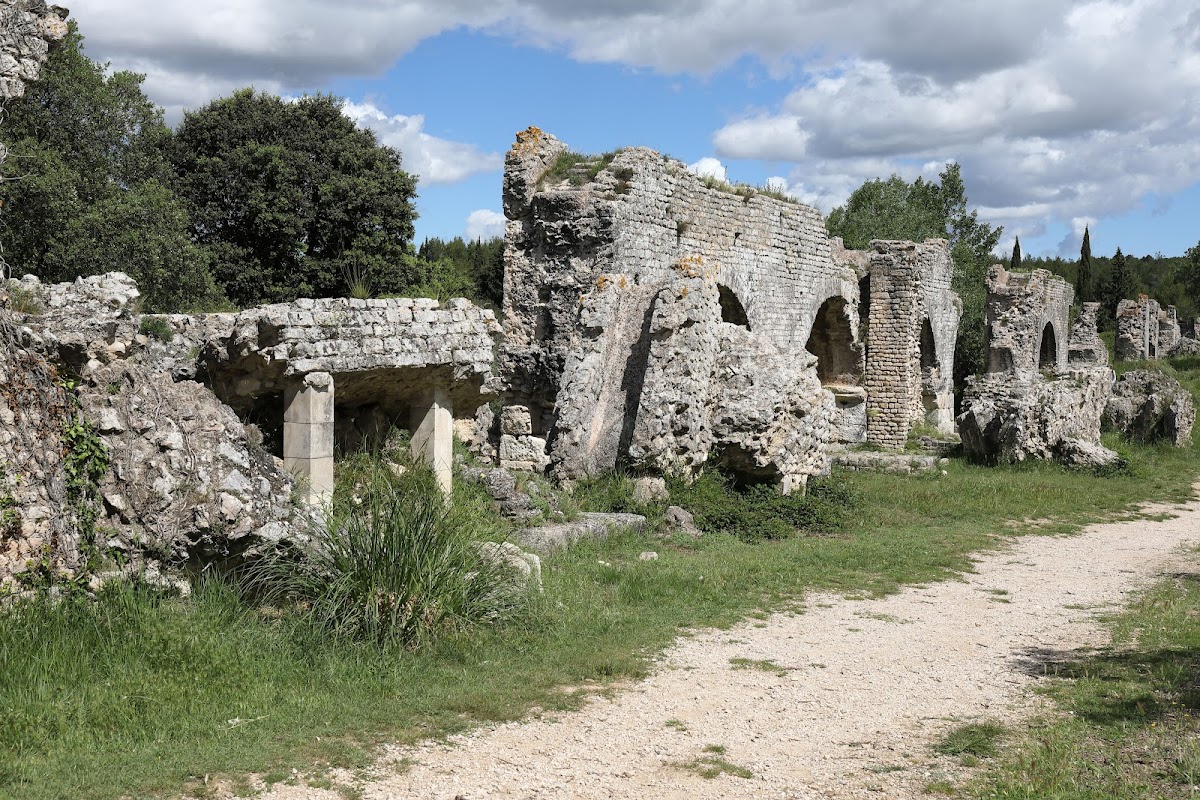
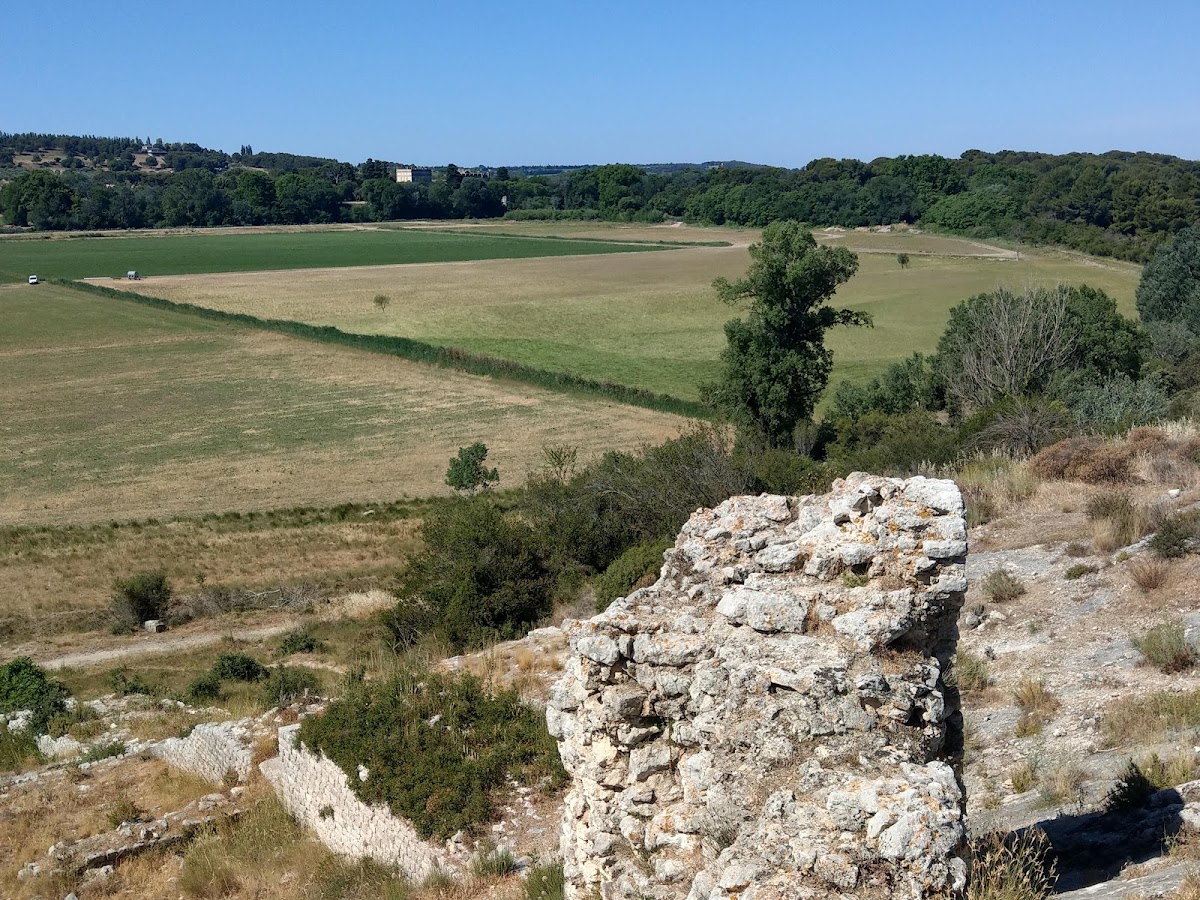
The surviving complex occupies a steep hillside and combines aqueduct channels, rock-cut passageways, masonry structures, mill foundations, and a central staircase. The milling installation extends for approximately 61 metres along the slope and measures about 20 metres in width. Its arrangement in two parallel rows preserves the basic relationship between the water supply and the sixteen milling units.
Aqueduct bridges and rock-cut channel
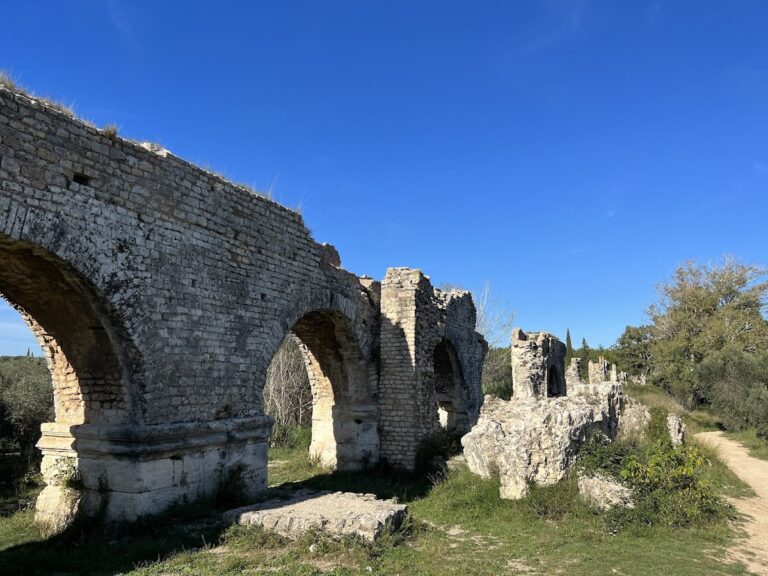
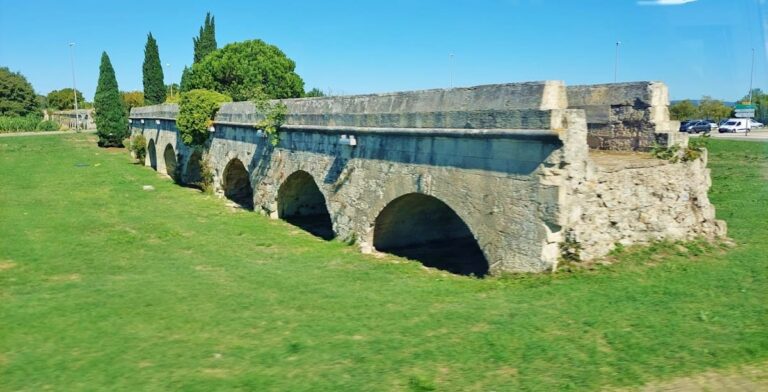
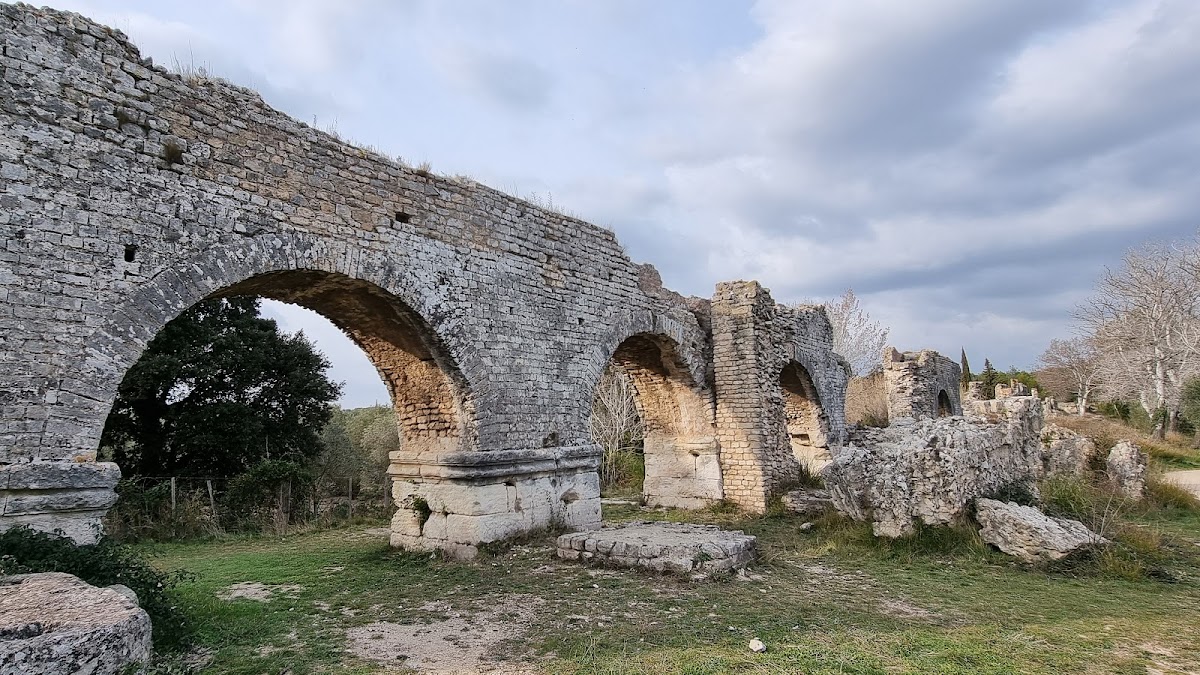
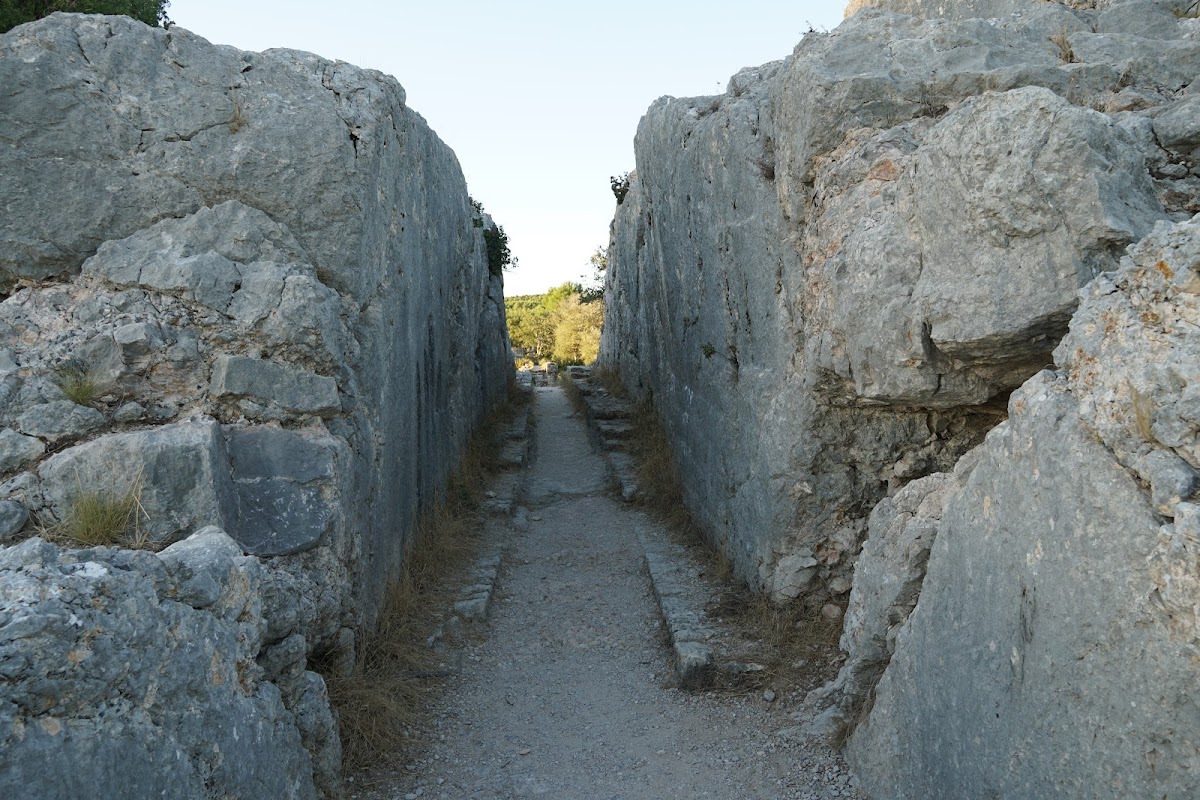
The aqueduct crossed the Vallon des Arcs on two parallel bridges. One carried the Arles aqueduct, and the other belonged to the Barbegal diversion. Portions of both structures rested on arches. Farther along the route, the Barbegal channel cut through the Pène ridge in a trench excavated from the rock. The surviving cleft reaches about 3 metres in depth and emerges at the upper end of the mill complex.
The mill installation
At the complex, the aqueduct divided into two channels. Each channel supplied a descending line of eight hydraulic drops, with every drop driving a water wheel and millstone in its own milling chamber. The sixteen wheels formed two parallel rows of eight, separated by a central staircase that climbed between them. They are generally understood as overshot wheels, meaning that water was delivered onto or near the top so gravity supplied much of the turning force. The outflow from one wheel fed the next units farther down the slope. Masonry from the channels, the individual mill foundations, and the staircase remains substantial, making the installation the best-preserved Roman milling complex.
Water control and mechanical power
A sluice just north of the mills controlled the supply after the two aqueduct branches joined. The flow has been estimated at between 240 and 1,000 litres per second. The installation used an elevation difference of about 18 metres, producing a maximum gross power estimated at approximately 50 kilowatts, or about 3,000 watts for each of the sixteen mills. The surviving two-row layout and associated channels make the system’s cascade of water-powered machinery physically legible.