Lida Castle: A Lithuanian Frontier Fortress in Belarus
Site at a Glance
- Rating
- 4.5
- Popularity
- Medium
- Country
- Belarus
- Primary era
- Medieval
- External website
- Open
- Eras represented
- Medieval, Early Modern
- Civilizations
- Grand Duchy of Lithuania
- Site type
- Military
- Remains
- Castle
On this page17 sections
History
Lida Castle is a medieval fortress in Lida, Belarus, built in the 1320s under Grand Duke Gediminas of Lithuania. It is generally dated to about 1323–1325, although some catalogues place its foundation in the 1330s. Constructed as the first stone castle in the Grand Duchy of Lithuania, it guarded the frontier against the Teutonic Order, a German military-religious order whose crusading campaigns brought it into prolonged conflict with Lithuania.
Foundation and dynastic use
The castle formed part of a defensive line linking Navahrudak, Kreva, Medininkai, and Trakai. It protected the lands around the Neman River and provided refuge for its garrison, the people of Lida, and inhabitants of nearby villages. Its purpose combined that of a feudal residence with a military stronghold. The courtyard later accommodated an Orthodox church, residential and commercial buildings, and service structures.
After Gediminas died, Lida became a capital of Grand Duke Algirdas and later of his son Władysław II Jagiełło, who was both Grand Duke of Lithuania and King of Poland. In 1387, Jagiełło received the oath of allegiance of his brother Skirgaila at the castle. The Orthodox church was transferred to the town in 1533. From 1568, the castle also contained a court, archive, and prison.
Sieges and political refuge
The castle was drawn into the dynastic struggles of the late fourteenth century. English, French, and German knights besieged it, and it fell after an assault in 1384, when it was partly devastated. In the winter of 1392, German and English crusaders joined forces allied with Grand Duke Vytautas, whose rule later strengthened Lithuania’s political and military power. The commander, Prince Dmitry Korybut, held the castle with only a small force and withdrew the garrison at night through a secret passage. The attackers then carried away large quantities of weapons and ammunition.
In the winter of 1394, the inhabitants of Lida burned their own houses and sought shelter behind the castle walls. The defenders repelled attacks by French and English crusaders. From 1396 to 1399, Tokhtamysh, khan of the Golden Horde, lived in exile at Lida. Vytautas hoped to use his support to recover the grand-ducal throne and later campaign toward Moscow.
On 5 August 1406, forces led by Prince Yuri of Smolensk burned Lida but withdrew after unsuccessful assaults and a siege. Their aim was to recover Yuri’s family, whom Vytautas had captured during the conquest of Smolensk the previous year. In 1422, the castle hosted the marriage of the 71-year-old Władysław II Jagiełło to his fourth wife, the 17-year-old Sophia of Halshany. Prince Švitrigaila’s forces burned the town in 1433 but failed to seize the castle. From 1434 to 1443, it sheltered the exiled khan Devlet Haji Giray, who later became khan of Crimea.
From royal residence to state fortress
In July 1506, the ailing King of Poland and Grand Duke of Lithuania Alexander received communion and signed his will at Lida Castle. That same year, a Crimean Tatar force was defeated about one kilometre outside Lida by a popular militia of 10,000 men before it could attack the fortress.
Lida received Magdeburg rights in 1590, granting the town a recognized municipal legal status, while the castle remained state property. Local nobles were responsible for its protection, and the fortress continued to hold an armoury and garrison.
In the summer of 1659, Russian forces commanded by Voivode Khovansky captured the castle after a prolonged siege and heavy bombardment. Its wooden structures were burned and its wells were filled. After the Russo-Polish War, no permanent population remained at the castle. Its strategic importance declined during the eighteenth century. Swedish forces damaged it twice during the Great Northern War of 1700–1721 and blew up both towers. The castle saw its last military use in 1794, when insurgents associated with Tadeusz Kosciuszko fought Russian troops among the ruins.
Destruction, research, and restoration
After a fire destroyed Lida’s town centre in 1891, local authorities dismantled and sold parts of the castle for building material and removed sand from its mound. The south-western tower was almost entirely destroyed, and part of the western wall was taken down. The Imperial Archaeological Commission then prohibited further destruction. The architect-restorer Vladimir Suslov studied and conserved the remains.
Strengthening work took place from 1909 to 1911 on the western, northern, and eastern walls. Further restoration under Polish administration began in the 1920s. The western and southern walls were reconnected, the south-eastern corner was partly rebuilt, and a wooden gate was erected at the destroyed north-western corner.
Lida Castle received architectural-monument status in 1940 and state protection in 1953. Archaeological and architectural research was conducted by Mikhail Tkachev, Oleg Trusov, and Alexander Kravtsevich. Restoration and conservation campaigns begun in 1978 continued intermittently, although major work stopped in the mid-1990s because of insufficient funding.
During the German occupation in 1941, the castle first held prisoners of war and later served as an ammunition store. Shells and mines remained throughout the courtyard after the occupiers withdrew, repeatedly forcing archaeologists to suspend excavations while sappers cleared them. In 1978, 150 shells, eight mortar mines, ammunition, and fuzes were found. In 1986, more than 500 shells were recovered from a single deep pit.
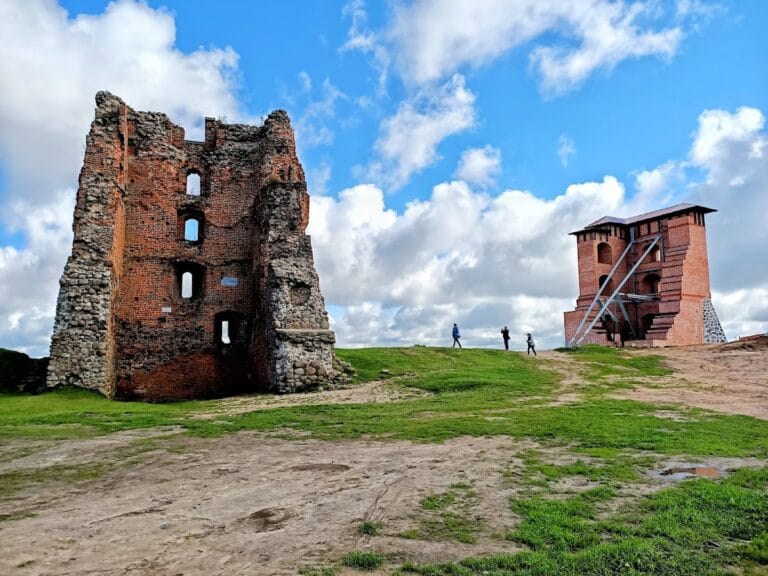
A new restoration phase began in 2006 with the stated aim of recovering the castle’s possible fourteenth-century appearance. By 2010, the walls and south-western tower had been completed, a wooden gallery linking the towers had been rebuilt, and the courtyard had been filled with sand and rubble. The castle is part of the Lida Historical and Art Museum and is a protected historical and cultural value of Belarus. Since 2005, it has also hosted the Gediminas Castle International Festival of Medieval Culture.
Remains
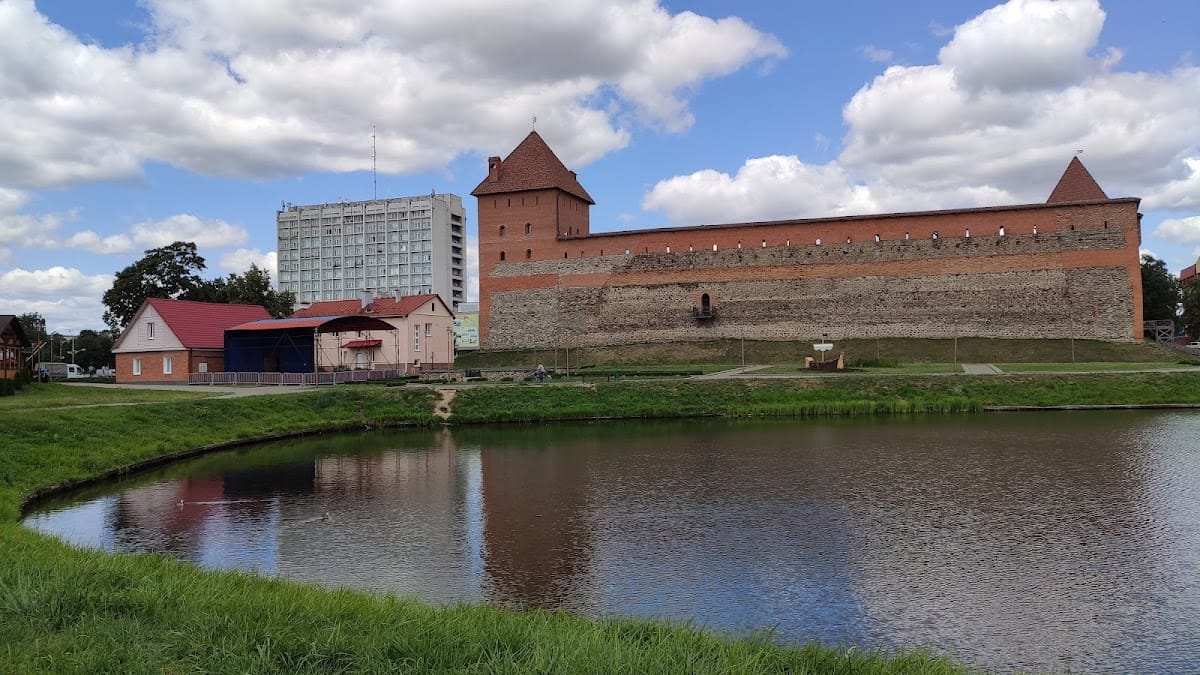
Lida Castle stands on a former sand dune at the confluence of the Lideya and Kamenka rivers, in marshy terrain southeast of Lida. The dune was enlarged into an artificial rectangular mound, raised by approximately 5–6 metres with gravel and stone fill. The fortress follows an irregular quadrilateral plan, measuring about 93.5 metres on the north, 83.5 metres on the east, 80 metres on the south, and 84 metres on the west. Its spacious courtyard reflects the adaptation of the compact European kastel, a medieval fortress arranged around an enclosed courtyard, to local conditions and the need to shelter soldiers and civilians.
Walls and defensive towers
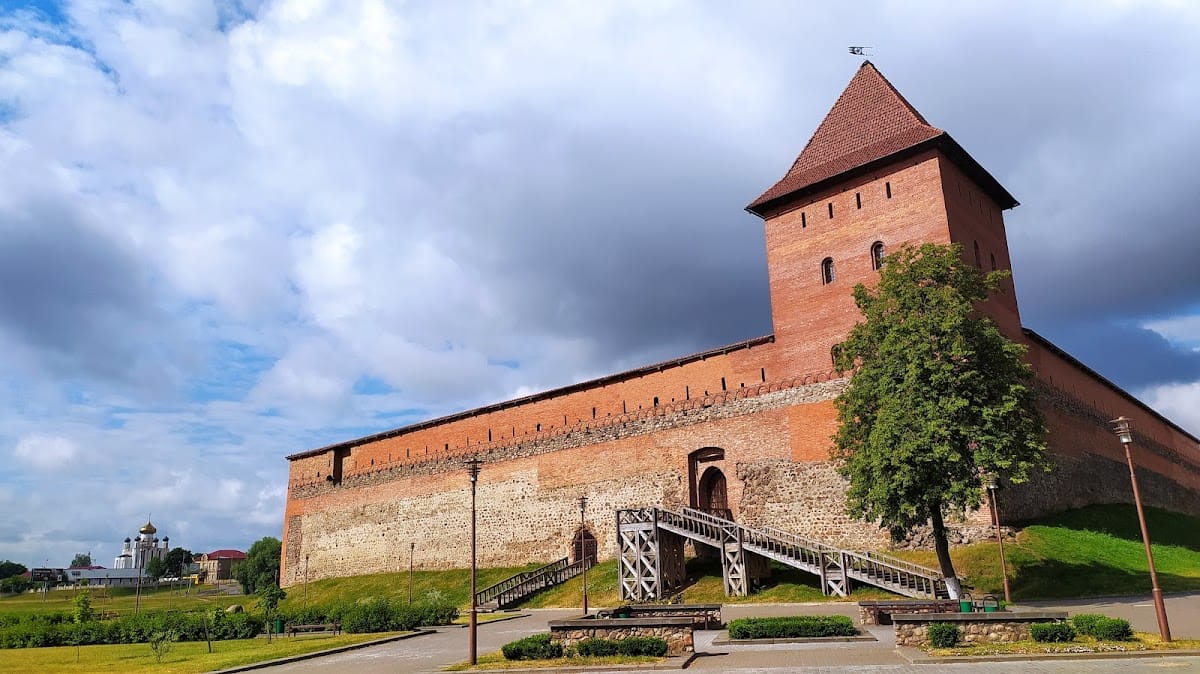
The castle was built mainly of fieldstone, partly dressed stone, and brick, combining Romanesque and early Gothic elements. Foundations range from about 70–80 centimetres to approximately one metre deep, with large and medium stones compacted with sand or clay. The walls are 1.5–2 metres thick and narrow upward from about two metres at the base. Descriptions place their surviving height at approximately 12–15 metres. Large boulders form the outer faces in horizontal courses, while smaller stones and lime mortar fill the gaps. Wooden beams or logs were embedded in the masonry as reinforcement.
Brick was used chiefly for corners, arches, vaults, battlement walls, decorative facade bands, and other structural details. The external bands use Baltic, or Wendish, masonry, a pattern in which two lengthwise bricks alternate with one laid across the wall. The walls end in an upper brick parapet about 70 centimetres thick, pierced by trapezoidal loopholes for bows and crossbows and later for light firearms. The openings are wider toward the courtyard and occur in three alternating types.
South-western tower
The south-western tower was built in the first half of the fourteenth century. It was approximately 10 metres square, with walls about three metres thick. Only fragments of its foundation survive. The tower masonry was not bonded to the castle walls, although its foundations were laid at the same level. Later restoration rebuilt the tower and completed portions of its surrounding fortifications.
North-eastern tower
The north-eastern tower was added between the late fourteenth and early fifteenth centuries, when Vytautas strengthened the castle. It formed an irregular quadrilateral with sides measuring approximately 12–12.5 metres. Its foundations extended 70–80 centimetres below those of the walls. The courtyard-facing walls were three metres thick, while additional masonry joining the two-metre castle walls was 83 centimetres thick.
An arched courtyard entrance, built of shaped brick, led to wooden steps set on a brick base within the wall thickness. Stove niches survive in the northern, eastern, and southern walls. The first floor had a cross vault and traces of a wooden floor. The towers were formerly covered by hipped roofs and did not project beyond the perimeter of the walls.
Gates and internal defenses
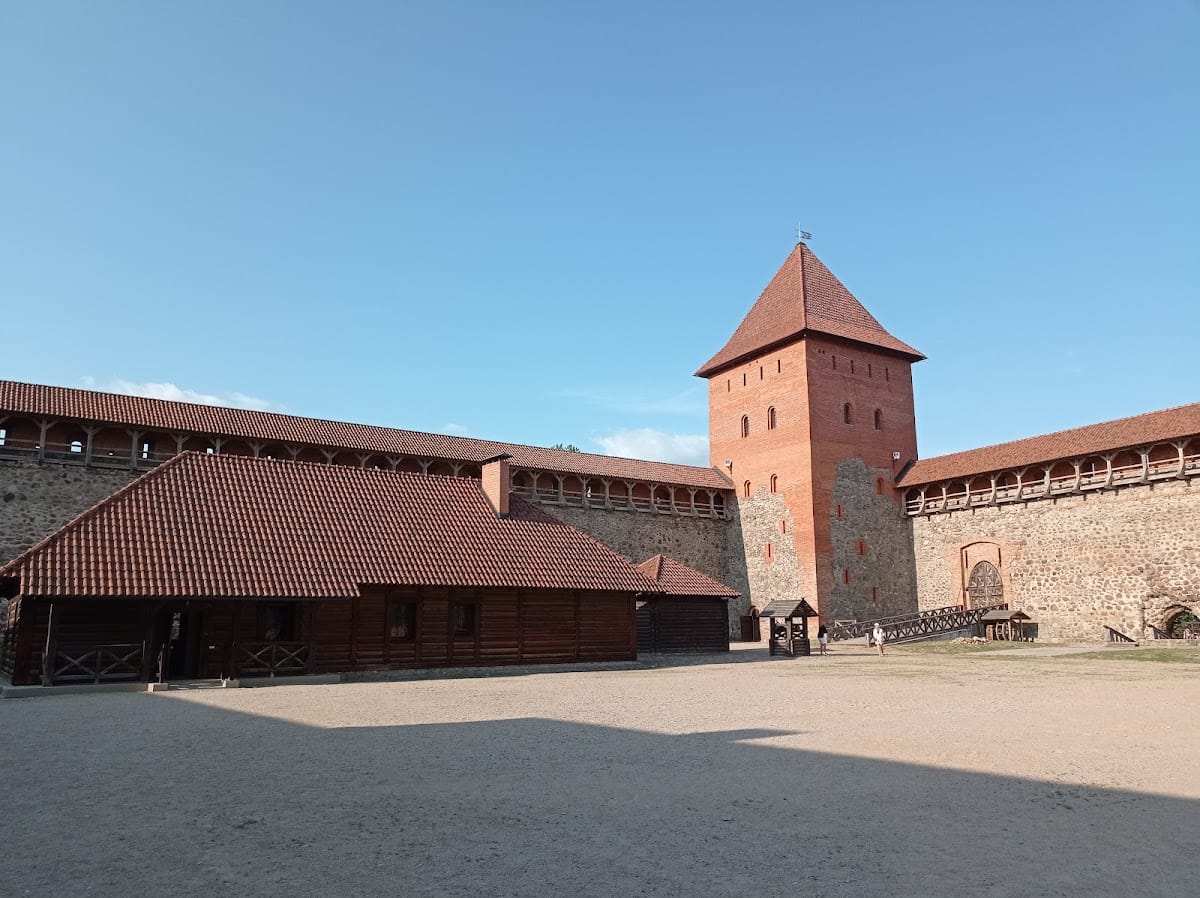
Three entrances gave access to the castle, with two in the eastern wall and one in the southern wall. A wooden fighting gallery ran along the inner perimeter immediately below the loopholes. It rested on projecting beams measuring about 20 by 20 centimetres and was reached by wooden stairways at the north-western and south-eastern corners. Its single-pitched roof sloped toward the courtyard. Two brick latrines rested on decorated stone corbels along the southern and northern sides.
Eastern gates
The smaller eastern gate was about 2.5 metres wide and three metres high. Its pointed arch served everyday movement through the fortress. The larger eastern entrance was about 4.5 metres wide and up to six metres high, probably serving ceremonial use. Above its semicircular arch was a stucco cartouche bearing the state emblem of the Grand Duchy of Lithuania.
The larger gate stood about 2.5 metres above ground level and could be reached only by a drawbridge. A pointed unloading niche contains a smaller entrance opening, which may relate to the former bridge. The surviving masonry and restored sections preserve the entrance as part of the castle’s eastern defensive front.
Southern passage
The southern entrance stood about 22 metres from the south-western tower and approximately four metres above the original courtyard level. It ended in a semicircular arch and was probably a reserve passage for reconnaissance, sudden sorties, or escape. Access required a long ladder. The opening was about 2.45 metres high and was protected on the courtyard side by a horseshoe-shaped structure, represented today by slight foundation traces.
Courtyard buildings and water supply
The courtyard contained an Orthodox church, residential and service buildings, barracks, stores, a commandant’s house, a forge, a soldiers’ kitchen, and two wells. Excavations exposed approximately 3,260 square metres of the courtyard. The cultural layer is about 0.4–0.8 metres deep in the centre and approximately two metres deep near the northern wall.
Barracks
Three barrack rooms were excavated against the northern, western, and eastern walls. Each was about four metres wide, with partitions dividing the interior into smaller rooms. Clay-tile stoves stood on foundations of stone and crushed brick, providing heat for the occupants.
Commandant’s house
A separate rectangular commandant’s house stood near the western wall. It measured approximately 6 by 4 metres and had stone foundations. Tile stoves heated the building, although the house itself has not survived.
Wells and courtyard surface
Two wells stood in the eastern part of the courtyard. The smaller was near the north-eastern tower, while the larger supplied water for domestic animals and was reached by a paved road. The centre of the courtyard was paved with cobbles. On the northern side, a ditch about 20 metres wide ran approximately seven metres from the wall, connecting the Lideya and Kamenka rivers and separating the castle from the town. An artificial lake was incorporated into the eastern outer defenses, probably in the sixteenth or seventeenth century.
Archaeological finds
Excavations have produced objects connected with military, domestic, and craft activity. Metal finds include soldiers’ heel pieces, horseshoes, knives, fire steels, scissors, keys, locks, arrowheads, and crossbow bolts. The collection also contains glass and ceramic vessels, stone shot from stone-throwing weapons, and bone objects. Ceramics include green-glazed and terracotta vessels as well as western European wares.
A large group of fourteenth- to sixteenth-century pot and box tiles was recovered. Most box tiles were covered with green glaze, and their outer panels carried vegetal, geometric, or narrative ornament. Silver and copper coins include fourteenth-century pieces associated with Princes Kestutis and Vytautas, fourteenth-century groschen, and fourteenth-century solidos.
The castle has been repeatedly damaged, rebuilt, and conserved. Restoration in the 1920s reconnected the western and southern walls, partly rebuilt the south-eastern corner, sealed side entrances, and replaced the destroyed north-western corner with a wooden gate. Later campaigns rebuilt or completed parts of the walls, towers, and wooden fighting gallery. Newly reconstructed wall sections were distinguished by their brick colour.