Hambach Castle: A Medieval Stronghold and Symbol of German Democracy
Site at a Glance
- Rating
- 4.4
- Popularity
- Medium
- Country
- Germany
- Primary era
- Medieval
- External website
- Open
- Eras represented
- Medieval, Modern
- Civilizations
- German, Holy Roman Empire
- Site type
- Military
- Remains
- Castle
On this page17 sections
History
Hambach Castle is a medieval castle in Germany, above Hambach in Neustadt an der Weinstraße, probably built in the first half of the eleventh century and later reshaped with Renaissance-influenced classical and nineteenth-century Neo-Gothic elements. It developed from an earlier fortified site and became a residence and defensive possession of the Bishops of Speyer. Its best-known historical role came in 1832, when the ruins hosted the Hambach Festival, a mass gathering that articulated demands for political freedom, German unity, and a democratic Europe.
Early fortifications and the Salian period
Archaeological investigations indicate that the hill was occupied or fortified during the Late Roman period. A refuge fortification was established there during the late Carolingian and Ottonian periods, before the medieval castle was built. The castle probably arose in the first half of the eleventh century on an older Romanesque and medieval site.
It originally belonged to the Salian dynasty, the ruling house that produced several eleventh-century German kings and Holy Roman Emperors. The idea that Hambach was an imperial residence remains unproven. The name Kästenburg came from the Kästenberg, now called Schlossberg, and was also associated with the chestnut woods around the hill. The later popular name Maxburg refers to Crown Prince Maximilian of Bavaria, who received the castle in 1842 and later became King Maximilian II.
Castle of the Bishopric of Speyer
Bishop Johannes I of Speyer, a relative of the Salian dynasty, transferred Hambach Castle to the Bishopric of Speyer between 1090 and 1104. The Bishopric of Speyer was an ecclesiastical principality whose bishops held both religious and territorial authority. Hambach remained in its possession until the end of the feudal period and served as a residence for Speyer’s bishops, especially from 1104 to 1256.
The castle formed part of the bishopric’s medieval defensive system and controlled or protected trade routes crossing near Neustadt. Repeated episcopal visits from 1180 onward show its continuing importance. On 12 June 1388, Nikolaus of Wiesbaden received episcopal consecration in the castle chapel.
Administration rested with ministerials as well as churchmen. These members of the medieval service nobility performed military, administrative, and judicial duties for rulers or ecclesiastical lords. Burkhard von Kästenburg served as governor from 1154 to 1186. His brother Trushard von Kästenburg, known from 1178 to 1201, served Emperor Henry VI in Lombardy, became podestà, or civic magistrate, of Chieri and Ivrea in 1188, represented the emperor in Italy in 1193, and later returned to Speyer as treasurer.
From 1256, the Schnittlauch von Kästenburg family belonged to the families that followed the Trushards. The governors’ office ceased to require residence at the castle in 1272. It was later combined intermittently with the titles of Count Palatine of Zweibrücken in 1284 and Count of Veldenz in 1311.
Medieval expansion and strategic decline
Extensive work took place during the thirteenth century, followed by further building under Bishops Nikolaus I and Matthias I in the late fourteenth and fifteenth centuries. The frequently repeated claim that these works followed destruction during the conflicts between Frederick the Fair and Louis IV remains unproven.
Hambach gradually lost strategic importance. Its chapel housed the archives of the Bishopric of Speyer, while the castle became increasingly detached from the administration and economic activity of the period. This decline was also connected with the construction of Marientraut Castle at Hanhofen between 1414 and 1420.
In 1466, Count Palatine Frederick I placed parts of the Bishopric of Speyer, including Hambach Castle, under his protection. An inventory from 1464 lists food, beds, an ass, two horses, fourteen usable crossbows, three winches, 5,000 arrows, and several kinds of firearm. The contents reflect the castle’s continuing military provisions even as its wider strategic role diminished.
Plunder, burning, and ruin
Farmers from Nussdorf plundered the castle during the German Peasants’ War in 1525, a widespread uprising against aspects of social, economic, and political authority. In 1552, troops led by Albert Alcibiades of Brandenburg-Kulmbach captured and burned the castle after a ransom of 150,000 florins was refused.
Bishop Marquard of Speyer, who held office from 1560 to 1581, rebuilt the residential buildings only provisionally and assigned the remaining ruins as a forester’s residence. Hambach consequently moved still further from the administrative and economic life of the period.
French troops burned the decayed complex in September 1688 during the War of the Grand Alliance, a European conflict involving France and a broad coalition of opposing powers. Hambach was left a ruin. Fortification work undertaken between 1701 and 1703 remained incomplete. The chapel was rebuilt and rededicated on 9 July 1723, but French revolutionaries looted and destroyed it on 30 July 1794.
From Bavarian possession to the Hambach Festival
After the French occupation of the Palatinate, the ruins passed to the French state in 1797. Following the Congress of Vienna, they became property of the Kingdom of Bavaria in 1816. Bavaria gave the castle to Crown Prince Maximilian in 1842 as a wedding gift.
From 27 May to 1 June 1832, the ruins hosted the Hambach Festival. The Bavarian administration had imposed strict censorship and prohibited political demonstrations, so the event was officially presented as a popular festival. In practice, it brought approximately 25,000 to 30,000 participants from Germany, France, and Poland together at Hambach. They called for political freedoms, fundamental rights, equality, tolerance, German unity, and a free and democratic Europe.
The black-red-gold tricolor was used at the festival as a symbol of prospective German unity. It was later adopted by the Frankfurt Parliament during the revolutionary movements of 1848 and by the Weimar Republic from 1919. The gathering became a major event in the history of German democracy and European political liberalism, giving Hambach Castle its enduring political meaning.
Nineteenth-century rebuilding and preservation
Bavaria began rebuilding the castle in 1844 according to plans by August von Voit. The project was conceived as a Neo-Gothic palace, influenced partly by Hohenschwangau, rather than as an exact medieval reconstruction. It nevertheless retained substantial historic fabric. Work stalled two years after it began and ended during the revolutions of 1848 and 1849, leaving Hambach as an open building ruin for more than a century.
The ruins became the property of the Bad Dürkheim district in 1969, when that district succeeded the former Neustadt an der Weinstraße district. A major restoration for the 150th anniversary of the Hambach Festival took place from 1980 to 1982 and was followed by the castle’s first permanent exhibition. Further restoration and modernization occurred from 2006 to 2008, while a restaurant project was completed between 2009 and 2011.
The Stiftung Hambacher Schloss, a foundation under public law, was established on 1 February 2002 to preserve the site as a historical place of national and European importance. The foundation includes the state of Rhineland-Palatinate, the Bezirksverband Pfalz, the Bad Dürkheim district, and the city of Neustadt an der Weinstraße, with financial support from the federal government. Hambach Castle now functions as a historical museum and conference venue. Its exhibitions examine the events of 1832, their causes, and their consequences in Germany and Europe. The castle joined the Road of Democracy in 2007, and the European Commission awarded it the European Heritage Label in 2015 for its association with European democracy, civil liberties, and unity.
Remains
Setting and defensive fabric
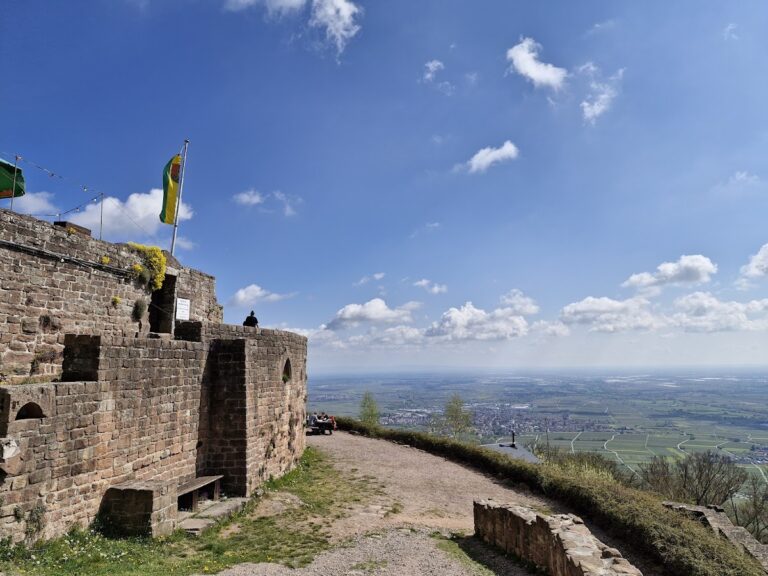
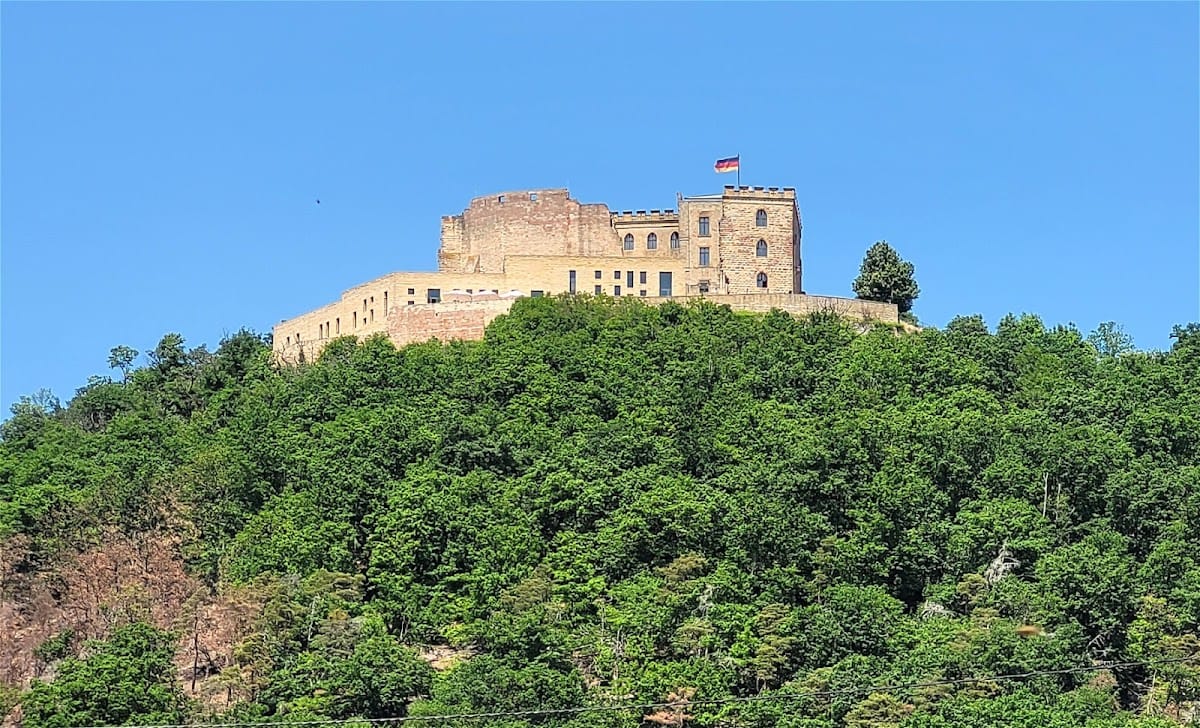
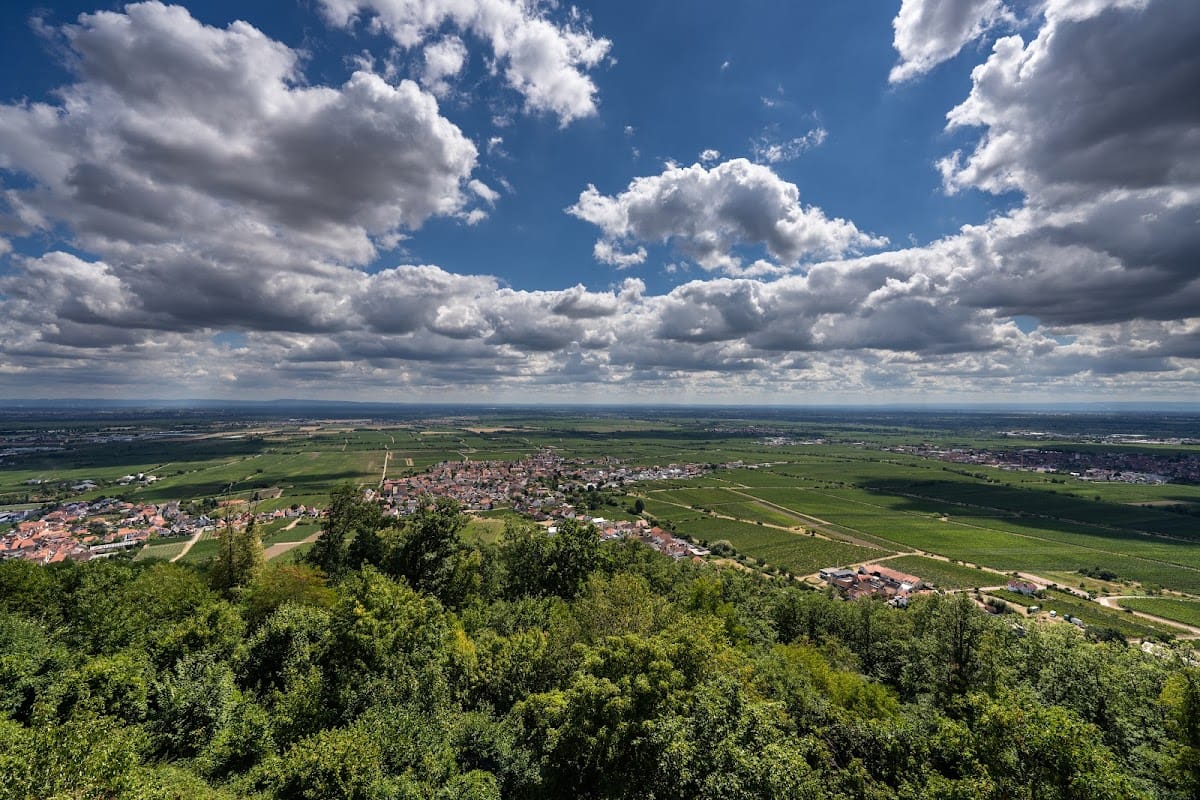
Hambach Castle stands at about 376 metres above sea level on Schlossberg, whose summit reaches approximately 379 metres. The hill belongs to the Haardt range on the eastern edge of the Palatinate Forest, above Hambach and west of Diedesfeld. From this position, the complex overlooks vineyards along the German Wine Route and the Rhine Rift Valley to the east.
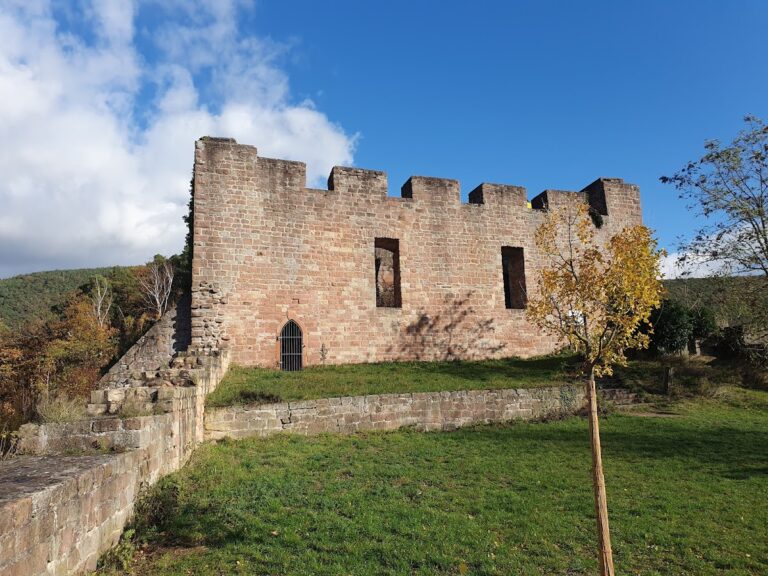
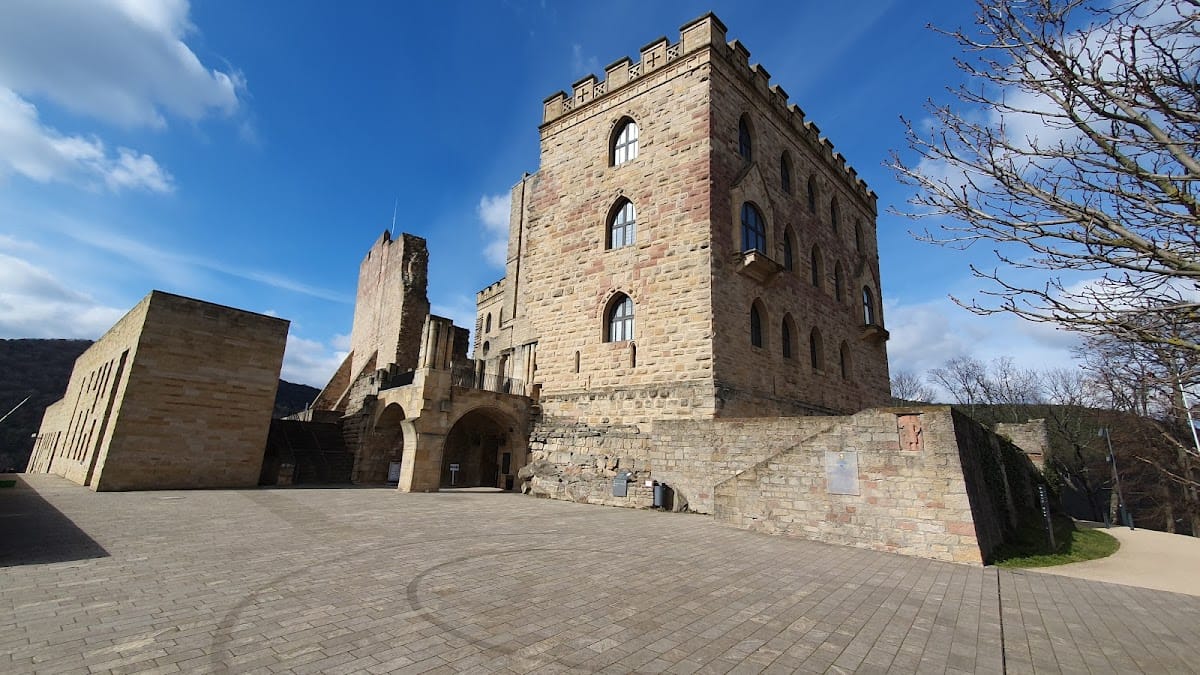
The surviving complex brings together construction from several periods, creating a physical sequence from early medieval fortification through Renaissance-influenced classicism and nineteenth-century Neo-Gothic work. The older Romanesque curtain wall surrounds the main building and formed the castle’s first defensive barrier. It was built with irregular stones fitted into the wall rather than arranged in regular courses, a technique known as opus incertum.
Historic building groups
Central building
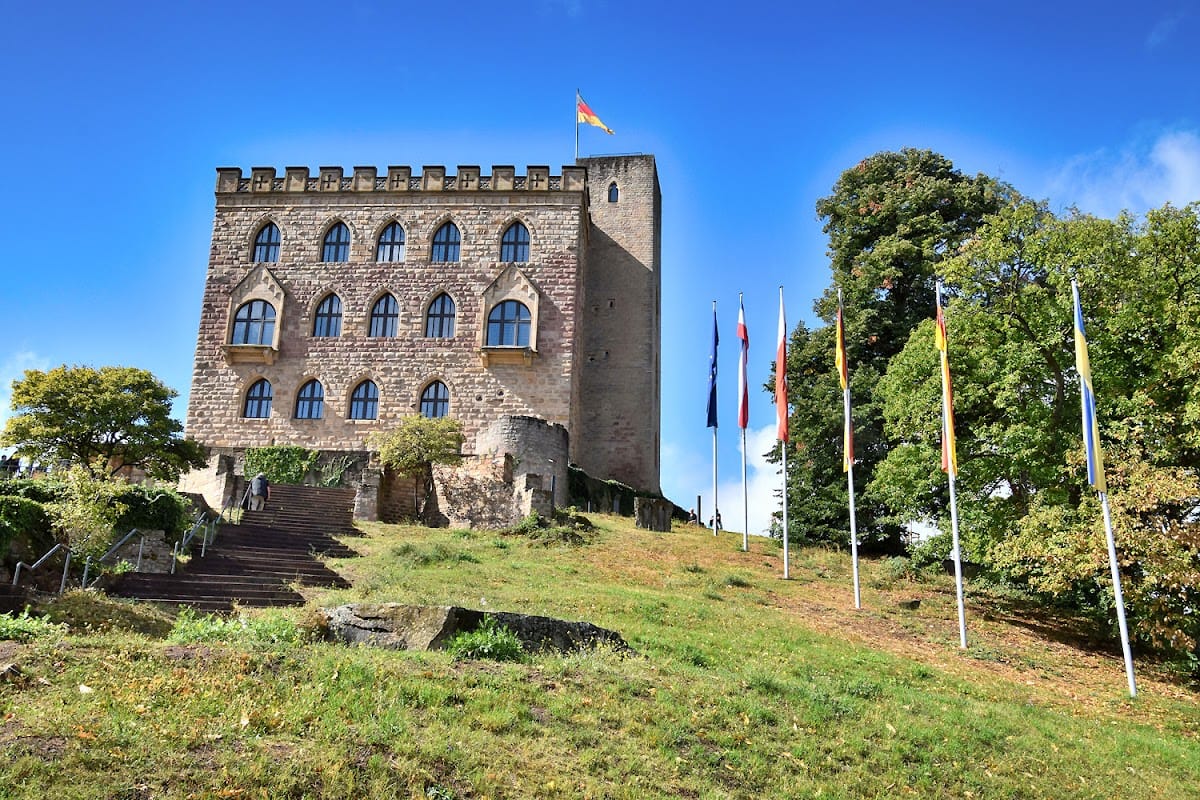
The central building has an L-shaped plan and rises more than 12 metres. Its principal facade combines classical and Renaissance-influenced features with three rows of pointed-arch windows. Two round-arched openings sit in niches with corbels and probably once supported a gallery or balcony. The entire facade is faced with sandstone laid as squared rustic rustication. Its battlements alternate plain merlons with merlons carrying cross-shaped decoration.
North tower
A tower rises on the north facade and permanently bears the German tricolor. Its presence links the surviving architecture directly with the castle’s modern political identity and with the use of the black-red-gold colors at the Hambach Festival.
East bay and balcony structure
The projecting bay on the east facade belongs to the medieval castle, although its appearance is Neo-Gothic. The window tracery and the battlement crown on this facade were nineteenth-century additions rather than medieval survivals. The rebuilding campaign also produced an unfinished altan, an elevated balcony or open gallery, beside and behind the main building. Its side walls and balcony were erected without their planned decoration before work stopped in 1848.
Castle chapel
The castle chapel was dedicated to the Archangel Michael. It was rebuilt and rededicated in 1723 before French revolutionaries destroyed it in 1794. Around 1800, a pointed arch from the castle was reused as a building element in a house on nearby Andergasse, preserving part of the complex in a different setting.
Modern interventions
Conservation and interior changes
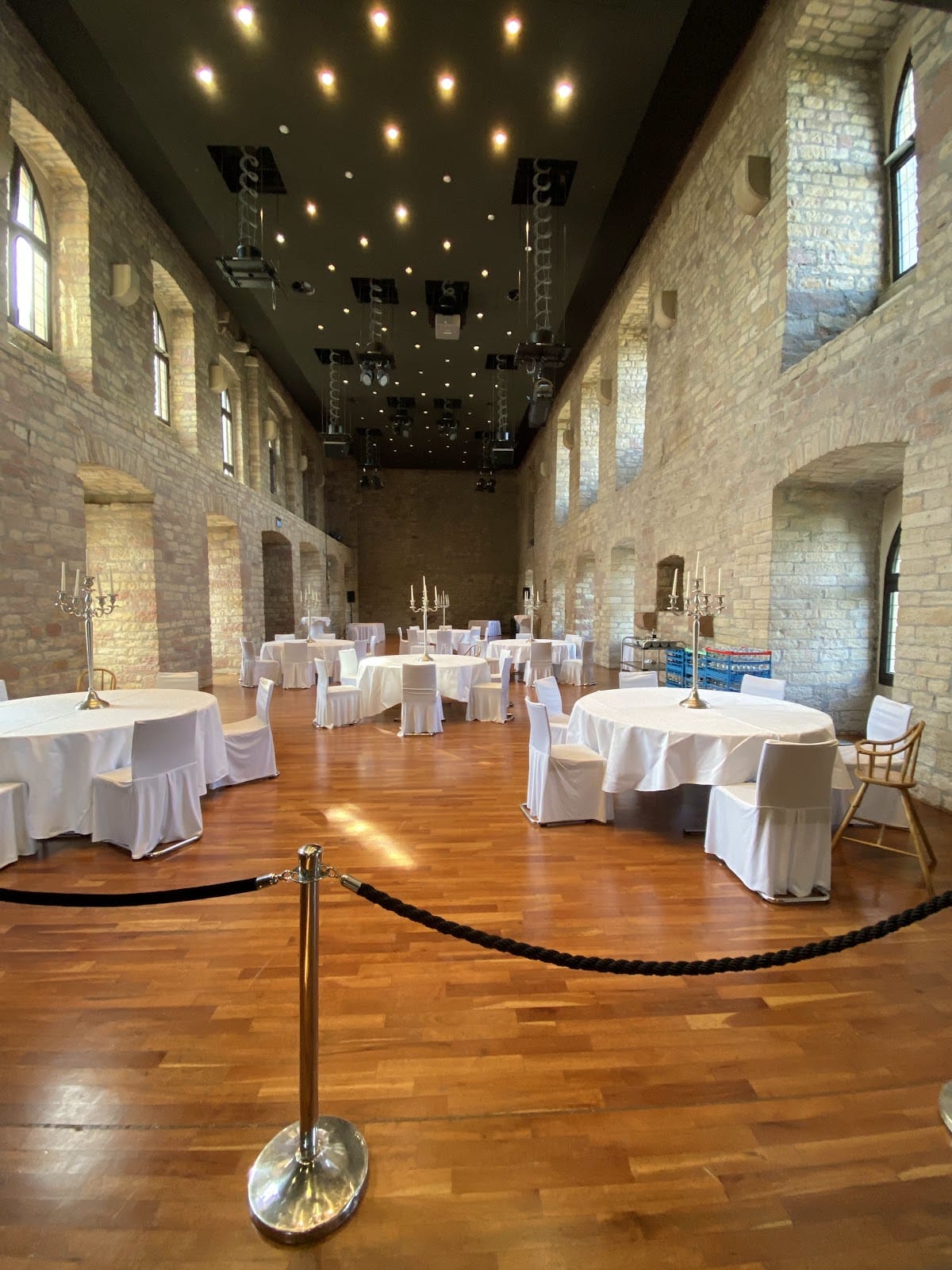
The 2006 to 2008 restoration cleaned and consolidated the old masonry while seeking to make the successive spatial and chronological layers legible. New construction used cherry wood, sandstone, glass, and steel, and an elevator was installed to improve accessibility. A large wooden ceiling inserted in 1980 was removed during the second phase of the 2007 to 2008 renovation, a decision that attracted public controversy.
Contemporary additions
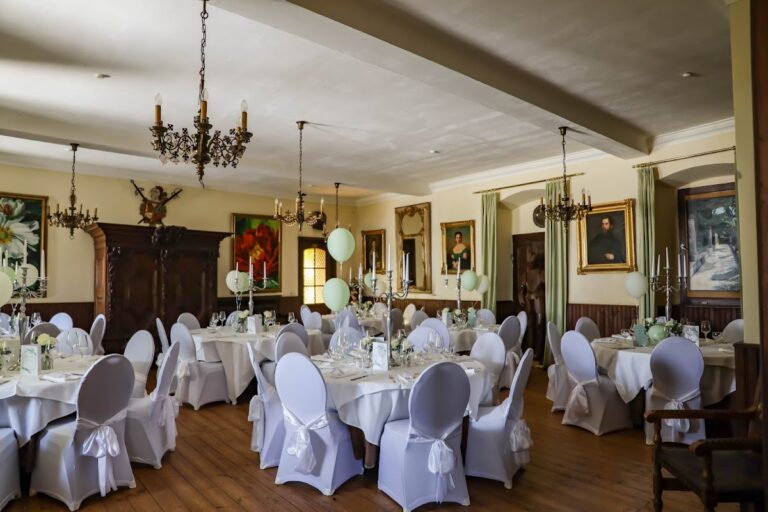
A relatively small modern building adjoining the historic complex contains the entrance and reception area. Between 2009 and 2011, a restaurant with more than 100 seats was built on the curtain wall, positioned to overlook the castle grounds. These additions form part of the present museum and conference complex while the historic masonry remains the physical record of Hambach’s successive medieval, early modern, nineteenth-century, and contemporary phases.
Nearby sites