Spangenberg Castle: A Medieval Rock Castle in Germany


Site at a Glance
- Rating
- 4.4
- Popularity
- Low
- Country
- Germany
- Primary era
- Medieval
- External website
- Open
- Eras represented
- Medieval
- Civilizations
- Holy Roman Empire
- Site type
- Military
- Remains
- Castle
On this page7 sections
History
Spangenberg Castle is a partly reconstructed medieval rock castle in Germany, probably built in the 11th century. It initially belonged to the Prince-Bishopric of Speyer, a territory governed by a bishop who also exercised secular princely authority. The castle was held as a fief, meaning that its holder owed obligations to a superior lord, and was administered by ministerials, legally unfree officials who could serve as military retainers and castle administrators.
Speyer Administration and Rival Lords
Tradition attributes the castle’s transfer to the Prince-Bishopric of Speyer to a donation by Bishop Johannes I in 1100. The arrangement placed Spangenberg within a feudal system rather than making it the outright private property of its successive holders. Diether of Zoller served as castellan, the officer responsible for managing and defending the castle, in 1317. Eberhard of Sickingen became its fief-holder in 1431, followed by Henry of Remchingen in 1439.
Spangenberg and neighbouring Erfenstein Castle were controlled by different lords and consequently stood in competition with one another. Spangenberg belonged initially to the Prince-Bishops of Speyer, while Erfenstein was held by the Counts of Leiningen. This rivalry formed part of the political tensions that later brought both castles into the Weißenburg Feud, a late-medieval conflict between competing territorial powers in the Upper Rhine and Palatinate region.
Destruction and Temporary Reuse
In 1470, forces of Elector Frederick I of the Palatinate and his cousin, Duke Louis I of Palatinate-Zweibrücken, fought during the Weißenburg Feud. The opposing forces destroyed both neighbouring castles, attacking Erfenstein first and Spangenberg afterwards.
A stud farm was established in the nearby forest in 1505. After Spangenberg had been made habitable again, it served for just under a century as the residence of the studmaster, the official responsible for managing the horse-breeding establishment.
Wartime Destruction and Later Ownership
Spangenberg was destroyed again in 1618, the first year of the Thirty Years’ War, the major European religious and political conflict that lasted from 1618 to 1648. The attack was carried out by the mercenary commander Ernst von Mansfeld, acting for the Protestant Union. At the beginning of the War of the Palatine Succession in 1688, a conflict between France and a coalition of European powers, troops of Louis XIV of France finally destroyed the castle.
Around 1900, the ruin passed into municipal ownership. It is now owned by the city of Neustadt an der Weinstraße. Spangenberg Castle is listed as a cultural monument of Neustadt an der Weinstraße, while its sandstone outcrop is separately recorded as a natural monument in the municipality.
Legends of Spangenberg
The castle is associated with Erfenstein Castle through the legend of the Leather Bridge. Another local tradition attributes its construction to an evil knight named Caspar, known as “Wild Caspar.” According to the story, he hid the emperor’s daughter at Spangenberg. After the emperor discovered the castle, Caspar and the daughter allegedly leapt from its walls. Their robes supposedly acted like parachutes, allowing them to survive before they were captured.
Remains
Rock Setting and Castle Wards
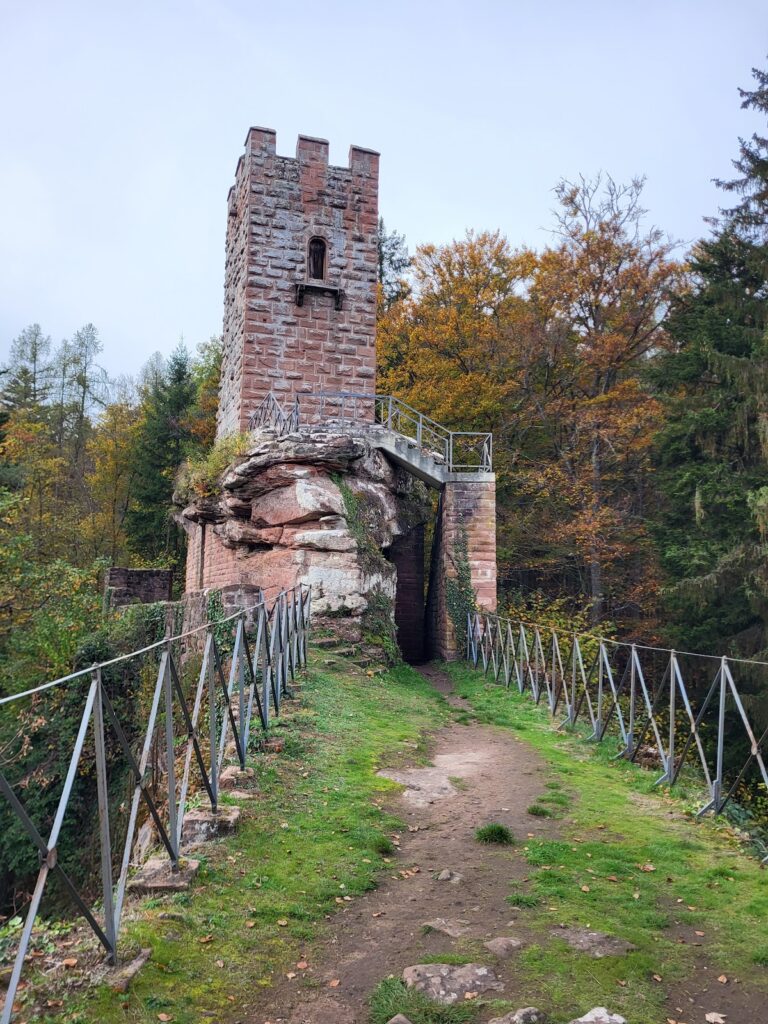
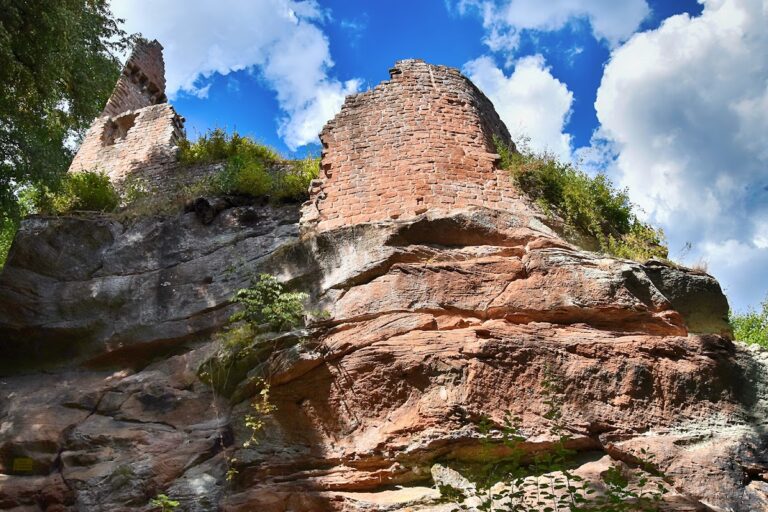
The ruin occupies a sandstone rock on the northwestern spur of the 343.2-metre Schlossberg in the Palatine Forest. It stands at approximately 249 metres above sea level above the Speyerbach in the Elmstein valley, while the settlement of Erfenstein, within the municipality of Esthal, lies about 200 metres to the north in a straight line. The partly reconstructed remains rise from the rock in a hill-spur position rather than surviving as an untouched medieval complex.
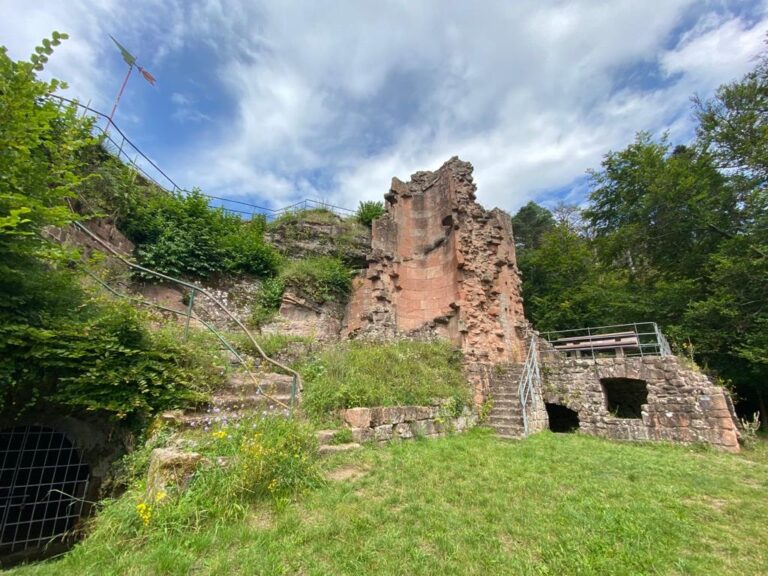
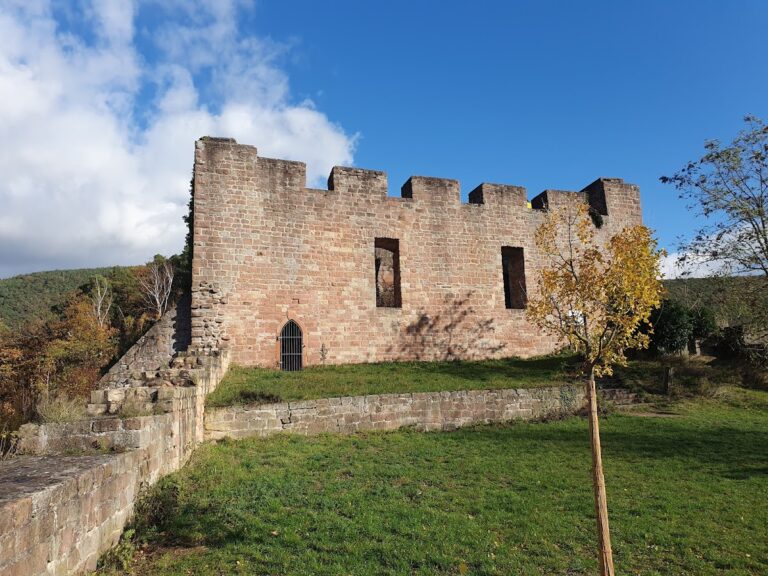
From the lower ward, also called the outer ward, the surviving arrangement includes the fortified palas, the main residential and representative building of a medieval castle. The view of the ruin also includes the gate leading to the upper, or inner, ward and a shield wall, a particularly strong defensive wall protecting the most exposed side of a castle. These elements remain part of the reconstructed castle ruin on its sandstone outcrop.
Nearby sites