Kaltenštejn: A Gothic Silesian Castle Ruin in Czechia
Site at a Glance
- Rating
- 4.6
- Popularity
- Low
- Country
- Czechia
- Primary era
- Medieval
- External website
- Open
- Eras represented
- Medieval
- Civilizations
- Holy Roman Empire
- Site type
- Military
- Remains
- Castle
On this page12 sections
History
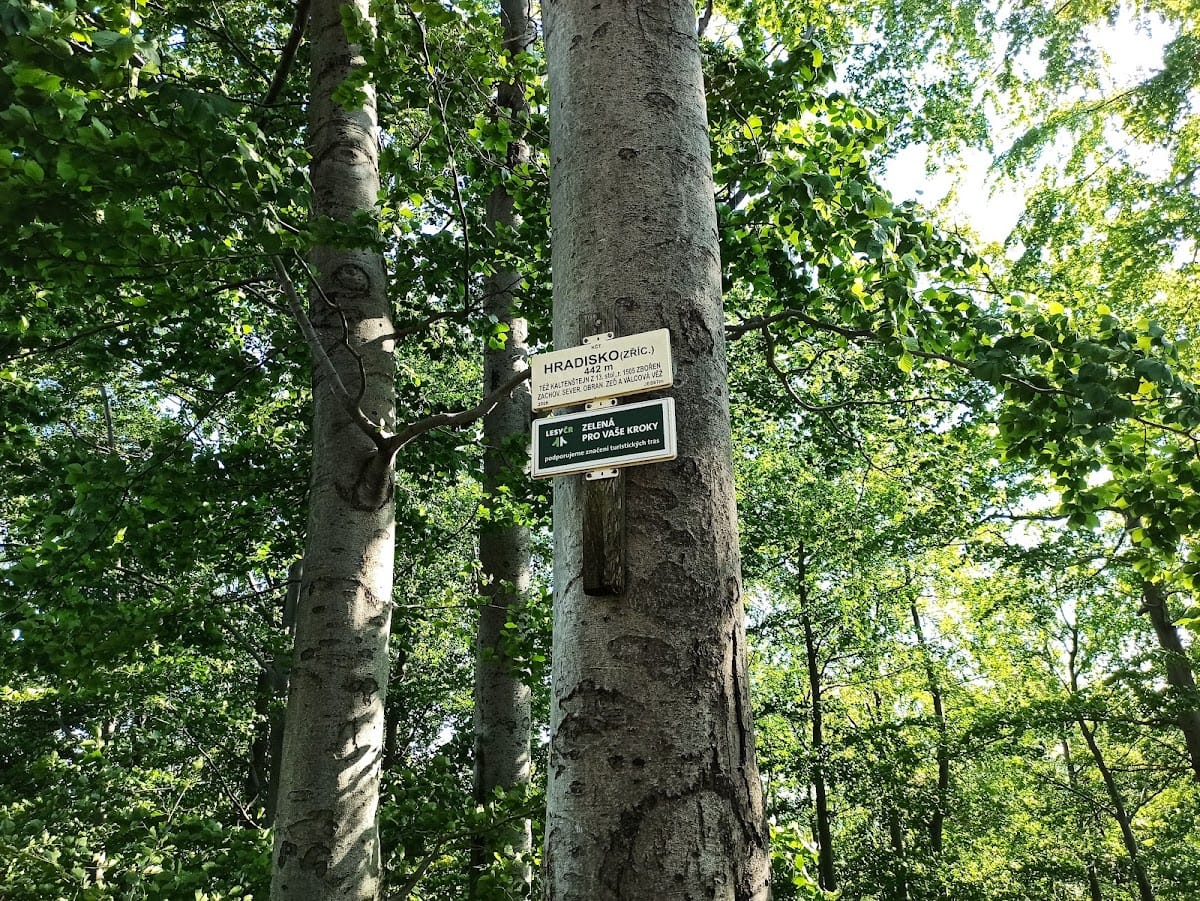
Kaltenštejn is a Gothic castle ruin in Czechia, built by Silesian builders around 1290 on the Hradisko elevation near Černá Voda. First recorded in 1295 and 1296 as a newly built castle in the Nysa Land, it stood on territory belonging to the Wrocław bishopric and became part of the political and military history of the region.
Foundation and Episcopal Control
In the late thirteenth century, Duke Bolko I of Świdnica acquired Kaltenštejn from its original builders, who were described as enemies of the Church. After a judgment mediated by the Bishop of Kraków at the request of Bishop Johann Romka of Wrocław, Bolko had to demolish the castle or surrender it to the Wrocław bishopric. By 1299, the castle was in episcopal possession under the command of the bishop’s brother, Dětřich.
During the first half of the fourteenth century, Kaltenštejn was repeatedly pledged, sometimes to several holders at once. The castle was redeemed from pledge in 1307, passed to the Haugwitz family in 1319, and in 1345 came partly by inheritance and partly by repurchase to Bishop Preczlaw of Pogarell. The Wrocław bishops later held it directly and used it to administer the villages of Stará Červená Voda and Jindřichovice near Vidnava. By 1398, its castellan was Konrad Muschin.
Conflict and Repeated Pledging
Kaltenštejn apparently remained unconquered during the Hussite Wars, the fifteenth-century religious and political conflicts in Bohemia associated with the reform movement founded by Jan Hus. It was administered during this period by Kunz of Sedlitz, but the financial exhaustion of the episcopal treasury led to another series of pledges. In 1428, the castle and surrounding towns and villages were leased to Pelkan of Kalkov, who was recorded as a holder in 1435. Other holders included Hanušek of Mušín in 1441, the Wrocław cathedral chapter in 1443, Kryštof of Czechssdorf in 1455, Mikuláš Meinholt from 1460 to 1470, his son Hynek, the Wrocław canon and Opava duke Přemek II in 1470 and 1471, Hynek Meinholt again from 1472 to 1497, and his son-in-law Jindřich of Tetov from 1497 to 1505.
A violent episode occurred in 1440 and 1441. The knight Zikmund Rachna, also known as Sigismund of Reichenau, abducted the daughter of the Kladsko captain Půta of Častolovice. After she was freed, Rachna fled to Kaltenštejn with his supporters and seized the castle. The group captured its lord, Mikuláš Pelkan of Kalkov, but an episcopal army retook the castle on 11 March 1441. Rachna was tortured to death at Kaltenštejn, while his helpers were taken to Nysa, tortured, and hanged.
The fifteenth-century conflict apparently caused no major structural damage, yet the castle was not repaired and had become dilapidated and militarily outdated by the middle of the century. Repairs proposed in 1443 probably did not take place. In 1467, Bishop Jodok of Rosenberg had the rebellious Wrocław cathedral provost Johann Düster imprisoned and brought to Kaltenštejn.
Final Ownership and Demolition
In 1470, the Wrocław cathedral chapter bought the castle back for 2,700 gulden and compensated Hynek Meinholt with the town of Weidenau and its dependent villages. Hynek acquired Kaltenštejn again two years later, and Jindřich of Tetov later obtained it for the same sum.
In 1505, Bishop Jan IV Roth bought Kaltenštejn out of pledge as part of a consolidation of the Wrocław bishopric’s possessions in the Jeseník region. Against the wishes of the cathedral chapter, he authorized the castle’s demolition. By 1512, Kaltenštejn was recorded as completely demolished. Local tradition holds that stone from the castle was reused during the extensive reconstruction of Jánský Vrch, the nearby summer residence of the Wrocław bishops. Kaltenštejn has been protected as a cultural monument of the Czech Republic since 1964.
Remains
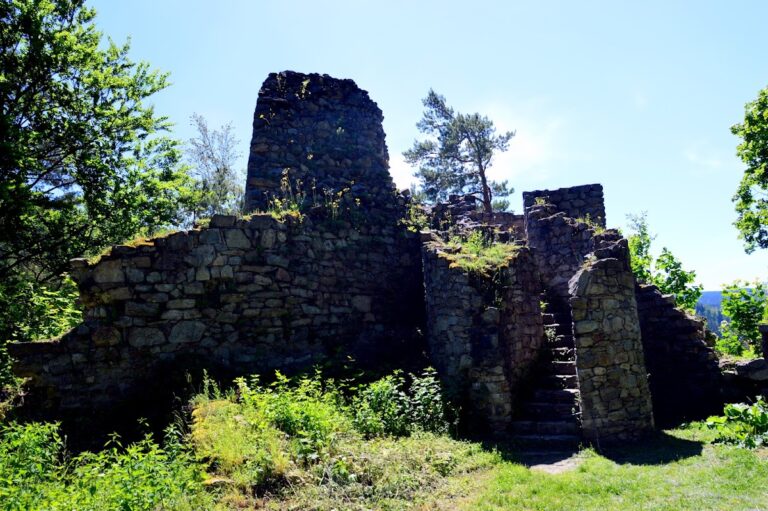
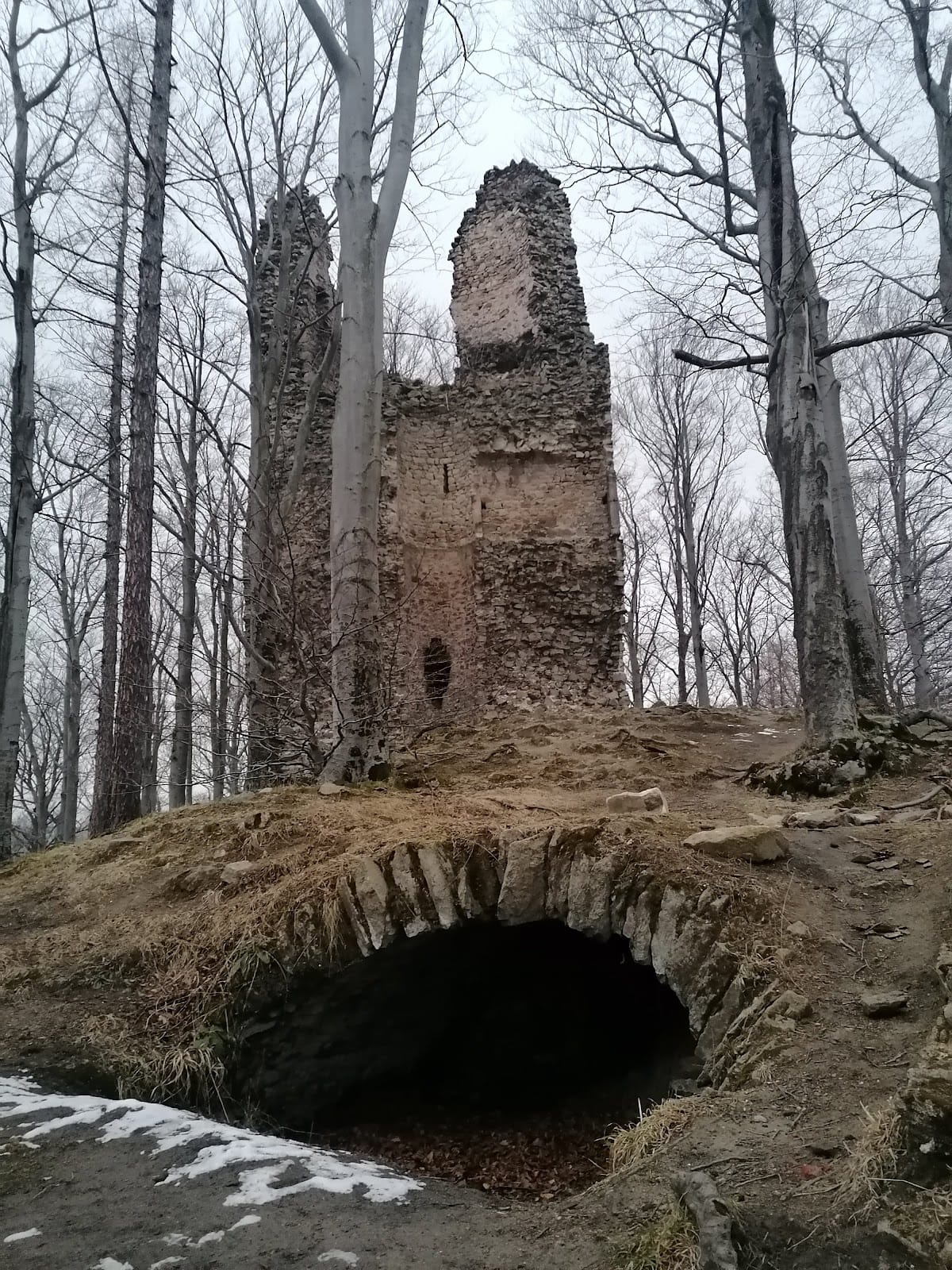
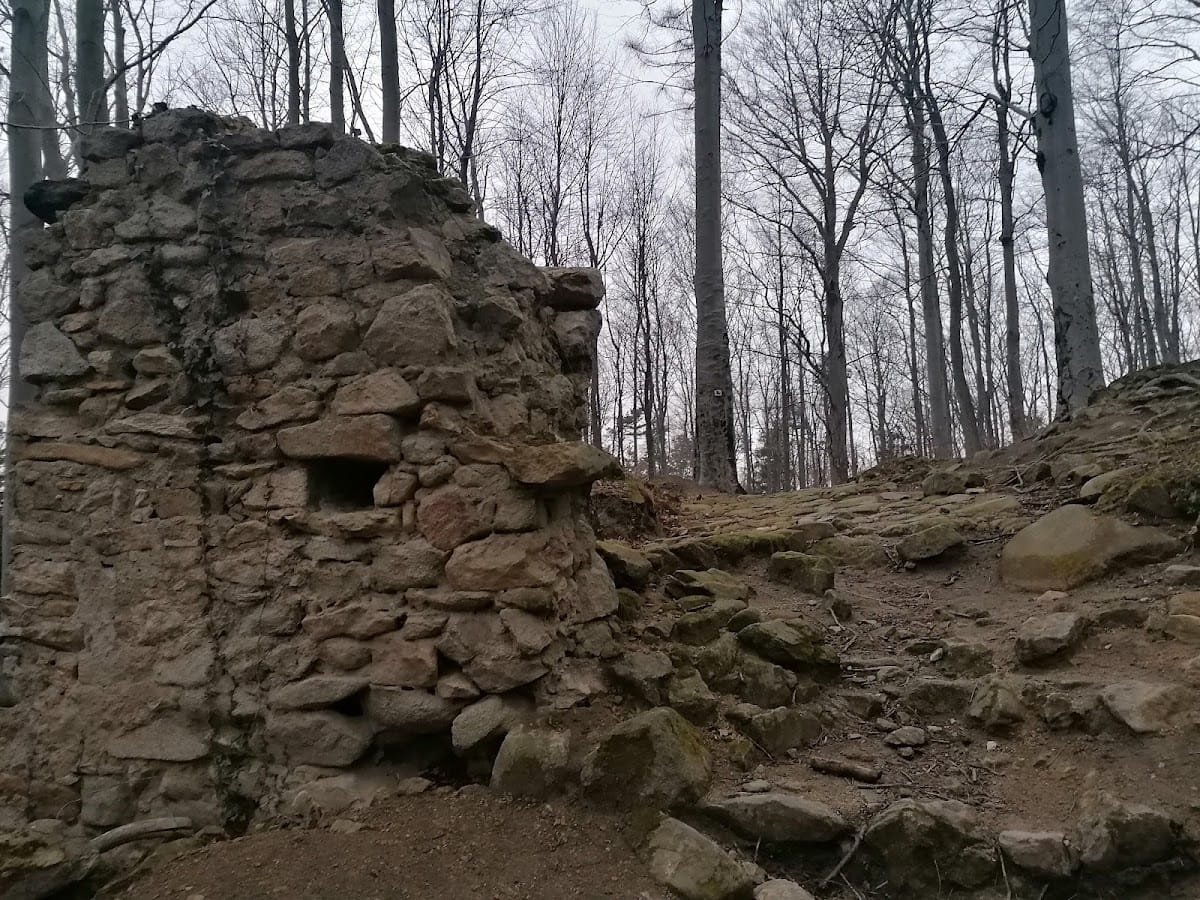
Kaltenštejn’s Gothic remains occupy an isolated knoll beside the Hagewasser near Nové Podhradí and Staré Podhradí, at approximately 437 metres above sea level. The entire castle complex covered roughly 100 metres by 30 to 70 metres. Its east-west-oriented oval core measured up to about 45 by 30 metres and occupied the summit. The southern side, the most vulnerable part of the position, received especially heavy fortification. Granite quarried nearby supplied the building material. The main approach came from the south, while the principal surviving entrance remains lie on the western or northwestern side.
Castle Core
Defensive Tower
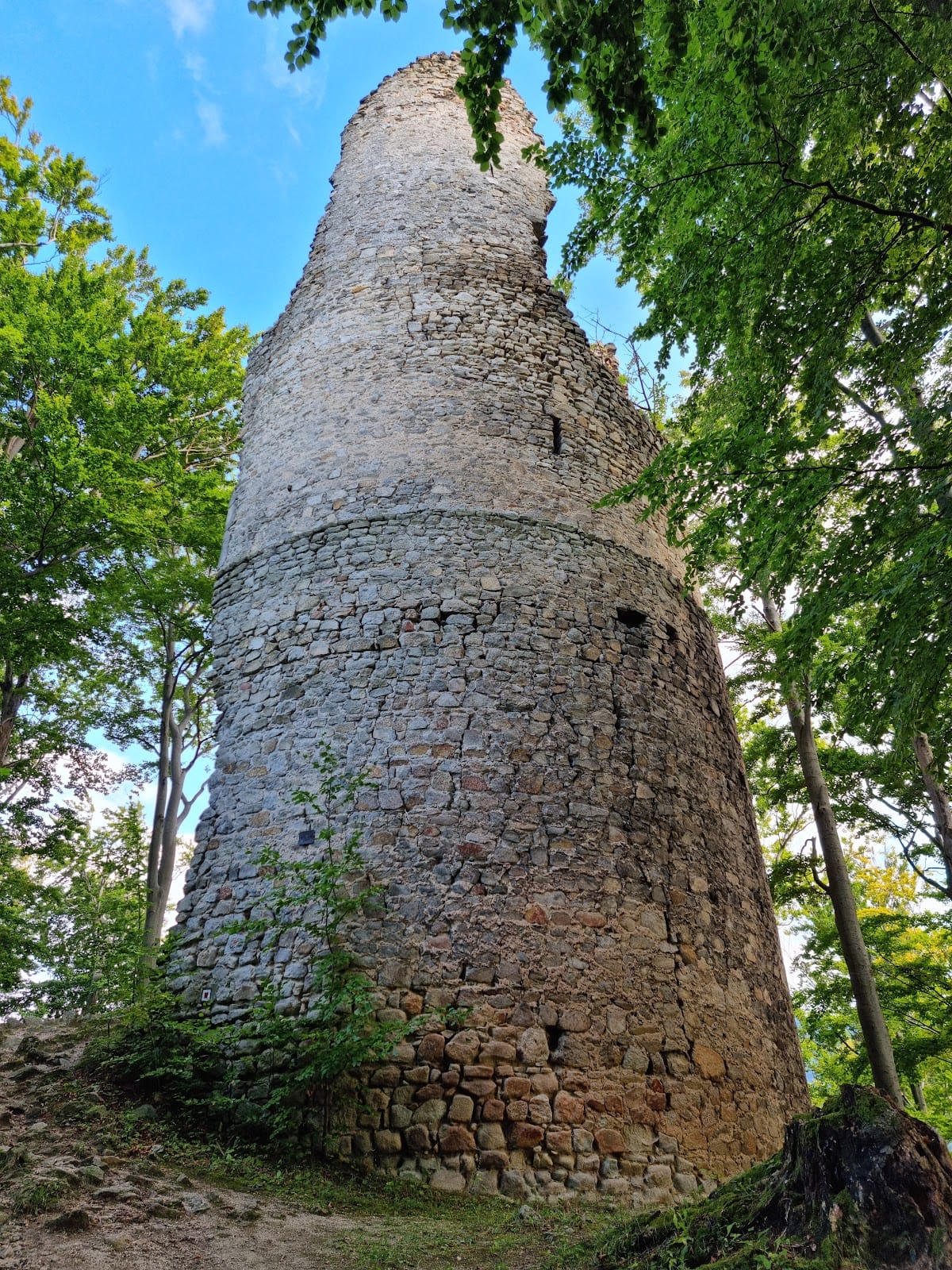
The core contained a free-standing circular bergfried, the castle’s principal defensive tower, used for protection and observation. It measured approximately 10 metres in diameter, with a ground-floor diameter of 10.6 metres. Its walls were about 4.35 metres thick at the base and approximately 1.5 metres thick in the upper levels. Loopholes and a wall-walk with battlements formed part of its original defensive arrangement.
Entry to the tower was through a small portal at first-floor level, part of which survives. The ground floor held a vaulted chamber, while the upper storeys may have provided living space. An explosion destroyed the tower, but a surviving section rises to roughly 20 metres.
Palace and Core Wall
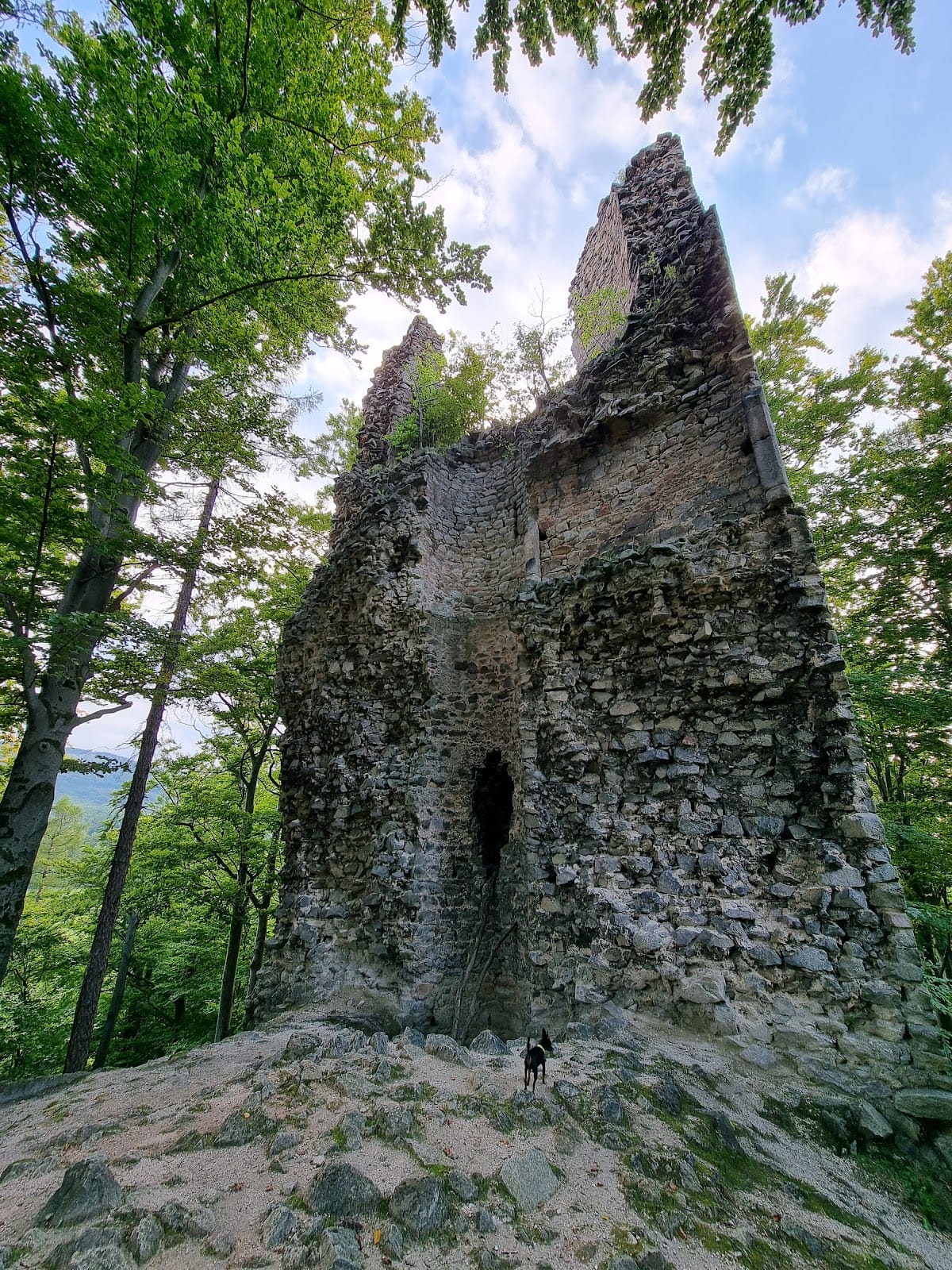
A two-part palace adjoined the core wall. The earliest palace was tower-like, measured about 11 by 13 metres, and had several storeys. Only slight remains survive, including its basement, which was divided into three spaces. Part of a vault remains in the southeastern basement, and the palace walls reached up to two metres in thickness.
The core wall survives in a small remnant on the northwestern side. It appears to have been approximately two metres thick and about seven metres high, while recognizable castle-wall remains extend for roughly 38 metres.
Forecourts and Outer Defences
Original Forecourt
Two forecourts lay northwest of the core beyond a small gate in the core wall. The northwestern forecourt probably belonged to the original castle and contained a building mentioned in 1443. Its first entrance stood near a stepped pillar.
Gate and Bastion
A second entrance to the forecourt stood beside a square bastion, a projecting defensive structure. Its surviving portal retains a groove for a drawbridge. The gate was connected with a room probably used as a guardhouse, as well as with a covered well that was still visible in the nineteenth century.
Outer Enclosure
A later outer enclosure consisted of a wall around the summit and the wall of the outer forecourt. The outer wall was only about 1.1 metres thick and included a single inconspicuous bastion. This outer forecourt was built in the late fourteenth or early fifteenth century. Its entrance was formed by an opening fitted with gates. Historical references place stables, a windmill, and a brewery somewhere within the forecourt.