Deganwy Castle: A Medieval Stronghold of Gwynedd


Site at a Glance
- Rating
- 4.6
- Popularity
- Low
- Country
- United Kingdom
- Primary era
- Medieval
- External website
- Open
- Eras represented
- Medieval
- Civilizations
- English, Welsh
- Site type
- Military
- Remains
- Castle
On this page13 sections
History
Deganwy Castle is a ruined fortress in the United Kingdom, at Deganwy in north Wales. It began as an early stronghold of Gwynedd, the medieval Welsh kingdom whose rulers controlled much of north Wales, and its history extends from the early medieval period through the conflicts between Gwynedd and England in the thirteenth century.
Early medieval stronghold
The site was probably occupied during the Roman period. After the Roman withdrawal from Britain, its steep and defensible position became attractive as protection against Irish raids. A settlement of serfs may have existed below the stronghold.
An early medieval timber fortress was later established on the rocky outcrop. Tradition associates it with Maelgwn Gwynedd, an early king of Gwynedd who flourished around 520 to 547, identifying Deganwy as his headquarters or residence. The stronghold was burned in 812 after being struck by lightning.
Norman intervention and Welsh rebuilding
During the Norman campaigns in north Wales, Robert of Rhuddlan is recorded as establishing a castle at Degannwy, probably no earlier than 1073 and possibly around 1080. The exact position and arrangement of this Norman castle remain uncertain. Robert was killed in 1093, and the Welsh expelled the Normans from Gwynedd in the following year. Deganwy’s history during the twelfth century is not known.
By the thirteenth century, Llywelyn ab Iorwerth, commonly known as Llywelyn the Great, had fortified Deganwy. The Earl of Chester captured it in 1210, after which Llywelyn recovered the site and refortified it in stone. The Brut y Tywysogion describes the earl rebuilding a castle that Llywelyn had destroyed, while also recording that Llywelyn began rebuilding the site again in 1213.
Llywelyn used the castle as a prison in 1228 for his son Gruffydd, who had protested against being passed over in the succession. In 1241, Dafydd ap Llywelyn, Llywelyn the Great’s son and successor, destroyed Deganwy before an English advance.
English occupation and destruction
King Henry III of England then took control of Deganwy and began an extensive rebuilding programme costing more than £2,200. English forces started rebuilding the castle during their campaign in Gwynedd in 1245. After the Treaty of Woodstock in 1247 transferred Perfeddwlad, the eastern region of north Wales contested by Gwynedd and England, to English control as far west as the River Conwy, Henry invested further in Deganwy. With nearby Dyserth Castle, it was intended to defend the frontier against Gwynedd.
Henry established an English borough called Gannoc around the castle and granted it a royal charter in 1252. A borough was a settlement with recognized legal and administrative status, while a royal charter was a formal grant defining a settlement’s rights and privileges. Gannoc remained relatively small, and Welsh attacks on English territory resumed from 1254.
Llywelyn ap Gruffudd, known as Llywelyn the Last, captured Perfeddwlad in 1256. Deganwy and Dyserth then became isolated English fortresses that could receive supplies only intermittently. An English army under Prince Edward relieved Deganwy in April 1263, but Welsh forces cut its supply lines later that summer. The starving garrison surrendered in September, and Welsh forces completely destroyed the castle.
Abandonment and archaeological investigation
Edward I reached the ruins during his campaigns of 1277 and 1283. From 1283 he built Conwy Castle and its fortified town across the estuary, where the fortress could be supplied by sea, and left Deganwy Castle in ruins. Stone from Deganwy may have been reused in the walls of Conwy Castle and its town.
Leslie Alcock directed excavations at Deganwy between 1961 and 1966 in a programme planned by the University of Wales and funded by the Board of Celtic Studies and the Caernarvonshire Historical Society. The excavations recovered twelve sherds of early medieval pottery imported from the Mediterranean, revealing the far-reaching contacts of the Gwynedd royal dynasty. In 2009, the Gwynedd Archaeological Trust carried out a geophysical survey of the bailey between the hills and of land immediately north and south of the castle. The ruins are a Grade II* listed monument and a Scheduled Monument, forms of legal protection recognizing the site’s historical and archaeological importance.
Remains
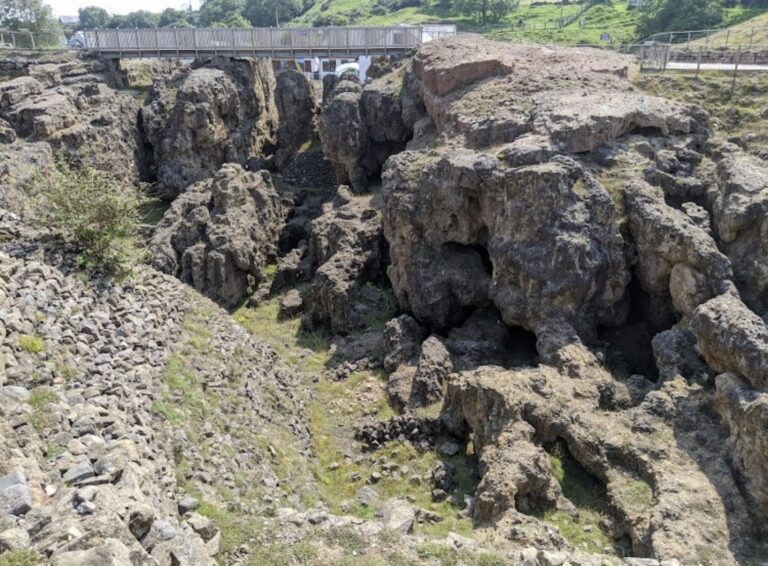
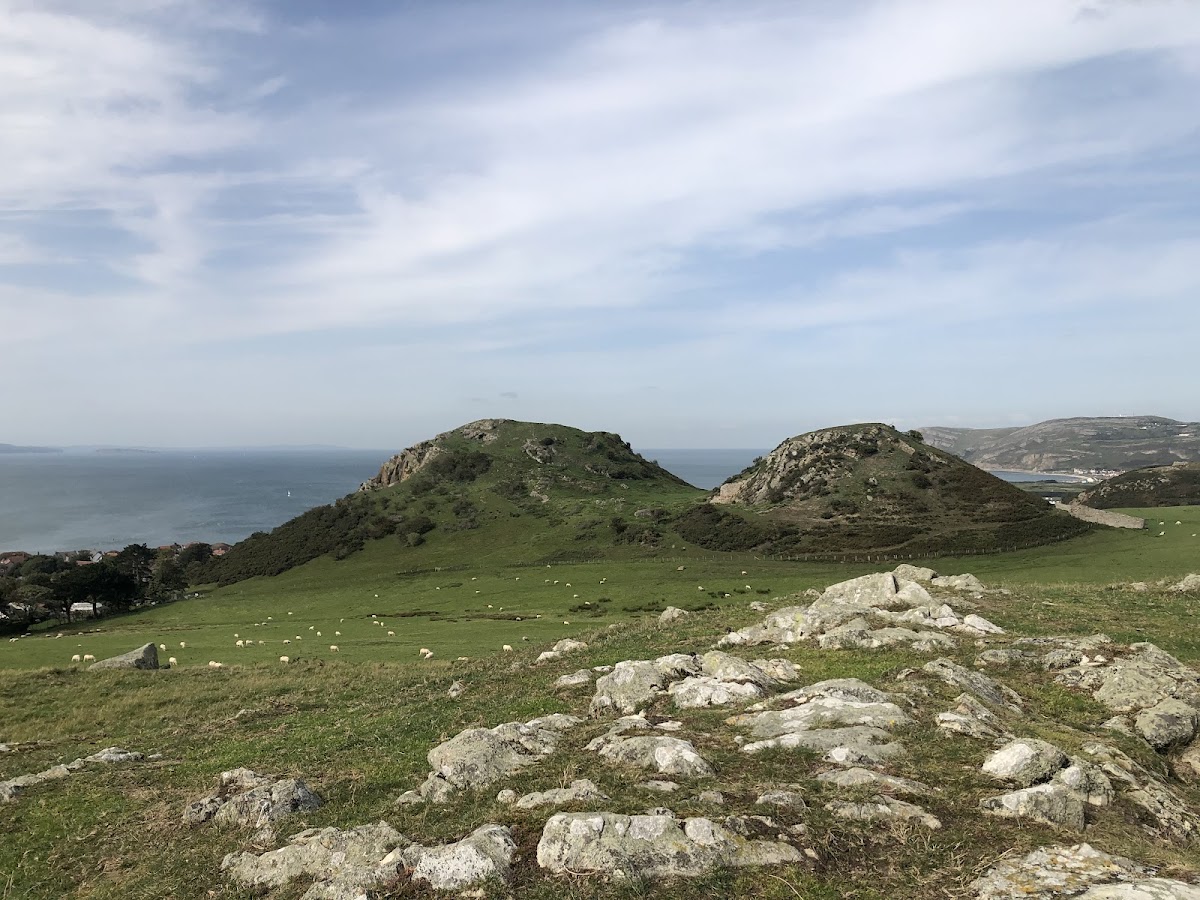
Deganwy Castle occupies two steep hills on the Vardre, on the east bank of the River Conwy and south of Llandudno. The site rises to about 110 metres and consists of volcanic rock within an area of limestone. Its surviving remains combine earthworks, ditches, mounds, and limited masonry arranged around an inner castle on the larger western hill and a bailey between the two summits.
Early earthworks and the bailey
Early fortress
The earliest fortress was a timber construction on a massive rocky outcrop. Its surviving physical evidence is chiefly formed by ditches and mounds, while excavation on the western summit identified remains associated with the fifth and sixth centuries. The earliest surviving defensive works are earthworks attributed to Llywelyn ab Iorwerth’s rebuilding programme begun in 1213.
Outer bailey
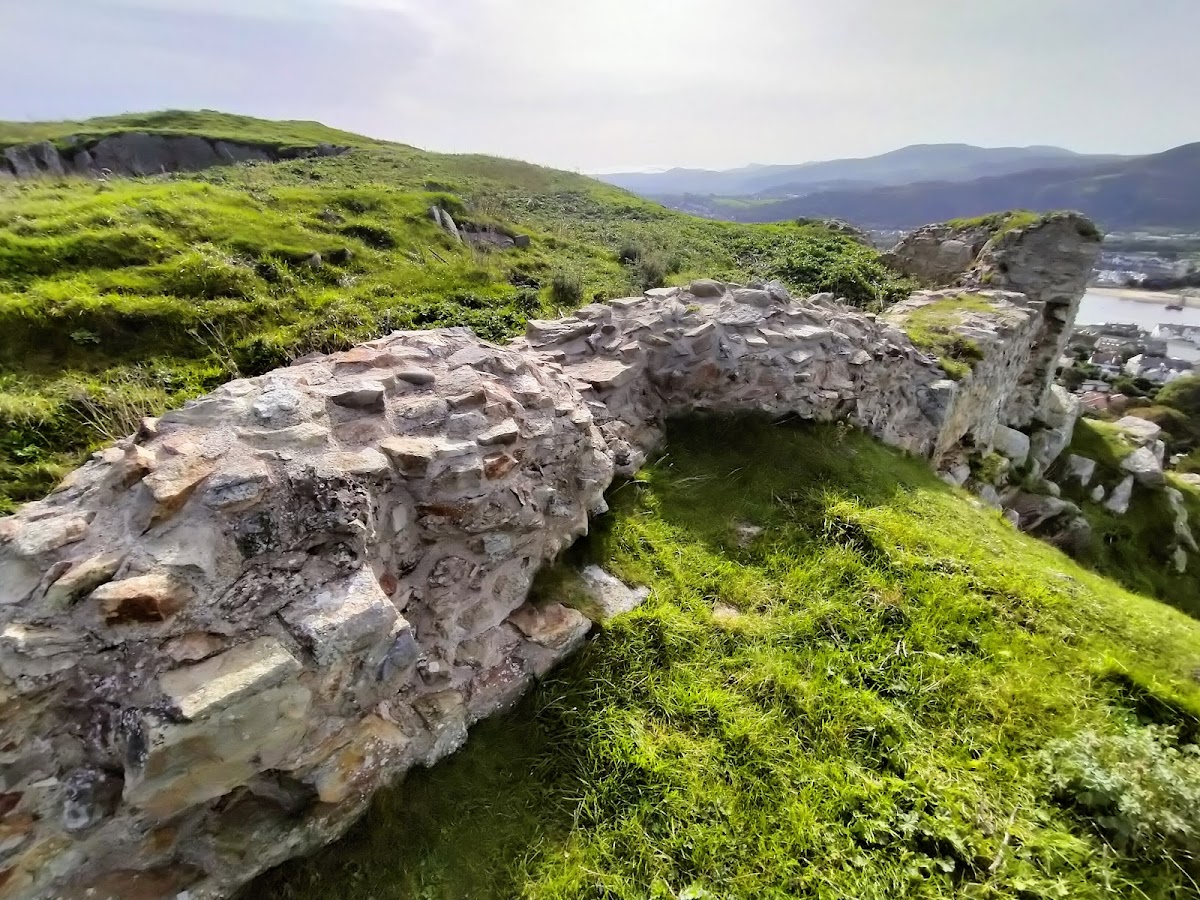
From 1245, Henry III’s forces constructed a bailey, an enclosed outer part of a castle, in the space between the two hills. Its northern side had a wall and ditch, and work began on a wall and gate tower there. The southern side was defended by a stone wall and a gatehouse flanked by two D-shaped towers. Small sections of these masonry defences survive.
Inner castle and connected structures
Western summit
The inner castle on the larger western hill retained parts of the curtain wall built from 1245. A curtain wall was the main enclosing defensive wall of a castle. The summit also contained a round tower and a palas, the principal residential hall of a medieval Welsh or English castle.
Mansell’s Tower
Connecting walls linked the inner castle with the bailey. The eastern summit carried the U-shaped tower known as Mansell’s Tower, forming part of the castle’s arrangement across the two hills.
Borough remains
A borough was established north of the bailey from about 1250. Excavations in this settlement uncovered the remains of a chapel and a horse mill, adding evidence of the community that developed alongside the English castle.