Valsery Abbey: A Premonstratensian Monastery in France
Site at a Glance
- Popularity
- Low
- Country
- France
- Primary era
- Medieval
- Eras represented
- Medieval, Early Modern, Modern
- Civilizations
- French
- Site type
- Religious
- Remains
- Monastery
On this page15 sections
History
Valsery Abbey is a former Premonstratensian monastery at Cœuvres-et-Valsery in the Aisne department of France. Its religious community was founded in 1124, first settling at Viviers before moving to the Valsery site, chosen in 1153. The Premonstratensian canons were members of a religious order who lived together under a common rule, founded by Norbert of Xanten.
Foundation and royal consecration
Twelve canons sent by Norbert at the request of Lisiard, bishop of Soissons, formed the original community. Henry, Norbert’s coadjutor, meaning an assistant to a senior church official, became its first abbot. The move to Valsery followed a donation by Jean Leroux, lord of Saint-Pierre-Aigle. Dedicated to Mary, the mother of Jesus and a central figure in Catholic devotion, the abbey received substantial endowments. In 1154 Pope Adrian IV confirmed its possessions to Abbot Étienne. Benefactors included Yves, count of Soissons; Raoul, count of Vermandois; Drogon of Pierrefonds; Eudes, count of Clastres; Bernard of Audrival; Mathieu of Loistres; Gérard of Compiègne; and Philippe of Alsace. The canons may also have helped clear the nearby Forest of Retz.
Bishop Jacques de Bazoches of Soissons consecrated the abbey in November 1226. Louis IX and his mother, Blanche of Castile, attended shortly after his coronation at Reims.
Burials and conflict
The abbey received the burials of Marguerite of Anjou, wife of Charles of Valois, who died on 31 December 1299, and their daughter Catherine, who died in infancy in 1300. Charles visited their tombs on 20 May 1303.
During the Hundred Years’ War, a prolonged series of conflicts between the English and French crowns, the monks fled to Viviers Castle in 1359 when they learned an enemy force was approaching. The English found no booty and burned the abbey. In 1414, forces associated with the duchy of Burgundy brought violence and terror to the monks and their community.
In 1567, French Protestants known as Huguenots captured Soissons. Three days of violence followed after 25 September, during the Wars of Religion, conflicts between Catholics and Protestants in France. Jean d’Estrées, lord of Cœuvres Castle, was suspected of failing to aid the monks after converting to Protestantism. The abbey’s thirteenth-century choir survived the destruction of 1567.
Rebuilding and suppression
Rebuilding continued for two centuries after 1585. Abbots including Louis de Lametz and Denis de Lorry undertook a comprehensive rebuilding of the estate, which was enclosed by 1653. Claude de Hannivel de Mannevillette served as abbot for 43 years from 1672. He was the last regular abbot, a member of the religious order rather than a holder of its benefice from outside the community, and also served as vicar general, authorized to act on behalf of a religious superior. Later abbots included the bishops of Soissons Jean-Joseph Languet de Gergy from 1715, Charles-François Lefebvre de Laubrière from 1731, François de Fitz-James from 1738, and Henri-Joseph-Claude de Bourdeilles from 1764. The abbey’s succession records thirty-seven abbots.
The abbey was suppressed in 1790 and sold as national property, meaning property seized by the state and offered for sale during the French Revolution. It had been emptied by the end of 1791. The church and cloister were demolished in 1793, and the site’s thirteenth-century artistic works were lost.
From country house to restoration
Baron Charles Estave bought the ruins in 1804 and served as mayor of Valsery until 1830. He had a country house remodelled on the site. His daughter Pauline Émilie Mathilde married Adrien Boitel de Dienval there in 1851, and his son Joseph Maurice occupied the house from 1871. Estave died in 1873.
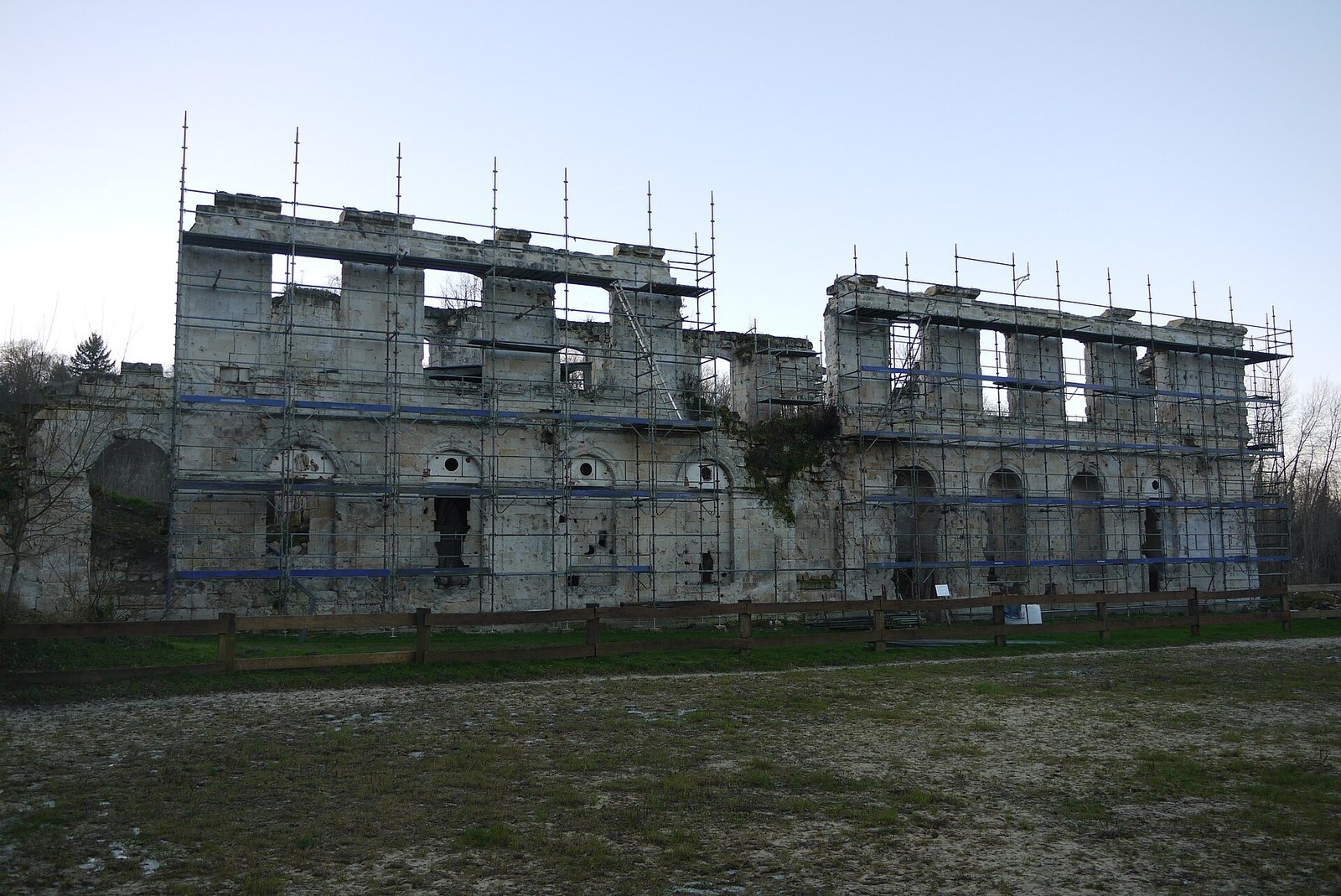
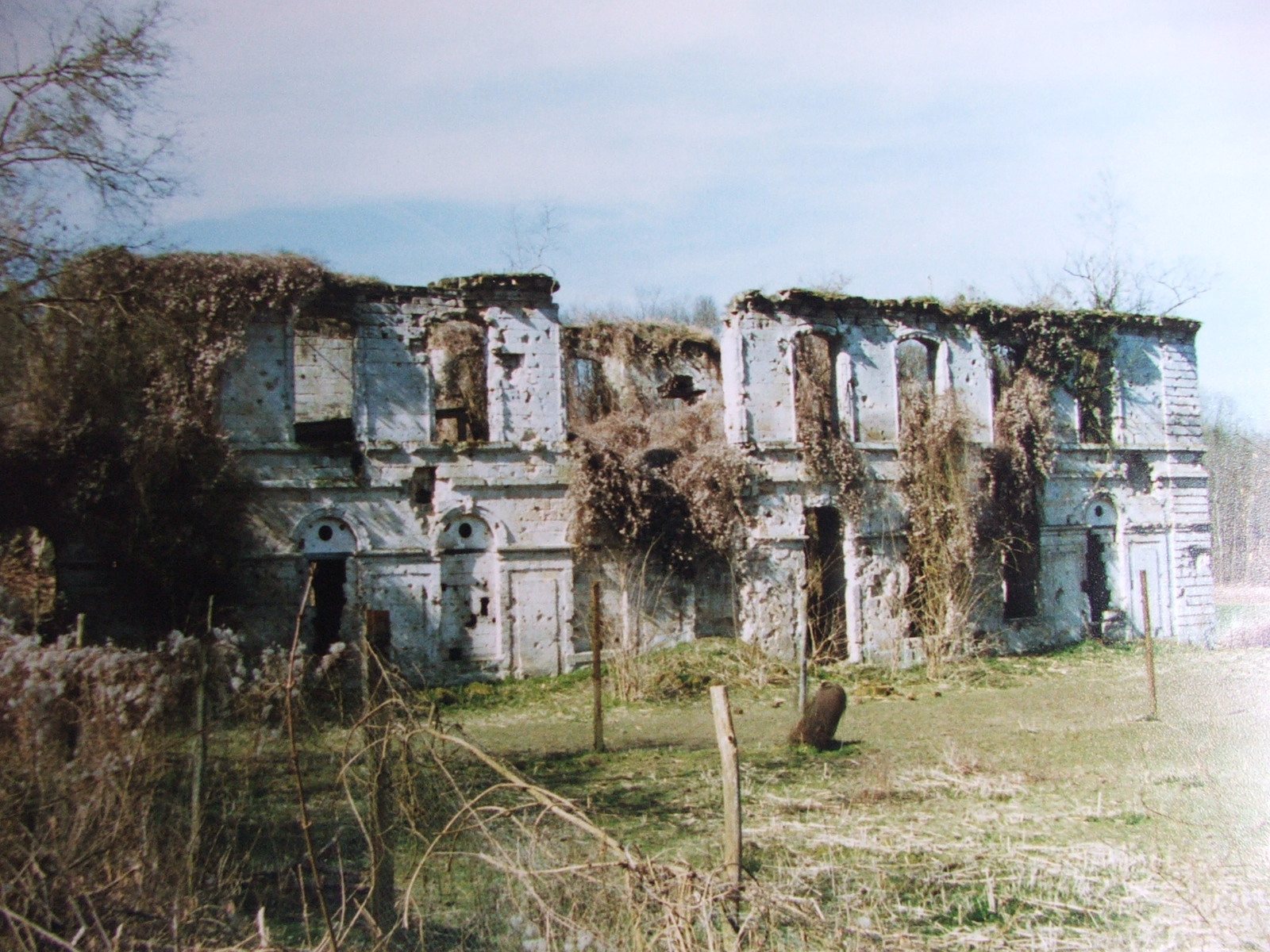
The family house served as a military field hospital in 1915. An evacuation order came in late May 1918; bombardments in June and July left the house abandoned for several decades. The abbey remains, its enclosing wall, and its icehouse, a structure for storing ice before mechanical refrigeration, were classified as historic monuments in 1986. The Black Lion property associated with the abbey in Soissons received the same classification that year. An abbey-restoration association established on the site in 1996 owns the remains. Surveys begun in the late 1990s located the buried church and cloister, and volunteer restoration work has continued since 2013 through a group linked to Rempart, a heritage network organizing volunteer restoration projects.
Remains
The abbey precinct
Overall layout
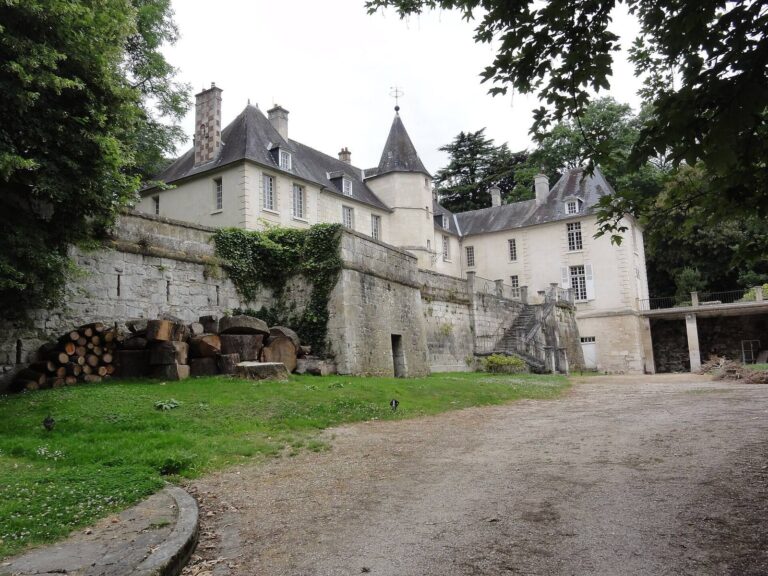
At the edge of the Forest of Retz, the abbey occupied an irregularly arranged complex. Its surviving walls belong to the dormitories and chapter house, while the rest of the site lies beneath about two metres of overlying material. A description from 1585 characterized the buildings as irregular in arrangement, plain, and relatively modern in appearance.
Chapter house
The chapter house, the monastery’s meeting room, is attested in the twelfth century and is incorporated into a residential building remodelled in the eighteenth century. It originally had six rib vaults, vaulted ceilings supported by intersecting ribs, carried on two central pillars. Painted and multicoloured decoration adorned the room, and its floor was paved.
Church and cloister
The church and cloister were levelled in 1793. Their buried remains lie beneath the site, and surveys begun in the late 1990s established their locations.
Other abbey buildings
A large building used by the religious dates from 1730. The prior’s and subprior’s apartments, along with the library, date from 1764. These buildings belong to the abbey’s later rebuilding phases.
Later buildings and associated features
Country house
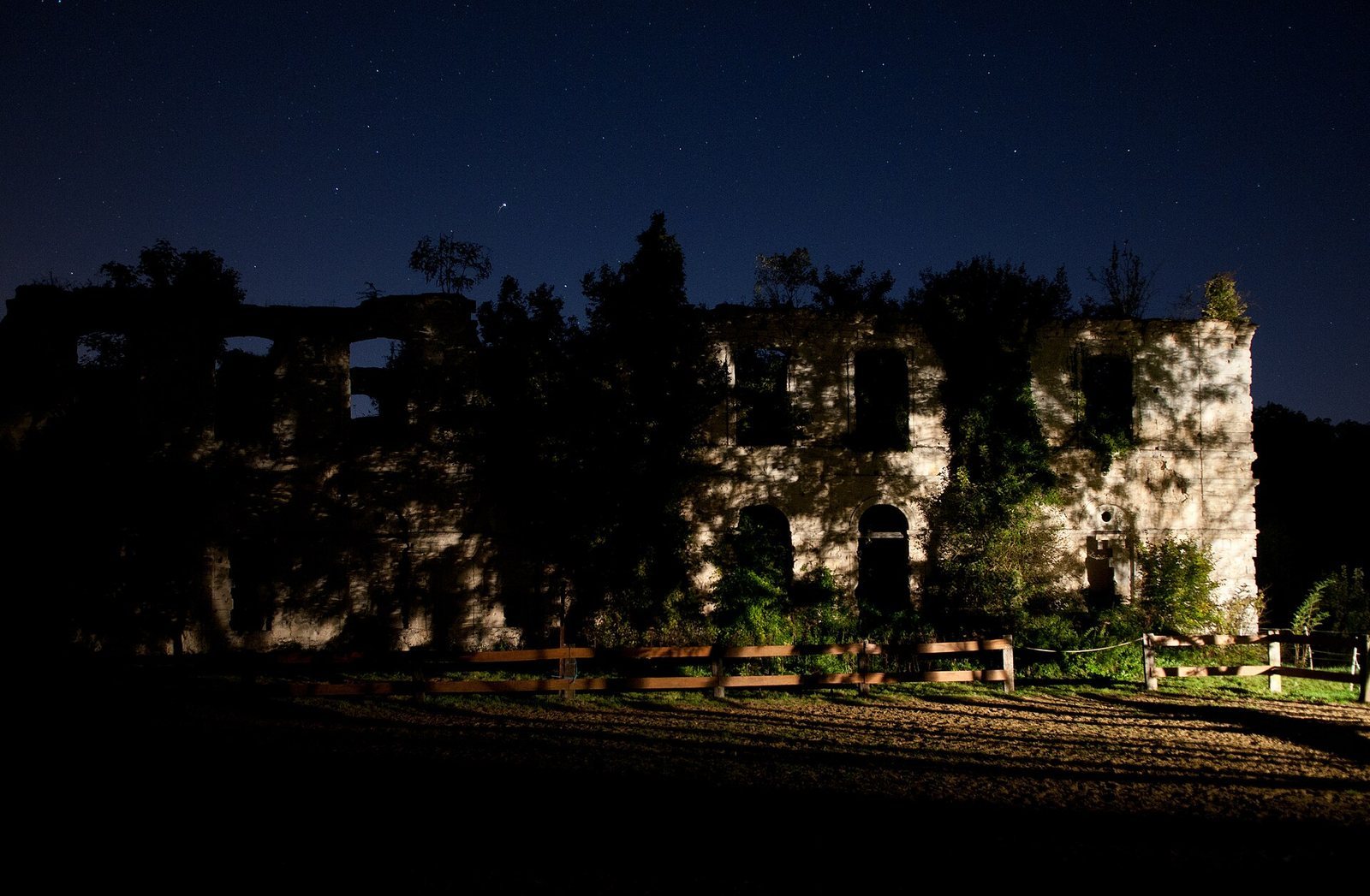
The nineteenth-century country house had a two-storey main block with an attic and a projecting three-storey pavilion with a high attic. Its façade contained twelve bays. After the bombardments of 1918, the walls that remained were charred and pitted by shell fragments.
Black Lion
The Black Lion, the abbey’s associated urban residence and inn in Soissons, survives only as cellars.
Mausoleum and coat of arms
A marble mausoleum built during Claude de Hannivel de Mannevillette’s abbacy served as his tomb. The abbey’s coat of arms had a blue field, with a gold fleur-de-lis, a stylized lily emblem, on the shield-bearer’s right and a gold rose with a gold stem and leaves on the left.