Schloss Affing: Seat of a Bavarian Manorial Estate
Site at a Glance
- Rating
- 5
- Popularity
- Very Low
- Country
- Germany
- Primary era
- Early Modern
- Eras represented
- Early Modern, Modern
- Civilizations
- Electorate of Bavaria, German, Holy Roman Empire, Kingdom of Bavaria
- Site type
- Domestic
- Remains
- Castle
On this page12 sections
History
Schloss Affing is a manor castle in Affing, Germany, and served as the seat of the Affing Hofmark, a Bavarian manorial estate whose lord held local administrative and judicial rights. Baron Johann Baptist von Leyden commissioned the present castle in 1694.
Early lords and the medieval castle
The Lords of Affing are first mentioned in 1040. From the fourteenth century, the Hofmark changed hands frequently. A moated castle on the site appears in records in 1408. In 1462, Albrecht Achilles, Margrave of Brandenburg, burned it; Wolfgang von Waldeck later rebuilt the castle. The predecessor was destroyed during the Thirty Years’ War (1618–1648), a major European conflict.
The Leyden castle
The estate passed to the Barons von Leyden in 1682. Johann Baptist served as vice-chancellor to the Bavarian elector in Munich, a prince entitled to vote in the election of the Holy Roman emperor.
Gravenreuth ownership
In 1816, Count Karl Ernst von Gravenreuth bought the Hofmark from Count Maximilian Anton von Leyden, using compensation Napoleon had given him for properties he had lost in France. The Iglhof estate also came into his possession. The castle had been poorly maintained by its financially troubled previous owner, so Gravenreuth renovated it, enlarged the brewery, and established a brickworks and nursery to bring in income. His wife redesigned the landscape garden in the informal English style.
A Frankish noble who had emigrated to Bavaria during the French Revolution, Gravenreuth was a friend of Napoleon Bonaparte and had studied at the French Military Academy, a military training institution. He later became a Bavarian state minister and helped arrange the secret 1805 treaty that made Maximilian I Joseph king of Bavaria. Napoleon often visited Schloss Affing, as did his stepdaughter Hortense de Beauharnais, queen-consort of Holland.
Fire and rebuilding
On 16 October 1927, a fire, probably caused by a faulty fireplace, destroyed the castle. Six firefighters died when their hand pumps could not reach the upper floor. Some antique furniture was saved, but many valuable objects were lost. The owner chose to rebuild the house as close as possible to its 1694 appearance, and the castle was reconstructed in its original form in 1928.
Remains
The present castle
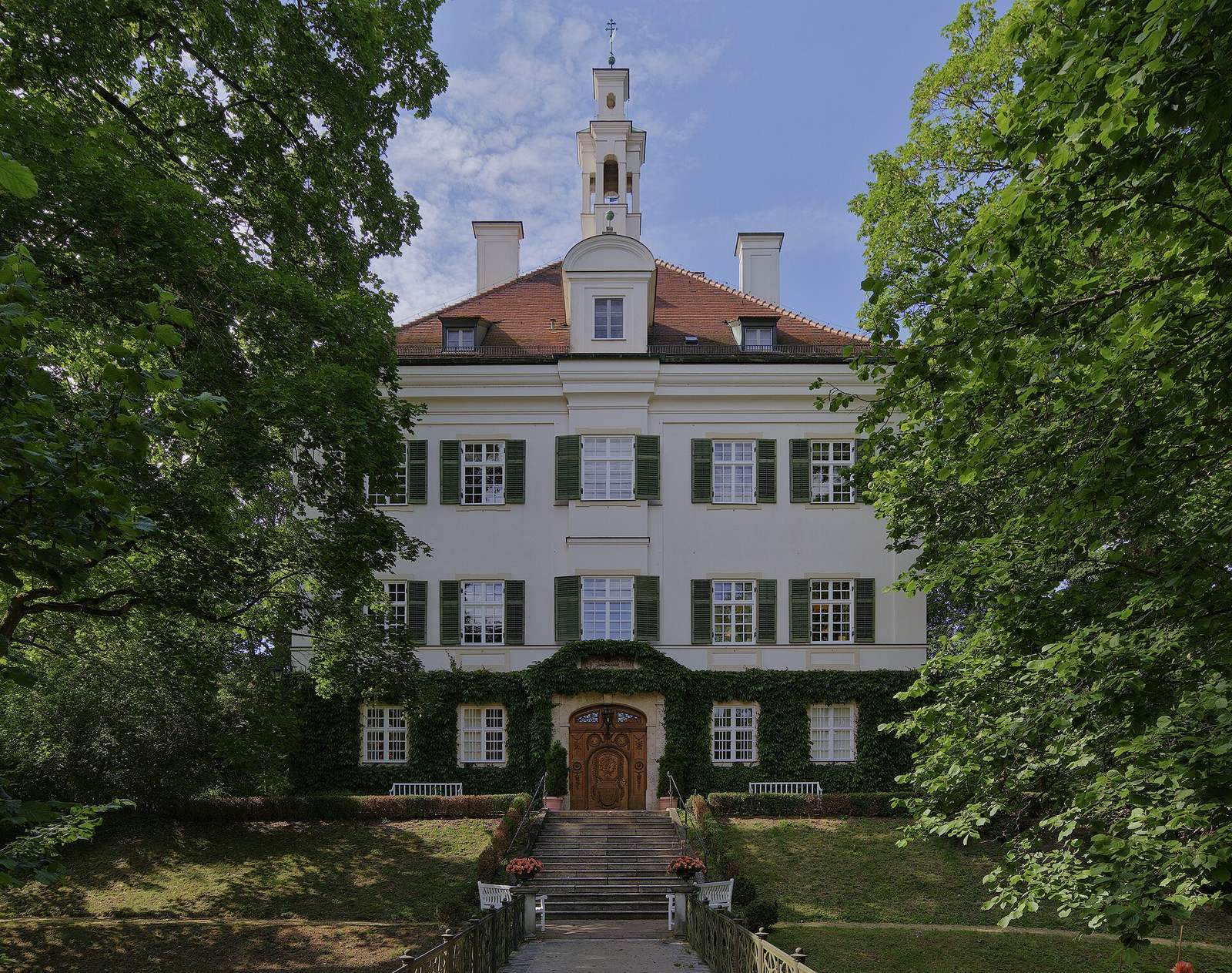
The present building has an almost square plan, three storeys, a tent-shaped roof, and a dormer. Its narrow central section projects slightly from the facade. The castle stands on an artificial hill, with a small bridge crossing the now-dry moat to an entrance reached by fifteen steps. Above the entrance, the Barons von Gravenreuth’s unicorn emblem is on the left and the Bavarian lion on the right. The carved wooden door dates to the late eighteenth or early nineteenth century and is said to have survived a fire in 1929.
The earlier castle and southern outbuildings
A 1568 image by Philipp Apian gives an indication of the earlier castle’s form: it had two storeys and a stepped-gable roof. An engraving by Michael Wening, made around 1700, shows the later castle with a chapel and outbuildings arranged along three sides of a square to its south. The southern outbuildings have survived. They were formerly used for carpentry, brewing, blacksmithing, and gardening.
Landscape and garden structures
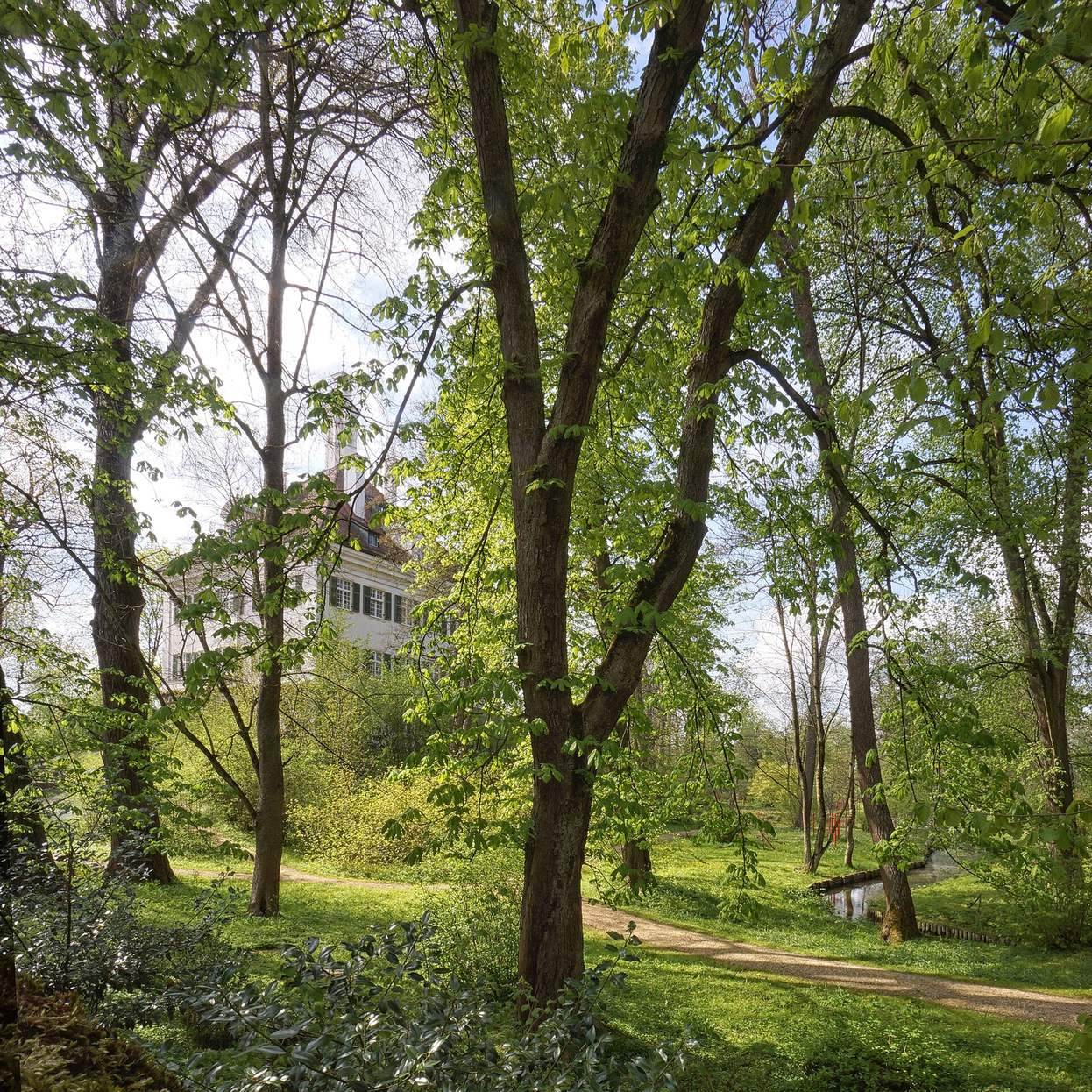
The castle stands at the southwestern edge of a large landscaped area. Its grounds include a stream, a pond, bridges, a boathouse, and a walled park.
Orangery
The nineteenth-century orangery sheltered delicate plants during winter and was enlarged in 1871. It retains old etched Bohemian glass panels. One wing has collapsed, and the Palm House roof is in precarious condition.
Grotto
Among the trees, the Countess of Boullion built a grotto in the nineteenth century and dedicated it to Our Lady of Lourdes, a Catholic title for the Virgin Mary associated with devotion to Lourdes.
Pavilion
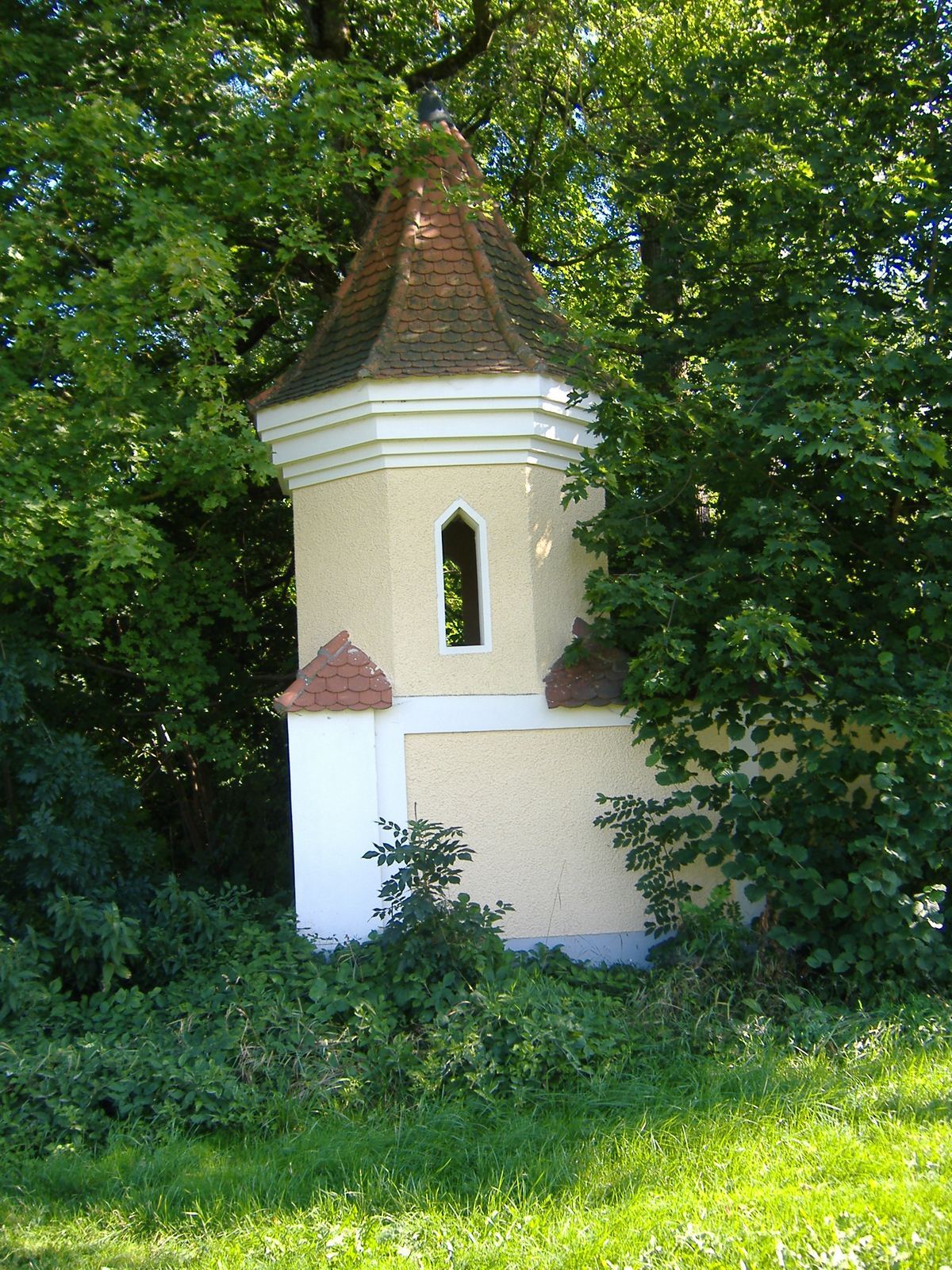
A small pavilion brought from the 1900 Paris Exhibition overlooks the great lawn.