Aigai: First Capital and Royal Center of Ancient Macedon
Site at a Glance
- Popularity
- Very High
- Country
- Greece
- Primary era
- Classical
- Eras represented
- Bronze Age, Iron Age, Classical
- Civilizations
- Kingdom of Macedon, Roman
- Site type
- City
On this page19 sections
History
Origins and the Macedonian kingdom
Aigai, in Greece, was the first capital of the ancient Macedonian kingdom and the royal center of the Argead dynasty. Macedonians were said to have settled in the Haliacmon plain from the tenth century BC, while tradition placed the dynasty’s beginnings around 750 BC. Alexander I is the first ruler of the dynasty known from historical evidence.
Several stories explained Aigai’s foundation. In one, the legendary Caranus followed a goat to establish the city. Another said that Perdiccas I acted on an oracle’s advice to build where white-horned goats rested at dawn. A tradition preserved by Justin gave Edessa as Aigai’s earlier name before Caranus captured it. Aigai was once mistakenly identified with Edessa.
During the seventh and sixth centuries BC, the Temenids, linked by tradition to the Argead line, extended Macedonian rule and subdued local populations. Aigai came under Persian imperial control between 513 and 480 BC, although King Amyntas I retained relative independence and expanded his territory. The city served as the Macedonian capital during the first half of the fifth century BC.
Royal court and sacred center
Aigai remained a modest urban center, with many inhabitants living in nearby villages and the built-up area formed from a group of settlements. The presence of the royal court brought greater wealth. Merchants supplied goods such as perfume, carved ornaments, and jewelry, while burial finds show connections with southern Greek cities including Athens and Corinth. They also point to an extensive metalworking industry. Philip II encouraged the city’s development.
At the end of the fifth century BC, King Archelaus I gathered artists, poets, and philosophers at his court. The tragedian Euripides wrote and presented his final plays at Aigai. In the early fourth century BC, Archelaus transferred the capital to Pella, but Aigai retained its sacred role. Traditional cult places, a royal palace, and the burial ground of the kings remained there.
In 336 BC, Pausanias of Orestis assassinated Philip II in Aigai’s theatre during the wedding of Philip’s daughter Cleopatra to Alexander of Epirus. Alexander the Great was proclaimed king at Aigai after his father’s death and established festive contests there.
Aigai continued as the burial place of Macedonian kings descended from Perdiccas, with Alexander the Great the exception. His body was intended for burial at Aigai, but Ptolemy I Soter took it to Memphis. In 276 BC, Gallic mercenaries serving Pyrrhus, a Hellenistic king, plundered many of the royal tombs.
Roman destruction and decline
After Rome overthrew the Macedonian kingdom in 168 BC, Aigai and Pella were destroyed. The city walls were pulled down and buildings burned. A landslide in the first century AD damaged parts of the settlement that had been rebuilt, although some people continued to live there. Between the second and fifth centuries AD, residents gradually moved from the foothills to the plain, leaving Aigai as a small settlement.
Rediscovery and preservation
Archaeological exploration began with Léon Heuzey in 1855. He returned in 1861 and excavated part of the site with the architect Honoré Daumet. K. Rhomaios continued investigations between 1938 and 1940. In 1968, historian Nicholas Hammond proposed that the remains near Vergina were Aigai. Manolis Andronikos resumed excavation in 1976 and identified the site, making major discoveries, including the royal tombs, in 1977. Work at individual burial areas and other parts of the settlement continued in later decades.
The archaeological site was added to the UNESCO World Heritage List in 1996 in recognition of its exceptional importance and architecture. Restoration work in the 2000s included a 16-year project on the palace, conserving and reconstructing architectural and mosaic elements.
Remains
Settlement and civic buildings
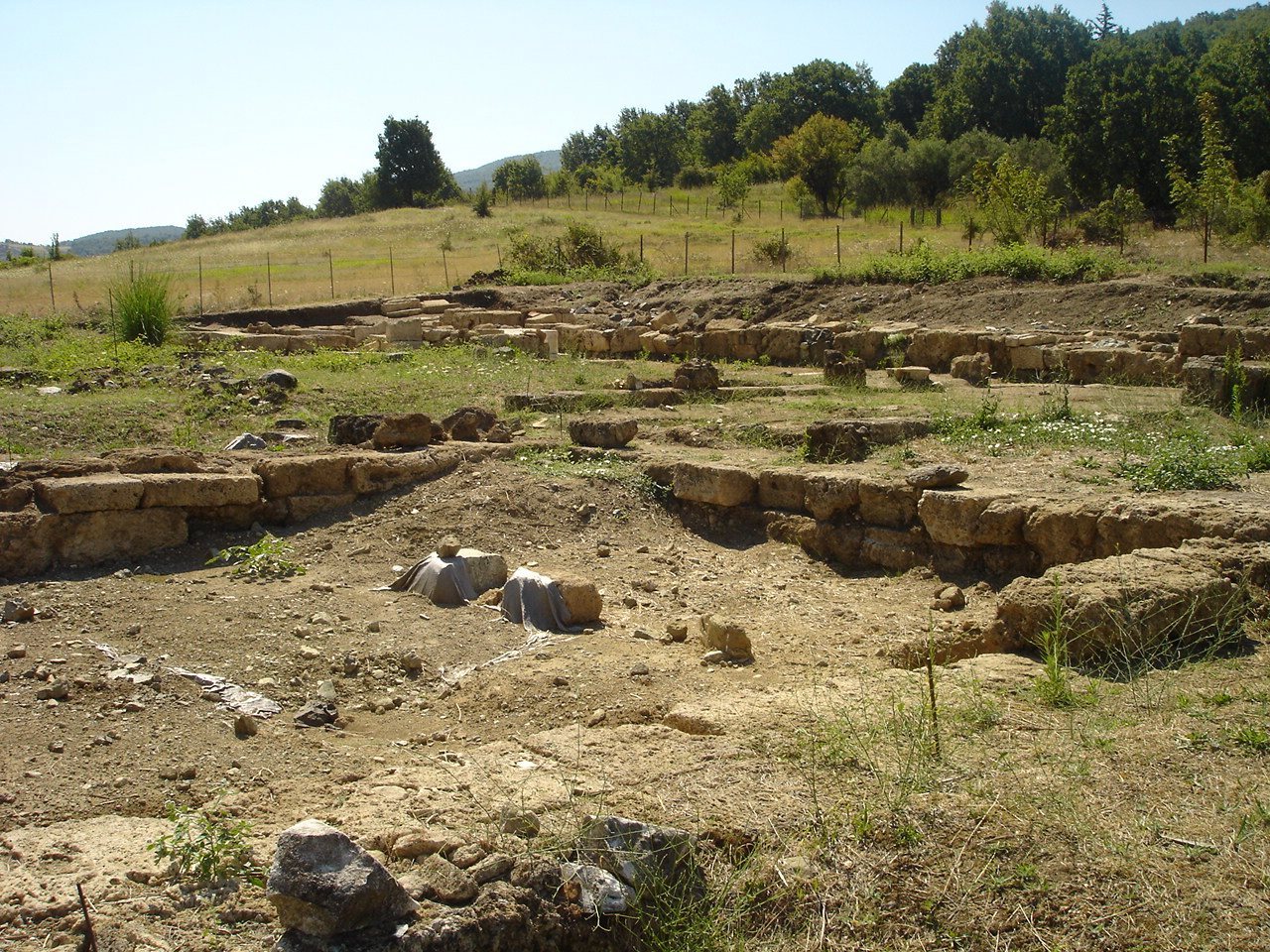
Aigai lies in the Haliacmon valley, on the foothills of the Pierian Mountains between modern Vergina and Palatitsia, overlooking the central Macedonian plain. Its built-up center formed part of a settlement group surrounded by villages. A walled high area stood at the center, with the palace below it on a plateau and the theatre close by.
Acropolis and city wall
The central fortified high ground was enclosed by a city wall built in the fifth century BC, probably under King Perdiccas II. Together, the wall and elevated position formed the defensive core of the settlement.
Palace
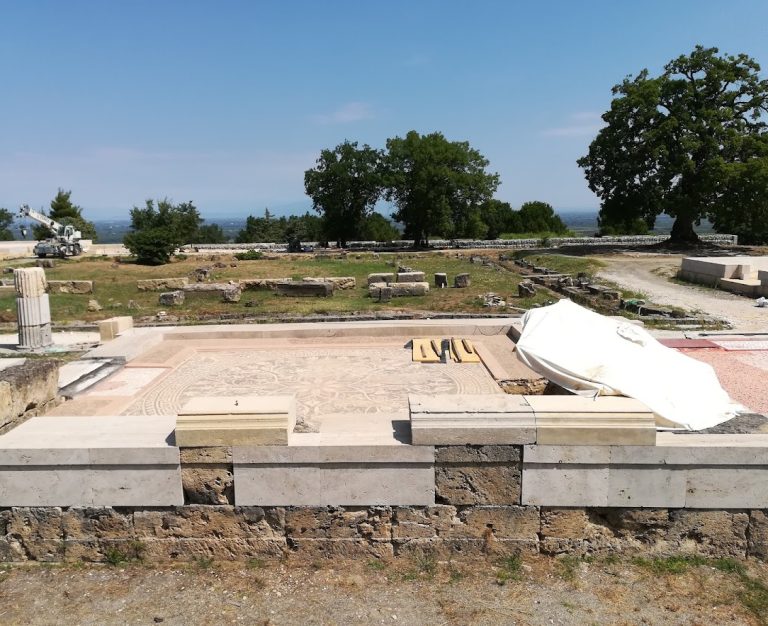
Philip II began building the palace around 350 BC, and it was completed in 336 BC. It covered about 12,500 square metres. The rectangular main building measured 104.5 by 88.5 metres and may have had two or three storeys. Around fifteen banquet rooms opened onto a central courtyard surrounded by Doric-style columns, a classical Greek column design. On the northern side, a long gallery looked out over the settlement, plain, and nearby theatre.
A column-ringed courtyard, or peristyle, on the west covered about 2,000 square metres and served public and practical purposes. It could seat about 3,500 people, showing that the palace was not simply a private royal residence. The principal entrance was a monumental structure, or propylon, ten metres wide in the middle of the eastern wing, with porticoes arranged in two levels.
The palace’s decoration included mosaic floors, painted plaster walls, relief tiles, and architectural elements finished with high-quality marble stucco. More than 5,000 square feet of mosaics have been conserved, including scenes of the abduction of Europa and designs drawn from nature. Nearly 30 large columns around the main courtyard have been reconstructed, some to about 25 feet high, along with the frieze on its southern side. A small round-building foundation was also found in the palace area. An inscription there may refer to a dedication to Heracles by Philip and Alexander, sons of Perseus.
Theatre
The theatre dates to the second half of the fourth century BC and stood close to the palace. It is the setting identified for Philip II’s assassination in 336 BC.
Sanctuary of Artemis Eukleia
The sanctuary contained two temples dating to the fourth and third centuries BC. One held statues thought to have been dedicated by Eurydice, Philip II’s mother. Her name appears on one of the statue bases.
A burial uncovered in the sanctuary in 2008 held the remains of an adolescent estimated to have been 15 or 18. An oak-leaf wreath of gold, dating to the second half of the fourth century BC, lay in a gold container inside a bronze water vessel. The wreath was associated with purple-and-gold cloth. The occupant is unknown but may have been an illegitimate son of Alexander the Great and Barsine, killed in 309 BC on the orders of Polyperchon. A nearby burial contained badly damaged remains in a silver Panathenaic amphora, a prize vessel associated with the Panathenaic Games.
Royal burial grounds
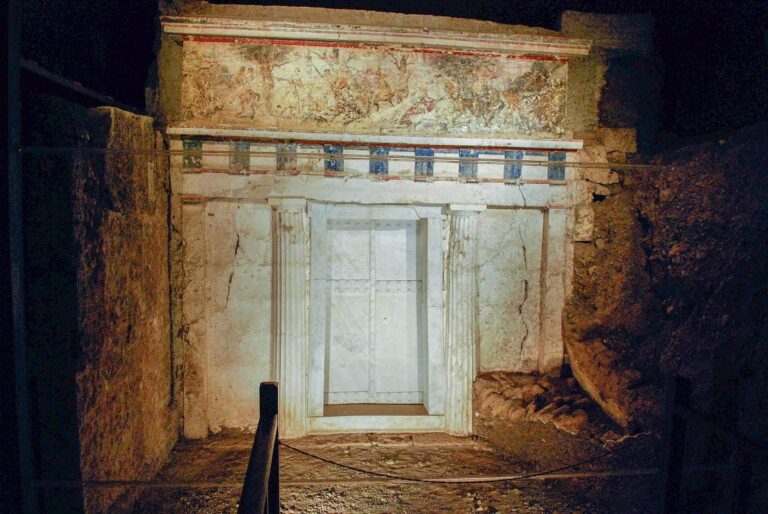
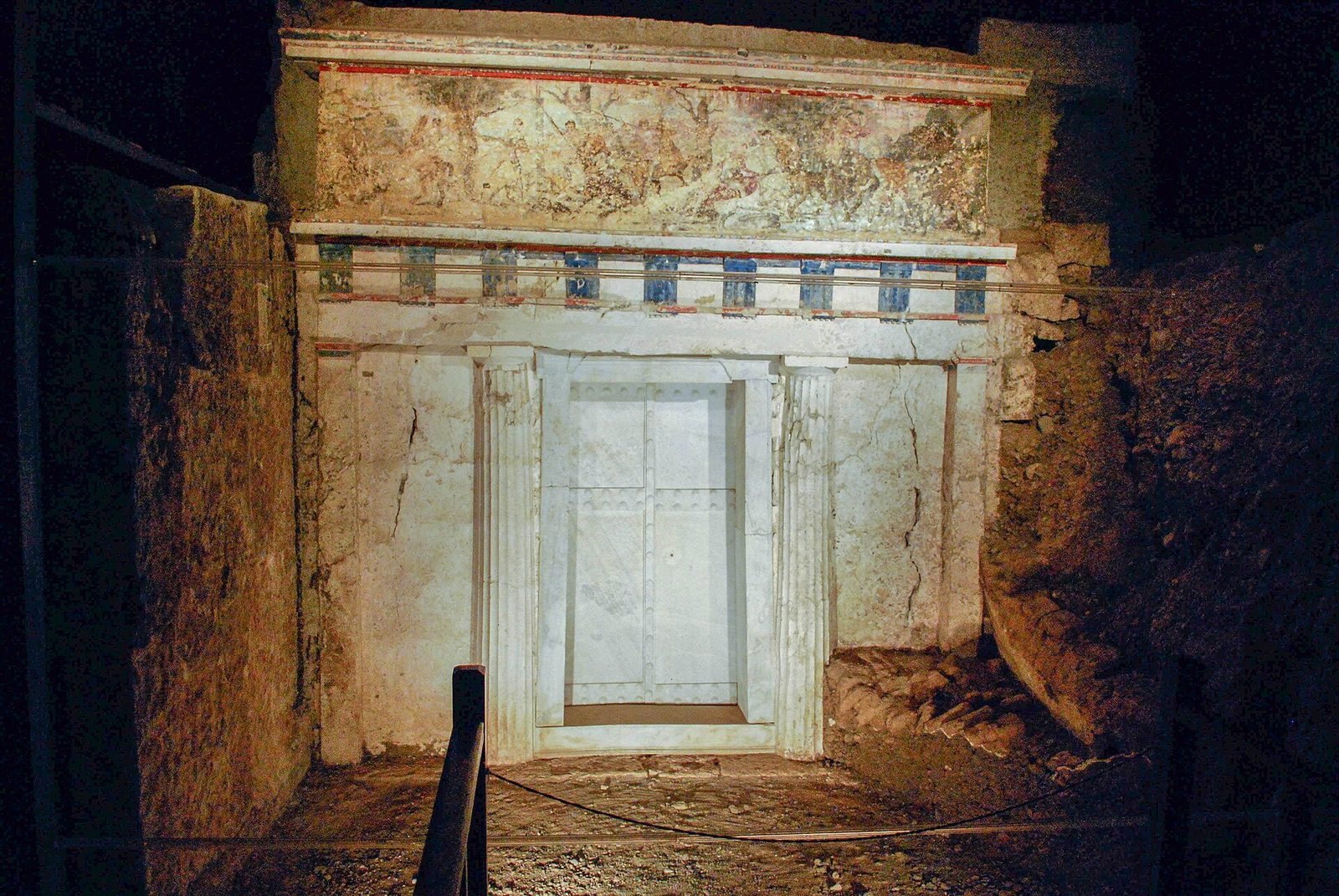
The burial area contains more than 300 chambers, and some of its earthen burial mounds, or tumuli, date as far back as the eleventh century BC. The largest mound, the Great Tumulus, measures about 100 metres across and contains four tombs, including those conventionally called the Tomb of Philip II, the Tomb of Persephone, and the Tomb of the Prince. Macedonian royal tombs commonly had a burial chamber and entrance vestibule, imposing marble doorways, painted fronts, and columns beside their entrances.
Tomb II, conventionally identified as Philip II’s
Tomb II in the Great Tumulus has a vestibule and a burial chamber beneath a curved, tunnel-shaped roof known as a barrel vault. Its decorative façade was not structurally joined to the rest of the tomb. A gold container for human remains in the vestibule held a woman’s remains, while another in the main chamber held a man’s. The tomb contained armor, a shield, lower-leg guards, a bow-and-arrow case, a gold wine jug, a gold oak-leaf wreath, a gilded myrtle wreath, a diadem, and carved ivory figures. The gold containers carried the star-like emblem known as the Vergina Sun.
The tomb is usually identified as Philip II’s, although some scholars have proposed that it held Philip III. The man’s skull had an injury above the right eye resembling the wound Philip received in 354 BC, and one pair of lower-leg guards was of unequal length, consistent with Philip’s lameness. In 2015, paleoanthropologist José-Luis Arsuaga argued that features of the remains in Tomb I fit Philip II better.
The tomb’s white-ground painted band, or frieze, is about 1.1 metres high and shows ten hunters, three on horseback, pursuing a lion, boar, bear, and deer. The first rider is identified as Philip II and the second as his son Alexander. This arrangement has been interpreted as a statement of Alexander’s claim to the throne. Alternating diagonal and upright lines direct attention towards the lion hunt at the center. The painting is dated to 336 BC and has been attributed to the early work of Philoxenus of Eretria.
Tomb I, the Tomb of Persephone
This stone-lined grave chamber, or cist tomb, measures 3.5 by 3 by 2 metres and dates to the third quarter of the fourth century BC. It may have been plundered in antiquity. A wall painting of Persephone’s abduction by Hades gives the tomb its familiar name. The scene is distinguished by rapid brushwork and varied pictorial effects. It has been attributed to the mature work of Philoxenus, although the ancient testimony of Pliny the Elder has also prompted an attribution to Nicomachus.
The tomb held the remains of a young man in a silver water vessel used as a funerary container, as well as a varied collection of silver vessels. A well-preserved painted band shows a chariot race.
Tomb of the Prince
The Tomb of the Prince is very likely to have been the burial place of Alexander IV, son and heir of Alexander the Great. Its archaeological date is about 330 to 290 BC. The age of the deceased, who may have been around thirteen, is consistent with the identification. Alexander IV and his mother Roxane were killed in 311 or 310 BC.
Throne tomb
Found in 1987, this separate tomb has an exceptionally large vaulted chamber and a painted marble throne. The throne’s back shows a couple in a chariot drawn by four horses. The figures may represent a royal couple, but the scene is more likely to show Hades carrying off Persephone. The tomb had been plundered in antiquity. Andronikos attributed it to Eurydice, Philip II’s mother.
Woman’s tomb
An undisturbed woman’s tomb discovered in 1988 dates to about 540–470 BC. The deceased was in her thirties and may have been a wife of Amyntas I. Her grave goods included a gold diadem; clothing and shoes with numerous gold inlays; gold clasps, pins, earrings, bracelets, and necklaces; fine vessels; and about six clay statuettes. A bowl bore the oldest inscription found in the burial ground. The grave also held a wooden scepter inlaid with ivory and amber.
Other excavated tombs
The Rhomaios tomb, discovered in 1937, is an underground Macedonian-style tomb covered by a burial mound and dating to the third century BC. The Heuzey tomb, also called the Tomb of Palatitza, was the first burial at Vergina to be scientifically excavated. It is a Macedonian-style tomb with an Ionic-style crowning feature on its façade. Heuzey A is an underground woman’s tomb from the reign of Alexander the Great. Heuzey B, a somewhat later stone-lined grave, held a man’s remains. Both tombs were found in 1998–1999.
Three tombs found in 2012 included a well-preserved but plundered stone-lined grave and an unusual column-supported tomb. A gold acorn from a wreath was found in the grave, and a coin of Perdiccas II came from a nearby funerary temple. Two further plundered stone-lined graves discovered in 2013 contained objects dating to the late fifth century BC, including an iron sword. In November 2014, an exceptionally undisturbed, box-shaped Macedonian tomb was found with offerings that included a mixing bowl and a gilded bronze wreath. It was attributed to a young man who died around 336–323 BC.
Royal Tombs museum
The Royal Tombs museum occupies the artificial mound above the royal burials, allowing the tombs to be displayed in their original positions. A further exhibition building for later discoveries opened in 2022 as part of the polycentric museum of Aigai.