Tigranakert of Artsakh: An Armenian Hellenistic City in Azerbaijan
Site at a Glance
- Popularity
- High
- Country
- Azerbaijan
- Primary era
- Classical
- Eras represented
- Classical, Medieval
- Civilizations
- Armenian, Caucasian Albania
- Site type
- City
On this page20 sections
History
Tigranakert of Artsakh was an Armenian city near Shahbulag in Azerbaijan, founded during the Hellenistic period. This era followed Alexander the Great’s conquests and preceded Roman domination in the eastern Mediterranean and Near East. The city’s foundation is placed around 120–80 BCE, during the reign of either Tigranes I or his son Tigranes II. Its name means “built by Tigran,” and tradition links it to Tigranes II, also called Tigranes the Great, king of Armenia from 95 to 55 BCE. That attribution remains uncertain and rests partly on the local place-name. The name was shared by several cities, and Tigranakert of Artsakh has sometimes been proposed as the earliest.
Foundation and ancient geography
The city was associated with Artsakh, a province of the ancient Kingdom of Armenia, and from the late fourth century came within Caucasian Albania, an ancient kingdom in the South Caucasus. Archaeological interpretations place the city itself in Utik, near the boundary with Artsakh. They distinguish it from a separate fortified settlement of the same name in Artsakh.
Seventh-century references
The seventh-century Armenian historian Sebeos refers to two places called Tigranakert in Utik. His account of a Byzantine–Sasanian campaign around 625–627 describes Shahrbaraz, a senior Sasanian commander, camping with his Persian force at one of them. A second force of 30,000 troops camped at a fortified settlement called Tigranakert behind Emperor Heraclius. The Byzantine Empire was the eastern Roman state, while the Sasanians ruled a Persian empire. The campaign ended in a Sasanian defeat. The second Tigranakert is thought to have been in Gardman.
A monk from a monastery associated with Tigranakert is also named among the clergy of Caucasian Albania who opposed the Chalcedonian position, Christian doctrine defined at the Council of Chalcedon in 451. The excavated basilica at the city has been proposed as the church where he served.
Medieval occupation and abandonment
Tigranakert declined in the early Middle Ages, but occupation continued. The central citadel, a fortified enclosure, was densely settled in the twelfth and thirteenth centuries, and finds indicate activity into the fourteenth century. The city became deserted during the Mongol invasions, apparently after a period of continued settlement. A form of its name, Tarnakert, persisted in local geographic usage after the city’s decline.
Shahbulag and the search for the city
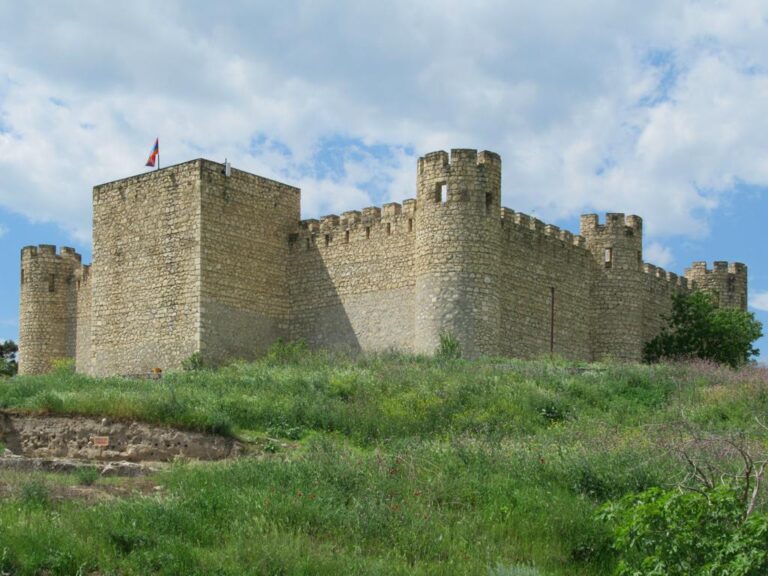
In the mid-eighteenth century, Panah Ali Khan, founder of the regional Karabakh Khanate, built Shahbulag Castle beside the Shahbulag spring near the ancient ruins. Construction was completed in 1751/52. Hamlet Petrosyan later proposed that stones from the basilica had been reused in the castle.
In the mid-nineteenth century, an Armenian visitor associated the area around the spring with Tigranakert, a location also supported by a researcher of Karabakh antiquities in the Khachen River valley. A different proposal followed the discovery of an inscribed stone coffin lid about six kilometres from Shahbulag in the 1950s, where a large settlement was excavated. The Azerbaijani archaeologist leading that work instead supported a location near Aghdam proposed by an Armenian scholar.
Excavation and recent history
Archaeological investigations began in March 2005 after the ruins were identified as Tigranakert. A 15-day excavation followed in 2006. The Institute of Archaeology and Ethnography of the National Academy of Sciences of Armenia, led by archaeologist Hamlet Petrosyan, carried out further work through 2020, with broader excavations beginning in 2008. In 2008, the government of the self-proclaimed Nagorno-Karabakh Republic declared the site a state reserve. A museum devoted to finds from the site opened in Shahbulag Castle in 2010.
After the First Nagorno-Karabakh War, Armenian forces controlled the site, which became part of the self-proclaimed Republic of Artsakh. During the 2020 Nagorno-Karabakh war, Petrosyan stated that Azerbaijan shelled the site several times. Under the November 2020 ceasefire agreement, the Aghdam District, including Tigranakert, was transferred to Azerbaijan. Some artifacts were removed from the area before the transfer.
Remains
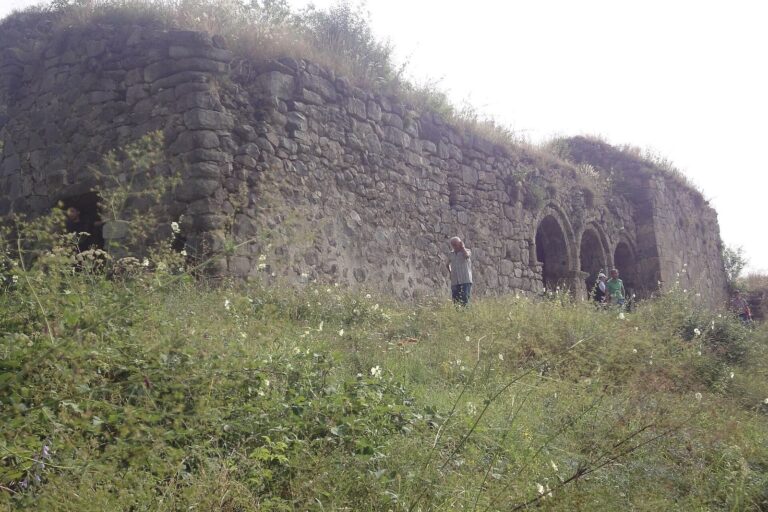
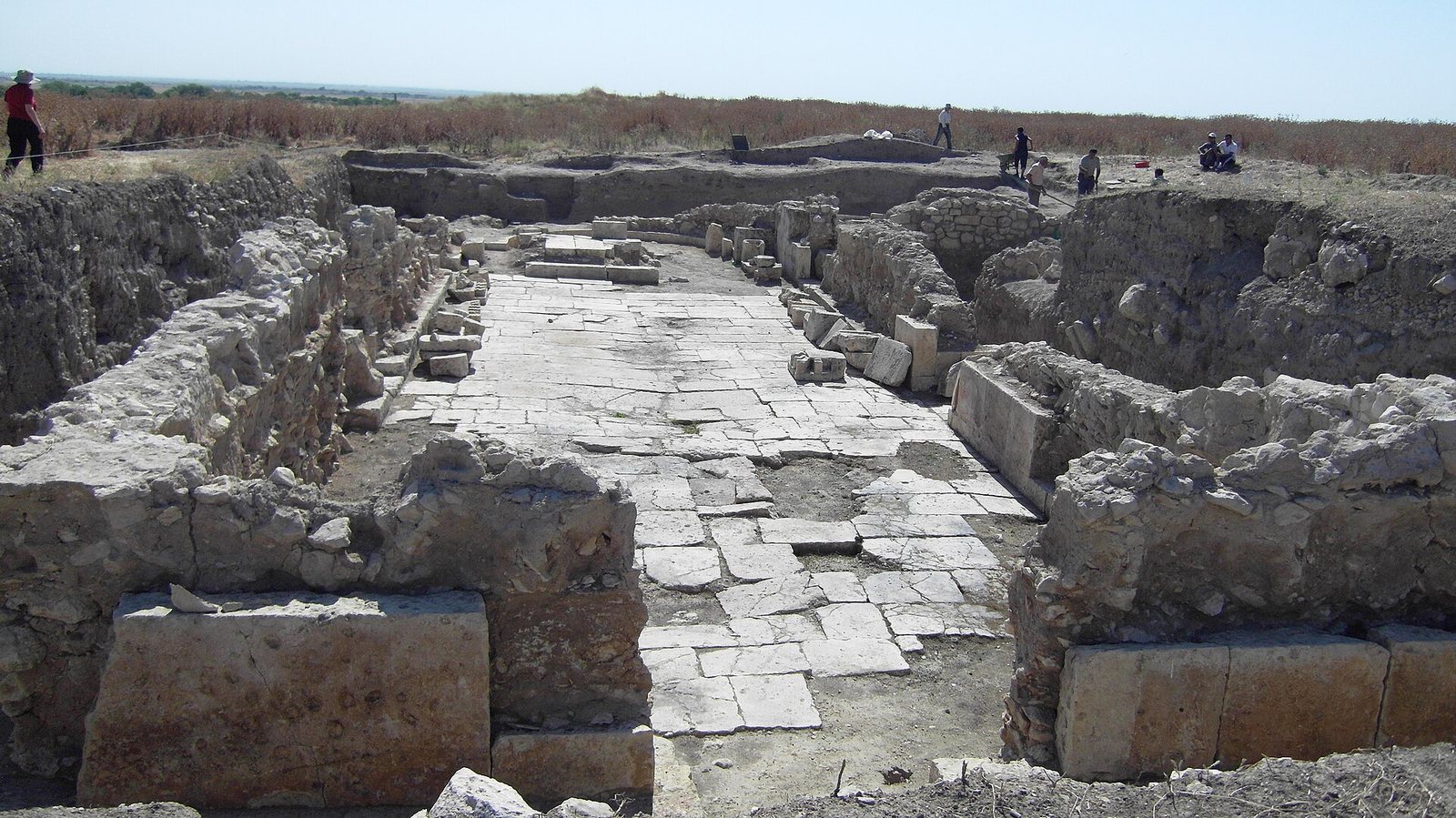
The archaeological site covers about 50 hectares on the slopes of Mount Vankasar, roughly four kilometres south of the Khachinchay River. Its steep ground was shaped with cut terraces, and limestone was among the city’s building materials. The reported plan has three parts arranged in a triangle: an upper area with palaces, a central quarter, and a lower walled district called the Acropolis, a fortified precinct of an ancient city. The Acropolis stood beside a large spring that supplied the population. Surveys in the Khachinchay valley identified groups of ruins on both banks of the river.
City layout and fortifications
Walls and towers
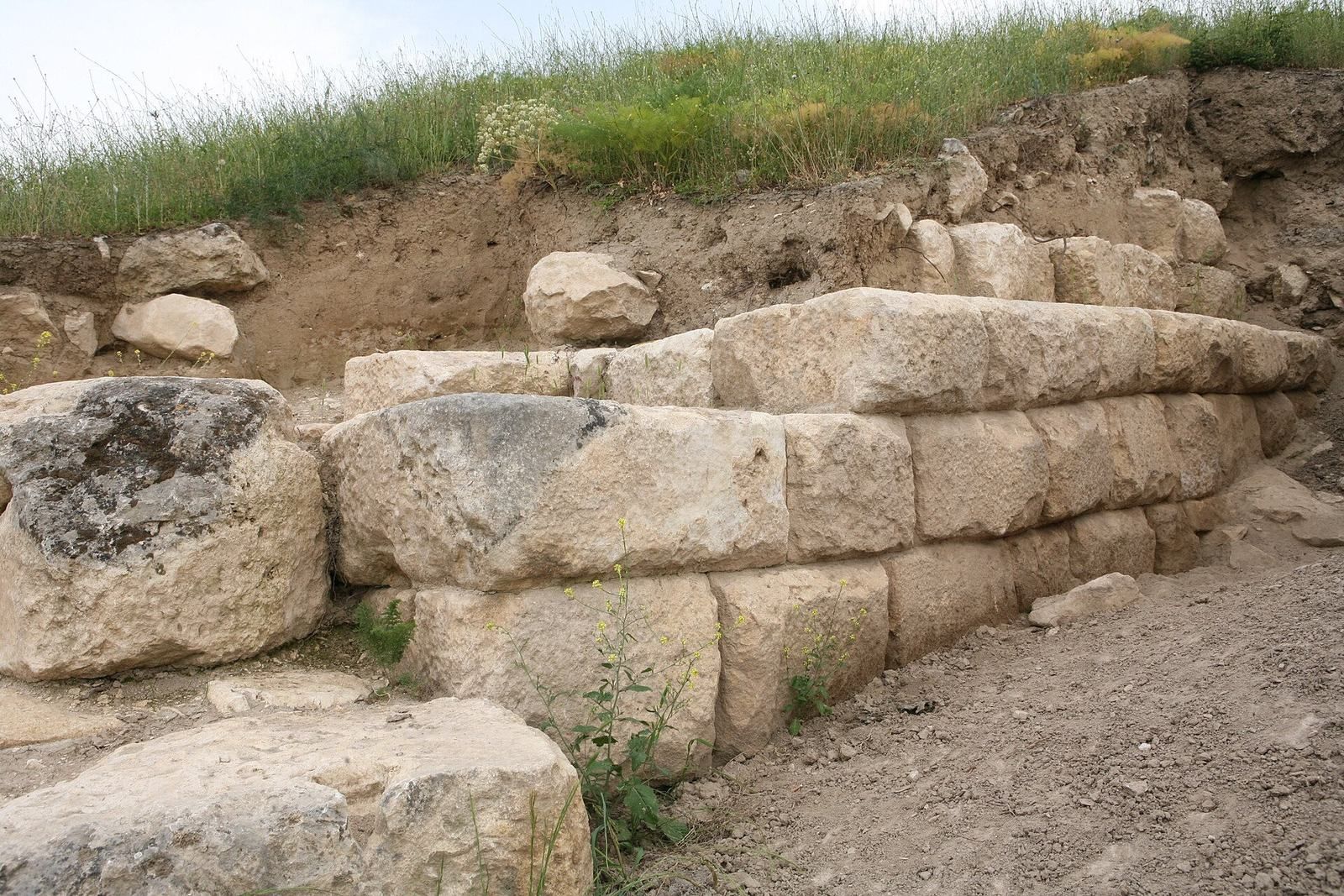
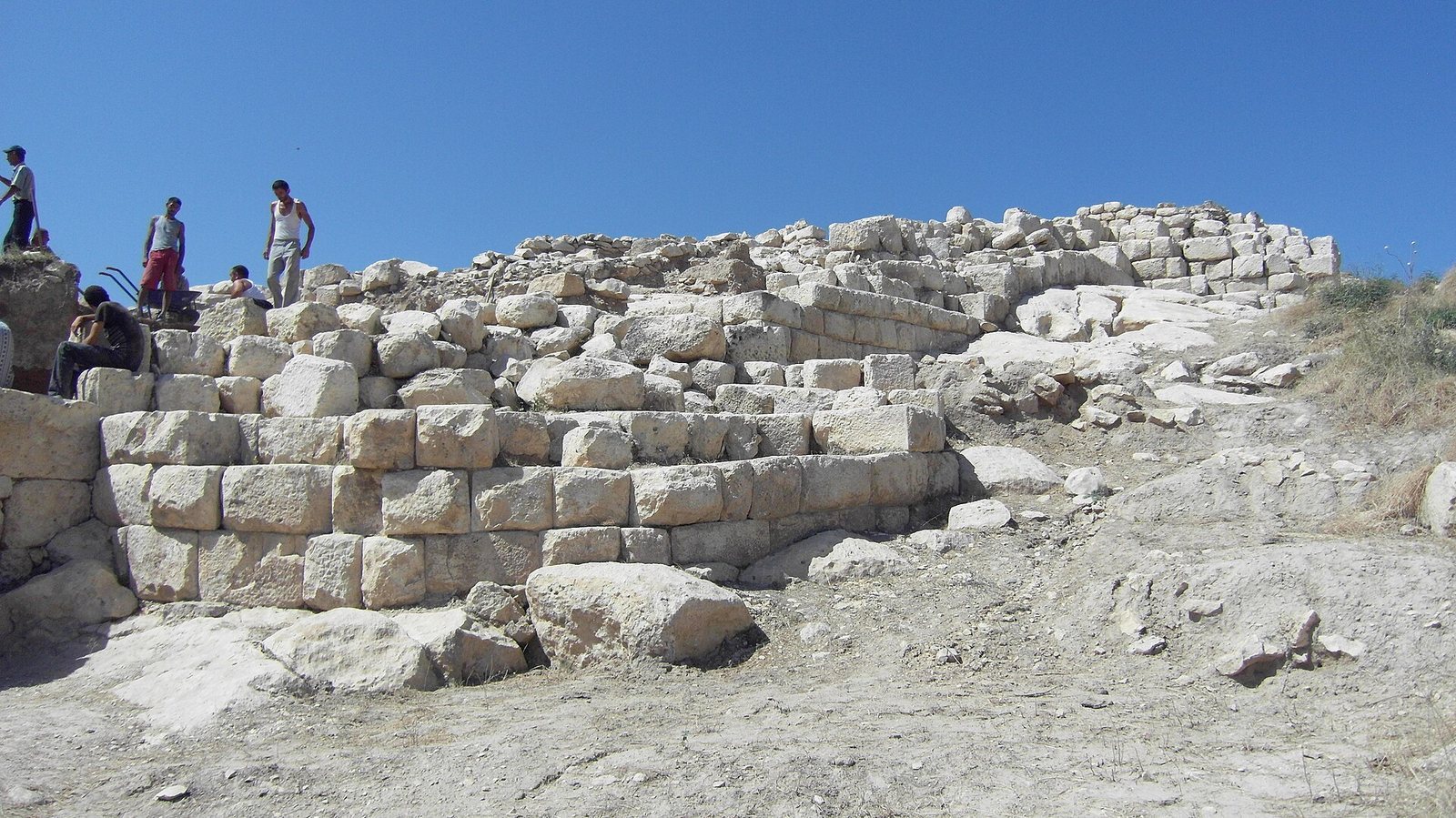
Excavations exposed two principal city walls, built as heavy stone defenses with dressed blocks and Hellenistic-style towers. The foundation of the southern wall was traced for 450 metres, while a 40-metre stretch of the northern wall was exposed in 2008. A wall foundation also continues uphill along Mount Vankasar. One round tower, made from smoothly dressed stone, measures more than nine metres across and has been associated with the defensive architecture of Tigranes the Great’s era.
Mountain fortification
A separate fortified structure stands on a mountain above the left bank of the Khachinchay. Its remains include a wall 3.5 metres wide, an entrance, and part of a tower.
Religious and burial remains
Basilica and dedication stone
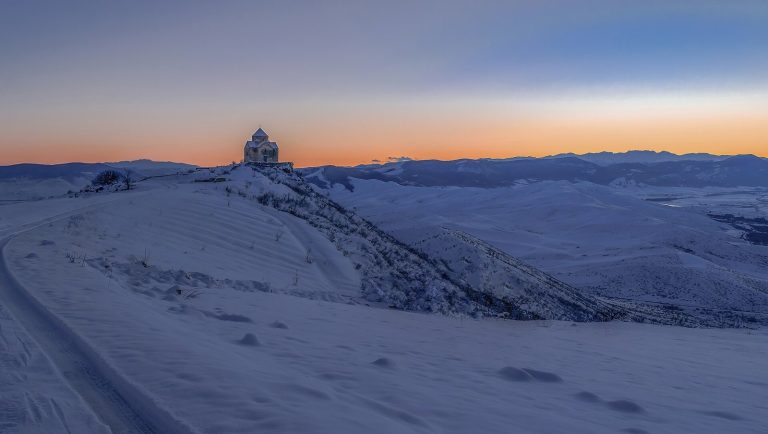
The early Christian basilica was cross-shaped and measured 21 metres long. It was found three metres below ground and is dated to the fifth or sixth century, or more broadly to the fifth through seventh centuries. Its large dressed blocks were fitted without mortar, a dry-stone building method, and entrances opened on its north, south, and west sides. On a paved floor among the ruins, excavators found a small stone disc about eight centimetres across. It bears an Armenian dedication reading, “I, Vache, servant of God.” The inscription’s Vache has not been securely connected to a particular historical person.
Cemeteries and cross-stones
The site includes two cemeteries, burial mounds, stone sculptures, and early Christian tombstones marked with crosses. Excavations also recovered ten khachkars, Armenian carved stones bearing crosses and often serving as religious monuments or memorials. A separate cross-stone fragment, found away from the central quarter and dated to the twelfth or thirteenth century, has been interpreted as evidence that the settlement remained Armenian and Christian at least until the Mongol invasion.
Rock-cut places
Rock-cut ritual structures and caves form another part of the site, including places used for Christian worship.
Water, inscriptions, and finds
Water channel
Near the Khachinchay, a water channel was identified as a feature built to carry water to the city.
Inscriptions and written material
Armenian and Greek inscriptions dated to the fifth through seventh centuries are associated with the city walls. Pottery bearing Armenian writing has also been found among the ruins.
Pottery and household objects
Excavations recovered abundant pottery from the first century BCE, including examples characteristic of its first half. Finds within the fortifications include first-century BCE and first-century CE oil jars, jugs, and plates, some of them intact. The southern and western areas also yielded ordinary and painted pottery, together with glass fragments.
Metal objects, coins, and seal gem
A complete iron shovel from the ninth century was recovered, as were fragments of an iron cross dated to the eleventh or twelfth century. Excavations in 2008–2010 produced silver coins of Mithridates IV and Orodes II, kings of the Parthian Empire, an Iranian power that preceded the Sasanians. A gem found in the citadel in 2009 depicts an eagle attacking a deer. Since gems served as seals, it has been interpreted as evidence of the city’s administrative importance.
Shahbulag Castle and settlement
The remains of Shahbulag Castle lie beside the spring, close to the ancient city. Its associated settlement included houses, a mosque, baths, and rows of markets. Petrosyan’s proposal that stone from the basilica was used in the castle links the later complex to the earlier city.