Burg Kreuzenstein: A Neo-Romantic Castle and Museum in Austria
Site at a Glance
- Rating
- 4.5
- Popularity
- Medium
- Country
- Austria
- Primary era
- Modern
- External website
- Open
- Eras represented
- Medieval, Modern
- Civilizations
- Holy Roman Empire
- Site type
- Military
- Remains
- Castle
On this page16 sections
History
Burg Kreuzenstein is a castle and museum in Austria near Leobendorf, with origins in the twelfth century and a present form shaped by a nineteenth-century neo-Romantic rebuilding. First erected around 1100–1200 by the Counts of Formbach, it occupied a hill above the Danube and later became associated with the Habsburg dynasty.
Medieval origins and Habsburg possession
The castle passed to the Counts of Wasserburg through marriage. In 1278, it came into Habsburg possession through Ottokar II of Bohemia, a thirteenth-century king whose territorial power extended into the Austrian lands. The medieval fortress retained its defensive importance for centuries and had never been conquered before the Thirty Years’ War, the major European conflict fought from 1618 to 1648.
Hubmaier’s imprisonment
In July 1527, the Anabaptist preacher Balthasar Hubmaier was brought to Kreuzenstein after his arrest at Mikulov in Moravia. Anabaptists were members of a sixteenth-century Christian movement that rejected infant baptism and emphasized baptism in adulthood. Hubmaier was interrogated at the castle but refused to renounce his beliefs. He was burned at the stake in Vienna on 10 March 1528.
Swedish occupation and destruction
The castle was taken during the Thirty Years’ War in 1645. Swedish forces under Field Marshal Lennart Torstensson occupied Kreuzenstein after Colonel Lukas Spicker, who commanded both Kreuzenstein and the fortress of Korneuburg, surrendered the two strongholds without a fight on 5 April.
When the main Swedish force withdrew toward Moravia in September, Torstensson ordered Kreuzenstein to be blown up at three locations, possibly four. The ruined fortress was later dismantled by local farmers, who reused its building material.
The Wilczek rebuilding
The Counts of Wilczek acquired the ruins in the eighteenth century. From 1874, Count Johann Nepomuk Wilczek, an Austrian count, art collector, and polar explorer, financed and directed a rebuilding on the medieval site. He intended the castle to house his extensive art collections and to serve as a family crypt.
The project lasted approximately thirty years and was completed under the direction of Carl Gangolf Kayser until his death in 1895, followed by Humbert Walcher von Molthein and the artist Egon Rheinberger. Fritz von Herzmanovsky-Orlando worked at the castle in 1904–05 as an associate of Walcher von Molthein. The rebuilt castle officially reopened on 6 June 1906.
Kreuzenstein was conceived as a neo-Romantic model castle, meaning an idealized medieval-style building rather than a literal reconstruction of one specific medieval structure. The work incorporated surviving medieval fabric as well as original architectural components that Wilczek purchased and assembled from different parts of Europe. A family crypt was built beneath the chapel, and Johann Nepomuk Wilczek was buried there. The Wilczek family continues to own the castle, with Johan-Christian Count Wilczek identified as its current owner and holder of the title.
Fire, wartime damage, and modern use
A lightning strike caused a fire in 1915 that partially destroyed the archive and library wing. In 1945, fighting between the German Wehrmacht and the Red Army severely damaged several rooms, while many objects from the collection were stolen. Some Wilczek manuscripts are now held by the Austrian National Library.
The castle functions as a museum and has undergone partial restoration after the fire and wartime destruction. In 2013, it became the titular home of the Lazarus Union Knighthood of Honour, a modern chivalric organization. Kreuzenstein also has a notable connection with film production. Max Reinhardt filmed parts of The Miracle there in 1912, and Mario Bava later used the castle for Baron Blood in 1972.
Remains
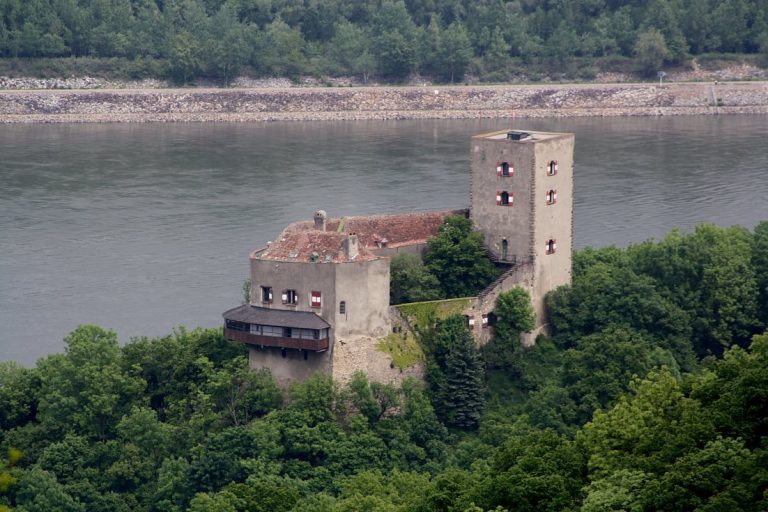
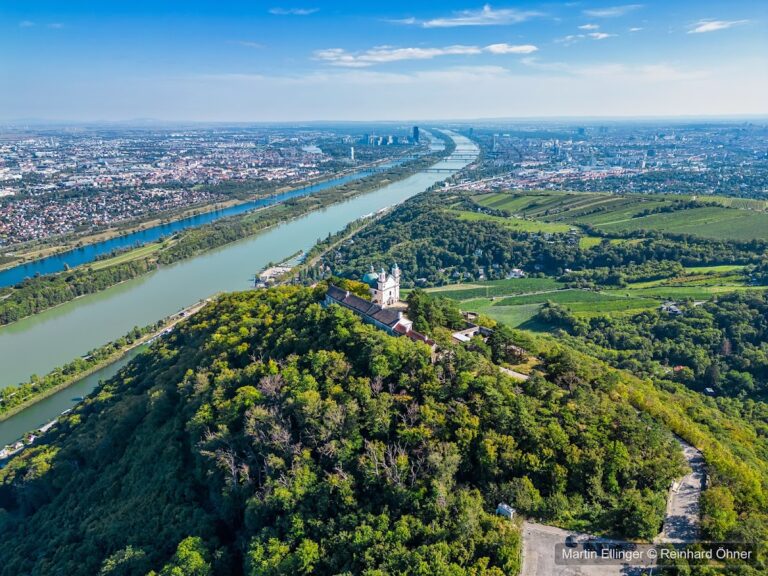
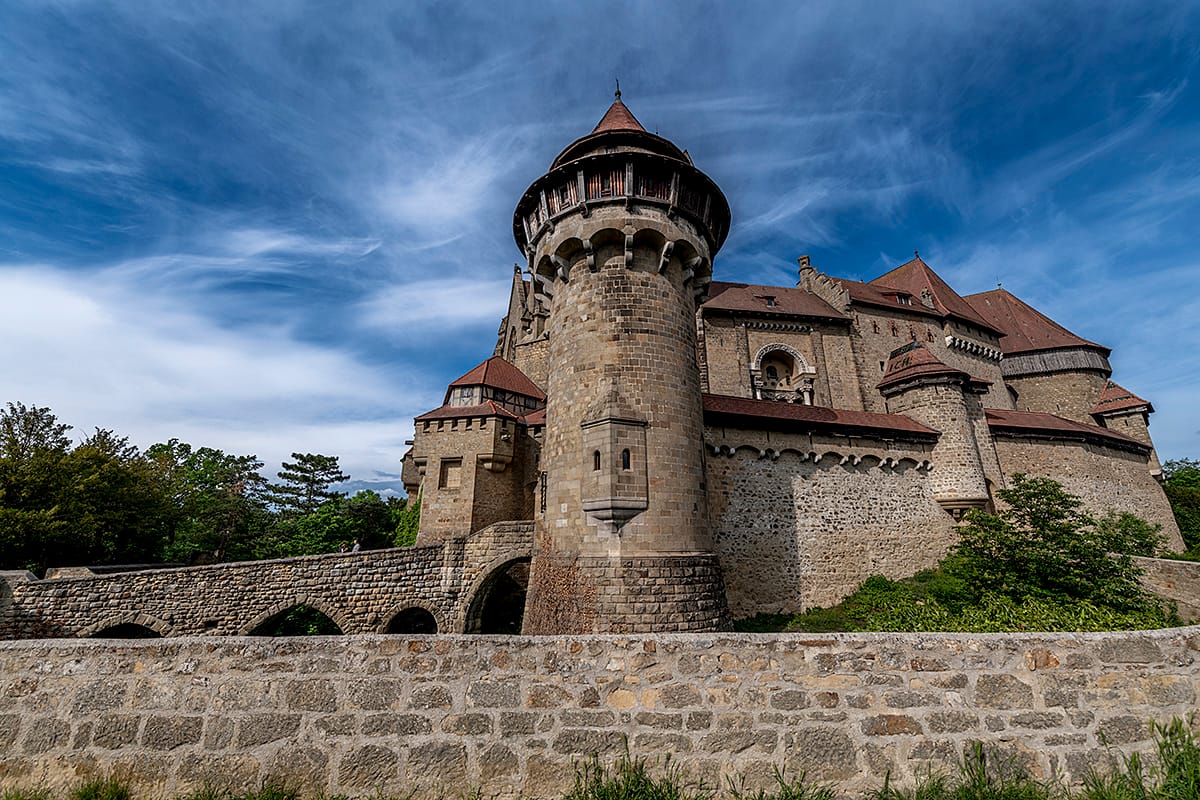
Burg Kreuzenstein stands on a hill in the Rohrwald directly above Leobendorf, between Korneuburg and Stockerau and north of the Danube. At approximately 266 metres above sea level, it rises about 100 metres above the river near the Danube water gap known as the Wiener Pforte. Its position provides views over the river and the Korneuburg Basin, while Burg Greifenstein stands on the opposite, southern bank.
Hilltop plan and defensive envelope
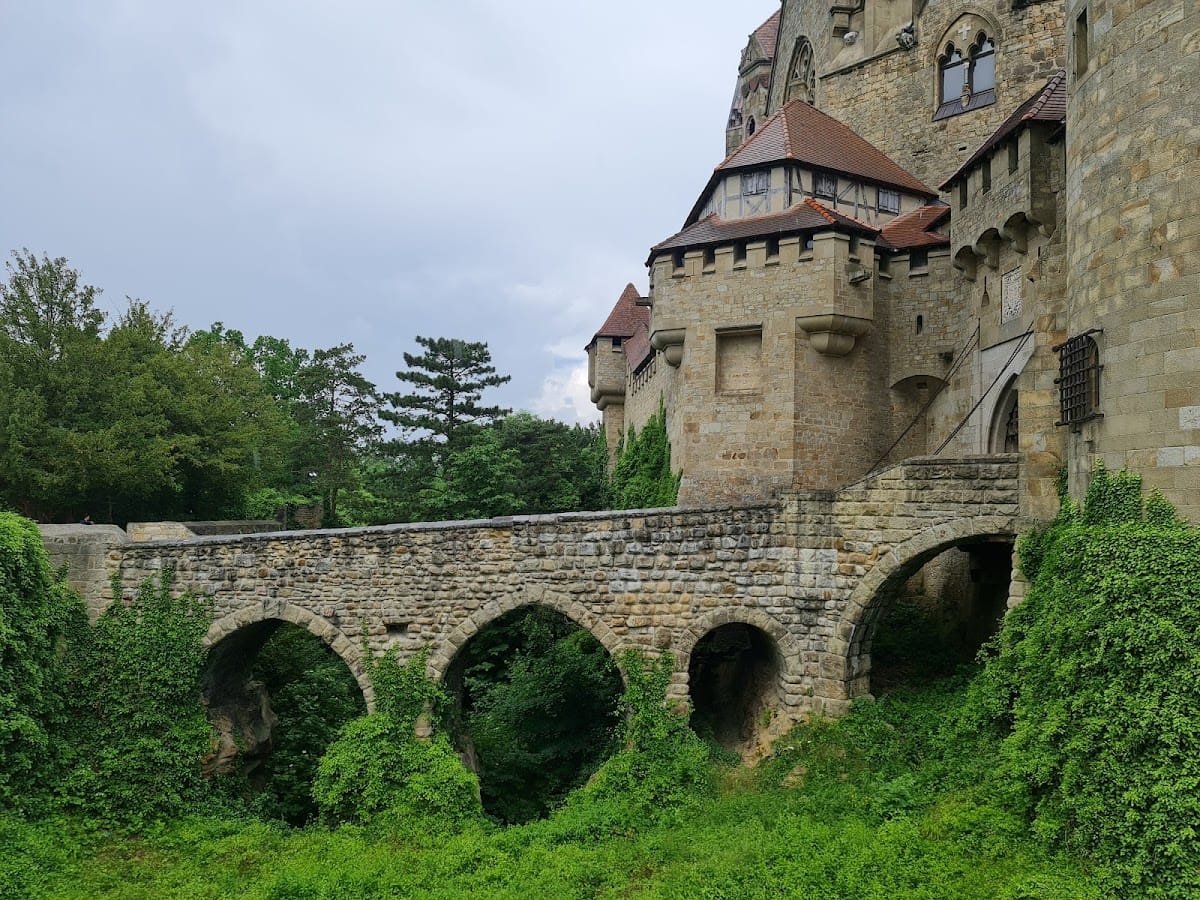
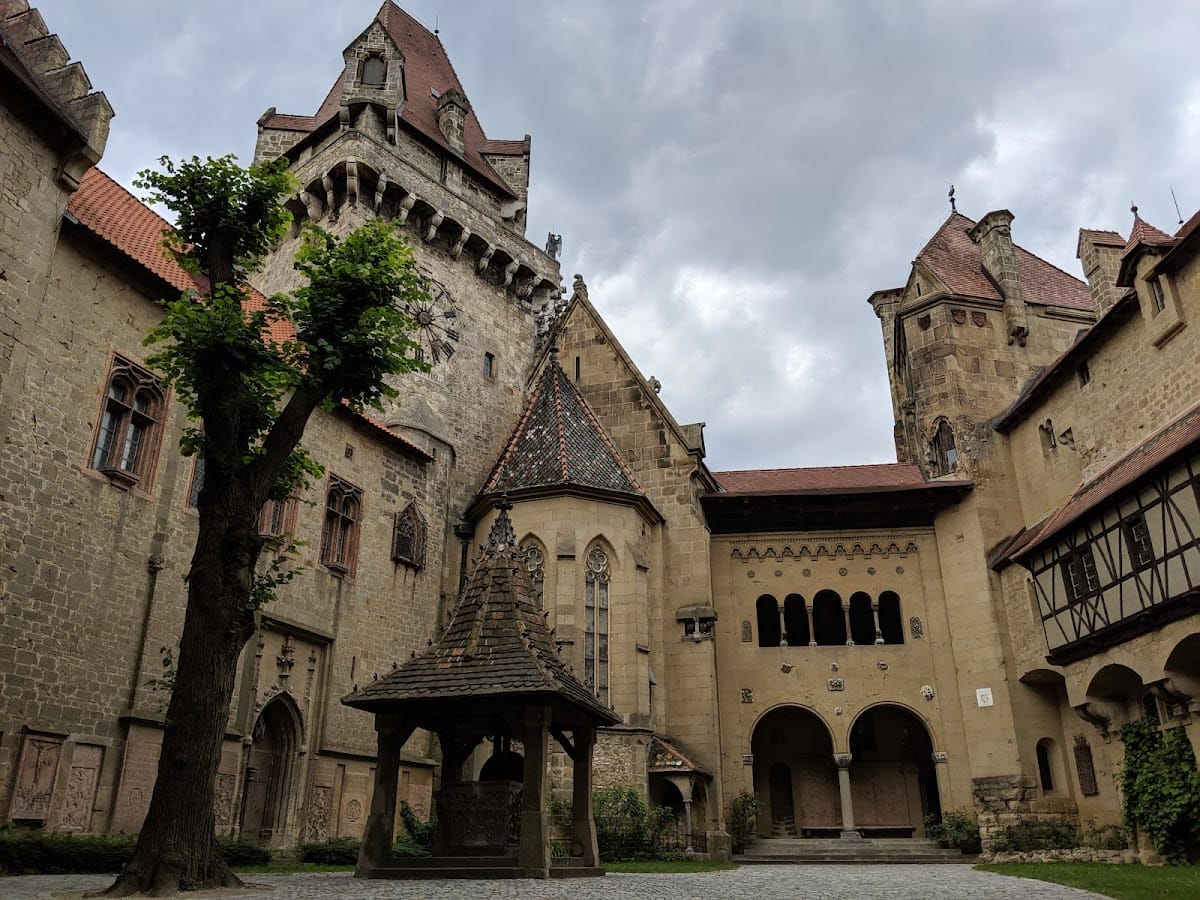
The castle follows a ring-shaped plan around a central courtyard, laid out on the ground plan of the medieval fortress. Towers of different heights, residential buildings, a moat, and a defensive wall form the principal enclosure. Exposed stonework gives the complex a strongly medieval appearance, while surviving medieval masonry can generally be distinguished from the nineteenth-century additions. Reused medieval material remains visible in several parts of the structure.
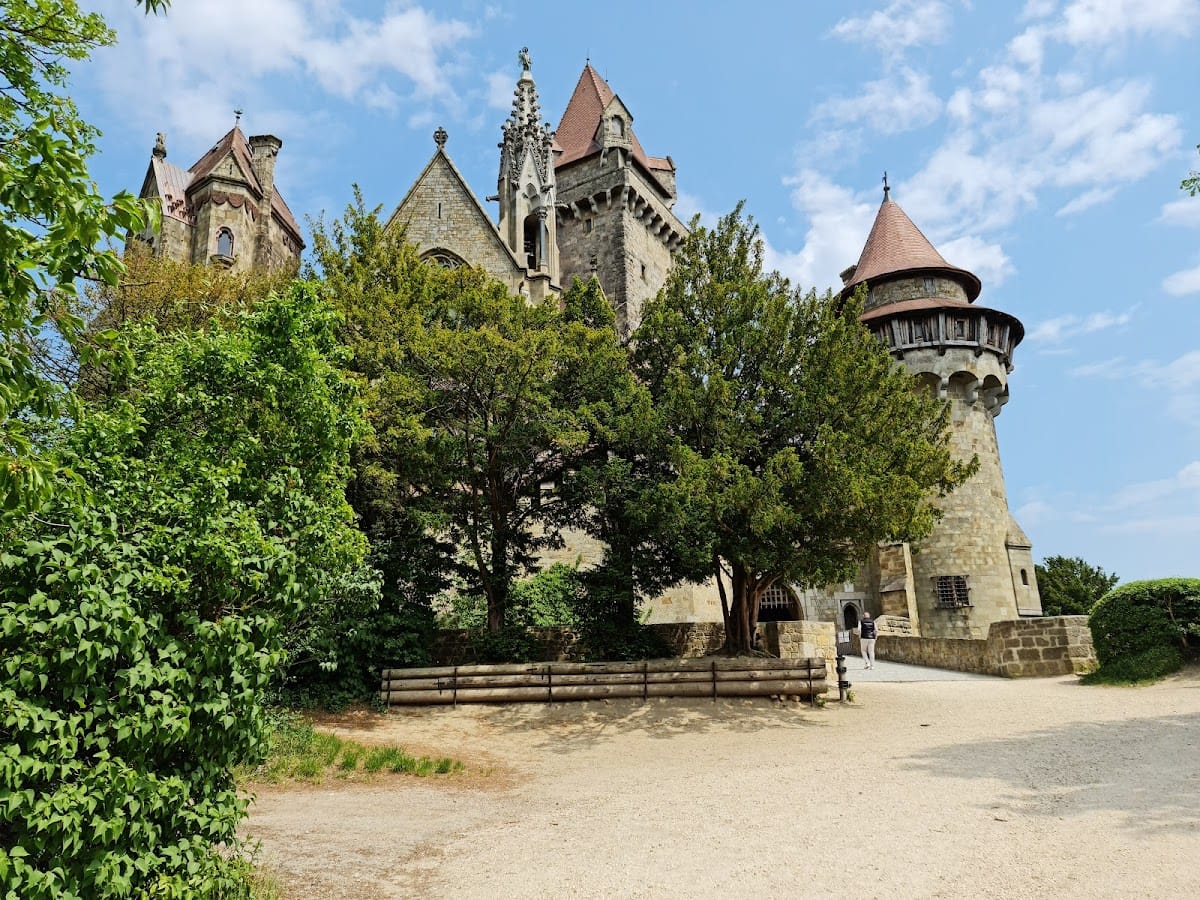
Its silhouette is formed by varied wings and numerous towers topped with hipped roofs. The narrow western front includes a polygonal northwestern tower and the gabled front of the chapel. The chapel front has tracery windows, whose stone supports create patterned openings, and a crucifix dating to around 1520 stands beneath it.
Entrance and chapel features
Western entrance
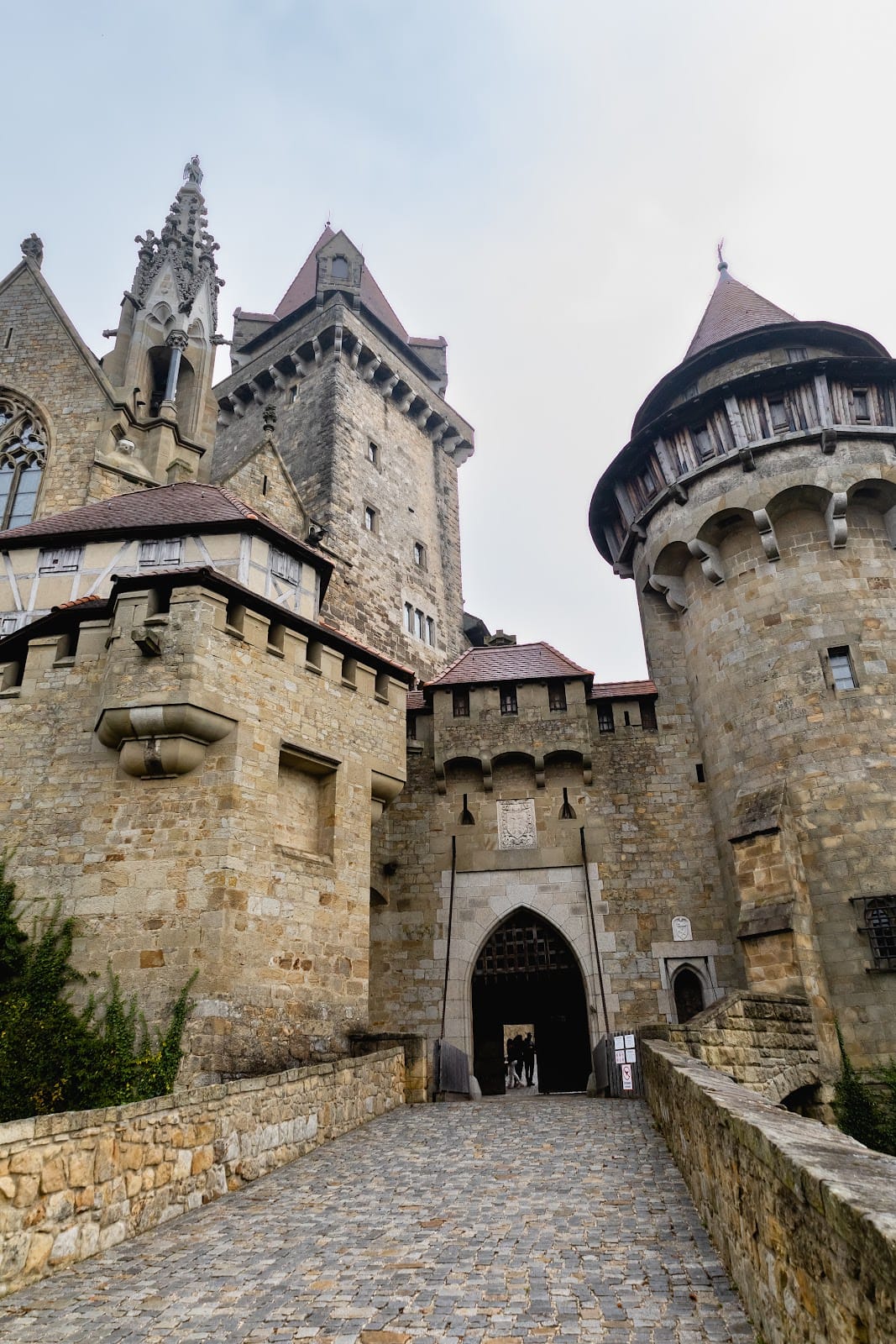
Approach to the western entrance crosses a high masonry arch bridge and then a drawbridge, a bridge that can be raised to restrict access. The route reaches the gatehouse, whose pitch-drop machicolation projects above the entrance. A machicolation is a defensive structure with openings through which objects or liquids could be dropped onto attackers. Beyond the gatehouse, the entrance continues into an outer defensive enclosure.
Bell tower
Beside the chapel front is a polygonal bell tower decorated with crockets and pinnacles. A sixteenth-century bronze figure of Saint Michael crowns the tower. Its wings, sword, and shield were added during the nineteenth-century rebuilding, distinguishing the later additions from the earlier figure.
Courtyard galleries and circulation
Kaschauer Gang
The courtyard contains the Kaschauer Gang, a passage formed by a tracery arcade spanning the space. It was created around 1450 as the western gallery of the cathedral in Košice, Slovakia. Wilczek acquired it in 1895 during the cathedral’s renovation and incorporated it into Kreuzenstein. A nearly identical reconstruction now occupies its original cathedral setting.
Nürnberger Gang
The Nürnberger Gang originally formed the facade of a demolished half-timbered town house in Nuremberg. Its presence reflects the rebuilding’s use of historic architectural components gathered from outside the medieval castle site.
Spiral staircase
A spiral staircase dated 1555 provides continuous access from the courtyard to the area beneath the roof. It was taken from the former Renaissance castle at Göllersdorf and reused within the rebuilt complex.
Museum collections
The museum contains a large collection of medieval furnishings and historical artefacts assembled for Kreuzenstein. Among them is one of the oldest surviving medieval stone-throwing machines, purchased from Hohensalzburg Castle. The collection forms part of the castle’s nineteenth-century purpose as a setting for Wilczek’s historical and artistic holdings.