Phnom Chisor: An Early Khmer Brahmanical Sanctuary in Cambodia
Site at a Glance
- Rating
- 4.4
- Popularity
- Low
- Country
- Cambodia
- Primary era
- Medieval
- External website
- Open
- Eras represented
- Medieval
- Civilizations
- Unclassified
- Site type
- Religious
- Remains
- Sanctuary
On this page14 sections
History
Phnom Chisor is a historic Khmer religious site in Takéo Province, Cambodia. Built during the reign of King Suryavarman I, who ruled the Khmer Empire from 1002 to 1050, the sanctuary probably dates to between 1010 and 1012 and belongs to the early eleventh century. It was founded as a Brahmanical temple, a sanctuary serving priests, Hindu deities, and temple rituals, on a mountain rising approximately 130 to 133 metres above the surrounding landscape.
Foundation under Suryavarman I
The temple was principally dedicated to Shiva, a Hindu deity associated with transformation, asceticism, and divine kingship, while also maintaining associations with Vishnu. Carved images of Shiva, Vishnu, and Brahma reflect this religious setting. Inscriptions give the mountain and its temple names including Sri Suryaparvata and Sri Suryagiri, meanings that can be rendered approximately as “Mountain of the Sun.” One inscription records offerings to the deity of Suryaparvata in 1019, while another describes a lingam ritual at the temple in 1018. A lingam is an aniconic sacred representation of Shiva.
Phnom Chisor also preserves evidence connected with Khmer dynastic history. An inscription discusses the genealogy of King Suryavarman II and links his ancestors with King Hiranyavarman. A local foundation tradition gives a different account of the sanctuary’s beginnings, stating that a king established a retreat on the mountain for a Brahman teacher who had become the royal tutor. This tradition remains distinct from the inscriptional and archaeological attribution of the temple to Suryavarman I.
Buddhist adaptation
After the Angkorian period, Phnom Chisor continued to be used for worship but changed from a Brahmanical sanctuary to a Buddhist religious site. The central sanctuary was converted into a Buddhist stupa, and the mandapa, a pillared hall attached to a Hindu sanctuary, was adapted as an ordination hall. Local worshippers now call the central building the inner temple.
The mountain remains a place of Buddhist pilgrimage and veneration, while it also retains religious importance for Brahmanical worshippers. Tonle Om, the former reservoir associated with the temple, continues to be regarded as a sacred Brahmanical place. It was connected with ritual bathing and with the washing away of sins. A Buddhist pagoda was built at Phnom Chisor in 1917, destroyed by wartime bombing in 1970, and reconstructed from 1979.
Damage, repair, and conservation
The École française d’Extrême-Orient, a French institution devoted to the study and preservation of Asian history and heritage, repaired the temple in 1936. Much of the complex was later damaged by bombing during the war in the early 1970s. The natural cave of Vimean Chan, about 150 metres south of the temple, was traditionally used for meditation by Brahman ascetics and other religious practitioners following forest ascetic practices. Bombing in 1970 caused large rocks to seal the cave and prevented further entry.
The Ministry of Culture and Fine Arts undertook two consecutive emergency-conservation projects in 2014 and 2015. Protective boundaries were marked around the temple structures, archaeological traces, and cultural landscape. These measures form part of the modern preservation of a site whose religious use extends from the Brahmanical period into the Buddhist present.
Remains
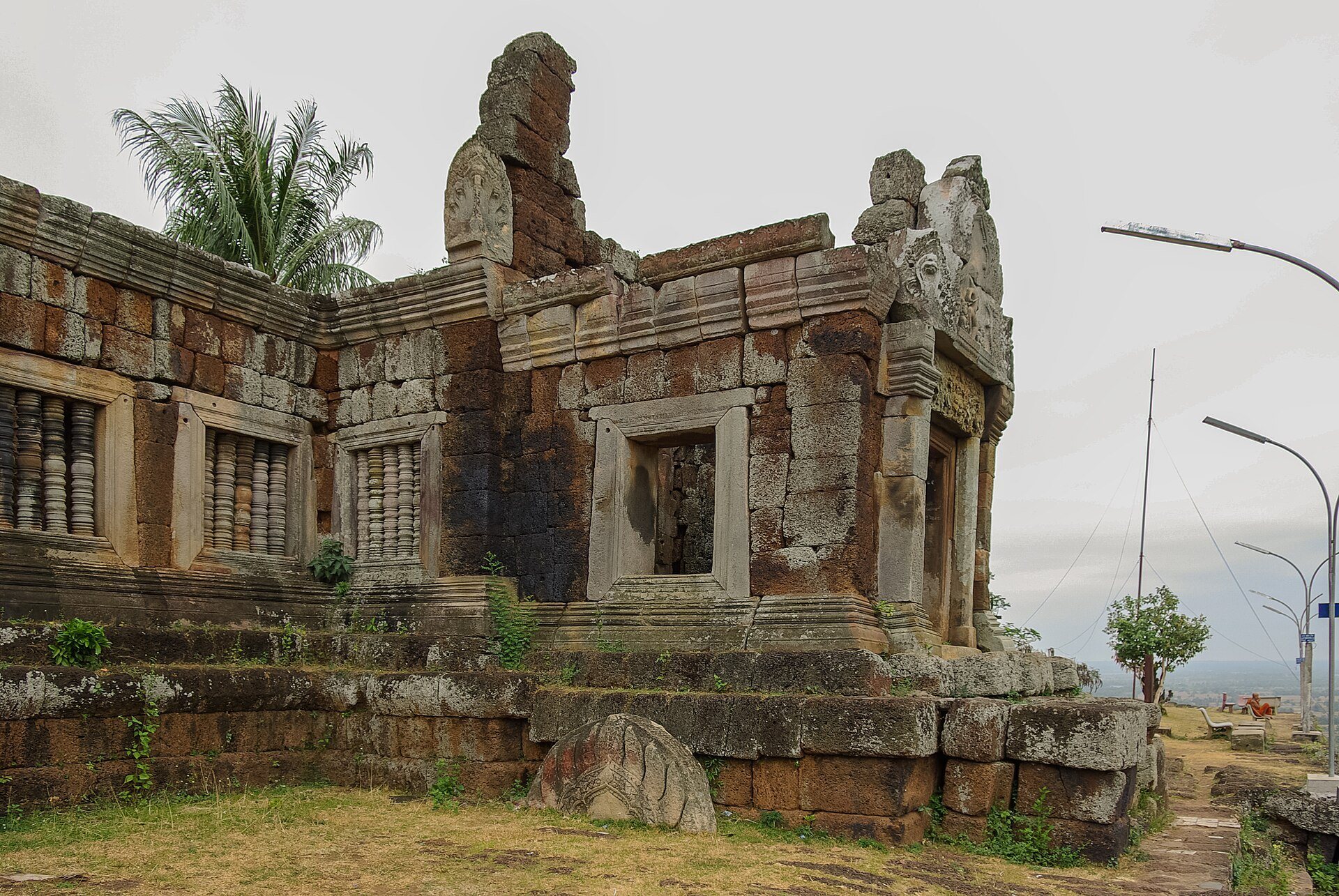
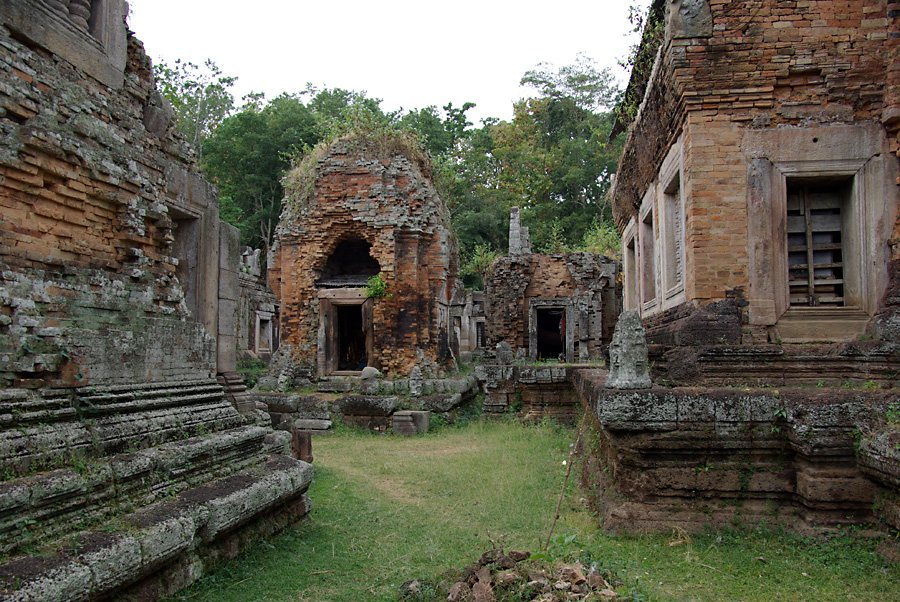
Phnom Chisor occupies the summit of the mountain and forms part of a wider cultural and natural landscape extending across the rice fields of Takéo Province. The principal temple follows an east-west axis. Its main enclosure measures approximately 60 metres from east to west and 50 metres across, and is built chiefly from sandstone and laterite, an iron-rich stone commonly used in Khmer foundations and walls. Brick is also used in parts of the wider complex.
Summit temple
Central sanctuary
The central sanctuary has a cruciform plan and extends eastward through a mandapa. Two galleries surround it, with the smaller second gallery enclosing the principal sacred area. The inner enclosure has two opposing doors and contains a wooden image. The sanctuary’s sandstone lintels, pediments, and diamond-patterned columns retain finely carved decoration. A lintel is the horizontal stone above a doorway, while a pediment is the decorated triangular surface above an entrance or facade.
The reliefs present Brahma, Shiva, and Vishnu. Some carvings show Shiva seated with Uma on the bull Nandi, while others depict Shiva in a dancing posture. These images preserve the temple’s Brahmanical character even though the central building was later adapted for Buddhist use.
Libraries and gateways
Two library buildings stand in front of the central sanctuary and face west. Large gateways occupy the western and eastern sides of the surrounding enclosure. The complex is associated with six temples in all, comprising the large central sanctuary and five secondary temples. The wider temple area measures approximately 100 metres in length and 80 metres in width, with further structures facing east and northwest.
Stairways and approaches
A western stone staircase contains 390 steps, while the southern staircase has 408. Another stairway and gateway in front of the temple connect the summit complex with the lower sanctuaries and Tonle Om. Together, these approaches link the elevated temple area with the sacred features at the foot of the mountain.
Lower sanctuaries and sacred water
Sen Chhmos
Sen Chhmos, also called Sen Nimol, lies below the mountain. The sanctuary is heavily overgrown and deteriorated, although some of its lintels remain. Its surviving carved elements connect the lower religious area with the architectural tradition of the summit complex.
Sen Roveang
Sen Roveang, also known as Sen Phouvang, is another lower sanctuary, approximately 800 metres from Sen Nimol. It is currently used as a Buddhist shrine and contains a reclining Buddha image, reflecting the continuing religious adaptation of the Phnom Chisor landscape.
Tonle Om
Tonle Om was formerly a baray, or large artificial reservoir associated with a Khmer temple complex. It was regarded as a representation of the Ganges and was used in lingam rites and ritual bathing intended to remove sins. The reservoir therefore formed part of the religious landscape rather than serving only as a source of water.
Later Buddhist buildings
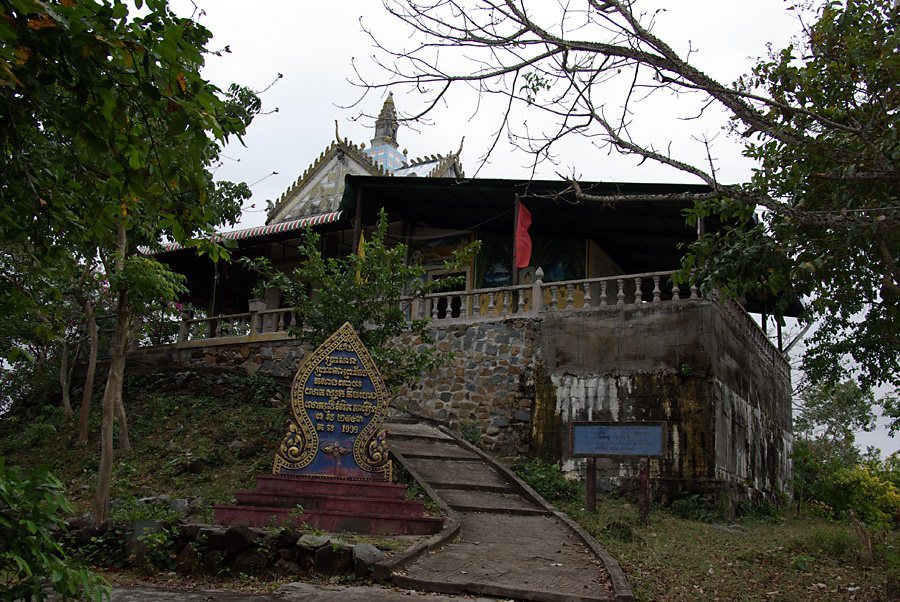
A new Buddhist temple stands south of the ancient sanctuary. Behind it are a religious assembly hall, residences for monks, a small shrine, and an old stepped concrete water tank. These buildings form part of the continuing Buddhist use of Phnom Chisor alongside the surviving ancient temple, lower sanctuaries, and sacred reservoir.