Wat Ounalom: Cambodia’s Central Buddhist Temple in Phnom Penh
Site at a Glance
- Rating
- 4.5
- Popularity
- Medium
- Country
- Cambodia
- Primary era
- Medieval
- Eras represented
- Medieval, Modern
- Civilizations
- Khmer
- Site type
- Religious
- Remains
- Monastery
On this page7 sections
History
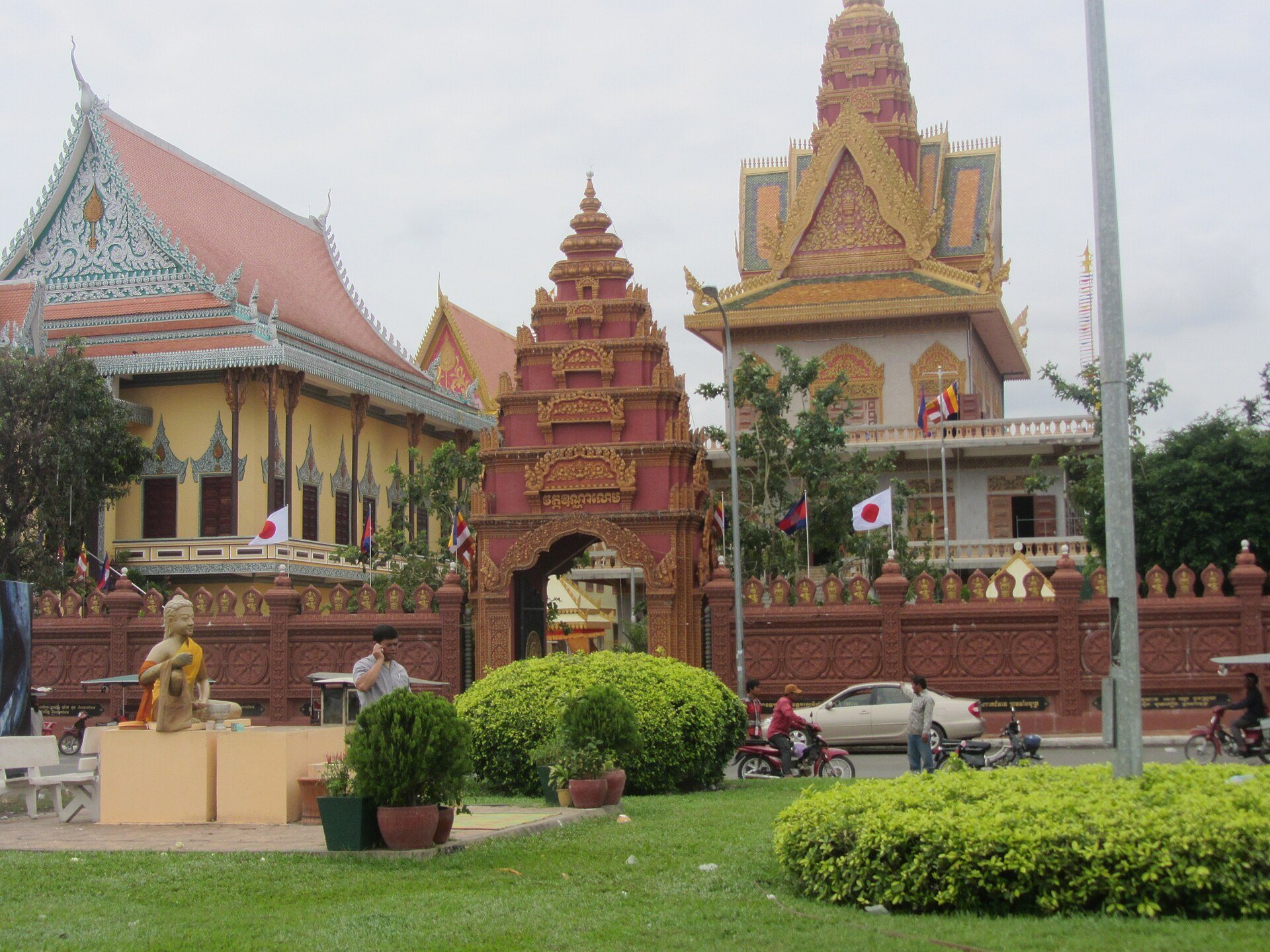
Wat Ounalom is a Theravada Buddhist temple in Phnom Penh, Cambodia, near the Chaktomuk Royal Palace. Traditionally dated to 1443, it was established during the reign of King Barom Reachea, also known as Chao Phraya Yat, and became the central institution of Cambodian Buddhism and the traditional seat of the Mahanikaya Supreme Patriarch, the senior leader of one of Cambodia’s principal monastic orders.
Foundation and early traditions
The temple’s foundation is linked to the movement of the royal capital to Phnom Penh in 1434. In a 1936 account, Supreme Patriarch Chuon Nath stated that the king built seven Buddhist temples in the new capital and that they were consecrated in 1442. Wat Ounalom is conventionally dated to the following year. The site is also believed to have been an older religious place that may predate Phnom Penh itself, with its foundation tradition connected to a stupa that stood there before the temple was established.
The name Wat Ounalom comes from the Ounalom Stupa. “Ounalom” refers to the sacred hair or tuft traditionally associated with the Buddha and located between the eyebrows. The stupa and the temple have remained objects of Buddhist reverence. Ceremonies may include pin peat music, a Cambodian ceremonial ensemble used in religious and court settings, while devotees come to pray at the stupa. A traditional belief holds that its entrance has supernatural power allowing monks to travel to forests or mountains for meditation.
Royal rebuilding and the new ordination hall
During the reign of King Norodom, a later Cambodian king associated with Phnom Penh’s establishment as the capital, older temples in the city were frequently rebuilt. Wat Ounalom was restored during the tenure of Supreme Patriarch Thieng, and its earlier ordination hall was eventually demolished and replaced. The new hall was begun in 1957 and completed in 1960. Its completion was celebrated with a four-day, three-night merit-making ceremony from June 1 to 4, 1963. An ordination hall, also called an ubosot, is the consecrated building used for formal monastic ordinations and major rituals.
Destruction, restoration, and continuing religious use
Wat Ounalom suffered severe destruction during the Khmer Rouge period, when the communist movement and governing regime ruled Cambodia during the 1970s. Some monastic residences were apparently used to store salt, and books were scattered throughout the grounds, while the Ounalom Stupa itself was not disturbed.
The complex was rapidly restored after the war and the return of peace. It continues to function as an important religious and administrative center, accommodating more than 300 monks and more than 600 students. It also remains a residence and institutional base for senior Cambodian Buddhist clergy.
Remains
Wat Ounalom contains 44 structures, including monastic residences, shrines, and educational facilities. The complex is centered on the Ounalom Stupa, which stands west of the temple as the central stupa in a group of five. The surviving buildings combine the religious, residential, and educational functions of the institution.
Ounalom Stupa
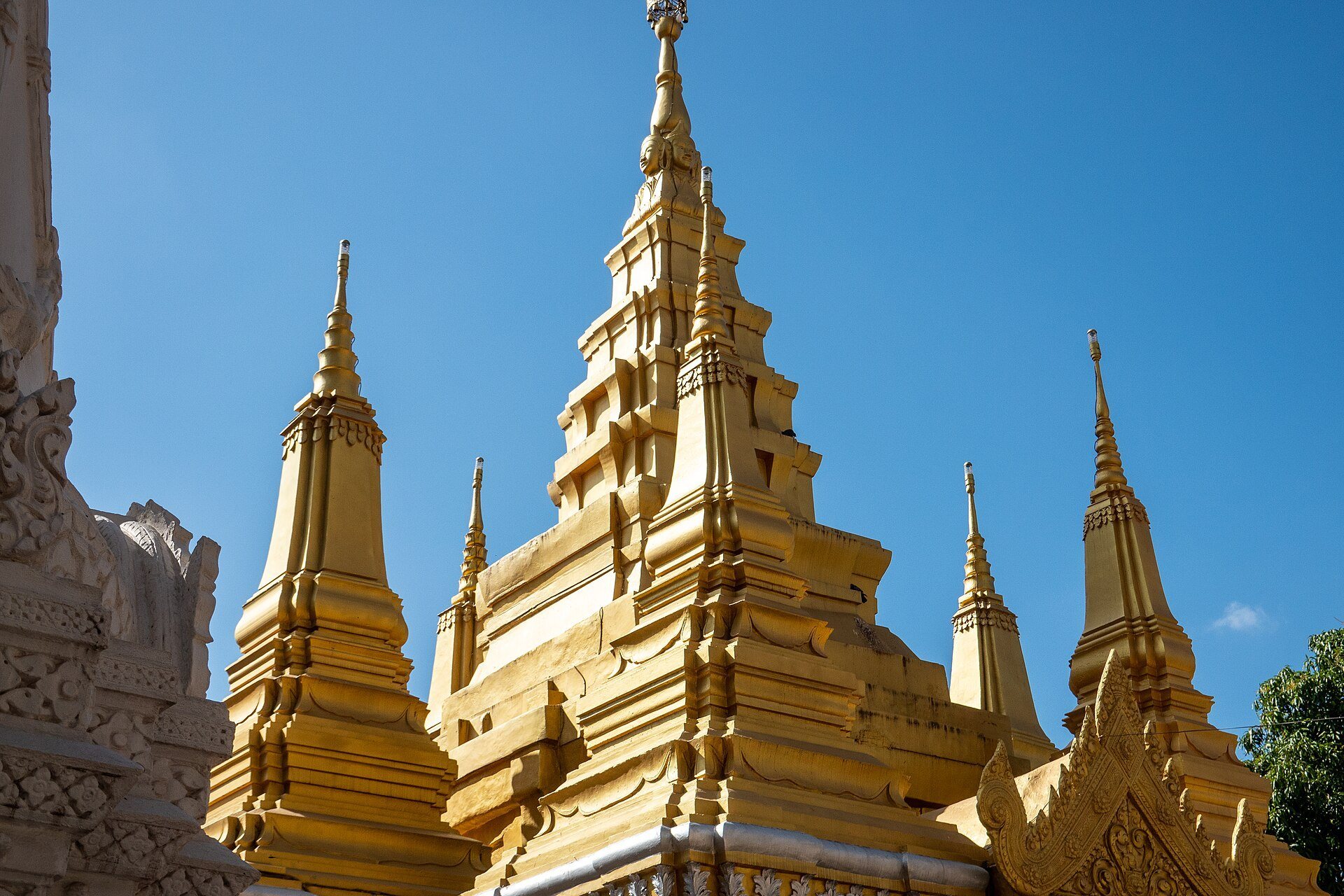
The Ounalom Stupa encloses, or stands over, an older stone sanctuary from the Angkorian period, when the Khmer civilization centered at Angkor produced major architectural works between the ninth and fifteenth centuries. It has five peaks, an unusual feature among Cambodian stupas. Later enclosing walls were built around the structure and covered with gold-colored paint, although gaps near the corners allow parts of the ancient stone to remain visible.
The stupa contains a relic traditionally identified as a hair from the Buddha’s eyebrow region. The attribution is not securely established, and the relic remains concealed inside the structure. Four Buddha images stand at the corners, with a larger image at the center. Their facial forms are described as resembling Buddha images at Angkor Wat. A Pali inscription, written in the classical liturgical language of Theravada Buddhism, is associated with the main stupa.
Ordination hall
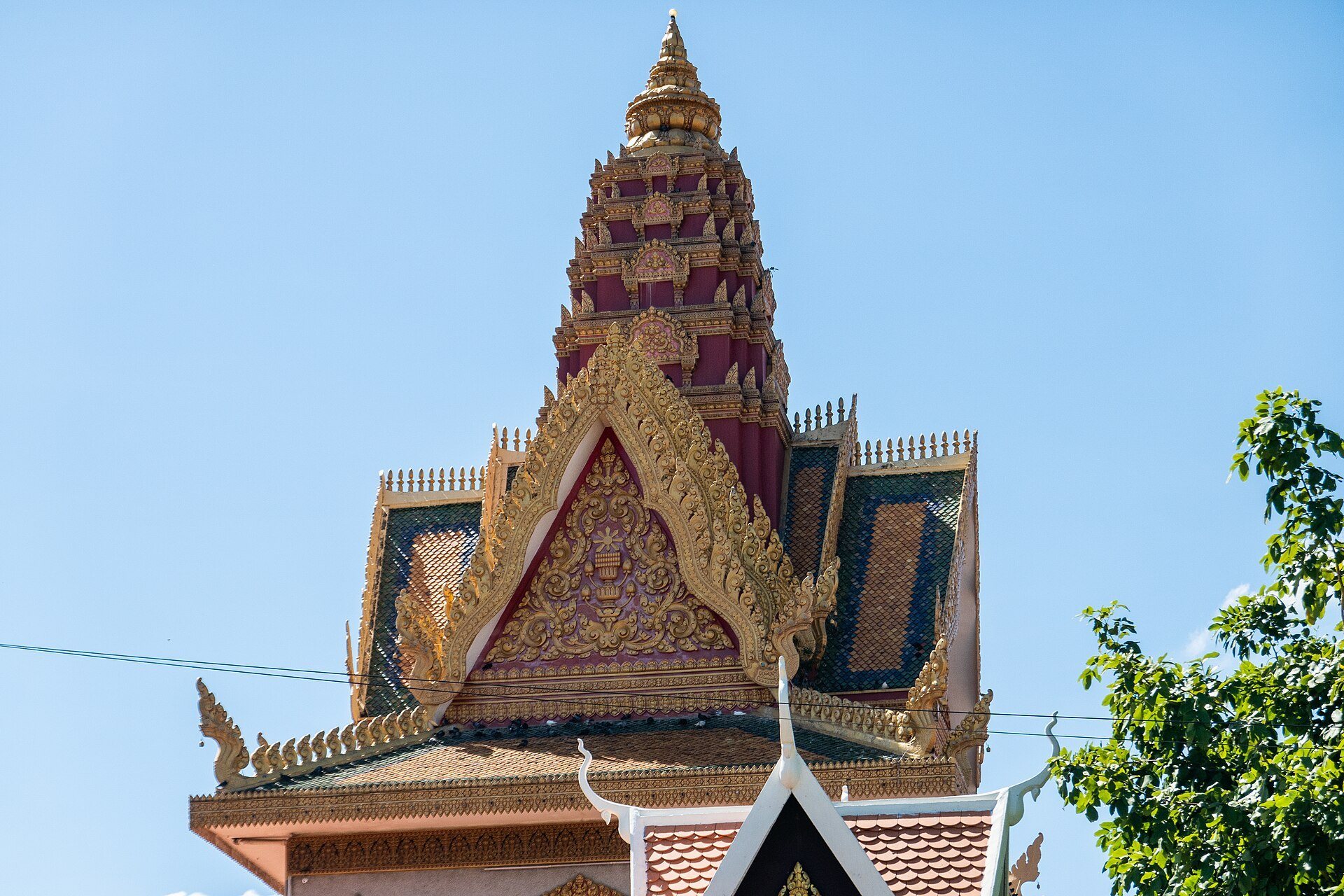
The replacement ordination hall is a three-story structure built during the twentieth-century rebuilding. It took the place of the older hall demolished during that period and serves the ceremonial function associated with formal monastic ordination and major Buddhist rites.