Wat Phnom: A Buddhist Temple and Historical Landmark of Phnom Penh
Site at a Glance
- Rating
- 4.4
- Popularity
- Medium
- Country
- Cambodia
- Primary era
- Medieval
- Eras represented
- Medieval, Modern
- Civilizations
- French, Khmer
- Site type
- Religious
- Remains
- Sanctuary
On this page10 sections
History
Wat Phnom is a Buddhist temple on an artificial hill in Phnom Penh, Cambodia, traditionally founded in 1372–73 and associated with the city’s origins and national identity. Its religious tradition is primarily Theravada Buddhism, which centres on monastic discipline, the Pali canon, and liberation through the Buddha’s teachings. The site was earlier known as Wat Chedi Parbat and is also called Wat Phnom Daun Penh.
Foundation and the creation of Phnom Penh
The foundation story centres on Lady Penh, a wealthy widow who discovered sacred images in a floating koki tree near the confluence of four rivers. She and local villagers built an artificial hill and a small wooden shrine for the images. Monks later blessed them, and the hermitage became known as Wat Phnom, meaning “Mountain Pagoda,” after its elevated setting.
The site already existed when King Ponhea Yat, also known as Barom Reachea I, moved the royal capital from Tuol Basan to the Chaktomuk area after severe flooding, traditionally dated to 1396–97. The new capital developed into the city later known as Phnom Penh, while Wat Phnom became an important religious and historical landmark within it.
Royal stupas and religious endowment
After Ponhea Yat’s death in 1432, his eldest son, King Narayan Rama, built the principal stupa between 1433 and 1434 to contain the former king’s remains. A stupa is a Buddhist reliquary monument used to enshrine relics or commemorative remains. Completion ceremonies lasted seven days and included Buddhist observances and the deposition of about 10,000 multicoloured gems. The temple then received the name Wat Chedi Parbat, which later developed into Wat Phnom.
In 1485, King Dharmaraja II ordered two further stupas for royal remains brought back from Ayutthaya. He endowed the religious establishment with villages, rice fields, servants, carts, animals, and musical instruments, assigning twenty-one of each of several categories to maintain the stupas, sanctuary, boundary markers, and grounds.
Changing devotion and wartime memory
After periods of warfare and broader changes in Cambodian society, earlier forms of devotion connected with the discovered statues declined. Khmer-Chinese residents increasingly venerated Neak Ta Preah Chao, a local guardian spirit associated with the site. Neak Ta refers to a Cambodian spirit linked to a locality, landscape feature, or community. Chinese merchants and Khmer-Chinese residents offered petitions and gifts at Wat Phnom, which later became associated with Wat Chin Damdek, or “Chinese Ironworkers’ Wat,” after Chinese residents in the area became involved in ironworking.
During the 1941 phase of the Second World War, Thai aircraft bombed Phnom Penh during Thailand’s attack on French military positions in Cambodia. Residents sought shelter at Wat Phnom. Although bombs struck other parts of the city, none exploded within the temple grounds. The belief that the guardian spirit had protected those sheltering there strengthened veneration of Neak Ta Preah Chao, whose shrine subsequently attracted continuing petitions and offerings.
Rebuilding and modern historical associations
The sanctuary was rebuilt several times during the nineteenth century and again in 1926. The site is now identified as Wat Phnom Historical Park and remains a religious, cultural, and historical monument.
A French-Cambodian friendship monument connected with King Sisowath was erected at the southern foot of the hill in 1909. It commemorated Cambodia’s recovery of Siem Reap, Sisophon, and Battambang through the Franco-Siamese treaties of 1907, which followed the Franco-Siamese War of 1893. The original bronze statue of Sisowath was later moved to the National Museum in Phnom Penh and replaced at Wat Phnom by a sculpture made in 1998.
A statue of Lady Penh was created during the 1990s after the end of Cambodia’s civil war. It became a focus for offerings of jasmine and lotus flowers, and the site continues to receive petitions concerning health, work, commerce, and personal matters.
Remains
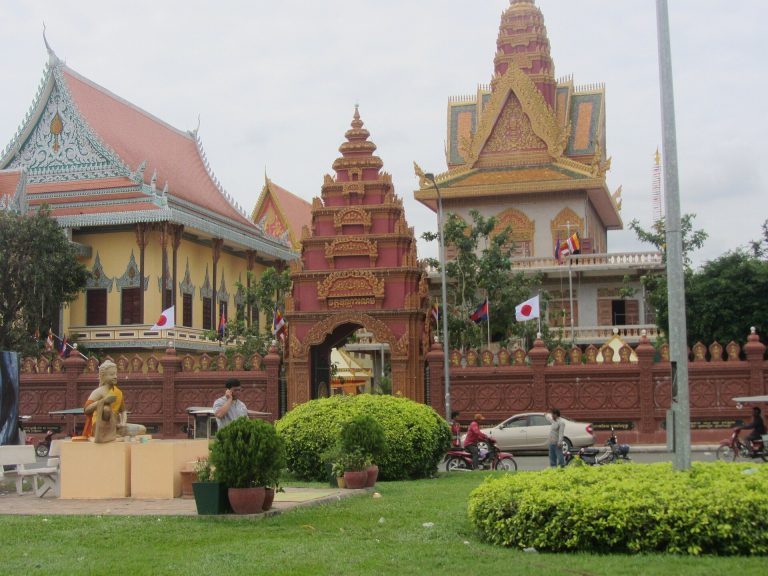
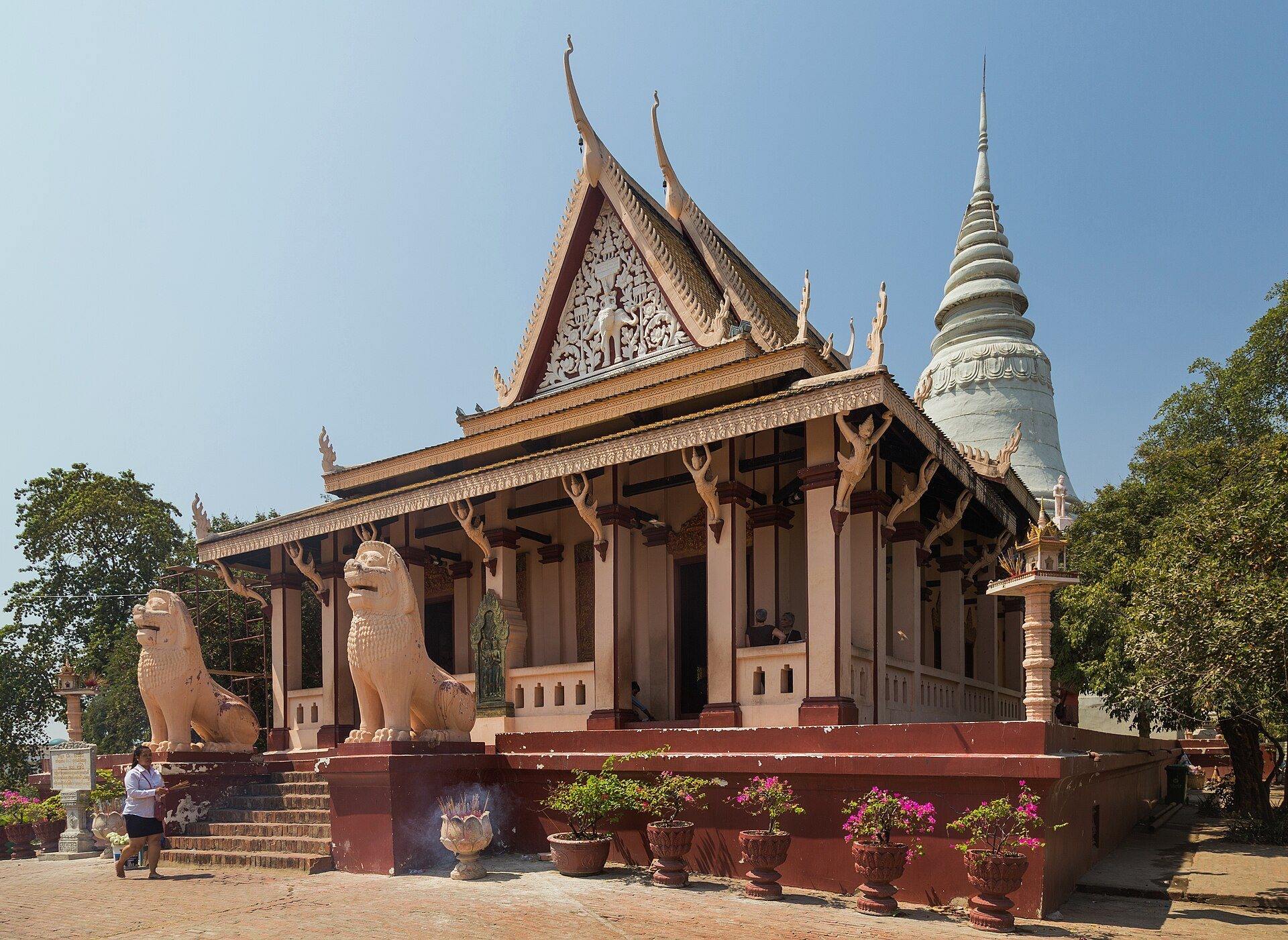
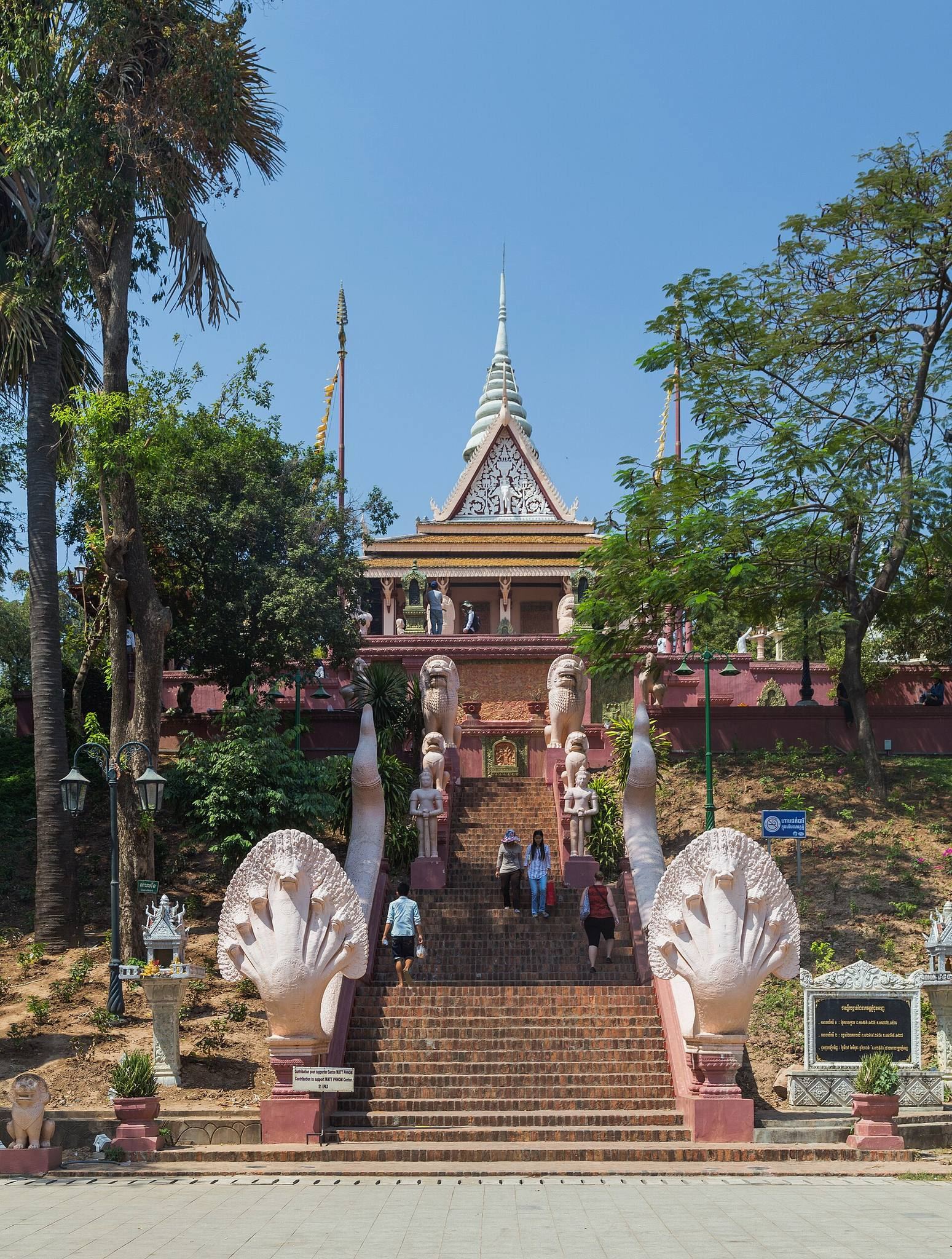
Wat Phnom occupies an artificial hill approximately 46 metres high, with the principal stupa rising about 27 metres. The sanctuary and stupa form the main architectural focus, while additional stupas, shrines, a giant clock, and the Sisowath monument occupy other parts of the complex.
Sanctuary and devotional images
The sanctuary contains a central altar with a large seated bronze Buddha, surrounded by other images, flowers, candles, and devotional offerings. Its interior walls carry murals showing Jataka stories, which recount the Buddha’s previous lives, together with episodes from the Reamker, the Khmer adaptation of the Ramayana. The lower wall tiers contain murals described as newer works combining traditional and modern characteristics.
The foundation tradition identifies four recovered images housed at the site. They comprise a jade Vishnu with four arms holding a staff, discus, conch, and lotus; a gold Buddha making the gesture of subduing Mara; a bronze image of Indra; and a brass Budai, a popular East Asian Buddhist figure represented as a smiling, corpulent monk.
Lady Penh Shrine
A small shrine to Lady Penh stands at the southwest corner of the sanctuary and stupa. Worshippers bring food and other offerings to the shrine.
Stupas and the hilltop complex
The principal stupa, built between 1433 and 1434, was intended to contain the remains of King Ponhea Yat. Two additional stupas were added in 1485 for royal remains associated with King Dharmaraja II. Together with the sanctuary, these reliquary monuments form the principal built group on the artificial hill.
Sisowath monument
The monument at the southern foot of the hill was originally made of bronze in 1909 by Théodore Rivière. The replacement sculpture installed in 1998 shows King Sisowath seated on a throne and receiving symbolic objects representing the three provinces returned to Cambodia.
The monument stands beside the giant Wat Phnom clock. Its reliefs and sculptural elements include three female attendants bearing the provincial symbols, Cambodian soldiers in French-style uniforms, the French flag, labels referring to the three provinces, and a representation of Louis Paul Luce, the French governor in Cambodia.