Angkor Borei and Phnom Da: Archaeological Sites of Ancient Funan in Cambodia
Site at a Glance
- Rating
- 4.4
- Popularity
- Medium
- Country
- Cambodia
- Primary era
- Medieval
- Eras represented
- Iron Age, Classical, Medieval
- Civilizations
- Khmer
- Site type
- City
On this page12 sections
History
Angkor Borei and Phnom Da are archaeological sites in Takéo Province, southern Cambodia, associated with Funan, an early polity in mainland Southeast Asia. Material from Angkor Borei has been carbon-dated to about 1523 BC and later, while Phnom Da’s temple has an early foundation dated to the late sixth or early seventh century and a surviving structure dated around the turn of the twelfth century. Angkor Borei probably served as a regional capital and a meeting point for Southeast Asian cultures and arts.
Angkor Borei and its Archaeological Record
Excavated objects indicate settlement at Angkor Borei lasting at least five centuries. Chinese writings provide the earliest historical information about the place, while archaeological research has revealed further evidence of its past. Finds and dating indicate three broad periods of occupation, and suggest that nearby Óc Eo was inhabited during at least part of the same span. Angkor Borei is linked to the earliest known dated Khmer inscriptions and perhaps to the earliest Khmer sculptural tradition.
Angkor Borei remains inhabited, a circumstance that complicates archaeological research. Earthmoving, gardening, and other everyday activities have damaged parts of the site; looting and the illicit trade in antiquities have also been serious problems. The Angkor Borei and Phnom Da archaeological sites were added to UNESCO’s Tentative World Heritage List in the cultural category in 1992, and the submission was renewed in 2020.
Phnom Da and the Temple’s History
The temple’s early origins are associated with Rudravarman, described as the last king of Funan. Hindu wooden temples may have preceded the stone building. Its original foundation is dated to the late sixth or early seventh century, while the surviving structure is dated around the turn of the twelfth century. An eleventh-century restoration is attributed to Suryavarman I, a Khmer king.
The temple is linked to Brahmanical worship, an older term for religious traditions that developed into Hinduism, and is dedicated to Narayana. Its sculptures are often assigned to Rudravarman’s reign, AD 514-539, but their style points instead to around the middle of the seventh century. Their artistic affinities include late or post-Gupta traditions, associated with the Gupta Empire in India and the centuries after its decline. The works blend ideas from India and what is now Vietnam with Cambodian innovation.
Inscription K.549 has informed proposals connecting Phnom Da with Rudravarman. Georges Cœdès argued that it referred to a sanctuary founded by that king, but both the inscription’s date and the identity of the king remain uncertain. The inscription is generally placed after the twelfth century.
Remains
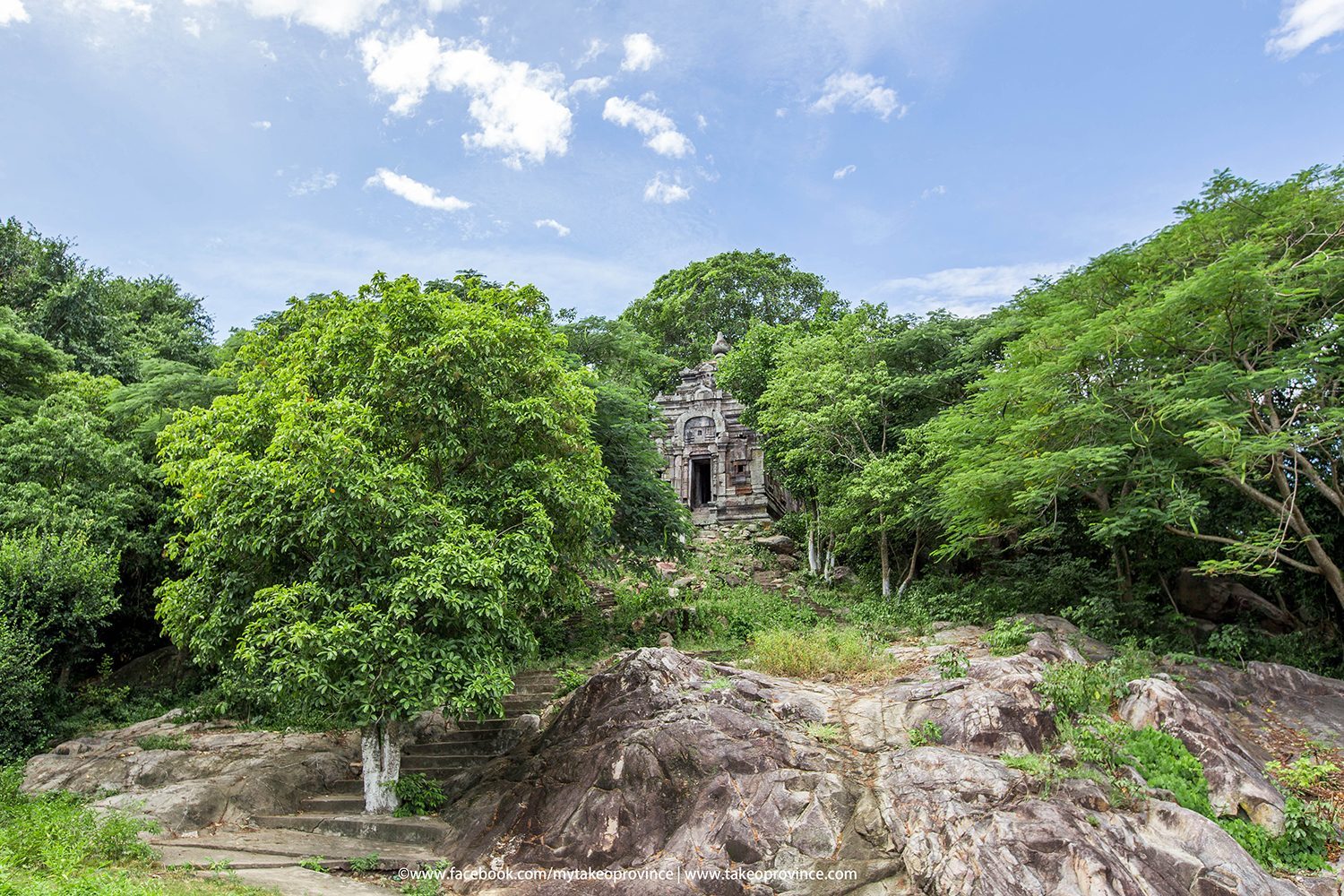
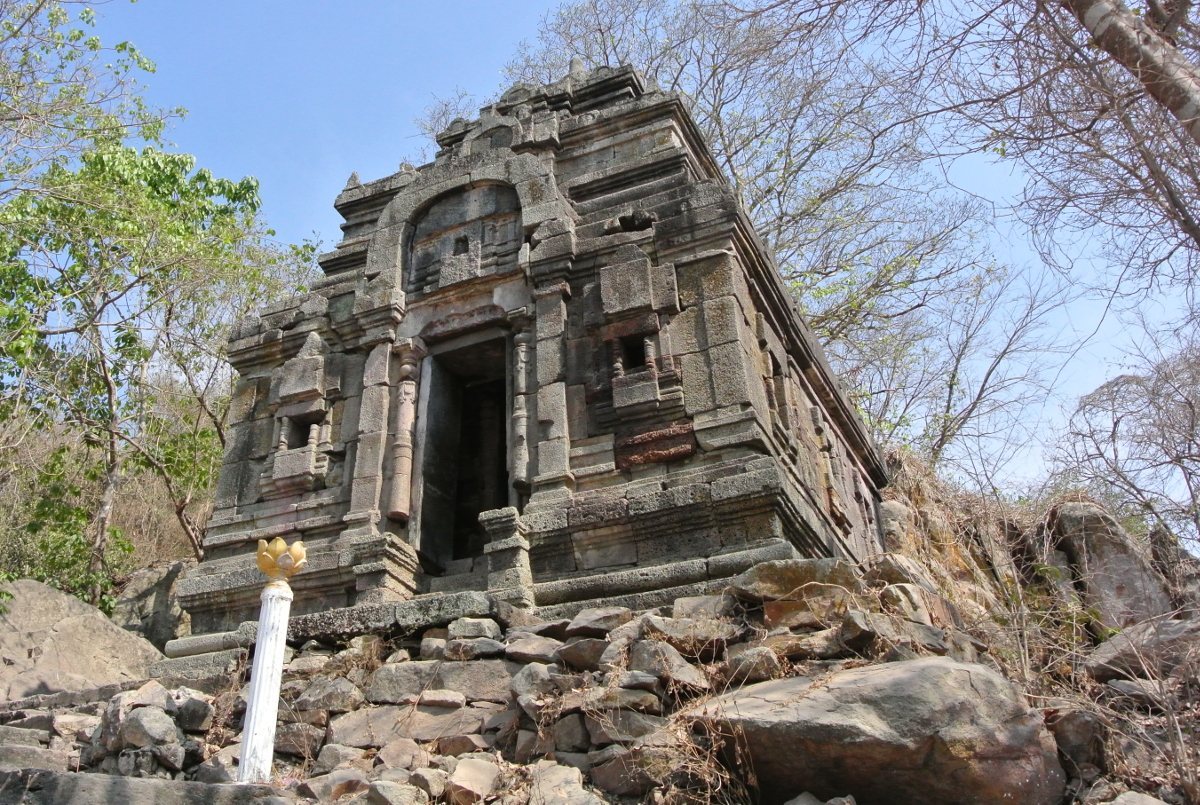
The archaeological remains occupy two distinct settings: the inhabited area of Angkor Borei and Phnom Da, a granite outcrop about 40 metres high roughly three kilometres to its southeast. A temple stands on Phnom Da’s summit, facing north toward Angkor Borei. Brick architecture is among the remains at Angkor Borei, while the hilltop temple combines laterite, brick, and sandstone.
Angkor Borei
Settlement Structures and Finds
Excavations have revealed brick architecture, postholes marking a large wooden structure, and a temple containing two statues of Vishnu, a major Hindu deity. Evidence also points to a moat or another constructed water-management system. Finds include ceramics, brick pieces, animal bones, vessels, clay pellets, metalworking slag, and stone statues. Pottery types include fine orange wares, cord-marked and burnished earthenware, gray pottery, and wheel-made pieces with a surface coating.
Vat Komnou Cemetery
Burials at Vat Komnou date from about 200 BC to AD 400. Excavation recovered about 60 individuals, including 25 people under 19 and 36 adults, as well as elderly individuals. Men outnumbered women by more than two to one. Many people had fractures in the lower back that suggest heavy labor, while bone analysis indicated no starvation or extreme physical stress. Their teeth lacked common signs associated with a diet rich in sugars and starches. Beads from the cemetery are thought to have come from across Southeast Asia, including India.
Phnom Da and Nearby Features
Summit Temple
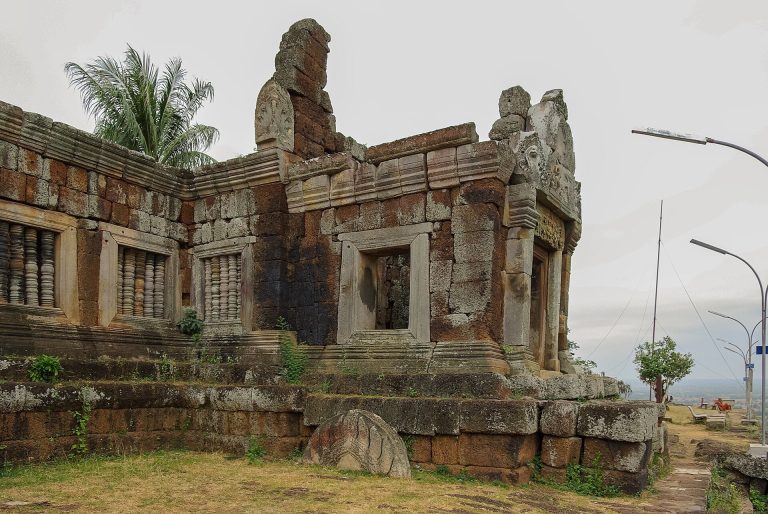
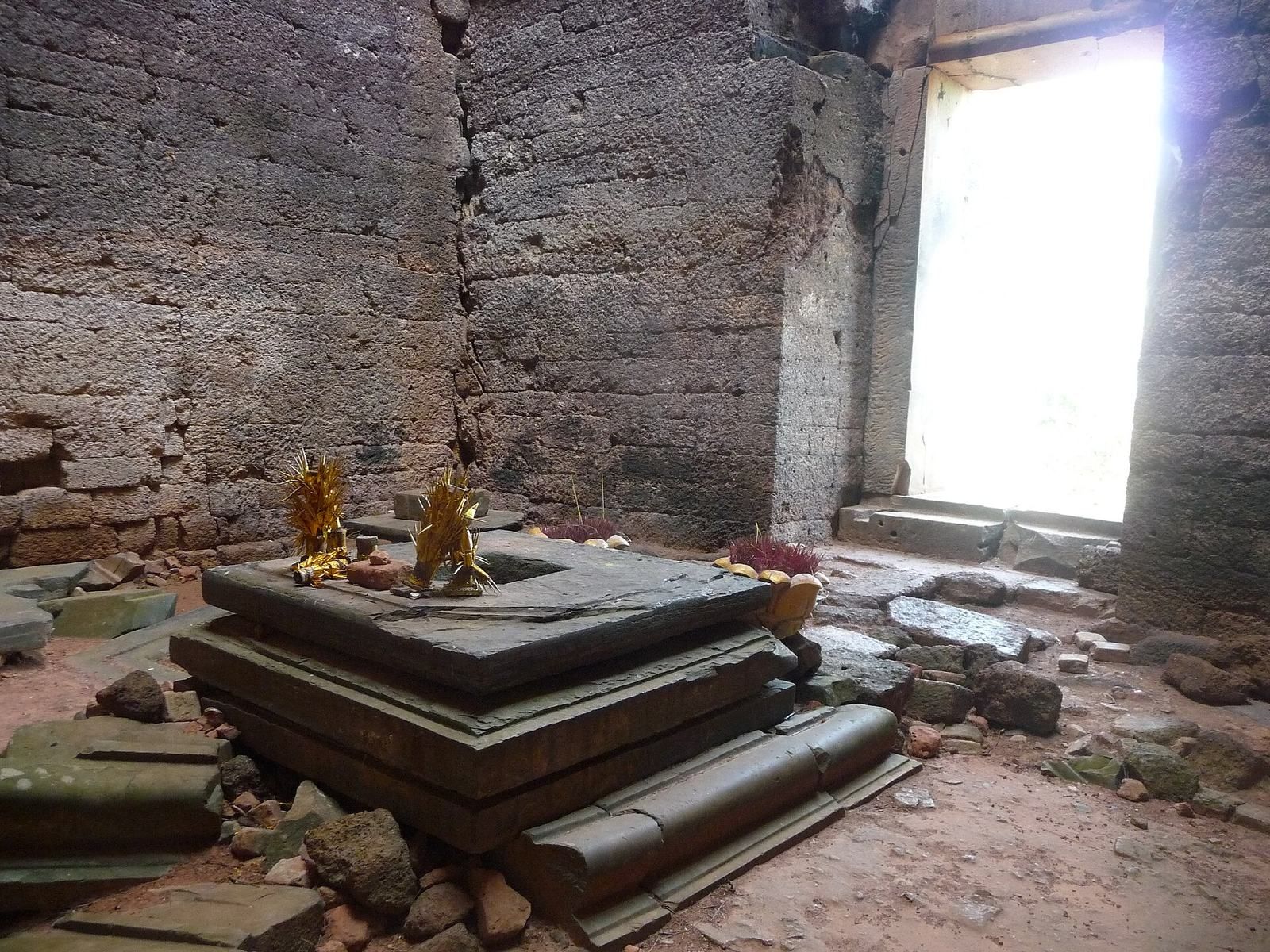
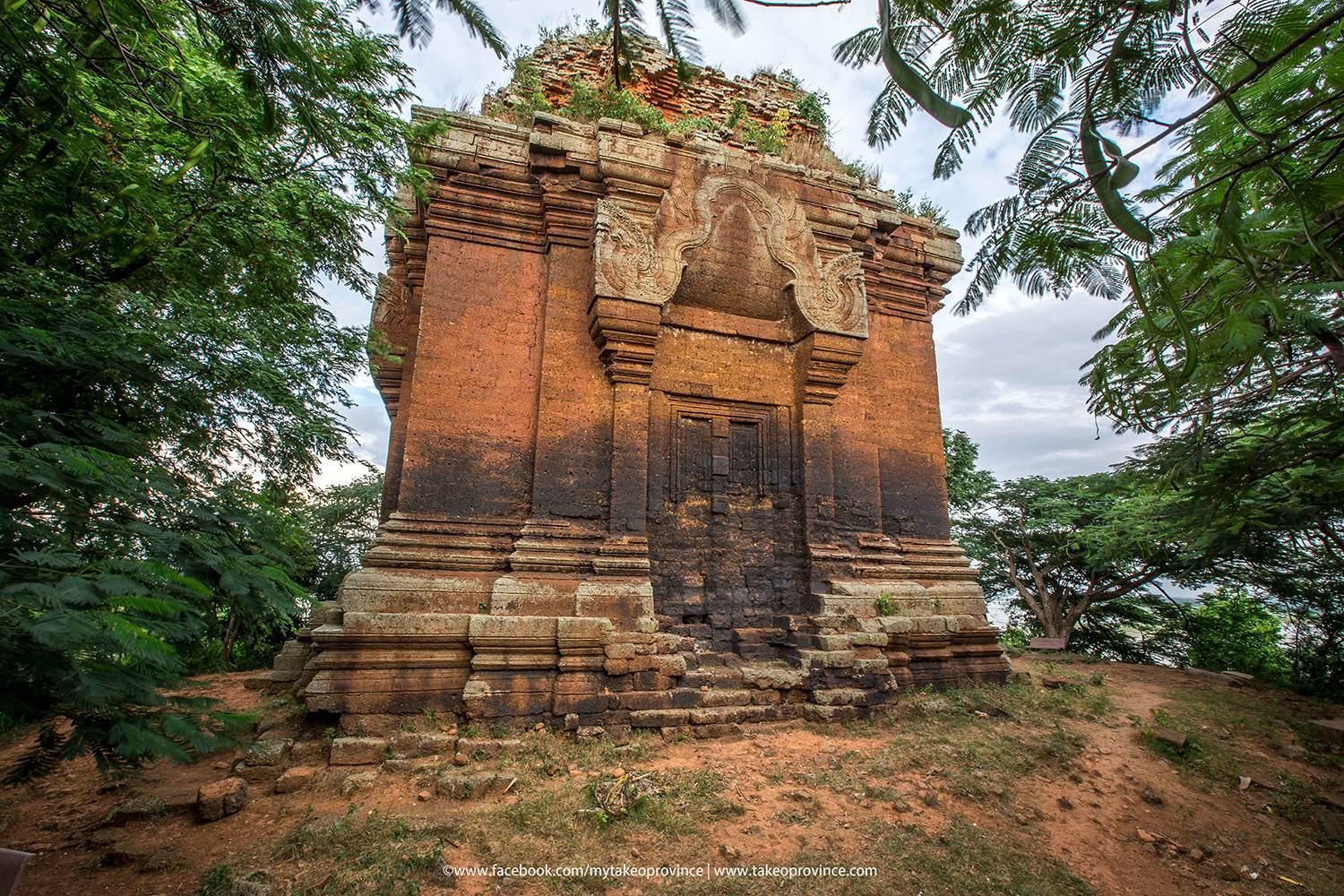
The temple is about 18 metres high and measures approximately 12 metres square. It is a standalone building with three imitation doorways and a functioning entrance in its north wall; its walls are thick. Laterite forms the platform and walls, brick is used in the upper roof, and sandstone appears in architectural ornament, including the doorways. A linga, a symbolic representation of Shiva, was installed inside from the time of construction. Age and past wars have left the building considerably damaged. Its sandstone lintels and octagonal columns from the doorframes, decorated in the Khmer Khleang style, a tradition associated with temple ornament, have been kept at the Angkor Borei Museum since 1999.
Stone Images
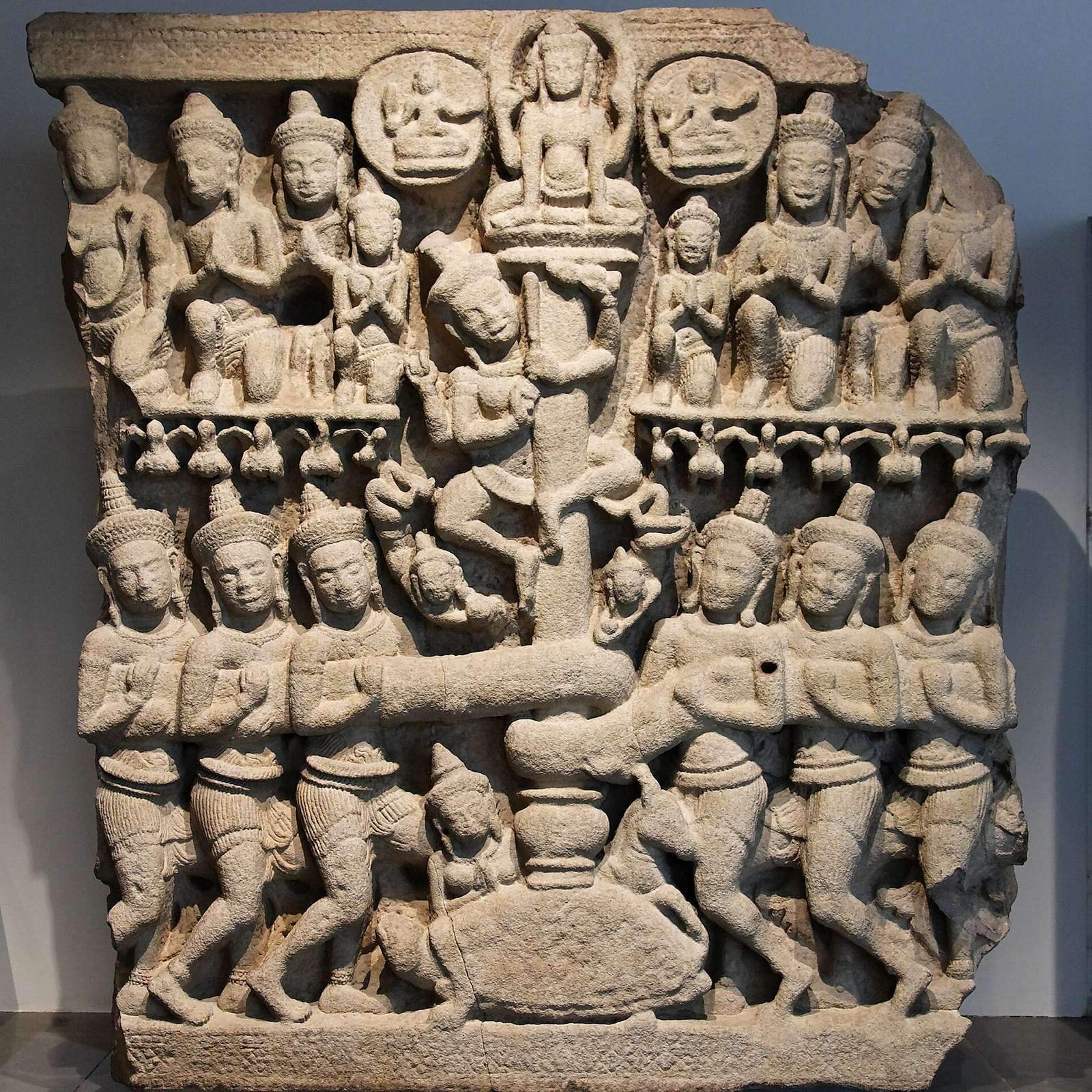
Seven stone figures of Vishnu or figures associated with him have been found at Phnom Da. Four stylistically related sculptures include an eight-armed Vishnu, Balarama, Rama, and a torso identified either as Krishna Govardhana or Trivikrama. The Vishnu figure is about 2.7 metres tall. Six hands retain their attributes, which are associated with the Lokapalas, deities regarded as guardians of the directions; two other attributes are thought to have been lost. The group of Vishnu and two associated figures is carved from schist. Other standing images, including Trivikrama, Krishna Govardhana, and Hari Kambujendra, are sandstone and are linked with Hinduism and possibly Buddhism. Most of the sculptures are now preserved or displayed at the National Museum of Cambodia in Phnom Penh, while a Phnom Da figure of Harihara, who combines aspects of Shiva and Vishnu, is at the Guimet Museum.
Inscription K.549
Found at Phnom Da, K.549 is carved on slate and has 32 lines, 11 in Sanskrit and 21 in Khmer. The first seven lines include names of Vishnu, and the seventh gives the name Sri Rudravarman. The opening Khmer passage describes the installation of an image of Hari Kambujendra in a cave, followed by a royal order; the remaining text concerns land. Cœdès was able to make out only scattered words.
Caves and Asram Moha Russei
About five caves surround the foot of Phnom Da: three to the north, one to the east, and one to the west. On another hill in the area, the restored Asram Moha Russei stands on the northeastern slope. This Hindu sanctuary, built of hard basalt and about eight metres high, dates to around AD 700. It is dedicated to Harihara and is believed to have served as a hermitage.