Madonna dell’Olmo: A Marian Sanctuary in Thiene, Italy
Site at a Glance
- Rating
- 4.6
- Popularity
- Very Low
- Country
- Italy
- Primary era
- Early Modern
- External website
- Open
- Eras represented
- Early Modern, Modern
- Civilizations
- Venetian
- Site type
- Religious
- Remains
- Sanctuary
On this page13 sections
History
Madonna dell’Olmo is a Catholic sanctuary in Italy, on the western outskirts of Thiene, whose present composite Romanesque-Gothic character grew from a chapel built in 1530. It became a pilgrimage destination through a Marian apparition tradition associated with the former territory of the Republic of Venice.
The apparition tradition and first chapel
The events are traditionally placed in the spring or summer of 1529, although 1530 is also associated with them. The reported apparitions took place in open countryside west of Thiene, near Castelletto and the ancient road to Marano. The area was used for grazing and was known for its elm trees.
According to the tradition, three unnamed shepherd girls saw a woman seated among the branches of an elm. She identified herself as the Mother of God, a traditional Christian title for Mary as the mother of Jesus. She urged the people of Thiene to repent and return to God, asked for a church to be built, and warned of an approaching famine.
The girls were initially disbelieved. During the third apparition, the elm was said to have lost its bark while retaining healthy foliage. A fourth apparition was then associated with Centrale, northeast of Thiene, where Simone, known as “the Hunchback,” was reportedly healed from paralysis. He was said to have walked approximately 2.5 kilometres to Thiene, persuading the civic authorities to accept the girls’ account and establish a place of worship.
The municipality decided to build the sanctuary and financed the work because the land and the elm belonged to it. The first building was the Chapel of the Apparitions, erected in 1530 when the municipality did not yet have the means to construct a full church. The Diocese of Padua authorized the parish of Thiene to celebrate Mass there, while the municipality retained ownership of the chapel and its land.
The chronology most often associated with the apparitions is supported by the chapel’s early authorization and by a triptych dated 10 April 1530. A later tradition linked the events to the locust invasion and famine of 1542, but that date conflicts with the chapel’s authorization and the dated artwork.
Growth of the shrine and Capuchin foundation
Devotion increased during the sixteenth century. Pastoral visits in 1563 and 1571 described the chapel walls as entirely covered with ex voto offerings, devotional gifts made in fulfilment of a vow or in thanksgiving. The chapel had not yet been consecrated at that time. Bishop Marco Corner of Padua consecrated the chapel and its altar on 24 September 1602.
Monsignor Settimio Marchesini, appointed archpriest of Thiene in 1599, promoted the arrival of the Capuchins. This reform branch of the Franciscan order follows the tradition of Saint Francis of Assisi. The friars accepted the municipality’s request in 1603, and on 29 September 1610 their provincial superior laid the foundation stone of a new church, after authorization from the Bishop of Padua.
The church and adjoining convent were delivered for Capuchin use at the provincial chapter held in Vicenza on 14 May 1612. Bishop Zerbino Lugo of Padua consecrated the sanctuary on 22 September 1613 in honour of the Annunciation of the Virgin Mary. Because the Capuchins could not own property, the church and convent initially remained municipal possessions.
Suppression, returns, and municipal ownership
The Venetian Republic suppressed the Thiene Capuchin convent in 1769 as part of a wider economic and ecclesiastical policy. Since the municipality owned the convent, Thiene successfully defended its property rights and retained the right to appoint the priest who served the sanctuary on feast days.
After the fall of the Republic of Venice in 1797, the municipality obtained permission for the Capuchins to return. The convent reopened on 10 November 1798 after Thiene financed the necessary modernization work. Napoleon Bonaparte’s suppression of religious corporations brought a definitive closure in 1810. Following prolonged petitions and negotiations, an imperial decree issued in Vienna on 24 January 1843 authorized the convent’s reopening, and the Capuchins returned after 33 years away.
After Veneto was annexed to the Kingdom of Italy, legislation suppressing religious corporations led to another expulsion. Cavalry reached Thiene on 12 July 1867 to quell disturbances and remove the friars, whose definitive departure from the sanctuary took place on 5 September 1871. In 1899 the municipality sold the convent to the Diocese of Padua but retained the sanctuary. The Capuchins purchased the convent from the diocese in 1900 and returned permanently after its renovation.
Parish and modern transformation
The sanctuary community, formerly part of the parish of Thiene, became the autonomous parish of Madonna dell’Olmo in 1985. Its Marian identity continues through the annual act of entrusting the city of Thiene to Mary, traditionally held at the end of May with a procession from the city cathedral to the sanctuary.
Major twentieth-century changes included the rebuilding of the facade in 1910, the construction of the bell tower in 1930, the enlargement of the Chapel of the Apparitions from 1945, and the remodeling of parts of the church in 1954. The seventeenth-century cloister was restored toward the end of the twentieth century, while the 1530 panel of the Madonna underwent another restoration in March 2018.
Remains
The sanctuary stands on level ground at approximately 147 metres above sea level in the western outskirts of Thiene. Its buildings combine Romanesque and Gothic architectural features. The church, convent, original apparition chapel, bell tower, artworks, and cloister form the surviving physical complex.
Church and apparition chapel
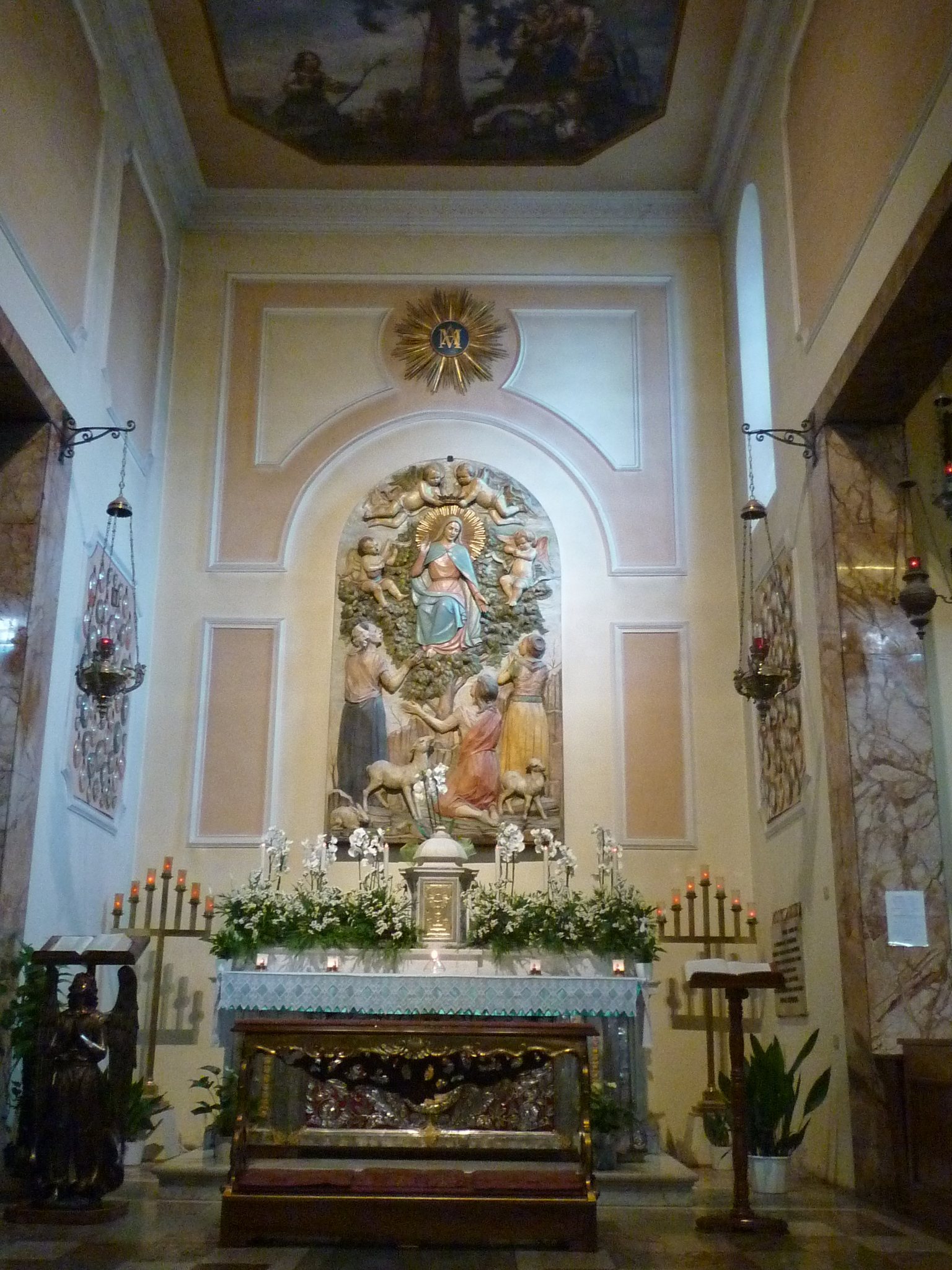
Chapel of the Apparitions
The Chapel of the Apparitions was built in 1530 at the place traditionally identified with the elm apparition. A portion of the elm’s wood was reportedly incorporated into its foundations. The later church enclosed the chapel while preserving its original structure, allowing the first place of worship to remain part of the larger sanctuary.
The chapel originally opened on the right side of the church and functioned almost like a lateral aisle. In the early nineteenth century, Gaetano Costalonga decorated it with imitation-marble painting. Its original walls were demolished during the 1945 enlargement because they had become weak. A larger central body with two smaller lateral spaces replaced them.
Church facade and interior
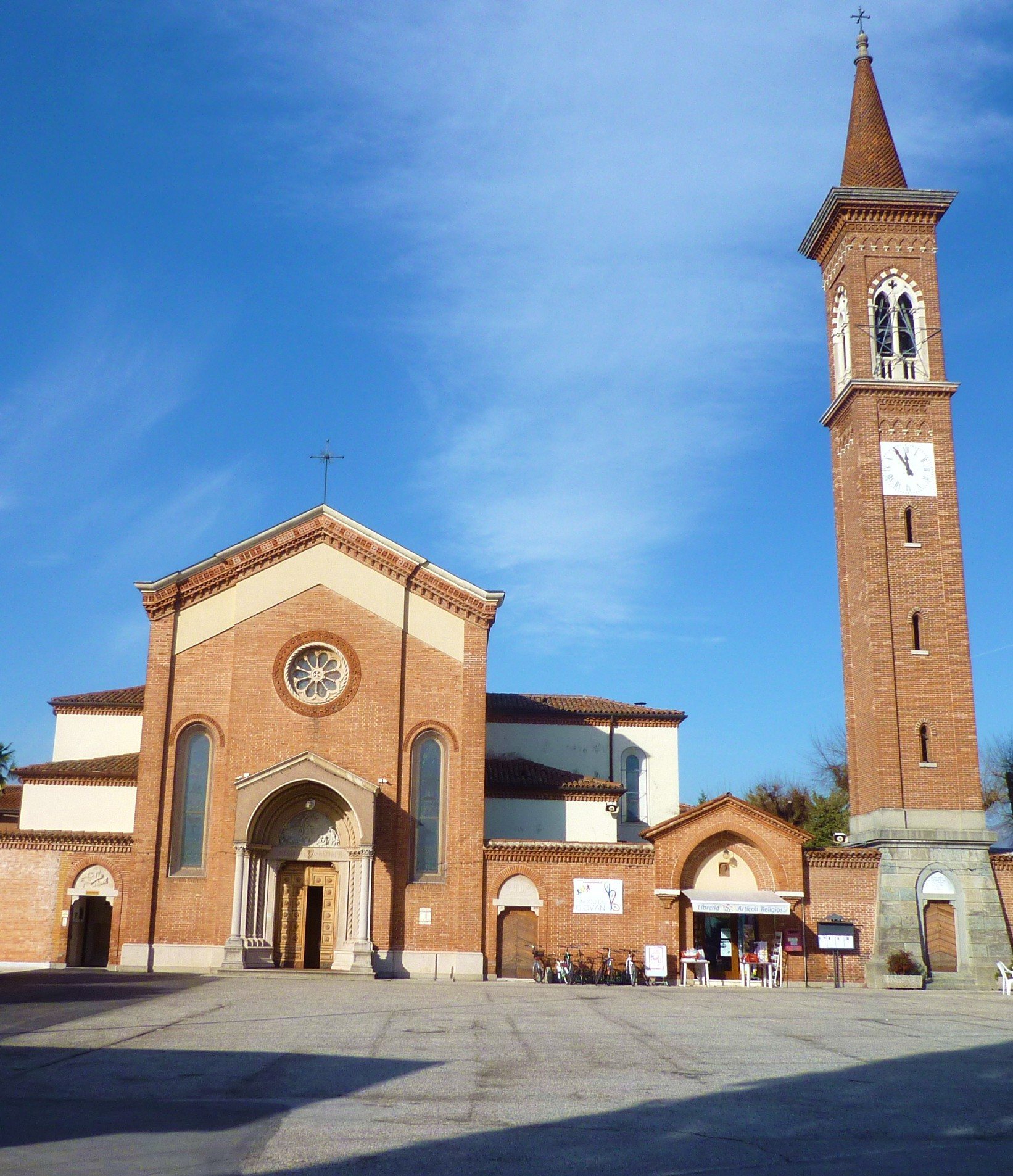
The church constructed after 1610 measured 32 metres by 21 metres. Its original facade was gabled and had a single central doorway, a small round window above it, and two rectangular side windows extending almost to the sides of the circular opening. The interior initially had exposed roof timbers and a simple high altar.
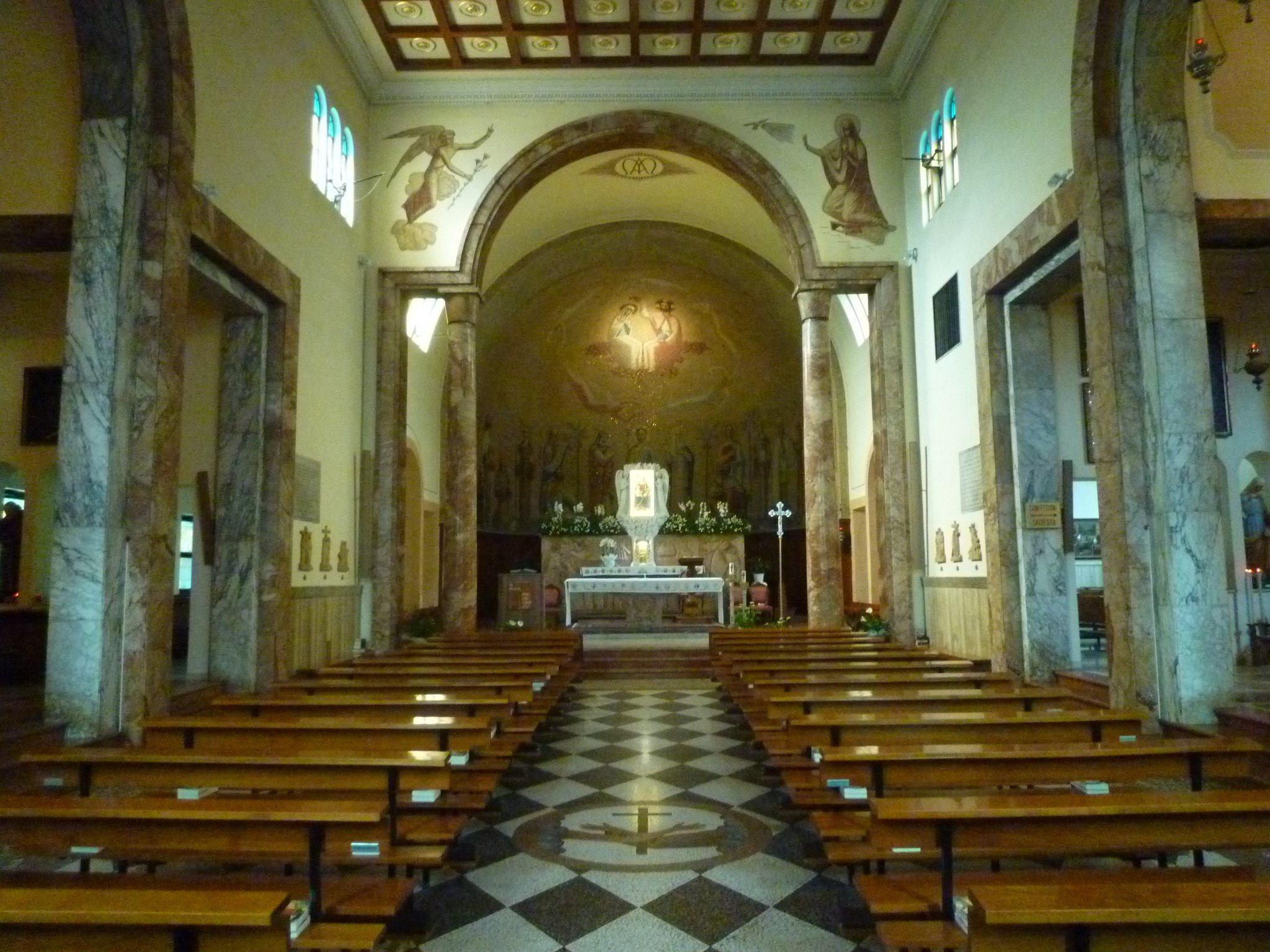
Carlo Pasinati designed the present facade, rebuilt in 1910 in the sanctuary’s composite Romanesque-Gothic style. Vittorio Altieri designed the brick bell tower added in 1930 for the fourth centenary of the apparitions. In 1954, under Dino Altieri’s direction, the coffered ceiling was raised, while the Chapel of Saint Francis, the presbytery, and the choir were enlarged. The presbytery is the area around the main altar.
Altars, paintings, and mosaic
Devotional panel and high altar
The central devotional image is a small panel painted in 1530 by Gian Giacomo Cavobianco of Schio on elm wood. It shows the Madonna seated among the upper branches of an elm, wearing a crimson tunic and a dark-blue mantle edged in gold and covered with stars. The Christ Child sits on her right knee and holds a small bird, while the Madonna holds a closed book. A green hilly landscape and golden sky fill the background.
The panel bears the painter’s name and the date 1530. Cavobianco was little known otherwise, but the work displays careful modeling, proportion, shading, and treatment of volume, together with intense Venetian-style colors. Giuseppe Poppini restored it in 1832, and another restoration was completed in March 2018.
In 1960, on a design by Giovanni Cerutti, Danilo Andreose created a pink-marble high altar. Its sides have relief carving, while the central portion is fully sculpted. The 1530 panel was placed above the altar within a stylized elm whose trunk contains the tabernacle. Two white Carrara-marble angels support the panel.
Later altar and apse mosaic
A later pink-marble altar facing the congregation reflects the liturgical reforms associated with the Second Vatican Council, the Catholic council held from 1962 to 1965. Its base imitates an elm tree. A relief in the marble trunk shows three loaves in a basket above two fish, referring to the multiplication of the loaves and to Eucharistic symbolism.
Angelo Gatto created the large apse mosaic between 1957 and 1959. It fills the vault and depicts Mary crowned by Jesus Christ, surrounded by angels and accompanied by saints and theologians. The left choir contains a Visitation and the right choir an Immaculate Conception, both by Giulio Carpioni. The Chapel of the Apparitions also contains paintings of Saint Joachim and Saint Anne attributed to Alessandro Maganza.
Convent and cloister
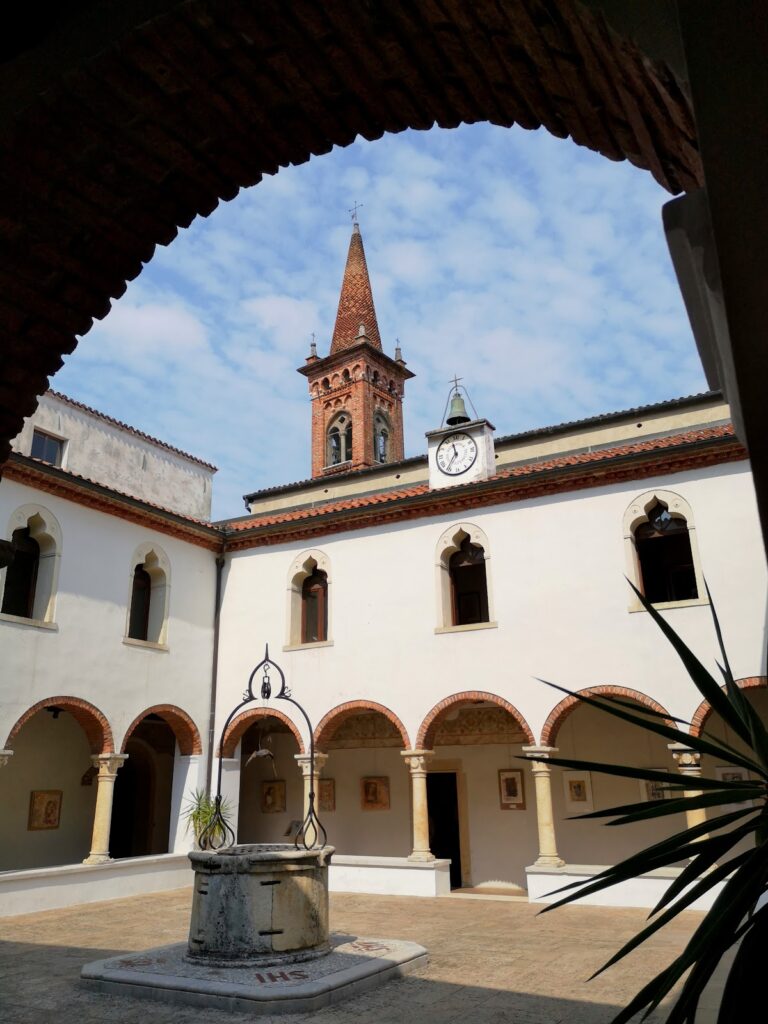
The convent behind the church was designed for approximately fifteen people. It included a small cloister with a centrally positioned well. The seventeenth-century cloister remains part of the complex and was restored toward the end of the twentieth century.