Santa Maria del Cengio: A Marian Church and Convent in Italy


Site at a Glance
- Rating
- 4.7
- Popularity
- Low
- Country
- Italy
- Primary era
- Early Modern
- External website
- Open
- Eras represented
- Medieval, Early Modern, Modern
- Civilizations
- Italian, Venetian
- Site type
- Religious
- Remains
- Monastery
On this page16 sections
History
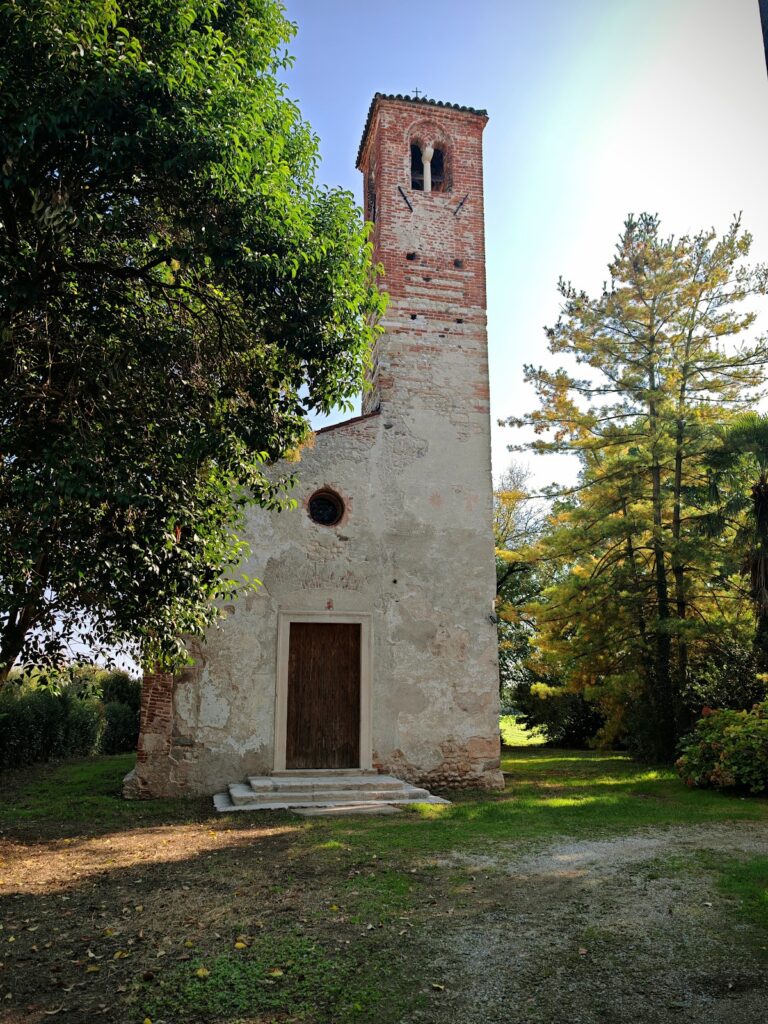
Santa Maria del Cengio is a Roman Catholic church dedicated to the Virgin Mary in Isola Vicentina, Italy, within the Diocese of Vicenza. Known by the end of the twelfth century and first mentioned in 1192, it may have begun as a parish church, a resting place for travelers, or a chapel connected with an ancient castle. Its history later became closely linked to a convent that housed several religious communities and shaped the church’s development.
Medieval origins and ecclesiastical administration
A priest was serving at Santa Maria del Cengio by 1273. By 1334, chaplain-vicars appointed by the archdeacon of Vicenza Cathedral administered the church. Medieval forms of its name included Santa Maria a Zenglo, Santa Maria a Cenglo, and Santa Maria del Cigno. The name Santa Maria del Cengio became established during the seventeenth century.
In 1447, Benedetto Zeno left fifty pounds for a residence beside the church intended for friars or hermits. His relative Lucrezia Zeno and her husband, Giovanni Porto, carried out this provision. Giovanni Porto donated land and houses to the church and obtained the right of patronage for the Porto family, meaning that the family could exercise recognized rights over the church and present its clergy. The arrangement allowed Andrea Porto’s heirs to retain ownership while the convent was vacant. It also directed that, if conventual life ended, the property should pass to the Hospital of San Marcello degli Esposti for abandoned children.
The Bridgettine foundation
On 7 March 1455, Battista of Normandy received the church and its benefice from Pietro Barbo, then bishop of Vicenza. A benefice was an ecclesiastical office or endowment that provided income. On 24 June 1456, Barbo authorized the first four Bridgettines to live in the convent. The Bridgettines belonged to the Order of Saint Bridget, a religious order founded in the fourteenth century. Their arrival began conventual life at Santa Maria del Cengio, including the restoration of the church and construction of the high altar.
The Bridgettines surrendered their investiture and left in January 1462. Investiture was the formal granting of rights or possession associated with an ecclesiastical office. Their departure brought the first phase of conventual life to an end, but the religious foundation continued under a different community.
The canons of San Salvatore
After the Bridgettines departed, the convent passed to the canons of San Salvatore, of the Order of Saint Anthony. They remained there for more than three centuries. A bull issued by Pope Paul II in 1466 required the convent’s revenues to be increased through the incorporation of the nearby lowland parish church of San Pietro. The convent consequently gained the right to appoint and support San Pietro’s priest.
During the second half of the seventeenth century, the church was remodeled. The work added the left nave, the presbytery surrounding the main altar, several side altars, and a new high altar. These changes gave the church much of the arrangement associated with its later interior.
Suppression and the Porto patronage
Three Venetian measures ended the conventual institution in the eighteenth century. On 7 September 1768, a rule connecting convent revenues with the number of resident religious led the prior to surrender the benefice of San Pietro, which again became independent. The Lateran canons were suppressed on 16 May 1771, followed by the suppression of the canons resident at Isola on 12 September 1771. Conventual life ceased, and Santa Maria del Cengio was no longer officiated.
After the suppression, the convent’s property passed to the Hospital of Santa Maria and San Cristoforo in Vicenza, commonly known as San Marcello. Under the earlier patronage arrangement, the Porto family recovered ownership while the convent was vacant and thereafter appointed the church’s rectors. Gaetano Porto was appointed in 1781, Giovanni Battista Gasparoni in 1836 on the bishop’s recommendation, and Stefano Dalla Cà in 1857.
The Servants of Mary and twentieth-century change
After Stefano Dalla Cà died in 1894, Count Antonio da Porto selected the Servants of Mary to restore religious life and take charge of the convent. The Servants of Mary are a Catholic order devoted particularly to the Virgin Mary. Once the family’s dispersed properties had been consolidated, the order’s general council formally founded the Isola convent on 14 December 1904 as a dependency of Monte Berico, the major Marian sanctuary in Vicenza. The convent became independent in 1912, when Filippo M. Grendene was appointed prior.
Educational work began in 1905 with four boys and later grew to thirty. In 1928, Isola became the Venetian seat of the Servants of Mary’s novitiate, the period of preparation for members entering religious life. During the First World War, soldiers stayed at the convent. The complex also housed a hospital, sheltered families, and temporarily accommodated the village primary school.
A fire severely damaged the convent during the night of 22–23 September 1931. Residents carried the statue of the Madonna outside, probably saving it from the flames. Several structures were demolished because they threatened to collapse, leaving the convent and church temporarily unusable. Worship resumed on 8 December 1931, after six months and twenty days, while scaffolding was still in place. The rebuilding shifted the principal entrance toward Valtessera and included a more convenient road for commercial vehicles serving the convent.
The complex continued to develop through repairs, additions, and religious initiatives. Fourteenth-century frescoes were restored in 1920, a new altar dedicated to Our Lady of Sorrows was built in 1928, and the Via Matris, a devotional practice centered on the sorrows of Mary, was inaugurated in 1939. A convent wing built perpendicular to the earlier complex in 1914 was renovated in 1928 and enlarged between 1944 and 1945. A separate hermitage house was established in 1976, and the Madonna statue was restored in 1993.
Remains
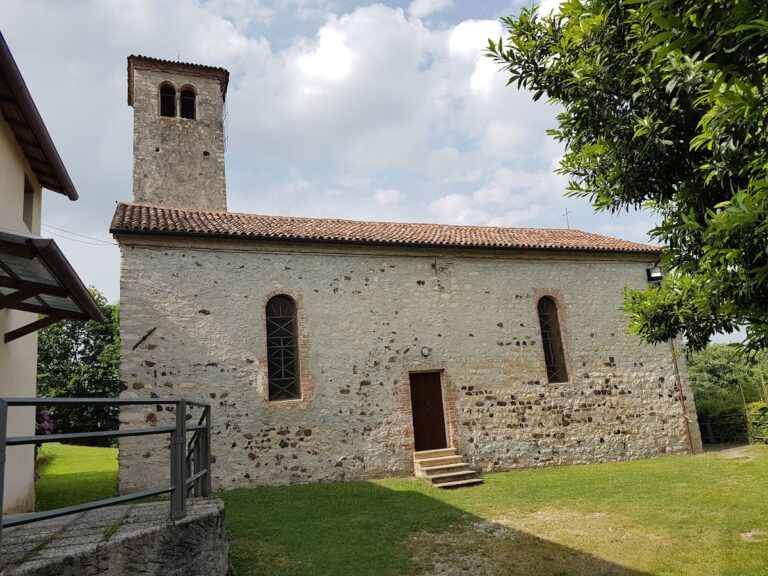
Santa Maria del Cengio and its convent occupy a rocky ledge at the terminal part of a mountain. The ledge is formed from white rock mixed with limestone and sandstone, a geological feature associated with the name Cengio. The surviving complex consists of the church, convent, cloister, and a small separate hermitage house. Its present extent reflects the seventeenth-century remodeling of the church and the successive twentieth-century changes to the convent.
Approach and convent structures
Bridges and original entrance
The convent stands across the Giara stream from the town. Two bridges built in 1874 serve the religious complex: the Bridge of Santa Maria on present-day Via Giarre and a smaller pedestrian bridge connecting the road with the beginning of the steps. The original pedestrian approach rises from the road by stone steps to the former north-facing entrance. Decorated uprights with floral panels support an architrave inscribed “Ave Maria – Gratia Plena.” This doorway now functions as a side entrance to the church, while the principal entrance faces west near the entrance to the complex kiosk.
Cloister and bell
Begun in the fifteenth century, the cloister has a square plan and covered walkways supported by four columns on each side. The columns were carved from the rock on which the convent stands. The cells occupy the upper floor and run along three sides of the cloister. Above it are a clock and bell commissioned by Pietro Dalle Ore in 1474. The bell carries the inscription “Glory to God and to Christ who became man.”
Hermitage house and later wings
A small, separate house serves as a hermitage and was established in 1976. The built complex also includes the convent wing erected perpendicular to the earlier buildings in 1914. That wing was renovated in 1928 and enlarged between 1944 and 1945, producing the present extent of the convent buildings.
Church interior and altars
High altar and apse
The church contains a main altar, two side altars, and two additional minor altars along the south wall. The high altar was once placed against the rear wall of the apse but now stands at the center of the presbytery. Its frontal bears a bas-relief of the Presentation of Jesus in the Temple carved by Orazio Marinali. At the rear of the apse, the Madonna stands within a support formed by two Corinthian columns topped by two angels.
The statue was made by Girolamo da Vicenza around 1490. It shows Mary standing with the infant Jesus in her arms rather than seated on a throne. Two niches in the apse walls contain statues of Mary’s parents, Saints Joachim and Anne, made by Orazio Marinali. The altar nearer the apse is dedicated to Our Lady of Sorrows, while the altar nearer the entrance belongs to the Chapel of Saint Bridget.
North-wall altars
The two side altars along the north wall stand on either side of the former entrance. One is dedicated to the Guardian Angel and was built in 1694, the date shown on its pediment. Its 1728 altarpiece by Cristoforo Menarola depicts the Virgin and Child with Saint Anthony of Padua, a guardian angel, and Saint Roch.
The other north-wall altar is dedicated to Saints Charles Borromeo and Cajetan of Thiene. The Cerchiari-Bissari couple commissioned it in 1682, and its 1684 altarpiece was painted by Pietro Bartolomeo Cittadella. The painting represents the two saints to whom the altar is dedicated.
Chapel of Saint Bridget
The Chapel of Saint Bridget is the first chapel on the right. It contains two probably fifteenth-century frescoes, Saint Bernardino on the left and a badly damaged Saint Sebastian on the right. A small niche retains fragments of a surrounding fresco.
Fresco fragments
Traces of an earlier fresco remain on the church’s right-hand wall, where they were uncovered in 1976. The wall was repainted so that a fragment found during the 1920 restoration of the upper cloister could be mounted there. The fragment depicts the Madonna with Isaiah on the left and John the Evangelist on the right.
Nearby sites