Fort Edward: A British Fortification in Windsor, Nova Scotia
Site at a Glance
- Rating
- 4.2
- Popularity
- Low
- Country
- Canada
- Primary era
- Early Modern
- External website
- Open
- Eras represented
- Early Modern
- Civilizations
- British
- Site type
- Military
- Remains
- Fort
On this page10 sections
History
Fort Edward is an eighteenth-century British fortification in Windsor, Canada, established in 1750 during Father Le Loutre’s War, a conflict involving British expansion, French and Acadian resistance, and Mi’kmaq opposition in Acadia. The British built it at Pisiguit, the community’s former name, to discourage Acadian departure and protect Protestant settlements from attacks by Mi’kmaq, Acadians, and the French.
Foundation and British Expansion
The fort occupied the site of the Acadian parish church of l’Assomption, which had been established in 1722. On 7 June 1750, Major Charles Lawrence ordered local Acadians to demolish the church so that the new fort could be built. Captain John Gorham named the installation for Edward Cornwallis, the British officer and colonial administrator who founded Halifax in 1749.
Fort Edward formed part of a wider British chain of fortified settlements in Nova Scotia. Other posts included Fort Sackville at Bedford, Fort Vieux Logis at Grand Pré, Fort Lawrence at Chignecto, and Fort Anne at Annapolis Royal. Government sloops supplied the garrison, carrying provisions, officers, and their families.
The Expulsion of the Acadians
Fort Edward became closely associated with the Bay of Fundy Campaign and the Expulsion of the Acadians in 1755. The expulsion was the forced removal of Acadian communities by British authorities from Nova Scotia and neighbouring colonies. On 5 September 1755, Captain Alexander Murray read the expulsion order to 183 Acadian men imprisoned at the fort. On 20 October, 920 Acadians from Pisiguit were placed aboard four transports.
Unlike at Grand Pré, British forces did not burn or destroy the local houses and barns at Pisiguit. New England Planters later used those buildings. Fort Edward was one of four forts used to imprison Acadians during the nine-year expulsion, alongside Fort Frederick, Fort Cumberland, and Fort Charlotte on Georges Island. About 350 Acadian prisoners were held at the garrison at a time and were forced to work for the New England Planters. After the war, many Acadians settled in what is now New Brunswick and Saint Pierre and Miquelon rather than remain in subordinate conditions.
Resistance and Detention
Acadian and Mi’kmaq resistance continued during the expulsion. In September 1756, about 100 Acadians ambushed thirteen soldiers of the 47th Regiment of Foot who were working outside the fort, taking seven of them prisoner. In April 1757, Acadian and Mi’kmaq partisans raided a warehouse near Fort Edward, killed thirteen British soldiers, carried away provisions, and burned the building.
British authorities detained 363 Acadians from the Minas region at Fort Edward between June 1763 and 1764. Joseph Broussard, known as Beausoleil, was also imprisoned there in 1762. Broussard was an Acadian military leader who resisted British control during the conflicts surrounding the displacement of Acadian communities.
Command and Military Use
Alexander Murray commanded Fort Edward from September 1751 through most of the following seven years, apart from a tour of duty at Halifax in 1753. In December 1752, the Nova Scotia Council accused him of exploiting the local Acadian community through unfair prices and arbitrary imprisonment. Captain William Phipps, an earlier commander, died around February 1751. Other recorded commanders or commanding officers included George St. Loe, Patrick Sutherland, John Hale, Matthew Floyer, Nicholas Cox, William Lampson, Silvanus Cobb, Quintin Kennedy, Daniel Fletcher, Jotham Gay, and Edmund Wetmough. Cox is identified as the fort’s longest-serving commander.
During the American Revolution, Fort Edward served as the Atlantic Canadian headquarters of the 84th Regiment of Foot, also called the Royal Highland Emigrants. The regiment moved there from Halifax to guard against a land assault on that city, and the fort held prisoners captured from American privateering vessels.
Flora MacDonald and her husband, Alan Macdonald, spent the winter of 1778 to 1779 at Fort Edward. MacDonald was a prominent Jacobite supporter associated with the cause of the Stuart monarchy in Britain. She later returned alone to Scotland.
Fort Edward remained part of the British defenses of Nova Scotia until 1858. It was active during the War of 1812, when it continued to protect the province against American privateers.
Later Military and Community History
During the First World War, the site became a training depot for Canadian and British soldiers and was informally called Camp Fort Edward. The British also trained Jewish recruits there for service against the Ottoman Empire in Palestine. The Jewish Legion was a First World War formation composed largely of Jewish volunteers serving with British forces in that campaign.
The 39th Battalion of the Jewish Legion trained at Fort Edward under Lieutenant Colonel Eliezer Margolin. Approximately 1,100 Jewish troops trained at the camp, with Major W. F. D. Bremner associated with it. Recruits lived in tents on the hillside below the blockhouse. David Ben-Gurion and Ze’ev Jabotinsky, both founders of the Jewish Legion, trained at Fort Edward. Ben-Gurion later recalled receiving his first military training and becoming a corporal at Windsor.
The Windsor Agricultural Fair was first held on the fort grounds in 1765. An annual autumn fair continues nearby and is described as the oldest surviving agricultural fair in North America. Its continuing existence is also dated from 1815. Fort Edward became a National Historic Site of Canada in 1920, while the blockhouse received separate classification as a Federal Heritage Building in 1994.
Remains
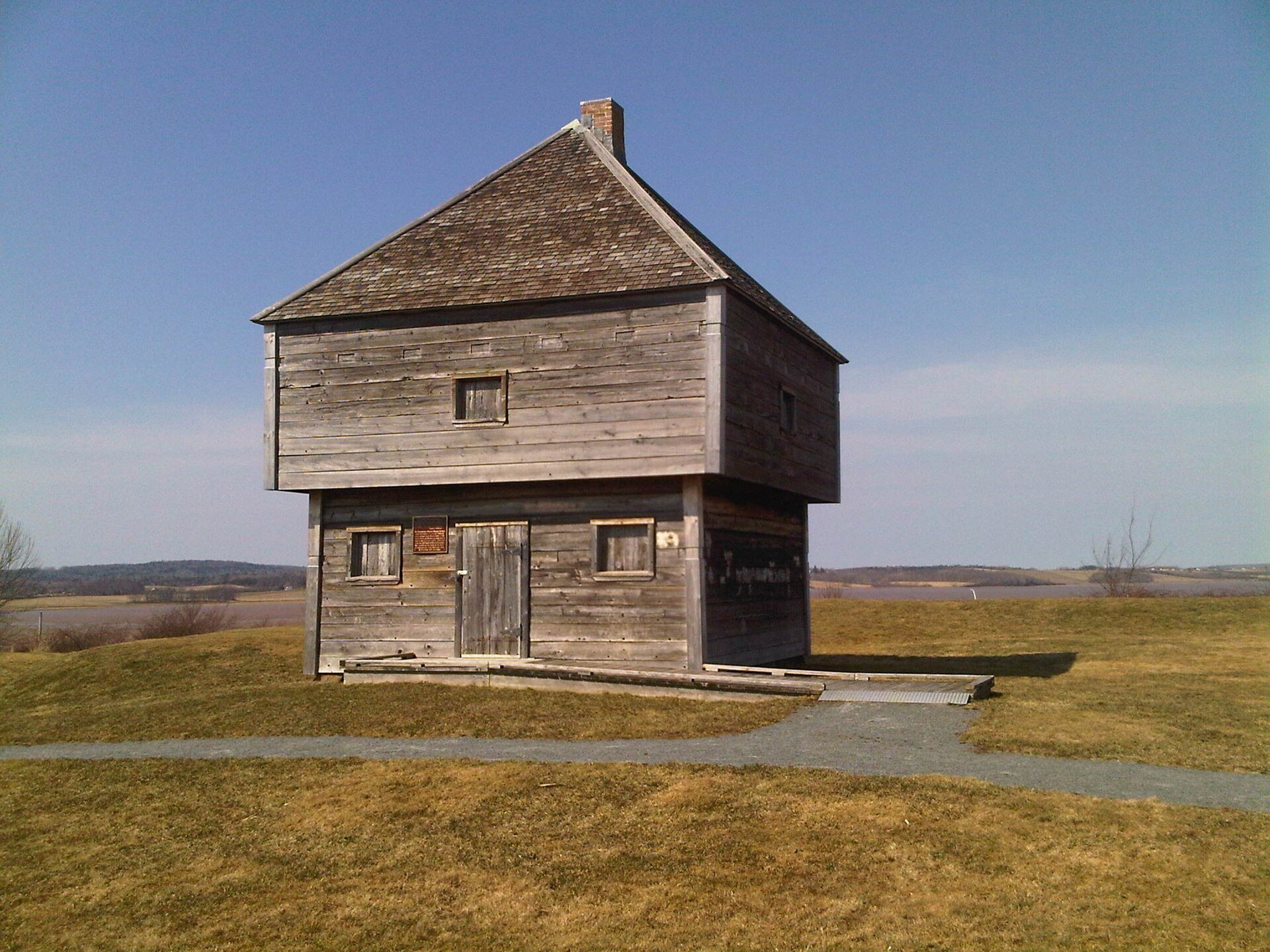
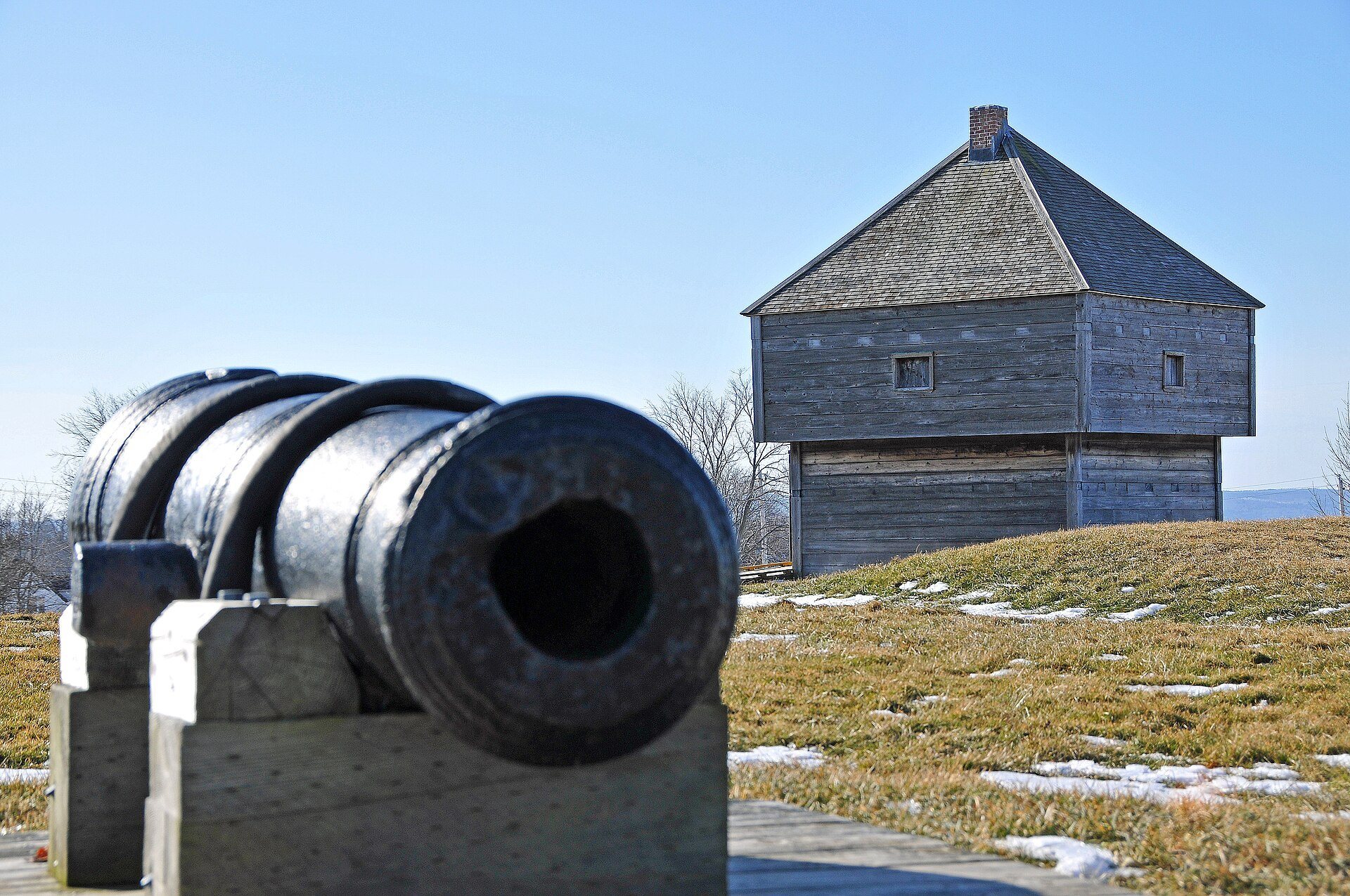
The surviving physical elements of Fort Edward are centered on a blockhouse and earth fortifications, the principal remnants of the original installation. The blockhouse stands above the hillside used for First World War training tents. A cairn was later added to the site, providing another visible marker of its history.
Fortifications and Commemorative Features
Blockhouse
The blockhouse is a compact fortified building designed to give troops protected firing positions and shelter. It is described as the oldest surviving blockhouse in North America and forms the principal surviving building associated with Fort Edward. Its position above the hillside connects the eighteenth-century defensive installation with the site’s later military use during the First World War.
Earth Fortifications and Cairn
Earth fortifications accompanied the blockhouse and preserve part of the fort’s original defensive character. The officers’ quarters burned in 1922, and the barracks were destroyed. A cairn was subsequently added to the grounds, complementing the surviving earthworks and blockhouse as a physical reminder of the fort’s long military history.