Palazzo Toaldi Capra: A Renaissance Civic and Cultural Palace in Schio
Site at a Glance
- Rating
- 4.5
- Popularity
- Very Low
- Country
- Italy
- Primary era
- Medieval
- External website
- Open
- Eras represented
- Medieval, Early Modern, Modern
- Civilizations
- Italian, Venetian
- Site type
- Domestic
- Remains
- Elite Residence
On this page6 sections
History
Palazzo Toaldi Capra is a Renaissance palace in Schio, Italy, whose present structure largely dates from the fifteenth century. It began in the fourteenth century as the residence of the Venetian da Pozzo family and is now recognized as an Italian cultural property. Its former name, “ca’ da Pozzo,” recalled the family that first occupied it.
From the da Pozzo residence to the Capra family
The da Pozzo family retained the palace until at least 1512. Ownership then passed to the Toaldi family and later to the Capra family. By the middle of the seventeenth century, the residence probably belonged to Giovan Battista Capra, who placed it on the market in 1668. Changes in ownership and function brought extensive alterations to the earlier building and contributed to the form it has today.
A civic and institutional building
In the second half of the eighteenth century, the Municipality of Schio acquired the palace and transferred the town’s Monte di Pietà there from the Loggia dei Battuti of San Giacomo. A Monte di Pietà was a charitable lending institution that offered secured loans, generally providing an alternative to high-interest private lending. The palace later became the seat of Schio’s municipal administration, a role it retained until the offices moved to Palazzo Garbin in 1914.
During the Fascist period, the building housed the 44th Volunteer Legion of National Security, a Fascist paramilitary organization, and probably other structures connected with Fascist Party activities. These functions moved to Villino Rossi in 1936. After the Second World War, the palace accommodated upper-secondary educational institutions. Conservation and restoration work in 1980 was followed by its use for exhibitions and conferences. The building is owned by the Municipality of Schio and continues to serve cultural and exhibition purposes. Until the 1980s, it was commonly but incorrectly known as Palazzo Tron.
Remains
Facade and exterior setting
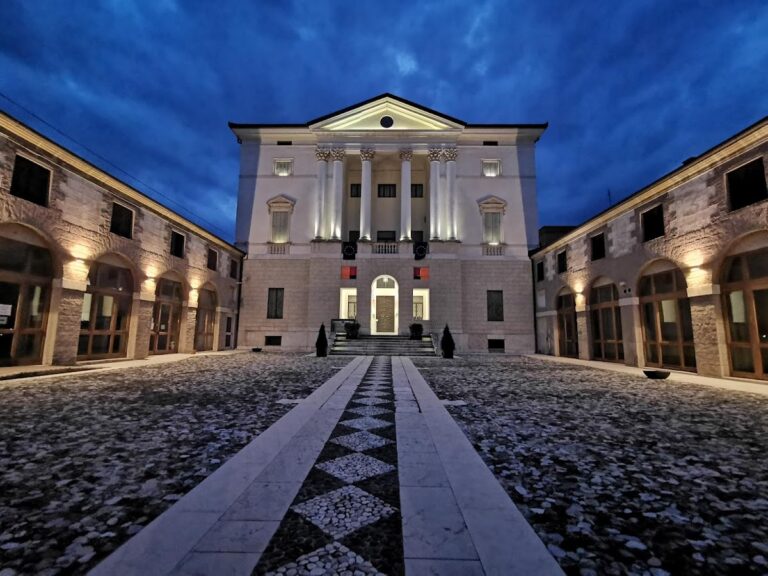
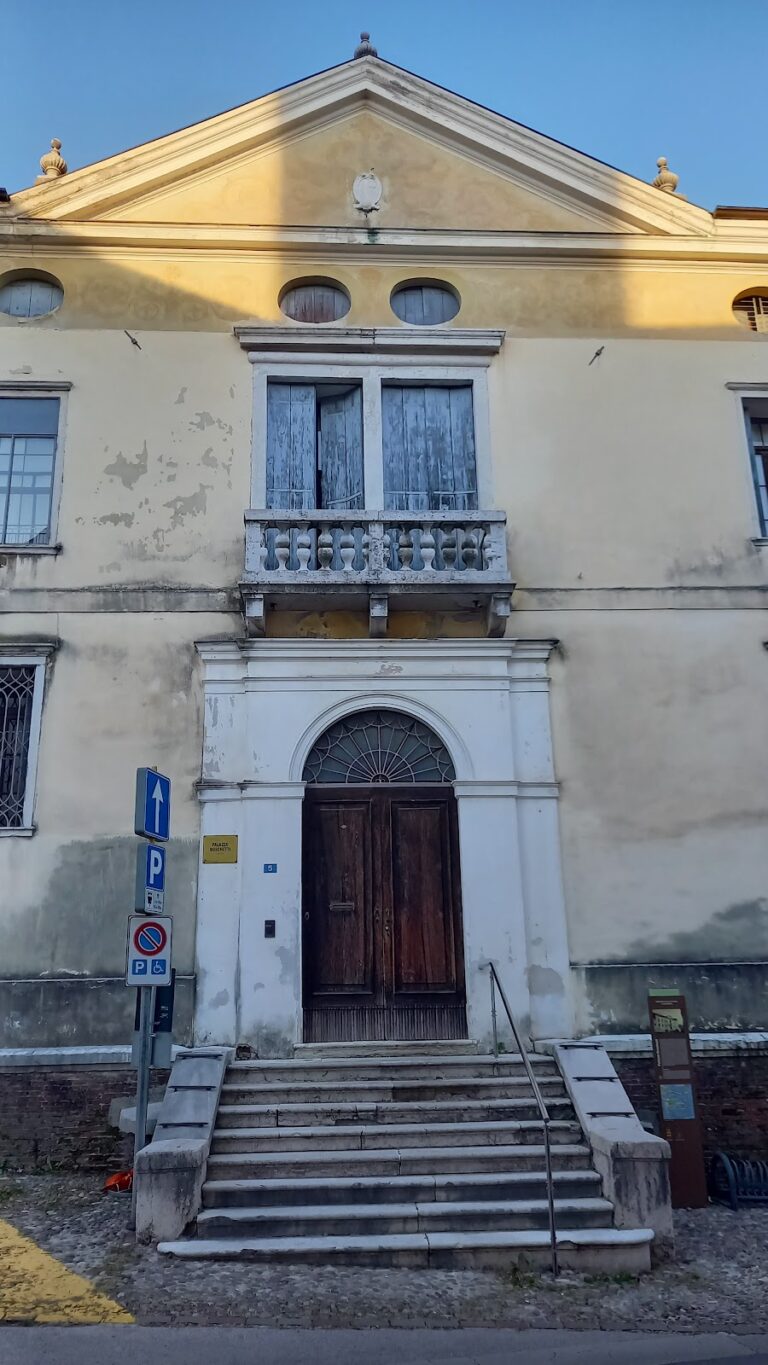
The palace stands along central Via Pasubio and has a slightly asymmetrical exterior that reflects its older origins. Its overall appearance is Renaissance. Rough plaster with horizontal bands covers the ground floor, while the upper levels have smooth plaster. Numerous rectangular windows punctuate the facade, with single openings at the sides and paired central windows equipped with balconies. A stone portal with a semicircular arch forms the entrance.
Several commemorative works enrich the facade. A marble bust of Nicolò Tron, sculpted by Pietro Danieletti and dated 1772, is set into the building. A bronze bust of Giuseppe Garibaldi occupies a marble frame; Carlo Lorenzetti made it in 1882, and it is described as the first monument dedicated to Garibaldi, the military leader and political figure associated with the nineteenth-century movement for Italian unification. A plaque also commemorates those who died for the Unification of Italy, the political process that brought the Italian states together into the Kingdom of Italy.
Interior rooms and restored areas
The interior contains numerous rooms. On the first floor, one room preserves frescoes discovered during the 1980 restoration. The paintings show scenes from the Gospels and date from the early fifteenth century, providing a surviving glimpse of the palace’s decoration during the period associated with its present structure.
Behind the palace, restoration revealed an open area that was later adapted as a small arena for performances of various kinds. This space forms part of the building’s current cultural use while remaining connected to the historic palace and its restored fabric.
Nearby sites