San Francesco di Paola: A Roman Catholic Church and Former Minims Monastery in Palermo
Site at a Glance
- Rating
- 4.7
- Popularity
- Medium
- Country
- Italy
- Primary era
- Early Modern
- External website
- Open
- Eras represented
- Medieval, Early Modern, Modern
- Civilizations
- Kingdom of Sicily, Kingdom of the Two Sicilies, Spanish
- Site type
- Religious
- Remains
- Church
On this page31 sections
History
San Francesco di Paola is a Roman Catholic church in Palermo, Italy, built by the Order of Minims between 1518 and 1594 in a complex that combines late Gothic, Mannerist, and Baroque elements. The church developed from an earlier foundation dedicated to Saint Oliva and became the principal church of a Minims monastery, an order founded by Saint Francis of Paola.
The church of Saint Oliva
A church dedicated to Saint Oliva occupied the site by at least 1310. It stood outside Palermo’s walls near Porta Carini, in an area traditionally identified with the saint’s burial place and also associated with a vineyard and cemetery. Saint Oliva is venerated in Palermo as a virgin martyr linked by tradition with Tunis and the early Christian history of the city. This association shaped both the earlier dedication and the later devotional importance of the site.
From 4 January 1485, the church was held by Palermo’s guild of tailors. In 1518, the guild transferred it to the Minims, a Roman Catholic mendicant order whose name expresses the founder’s ideal of humility and means “the least ones.” The transfer involved Ettore Pignatelli, Count and Duke of Monteleone and later Viceroy of Sicily, and Pope Clement VII confirmed it in 1523.
A tradition connects Pignatelli’s support with a meeting in Tours in 1495. According to this account, Saint Francis of Paola visited Pignatelli while he was imprisoned, predicted his release, and foretold that he would become viceroy of Sicily. Pignatelli’s later involvement in transferring the church to the Minims is associated with this tradition.
Minims monastery and enlargement
The Minims demolished the small church of Saint Oliva and began a larger church and cloistered monastery around 1518. Construction initially followed a Catalan Gothic manner, a regional Gothic tradition represented here by ribbed cross-vaults and related structural details. During the long building period, the design was modified in response to Mannerist taste, the later Renaissance style. Enlargement works were completed in 1594, when the church was consecrated and dedicated to Saint Francis of Paola.
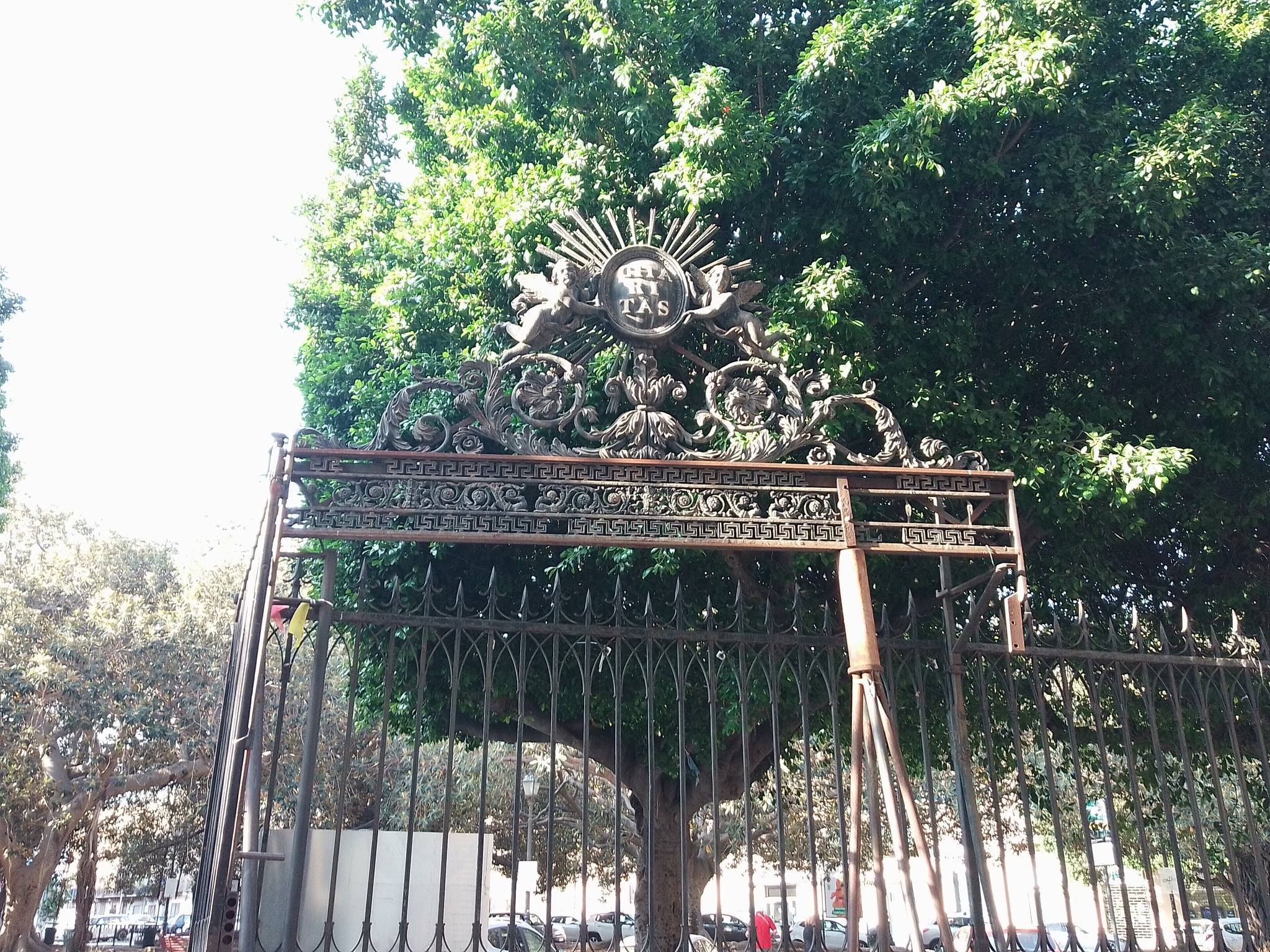
The monastery included a large library and a hospital. Donations from Palermo’s Senate and from the faithful helped produce the richly decorated Baroque interior. A confraternity of Franciscan tertiaries was established in 1739. Its members wore a medallion bearing the motto “Charitas,” a central expression associated with the Order of Minims.
The church retained devotional traditions connected with both of its principal saints. A silver statue of Saint Francis of Paola is carried in procession for his patronal celebration on the second Sunday of May. A silver statue of Saint Oliva is associated with a procession traditionally held on 10 June.
Suppression, military use, and restoration
After the Italian government suppressed the religious orders in 1866, the convent was converted into infantry barracks. The former monastery now accommodates the Ruggero Settimo barracks, an officers’ club, and other military associations. The conversion led to the removal or concealment of many original frescoes, while the former library holdings were transferred to the municipal library of Casa Professa.
On 1 March 1905, through the mediation of Archbishop and Cardinal Alessandro Lualdi, the Minims regained custody of the church and were permitted to live in a small part of the former convent above the church vault. During the First World War, from 1915 to 1918, the church and convent were used as a grain depot. Restoration of the interior paintings was completed in 1934, repairs to damage from Second World War bombing were undertaken around 1950, and the church interior received a comprehensive restoration in 2013 and 2014.
Remains
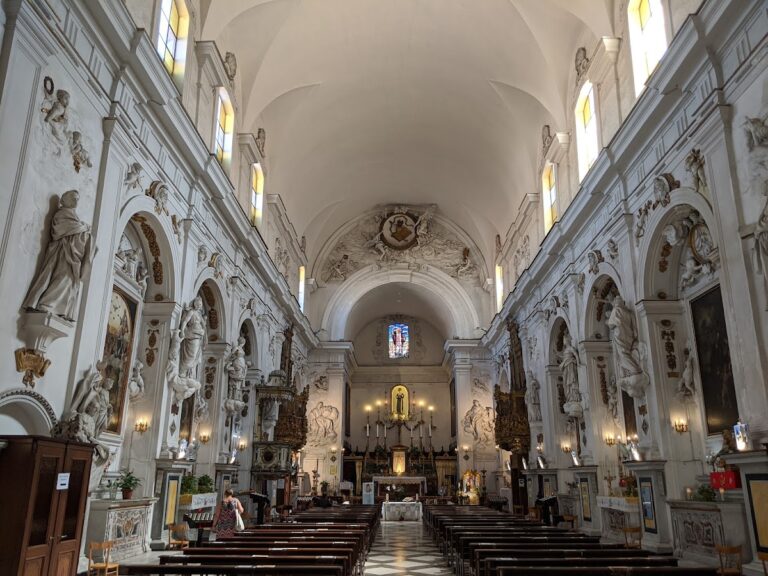
The church has a Latin-cross plan with a single nave and five deep, interconnected chapels on each side. The interior is approximately 40 metres long and 11 metres wide. Its surviving fabric brings together the original late Gothic structure, later Mannerist changes, and extensive seventeenth- and eighteenth-century Baroque decoration.
Exterior and entrance
Facade
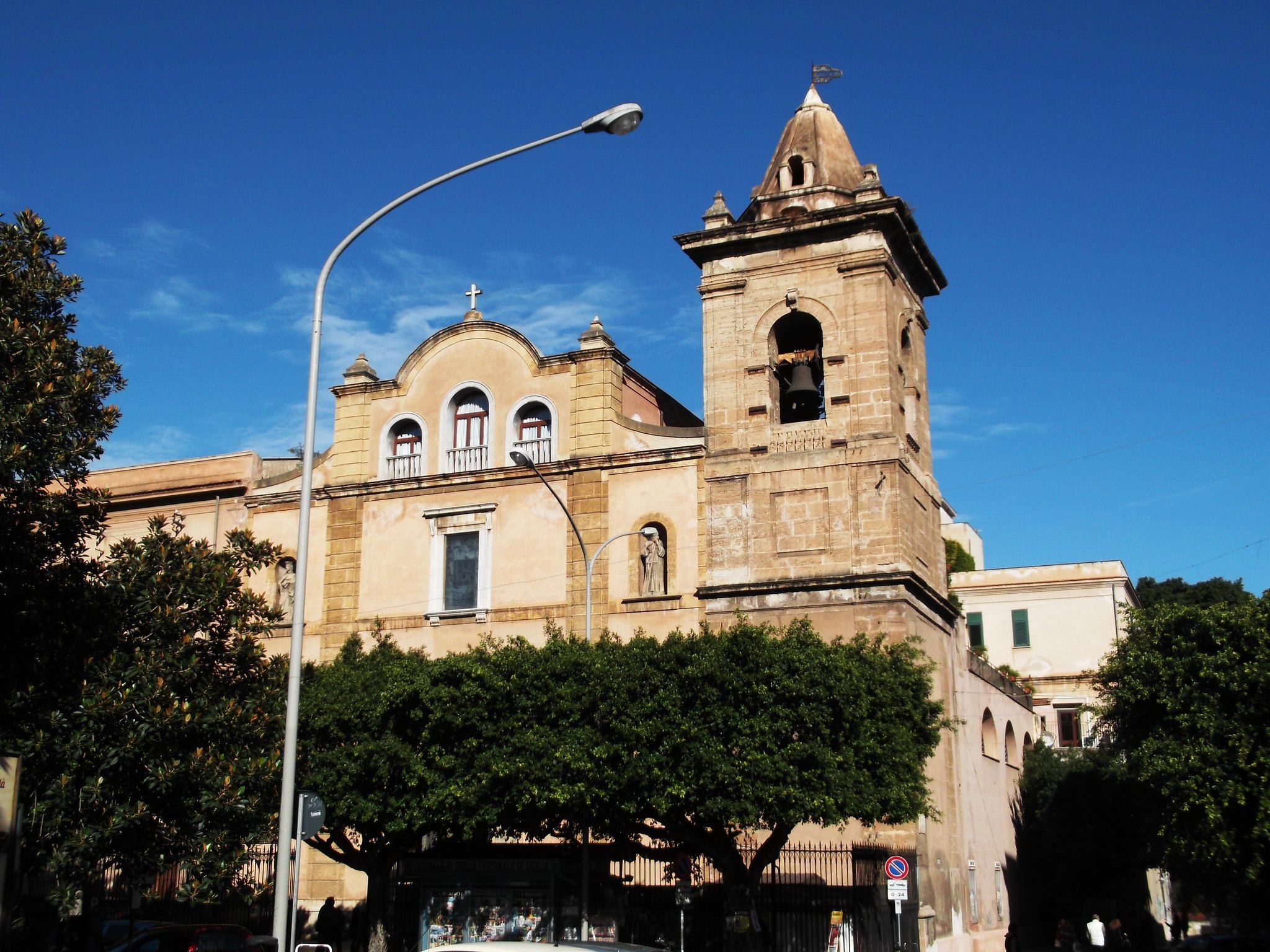
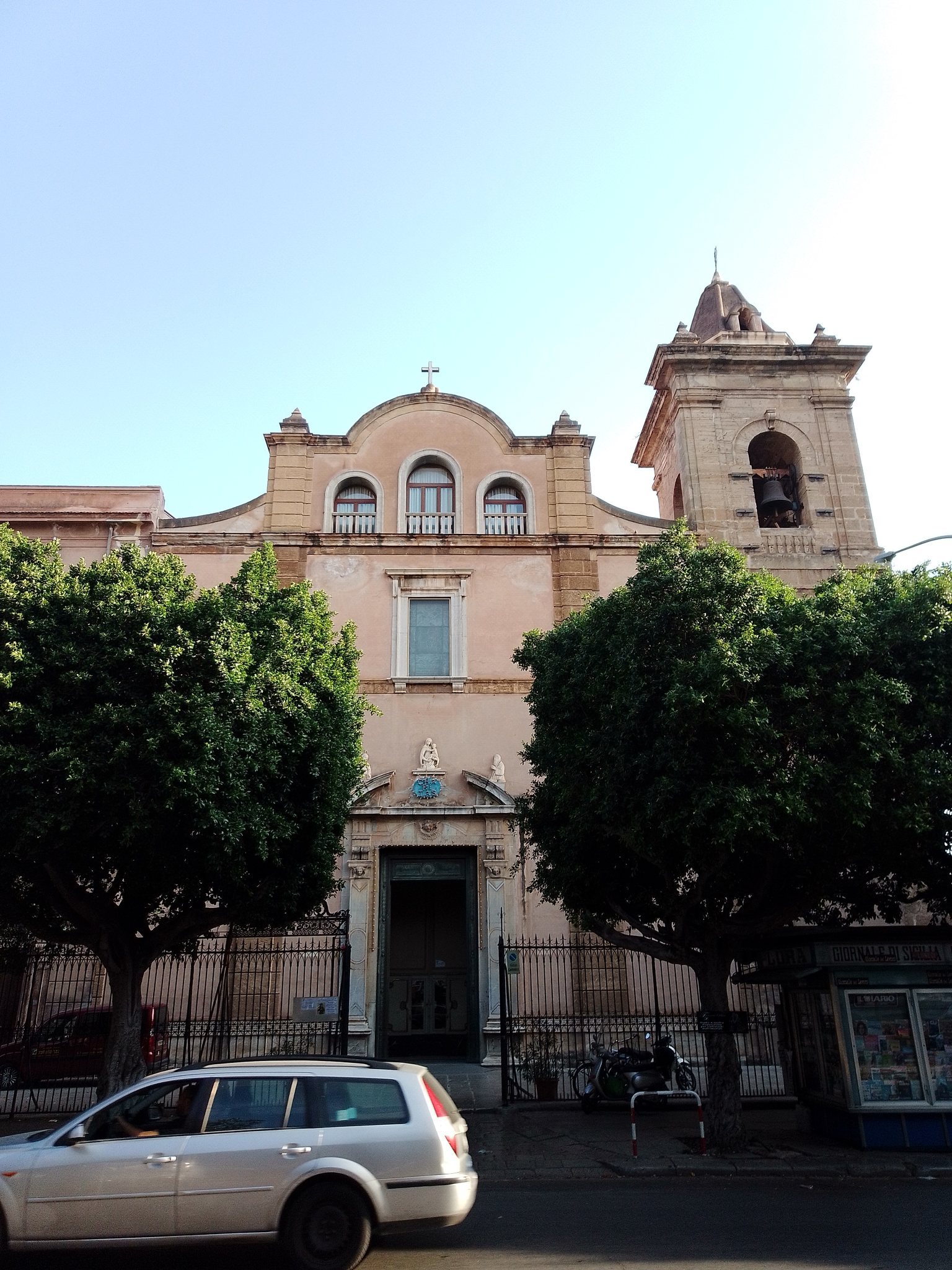
The facade is arranged in three orders by two tall rusticated pilasters and two cornices. Its upper central section ends in a curving pediment incorporating three belvedere loggias, with volutes linking it to the adjoining elements. A stone bell tower closes the composition on the right. The facade also includes a central window, lower-order windows, and full-length figures of Saint Francis of Paola and Saint Oliva set in niches in the second order.
Main portal
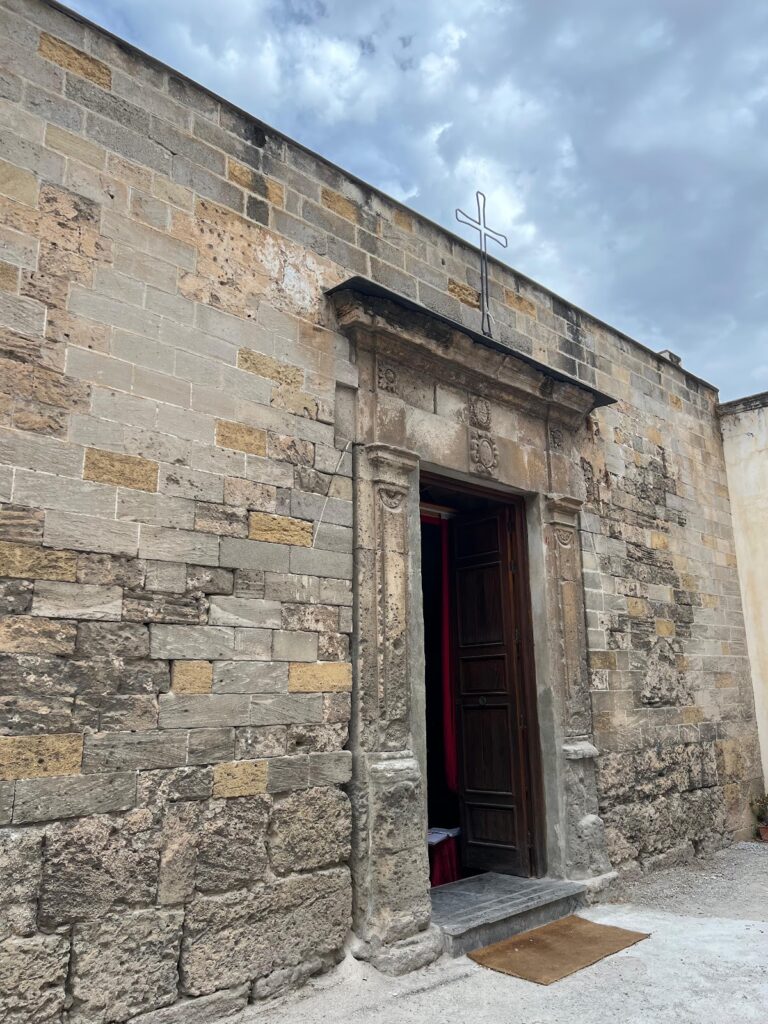
The main portal has pilasters decorated with angel heads and volutes, which support a broken-arched pediment. Above it stands a bust of the Madonna delle Grazie, flanked by sculptures of Saint Oliva and Saint Francis of Paola made by Giacomo Gagini in 1536. A pair of scissors in the lower relief recalls the building’s earlier ownership by the tailors’ guild. A radiating motif bears the word “Charitas,” while the date 1594 and an inscription on the cornice record the completion of the enlargement and the dedication of the church.
Counter-facade
The counter-facade has stucco decoration representing the Glorification of Saint Francis. Beside the historiated window are the Madonna of the Rose and Saint Charles Borromeo in prayer, works attributed to Zoppo di Gangi and dated to around 1620. The lunette frescoes are by Fra Mariano Castelli of Vicari.
Nave and presbytery
Nave vaults
The nave retains ribbed cross-vaults with pendant keystones, structural features that survive from the original Catalan Gothic design. Giuseppe Salerno painted the vault panels with groups of saints associated with Palermo and the wider Church, including the city’s four female patron saints, the four Doctors of the Church, four martyr saints, and the four Evangelists.
Chapel arches and pilasters
The arches between the chapels carry frescoes of the Miracles of Saint Francis of Paola. Between the windows, Fra Mariano Castelli painted figures of the Apostles between 1700 and 1710. He also created the stucco crowning of the arches, the stucco decoration above the interior entrance, and the polychrome-marble inlay of the presbytery pilasters. Putti and symbols referring to the Order of Minims are incorporated into the pilasters.
Presbytery
The presbytery vault contains allegorical frescoes of Peace, Wisdom, Charity, and Hope by Vito d’Anna and his son Alessandro d’Anna, dating from around 1766. The presbytery walls carry Giuseppe Salerno’s Birth of Saint John the Baptist and Nativity of Jesus. The high altar is decorated with polychrome marble, hard stones, and gilded copper friezes. Michele Messina made its ciborium, the architectural canopy over the altar, in 1829. Patronage and burial rights at the high altar belonged to the Branciforte family, the Counts of Cammarata, and the Barresi family.
Right-side chapels
Saint Catherine of Alexandria
The first chapel on the right is dedicated to Saint Catherine of Alexandria. Its altarpiece is by Filippo Paladini, and the marble reliefs framing it are attributed to Antonello Gagini. They came from the earlier church. Vincenzo Gagini is buried near the balustrade.
Sacred Heart of Jesus
The second chapel on the right is now dedicated to the Sacred Heart of Jesus. It was formerly dedicated to Saint Charles Borromeo and later to the Epiphany, or Three Kings. Its walls contain frescoes of Judith beheading Holofernes and Esther before King Ahasuerus. Corner niches occupy a polygonal drum, and an externally visible Arab-style dome survives from the older parts of the church. An Adoration of the Magi by Vincenzo degli Azani, known as Il Romano, was formerly documented in the chapel.
Saint Joseph
The third chapel on the right is now dedicated to Saint Joseph and was formerly the Chapel of the Madonna of Pietà. Its altar painting shows the Lamentation of Christ, with the Virgin Mary holding the dead Jesus and Saint Francis of Assisi and Saint Francis of Paola beside them. Other paintings represent mysteries from the glorified life of the Virgin Mary. A papier-mâché statue of Saint Joseph with the Christ Child stands on the altar.
Saint Francis of Paola of the Spaniards
The fourth chapel on the right is the Chapel of Saint Francis of Paola of the Spaniards. A panel painting of the saint commissioned by Ettore Pignatelli was replaced by a wooden statue set in a carved reliquary. The wall paintings show Saint Francis before Pope Sixtus IV and before King Louis XI of France.
Saints Bartholomew and Lawrence
The fifth chapel on the right is dedicated to Saints Bartholomew and Lawrence the Martyr. The Pilo family patronized it, and it was dedicated in the jubilee year 1600. Giuseppe d’Alvino painted its altarpiece in 1601. The chapel houses a richly worked silver statue of Saint Francis of Paola, which is carried through Palermo in procession.
Left-side chapels
Saint Michael the Archangel
The first chapel on the left is dedicated to Saint Michael the Archangel. Its altarpiece is a copy by Salvatore Lo Forte of Filippo Paladini’s 1601 painting, now kept at Palazzo Abatellis. The chapel also contains the baptismal font.
Blessed Nicola Saggio of Longobardi
The second chapel on the left is now dedicated to Blessed Nicola Saggio of Longobardi and was formerly the Chapel of the Immaculate Conception. Alessandro d’Anna painted its altarpiece around 1767. The painting represents the Trinity and Blessed Nicola Saggio of Longobardi.
Saint Oliva
The third chapel on the left is dedicated to Saint Oliva. Its altarpiece, Saint Oliva Baptizing the Unbelievers, was painted by Gaspare Serenari in 1758 and shows the saint baptizing inhabitants of Tunis. Other paintings depict her martyrdom and confinement, while Serenari’s Saint Oliva in Glory occupies the vault.
A trapdoor in the chapel floor leads to the Well of Saint Oliva. Tradition holds that Christians from Palermo brought the saint’s body from Tunis and buried it there in the fifth century. Devotees regarded the water from the well as miraculous.
Immaculate Conception
The fourth chapel on the left is dedicated to the Immaculate Conception and was formerly the Chapel of Saint Jerome. It contains an eighteenth-century statue of the Immaculate Conception and a small wall niche with a statue of the Infant Jesus of Prague.
Rosary Chapel
The fifth chapel on the left is the Chapel of the Rosary. Its altarpiece shows the Virgin Mary with Saint Rosalia and Saint Dominic in contemplation. The chapel also contains the elaborate sarcophagus of Stefania Branciforti, princess of Trabia, Scordia, and Butera, made by Valerio Villareale.
Transept and sacristy
Chapel of Saint Francis of Paola
The right arm of the transept contains the Chapel of Saint Francis of Paola, also called the Susinno Chapel. Its altar has a terracotta bust of the saint by Vincenzo Gagini. A glass case beneath it preserves the staff traditionally associated with the saint’s power to make water spring forth. Saint Francis of Paola was traditionally regarded as a wonder-worker, giving the object particular devotional importance.
Chapel of the Crucifix
The left arm of the transept is the Chapel of the Crucifix, whose patron was the Galletti family. A crucifix is mounted on an elaborate reliquary, a container made to hold or display a sacred object or relic.
Transept monuments
Other monuments in the transept include a marble bust of Giuseppe Pignatelli, Duke of Terranova, by Lorenzo Pennino. The sarcophagus of the writer Giovanna de’ Caravelli, who died on 28 February 1546, is attributed to Antonino Gagini and is surmounted by a marble seraph by Ignazio Marabitti.
Sacristy
The sacristy is entered from the transept. Its central vault fresco, The Triumph of Religion, is by Vito d’Anna. It also contains a silver statue of Saint Oliva made by Palermo silversmiths.
Funerary monuments
The church contains the tomb of Antonio Omodei, made by Giacomo Gagini in 1537 in the Chapel of the Madonna of Succour. Other funerary works include the tomb of Laura Valguarnera from the Gagini school, the tomb of Francesco Spinola, who died in 1561, and the tomb of Francesco Notarbartolo, Duke of Villarosa, who died in 1750. The funerary monument of Monsignor Alfonso Ajroldi was made by Valerio Villareale around 1817. Together with the paintings, sculptures, reliquaries, devotional statues, stucco, and polychrome-marble inlays, these monuments contribute to an interior whose decoration is especially concentrated in the seventeenth and eighteenth centuries.