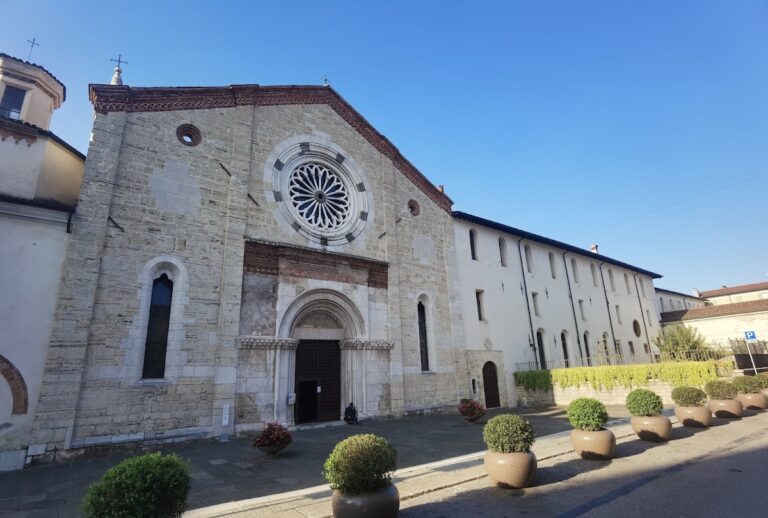
Abbey of Leno: A Benedictine Monastic Complex in Italy
Site at a Glance
- Rating
- 4.6
- Popularity
- Very Low
- Country
- Italy
- Primary era
- Medieval
- External website
- Open
- Eras represented
- Medieval, Early Modern
- Civilizations
- Holy Roman Empire, Lombard, Venetian
- Site type
- Religious
- Remains
- Monastery
On this page24 sections
History
The Abbey of Leno, also known as the Leonense Abbey, was a Benedictine monastic complex founded in 758 by the Lombard king Desiderius in present-day Leno, Italy. Its establishment formed part of Desiderius’s religious and political programme during the struggle for the Lombard throne and his attempts to secure Frankish and papal support. The monastery became one of the most autonomous institutions in the territory of the diocese of Brescia, exercising religious, fiscal, judicial, and territorial powers for more than a millennium.
Foundation under Desiderius
A parish church dedicated to John the Baptist helped establish the settlement before the monastery was created. The abbey was built beside an earlier church dedicated to the Savior, the Virgin Mary, and the Archangel Michael. Construction was completed shortly after Desiderius’s accession, and the king attended the inauguration with his consort and numerous bishops. He endowed the monastery with extensive property in eastern Lombardy, around Lake Como, and in 58 towns or estates in the areas of Brescia, Cremona, Milan, and Mantua.
Traditions offered different explanations for the name ad Leones, or Leonense. One story described a dream and a hunting episode involving Desiderius, a serpent, and three golden or marble lions found at the indicated place. The Brescian chronicler Giacomo Malvezzi instead connected the foundation with a dream foretelling Desiderius’s future coronation as king of the Lombards.
Twelve monks brought from Monte Cassino, the monastery traditionally founded by Saint Benedict, formed the first community and promoted the Benedictine rule in the region. The monastery was associated from its beginning with important relics, including part of Saint Benedict’s forearm and the remains of Saints Vitalis and Martialis. Desiderius had received these relics from the pope and transferred them to the new foundation.
Imperial privileges and territorial power
After the Frankish conquest of Lombard Italy in 774, Charlemagne preserved the monastery’s integrity and granted its abbots control of the court of Sabbioneta. Donations and bequests enlarged the abbey’s possessions, while links with the monastery of Reichenau near Constance connected Leno to a wider network of Benedictine institutions.
Leno became a Reichskloster, or imperial monastery under the direct authority of the emperor rather than a local lord or bishop. Abbot Remigio served as arch-chancellor to Emperor Louis II, who reconfirmed the abbey’s possessions, granted tax exemption, allowed the monks to elect their rector, and authorized taxation of the monastery’s estates. Judicial authority over dependants remained with the abbot.
During the tenth century, Hungarian incursions led the monks to protect the area around the abbey with palisades and towers. They also enclosed the court of Gottolengo. The monastery expanded its property through the acquisition of Gambara in 938 and through grants from Berengar II and Adalbert II. Its lands eventually extended from the Verona area to the Comacchio Valleys and from the Modena area to the Brescian region.
Local brigands occupied the monastery in 983 but were expelled through the intervention of Emperor Otto III. In 999 Pope Sylvester II granted or confirmed the abbey’s libertas, a form of institutional independence, added the court of Panzano to its possessions, and confirmed the abbot’s right to seek the consecration of chrism and monks from bishops other than the bishop of Brescia.
Eleventh-century expansion and reform
The eleventh century brought the abbey’s greatest development. An imperial diploma issued by Henry II in 1014 listed possessions in 95 northern Italian localities. In 1019 Abbot Odone adopted the reformed rules of the Cluniac movement. From 1035 to 1075, two monks from Bavaria governed Leno, enlarged the church associated with Desiderius, and defended the monastery’s authority against the diocese of Brescia.
Disputes with the bishop of Brescia over spiritual and temporal jurisdiction intensified from 1030. In 1078 Pope Gregory VII, a leading figure in the reform of the Latin Church, prohibited laymen from taking possession of the monastery or administering its lands without the abbot’s authorization. He also confirmed its fiscal and religious privileges. Around 1107, Leno’s ecclesiastical jurisdiction apparently extended to the Benedictine monastery of Saint Thomas the Apostle at Acquanegra, whose monks had reclaimed land between the Chiese and Oglio rivers.
The abbey’s estates were organized into agricultural courts, or curtes, large estates combining a central centre of administration with dependent lands and labour. Monks or lay delegates managed these properties. Peasants cultivated wheat and other crops in return for part of the harvest, while the abbey also bred livestock, practiced viticulture, maintained canals, exploited woodland, and participated in the timber trade. The Oglio and Po river system connected its possessions with the Adriatic, and salt from its pans near Comacchio was transported inland.
The community numbered more than one hundred members through at least the ninth century. At least a third were pueri oblati, boys entrusted by their parents to the abbot for education and religious formation. Monks copied manuscripts, cared for the sick and travellers, administered dependent churches, and carried out craft work. The abbey and its dependencies also sheltered poor people and pilgrims. In 1185 a large two-storey guesthouse hosted a judicial assembly presided over by Frederick Barbarossa, the twelfth-century Holy Roman emperor.
Fire, conflict, and decline
A major fire destroyed the monastery around 1135 to 1137, and repairs were completed in 1145. Pope Eugene III apparently stayed there in 1148. Pope Adrian IV restored part of its prestige and privileges in 1156, while Abbot Gonterio undertook a complete rebuilding of the church at the end of the twelfth century.
The abbey’s territorial power fragmented as northern properties passed to feudal lords and nearby communes, including Gottolengo, Gambara, Ghedi, and Leno, sought greater autonomy. Military campaigns during the conflicts of Frederick Barbarossa brought further damage and burning. The emperor later issued a temporary confirmation of the monastery’s privileges because the monks had supported him.
In 1209 the people of Leno seized the monastery and expelled the monks, who recovered it by force of arms later that year. Abbot Onesto II founded a Benedictine hospital dedicated to Saints Bartholomew and Anthony. In 1212 the Holy See appointed Sicardo, bishop of Cremona, to oversee the abbey’s finances because of its debts. In the 1230s Pope deposed Abbot Epifanio after the monastery’s finances, books, and sacred objects had fallen into serious disorder.
Later abbots alternated between the Guelph and Ghibelline sides, while the community increasingly relied on leases and land sales. A Visconti raid impoverished the abbey further in 1351. Andrea di Tacovia, a Bohemian abbot from Prague and chaplain to Emperor Charles IV, attempted to preserve its prestige, but his frequent absences allowed rival claimants to occupy the abbacy. Ottobono, who allied himself with the Venetians during their conquest of the Brescian region, obtained control of Leno from the doge and the pope in 1434.
Commendatory abbots and suppression
Abbot Bartolomeo Averoldi tried in 1471 to associate Leno with the reformed Congregation of Santa Giustina of Padua. In 1479, with papal approval, he transferred the monastery in commendation to the Venetian nobleman and cardinal Pietro Foscari in exchange for the archbishopric of Split. A commendatory abbot received an abbey’s title and revenues without necessarily residing there or directing its community. This arrangement ended Leno’s effective role as an imperial monastery and encouraged further decline.
From 1479, commendatory abbots were often members of Venetian and Brescian noble families who held the revenues without managing monastic life directly. Girolamo Martinengo, abbot in commendation from 1529 to 1567, built rooms for the monks and new work buildings and probably established a vineyard. After an apostolic visitation in 1580, Charles Borromeo, the reforming cardinal and archbishop of Milan, ordered repairs to the church, including levelling the floor, maintaining the tabernacle, providing a crucifix, and whitewashing the interior.
During the seventeenth and eighteenth centuries, Venetian patricians from families such as the Basadonna, Morosini, Barbarigo, and Querini held the abbacy. Angelo Maria Querini, commendatory abbot from 1734 to 1758, collected the monastery’s income while its buildings deteriorated and its archive was inadequately safeguarded. In 1758 Marcantonio Lombardi became the last commendatory abbot and commissioned Francesco Antonio Zaccaria to prepare a historical and architectural study, published in 1767.
After Lombardi’s death in 1782, the Republic of Venice confiscated the monastery’s remaining assets. A senatorial decree formally suppressed the abbey in 1783. The Dossi family purchased the former monastery and its land, then demolished the abbey buildings with Venetian authorization so that their materials could be reused for the new Parish Church of Saint Peter and the Dossi villa. The former monastic land was maintained as meadow. A villa built near the site was demolished in 1873 and replaced by the present Villa Badia.
Archaeological investigation
A proposal for archaeological investigation was made in 1990 as part of a University of Brescia project. After the Villa Badia site, covering about 6,500 square metres, was acquired by a local credit institution, ground-penetrating radar surveys began in 2002. This method uses radar signals to locate buried walls and foundations before excavation. Excavations based on the survey results and eighteenth-century maps took place from 2003 to 2004, covering 680 square metres.
The work exposed parts of the abbey church, the foundations of its crypt, a painted tomb, the base of the bell tower, and remains of other buildings. A second campaign in 2010 uncovered the foundations of a small church surrounded by numerous burials. These remains appear to support the existence of a settlement predating the Benedictine foundation, while their relationship to the monastery remains under study.
Remains
The surviving remains consist of buried foundations, archaeological traces, and architectural fragments recovered during demolition or excavation. The abbey occupied the southern part of a larger complex, with its church aligned from east to west and its apse at the eastern end. Other buildings extended northward around a large cloister, of which two wings appear to have survived shortly before demolition. A vineyard extended west of the church, while a sixteenth-century service and residential building stood to its south.
Earlier church and first abbey church
Pre-existing church
The monastery stood beside an earlier church dedicated to the Savior, the Virgin Mary, and the Archangel Michael. It served for worship and for the preservation of relics before or during the first stages of the Benedictine foundation. Radar surveys west of the abbey church also detected early medieval structures probably dating from the late fourth to sixth centuries. This area may extend beneath the present parish church and the former castle area.
Desiderian church
The first abbey church was probably founded around 756 and measured approximately 16 to 24 metres in length and 12 metres in width. It followed an east-west axis, with the presbytery and altar at the eastern end. The church was probably triapsidal, meaning that it ended in three apses, although this reconstruction remains tentative. Its triple dedication and comparison with other churches associated with Desiderius support the interpretation.
A crypt may already have existed beneath this first church in connection with the relics preserved at the monastery. Excavation confirmed the foundations, which were later incorporated into Gonterio’s twelfth-century rebuilding. A burial with painted crosses, dated to the eighth or ninth century, was associated with this phase.
Eleventh-century church and bell tower
Church of Abbot Wenzeslao
The second abbey church was built in the eleventh century under Abbot Wenzeslao, who governed from 1055 to 1068. It extended the earlier church westward by about 28 metres and consisted of a single nave ending in a broad apse with a raised presbytery. The relationship between the older eastern structure and the western extension remains uncertain, since the extension may have created two connected sacred spaces or a single large church after the earlier facade was removed.
Crypt
The second church contained a crypt, a chamber beneath the sanctuary used for worship and the veneration of relics. An altar stood within it, and two side stairways probably led down from the church, beside a principal staircase leading to the elevated altar above. Four small aisles were divided by 15 slender columns. An entrance opened directly to the exterior, while masonry seats in the semicircular end suggest that a monastic choir gathered there.
Bell tower
A massive bell tower stood along the southern perimeter of the second church. Its foundations were large enough for Andrea Breda to compare it hypothetically with the bell tower of San Zeno in Verona. The church and tower had disappeared by the early twelfth century, although the tower base was identified during modern excavation.
Gonterio’s church
Church plan and interior
Gonterio’s third church, built in the twelfth century, was the final major architectural phase and survived until the eighteenth-century demolition. It retained the east-west orientation of its predecessors but replaced both the first church and Wenzeslao’s extension. The building was almost 50 metres long and more than 25 metres wide.
The hall for the faithful was divided into three naves by six large quadrilobed pillars, three on each side, each about 1.80 metres in diameter. A long presbytery reserved for the clergy followed the main hall and ended in a semicircular apse. The final part of the presbytery was strongly elevated, creating space below for a large crypt.
Relic crypt
The large crypt probably housed or supported the veneration of the relics of Saint Benedict and Saints Vitalis and Martialis. It still existed in the second half of the sixteenth century. Its foundations were identified during excavation, together with part of the church perimeter wall in three successive phases.
Main portal
The principal surviving decorative remains came from the church’s main portal, known as the royal door. It was produced during Gonterio’s building campaign and remained intact at the end of the eighteenth century. A surviving fragment of its lunette, the curved or semi-circular area above the doorway, carries a sequence of small arches and a central human figure probably representing Jesus.
Three lions were associated with the portal. Two are preserved at the entrance to Leno’s parish church, while the third, one of the supports for the porch columns, is housed inside Leno’s town hall. These sculptures relate to the traditions surrounding the name Leonense.
Monastic buildings and later structures
Cloister and oratory
An eighteenth-century map records the wider arrangement of the abbey shortly before its demolition. Buildings extended northward from the church around a large cloister, of which two wings appear to have been standing. A small apsidal building northeast of the church has been identified as one of two additional oratories dedicated to Saint Mary and Saint James.
Badia Vecchia
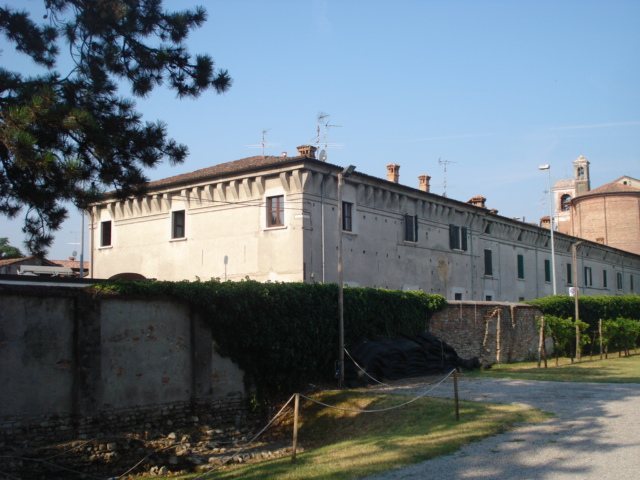
South of the church, Girolamo Martinengo introduced a sixteenth-century building containing service facilities and new monastic cells. This structure survives as a residence known as Badia Vecchia. West of the church, a large vineyard planted during the sixteenth century occupied ground that probably contained earlier structures.
Early settlement church
The 2010 excavation uncovered the foundations of a small church and multiple burials around it. Their position in relation to the Benedictine complex remains under study, but the remains may belong to a settlement that preceded the abbey. A possible artificial moat has also been proposed between this area and the monastery, perhaps created by the abbots as a defence during the Hungarian incursions of the tenth century.
Surviving fragments
About one hundred fragments from the abbey’s buildings have been recovered from demolition deposits, later identified as Lenese, or found during twentieth-century excavations. Most are preserved at the Santa Giulia Museum in Brescia, while others are held in public places and private collections in Leno. They include small capitals, column bases, cornice fragments, architectural sculpture, funerary inscriptions, and pieces of larger decorative schemes whose original positions are no longer known.
A fragment of the twelfth-century portal is preserved at the Santa Giulia Museum. Other surviving pieces include a relief lunette and two stucco images of the Madonna and Child whose provenance is uncertain. Most of the fragments date from the eighth to tenth centuries or from Gonterio’s rebuilding in the twelfth and thirteenth centuries, while later examples belong to the fifteenth through seventeenth centuries.