Castle of Pontevico: A Medieval Fortress on the Oglio River


Site at a Glance
- Rating
- 4.6
- Popularity
- Very Low
- Country
- Italy
- Primary era
- Modern
- External website
- Open
- Eras represented
- Medieval, Early Modern, Modern
- Civilizations
- Holy Roman Empire, Venetian
- Site type
- Domestic
- Remains
- Castle
On this page15 sections
History
Castle of Pontevico is a historic fortress complex in Italy, beside the Oglio River. Its first castle was built at the end of the ninth century, after the Frankish conquest of the surrounding territory under Charlemagne, and was traditionally established in response to repeated Hungarian raids. The stronghold became a principal defensive position on the frontier between Brescia and Cremona, an area shaped by the rivalry between Guelphs, who generally supported the papacy, and Ghibellines, who generally supported the Holy Roman Emperor.
Foundation and Brescian control
In the twelfth century, Pontevico was drawn into the disputes between bishoprics and emerging communes. On July 26, 1127, Count Goizone Martinengo granted the investiture of the castle to Bishop Villano and the consuls of the Commune of Brescia. Emperor Henry VI apparently transferred the fortress to Cremona in 1191, but it returned to Brescian control in January 1192. Brescia then controlled the Oglio’s waters and a strip of land extending about 170 metres from the river’s right bank into Cremonese territory, including plantations, pastures, and buildings.
During the late twelfth century, Brescia enlarged and renovated the fortress as it prepared for conflict with Cremona. The laying of the new foundation stone was accompanied by a public ceremony. Three of the town’s most influential men touched the communal standard, bowed, and kissed the stone under the bishop’s blessing. The rebuilt stronghold was described in contemporary chronicles as a colossal fortress, the munitissimum castrum, and was repeatedly restored after later attacks.
Sieges and destruction in the thirteenth century
Marquis Guido Lupo besieged and captured the castle in 1208 with an army apparently reinforced by troops from Parma and Cremona. The fortress was ceded to Cremona, but Brescian forces supported by Milan retook it in a night attack commanded by Brescia’s podestà, Obizone Pusterla. The episode produced the mocking phrase, “The Cremonese sleep in Pontevico Castle.”
In 1237, before the Battle of Cortenuova, the Lombard League, a northern Italian alliance formed against imperial power, stationed its army in the fortress. When the army moved away, Emperor Frederick II crossed the Oglio there without resistance. He held a military parade in Pontevico that included Alemannic and Saracen troops and war elephants. After the siege of Brescia in 1238, Frederick left Pontevico and set it on fire, after which the fortress returned to Brescian control.
The Malessardi outlaws captured the castle and transferred it to Cremona in 1242. Brescia recovered it in 1248 after Frederick II’s defeat at Parma, and Brescia and Cremona reached a settlement on March 8, 1252. A document from this period records two castles in Pontevico. The larger fortress stood in the upper part of the town, while a second castle defended the lower settlement, or borgo. During Uberto Pelavicino’s conquest of the Brescian area in 1260, the people of Brescia removed his appointed governors. Pelavicino responded by ordering the destruction of several castles in the Bassa Bresciana, including Pontevico. The fortress was rebuilt in the following years.
Visconti, Scaligeri, and Malatesta struggles
Pontevico remained involved in the contests between regional powers during the fourteenth century. In 1308, Bishop Nicholas of Butrint was held prisoner there by a garrison of 300 Guelphs while carrying an important letter. He destroyed the document and escaped through a stratagem involving a friar, wine requested from Robecco d’Oglio, and an arrangement with the castellan of that place.
After the Ghibelline success in the siege of Brescia in 1311, the fortress passed to Giberto da Correggio, while Brescian territory came under the Lordship of Milan. The Visconti of Milan and the Scaligeri of Verona subsequently contested the area. In 1362, an anti-Visconti League captured the village, but the castellan retained the fortress and summoned Bernabò Visconti. Troops from Verona, Ferrara, Mantua, and Carrara, joined by local inhabitants, besieged the castle with 28 companies of cavalry and many infantrymen. Bernabò and his forces entered through the drawbridges at night and defeated the besiegers in a sortie. Pontevico was then sacked, its inhabitants were massacred or imprisoned, and the town walls were demolished.
In 1404, Ugolino Cavalcabò used the fortress as a military base, assembling about 7,000 infantrymen and 200 cavalry there. At the beginning of the fifteenth century, a truce and prisoner exchange between Cabrino Fondulo and Pandolfo Malatesta were concluded at the castle. Malatesta later took refuge at Pontevico, strengthened the fortress, and used it repeatedly in operations against Cremona.
Venetian and Milanese campaigns
The Republic of Venice, led by Carmagnola, captured Pontevico Castle in 1426 during the Wars of Lombardy. Venice repaired and maintained its principal fortresses along the Oglio, including Pontevico, under a provveditore, a Venetian official responsible for supervising a territory or fortress, and a castellan. On June 8, 1452, after a two-day siege and the use of bombards, Francesco Sforza brought the fortress under the control of the Duchy of Milan.
Venetian forces commanded by Jacopo Piccinino besieged the fortress in May 1453. After three days, its garrison of 500 men still held out, but the besiegers concentrated their weapons against one bulwark, opened a breach, and entered. Piccinino used Pontevico as a base for an attack across the Oglio. An army of 5,000 infantrymen, 1,000 archers, and 500 firearms troops, slingers, and other artillerymen was repelled and forced back to the castle. In August, Piccinino left Pontevico to defend Ghedi, which Milanese forces captured.
In October 1453, a Franco-Milanese army commanded by Francesco Sforza and René of Anjou besieged Pontevico after assembling about 20,000 infantrymen and 3,500 cavalrymen. The castle fell at 10 p.m. on October 19, after more than three days and two nights of fighting. The town and fortress were looted, burned, and razed, and civilians suffered severe violence. After the Peace of Lodi, Pontevico returned to Venice. The republic rebuilt the town and castle, beginning two new towers on May 18, 1457. The inhabitants’ loyalty to Venice contributed to the town’s repeated nickname, “Castello.”
The Italian Wars
During the War of Ferrara in 1483, forces commanded by Alfonso of Aragon, Duke of Calabria, avoided attacking Pontevico because its castle was considered heavily fortified and well defended. Venetian troops later built a bridge across the Oglio at Pontevico and invaded the Cremonese countryside. Peace followed at Bagnolo in 1484.
The fortress again became a military assembly point during the conflicts of 1498 to 1516. In 1498, Ludovico Sforza sent 400 men to the Cremonese castles to defend Robecco d’Oglio. After the bridge over the Oglio was rebuilt in 1499, Cremonese representatives repeatedly came to Pontevico to discuss a possible transfer of Cremona to Venetian control. In January 1500, Brescian rectors sent 22,000 soldiers to Pontevico in response to Ludovico’s intention to retake Cremona. More than 10,000 infantrymen, archers, crossbowmen, firearms troops, and bombardiers then advanced towards the city.
The League of Cambrai, a coalition formed on December 10 by France, Spain, the Holy Roman Empire, and the papacy against Venetian expansion, prompted Venice to assemble its land army at Pontevico. Commanders including Nicolò Orsini, Bartolomeo di Alviano, Andrea Gritti, Giorgio Cornaro, and Vincenzo Valier gathered inside the castle. Between 40,000 and 60,000 soldiers assembled there from April 1509 and departed on May 2 to attack Milanese territory.
After Venice’s defeat at Agnadello, French troops occupied Pontevico Castle in June 1509. Louis XII and his court spent the night there on June 22 before continuing from Ghedi towards Cremona. In 1510, the inhabitants of Pontevico, supported by the castellan, revolted against the French and forced them to flee. Fourteen rebels were captured. French forces soon returned, and on February 19, 500 lancers commanded by Gian Giacomo Trivulzio entered and sacked the castle and town.
After the formation of the Holy League, a military coalition formed by several European powers against France, French forces placed much of their army in the fortress. They later abandoned and burned it while retreating from a Venetian army, destroying the bridge over the Oglio to delay pursuit. Venice rebuilt the bridge and used Pontevico as a base for the reconquest of Brescia. Leonardo Emo assembled 2,000 infantrymen and 500 cavalry there, while Milanese and Swiss forces attempting to cross the Oglio at Pontevico were repelled by the castellans.
Following the Franco-Venetian alliance of March 24, 1513, troops assembled at the castle for the campaign against Cremona. Under Bartolomeo di Alviano, they recaptured Cremona on May 27, while allied forces recovered Brescia and Bergamo. After the Battle of Novara, Venetian forces abandoned the Brescian area, which was occupied by the Spanish. A garrison of 300 defended Pontevico against Spanish forces led by Antonio de Leyva and resisted even after Spanish, Milanese, and German troops joined the siege. The besiegers isolated the fortress to cut off food and supplies. The garrison surrendered in mid-August after prolonged resistance, also affected by plague in the surrounding territory. Venetian forces led by Odet of Foix reconquered Brescia and its territory in May 1516.
Later military use and industrial transformation
Landsknecht troops, German-speaking mercenary infantry, sacked the Brescian province in 1529 and damaged several castles in the Bassa Bresciana, including Pontevico. A major strengthening and restoration of the fortress took place in 1560. In 1571, Venice established a school of bombardiers inside the castle. Although artillery made traditional castle defenses increasingly vulnerable, a description from 1610 still presents Pontevico as a defended fortress guarding the bridge, with soldiers, bombardiers, and a castellan inside walls, ditches, towers, and other defenses.
In 1702, after the victory at Chiari, Eugene of Savoy camped at Pontevico while preparing to confront French forces blockaded in Cremona. A message hidden in the stitching of a messenger’s shoes enabled him to enter Cremona at the right moment, defeat the French, and capture their commander, François de Villeroy, who was taken to Pontevico.
After the fall of the Republic of Venice in 1797 and the subsequent territorial changes, the castle permanently lost its strategic function. In 1804, Gaetano Pietro Cadolini of Cremona purchased the structure and established a foundry there, described as the first opened in Italy after the French Revolution. The foundry imported 600,000 weights of hard coal from Istria and recast more than 400,000 pounds of iron. Its five reverberatory furnaces, which reflected heated gases over the material being melted, mainly produced bullets and military tools. On May 5, 1805, the foundry produced an iron plaque for Napoleon’s establishment of the Kingdom of Italy. The plaque was originally surmounted by a medal of Napoleon and decorated with allegorical figures and an imperial eagle; it is now held in the Museums of the Sforza Castle.
Institutional history
After the Congress of Vienna, Pontevico became part of the Kingdom of Lombardy-Venetia under the Austrian Empire in 1816. Austrian archdukes visited the former fortress that year. In the 1840s, the German owner Kewmüller had the old castle completely demolished in spring 1844. The work obstructed the ancient passage beneath the bed of the Oglio. A new castle in neo-Gothic forms was begun for commercial and industrial use, but construction stopped during the riots of 1848. Only two of the planned four wings were erected.
On February 6, 1900, Monsignor Bassano Cremonesini, Don Paolo Roda, and Don Luigi Fossati purchased the castle for 26,200 lire and established a charitable institution there. It received people affected by conditions such as cretinism and pellagra who were rejected by other institutes because of their medical needs and need for supervision. The institution opened officially on March 18, 1901. In 1911, it became a legally recognized foundation called the Rest Home for Phrenastenics and Epileptics in Pontevico. Bassano Cremonesini completed the castle quadrangle between 1911 and 1912.
In the postwar period, Abbot Giuseppe Miglioli added two-story buildings for residents with tuberculosis and for service areas. In 1962, during Angelo Crescenti’s presidency, Miglioli’s pavilion was replaced by a larger, autonomous circular building of three floors containing radiology, a clinical-analysis laboratory, a physical-therapy room, and an EEG laboratory for recording electrical activity in the brain. Bombing during the Second World War had contributed to serious foundation subsidence, leading to the demolition and reconstruction of the central building and renovation of the complex. In 1966, President Giuseppe Saragat renamed the facility the A. Cremonesini Neuropsychiatric Institute. It was privatized in 2003 and renamed the Bassano Cremonesini Institute for the Mentally Disabled-Onlus. The restored complex remains in institutional use and is owned by that institute.
Remains
Fortress layout and surviving form
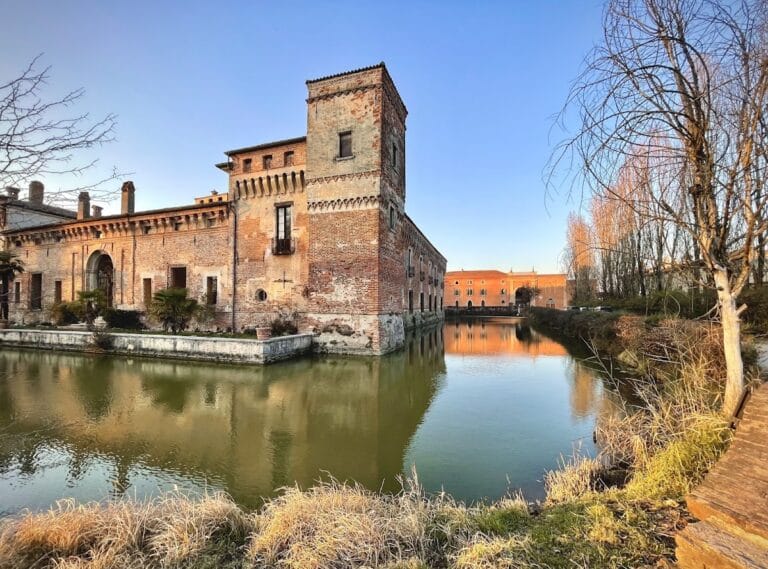
The original medieval fortress stood beside the Oglio River within a broad moat, with drawbridges enclosing its defensive works. In the Venetian period, it was described as having walls, ditches, bastions, and watchtowers. The town extended around the fortress, together with the provincial road and the ancient parish church of Saint Andrew. An underground passage was thought to connect Pontevico with nearby Robecco d’Oglio beneath the riverbed; demolition of the old castle in 1844 obstructed it.
The present castle has a quadrangular plan and a Romanesque appearance that evokes the medieval form. It was completely rebuilt in 1844 and substantially remodelled during the second half of the twentieth century. Its merlons are dovetailed and therefore Ghibelline in form, while the original merlons were reportedly square and Guelph in form. A plaque facing the Oglio bears the coat of arms of Pontevico and dates from 1560.
Courtyard and institutional buildings
The inner courtyard is enclosed by porticoes and a loggia around its perimeter. It contains several gardens and a small church. The institute’s quadrangle was completed between 1911 and 1912. Later construction added two-story buildings, the three-story circular medical pavilion erected in 1962, and the reconstructed central building that followed foundation damage and twentieth-century renovation.
Churches and devotional spaces
Chapel of Saint Mark
A chapel dedicated to Saint Mark existed in the castle during the period of Venetian rule. After the older chapel was demolished in 1815, its relics were transferred to a side chapel of the Church of Saints Thomas and Andrew the Apostles.
Church of the Holy Family
The present institute church was built in 1909 at the initiative of Monsignor Cremonesini. It stands at the center of the courtyard and is dedicated to the Holy Family, while its high altar is dedicated to Mary of Nazareth. Her statue occupies the center of the apse, the semi-circular sanctuary end. The small brick church has a gabled facade, a central marble rose window with radiating divisions, and a small bell gable holding two bells. Its principal interior decoration is an altarpiece by the Brescian painter Vittorio Trainini, showing a blessed nun kneeling before Mary as she presents the Child.
Crypt of Bassano Cremonesini
A Romanesque-style crypt beside the church contains the remains of Bassano Cremonesini. A trifora, or three-part window, provides access, while a stained-glass window shows two angels carrying a ribbon bearing the words “Deus caritas est.” The secluded chamber has a brightly coloured framed inlay ceiling, angels carrying inscriptions concerning suffrage and the eternal repose of the soul, and walls decorated with graffiti. Vittorio Trainini created its decoration and frescoes.
Trainini painted the Resurrection of Christ on a gold background on the rear wall. Four angels on the same wall support representations of four works associated with Cremonesini, the abbey church, the neuropsychiatric institute, the cemetery obelisk, and the Canossian Institute. The central part of the crypt has a single frescoed vault with Gospel symbols at the sides and a large crucifix on a gilded cross at the centre.
The crypt’s sarcophagus is made from a block of red Verona marble. Its decoration includes a cross worked with precious pearls and a gilded inscription dedicated to Monsignor Abbot Bassano Cremonesini. The sculptor Claudio Botta represented Cremonesini on the sarcophagus as gently sleeping and smiling.
Nearby sites