Shioe Tenmangū: A Tenmangū Shrine in Kōchi, Japan


Site at a Glance
- Rating
- 4.2
- Popularity
- Low
- Country
- Japan
- Primary era
- Early Modern
- External website
- Open
- Eras represented
- Early Modern
- Civilizations
- Tokugawa
- Site type
- Religious
- Remains
- Sanctuary
On this page9 sections
History
Shioe Tenmangū is a Shinto shrine in Kōchi, Japan, traditionally founded in 905 and dedicated to Tenjin, the deified Sugawara no Michizane. Formally called Tenmangū, it is regarded as the ujigami, or tutelary deity, of southern Kōchi. Its central urban position has made it the city’s most visited shrine for New Year pilgrimages, surpassing Tosa Shrine.
Foundation and the Sugawara family
The shrine’s origin is linked to the political conflict of 901 known as the Shōtai Disturbance, which resulted in Michizane’s demotion and exile. His son, Sugawara no Takami, was then Head of the University, the court office responsible for higher education, and held the office of Right Minor Controller. He was appointed provisional governor of Tosa, a historical province corresponding broadly to present-day Kōchi Prefecture, and was also exiled. Takami lived at Shioe in Tosa.
Michizane died in 903. Two years later, objects associated with him were sent to Takami and enshrined at Shioe. They included a mirror, a purple robe, a sacred sword, and an image of Kannon, a Buddhist bodhisattva associated with compassion. Their enshrinement is regarded as the foundation of Shioe Tenmangū and reflects the historical overlap of Buddhist and Shinto traditions.
Tradition holds that the messenger was Watarai Haruhiko, a retainer of Michizane also known as White Tayu. He fell ill at Unmonji in present-day Ōtsu and died there on December 9, 905, before he could meet Takami. Other people then delivered the objects to Tosa. After a series of disturbances in Kyoto, Takami returned there in 906, received promotion to Junior Fifth Rank, Upper Grade, and resumed his position as Head of the University.
Priests, decline, and revival
During the rule of the Chōsotabe warrior house, which controlled much of Tosa during Japan’s late medieval period, Miyaji Masakatsu, also known as Wakaemon, held the shrine’s ritual office. His descendants served as chief priests from that period until the government abolished hereditary shrine households under an ordinance issued in 1871.
The shrine was reportedly close to abolition during the Edo period, when Shinnyōji was being built as the Yamanouchi family temple. The Yamanouchi family ruled the Tosa domain during this period. Miyaji Heibei, the son of Miyaji Wakaemon, is said to have used his own money to rebuild the shrine buildings in the ninth month of 1606. This work revived the institution and preserved its continuity.
Modern changes and continuing observances
Shioe Tenmangū was ranked as a prefectural shrine in 1873. Major repairs followed in 1902 for the thousandth anniversary of Michizane’s death. The main sanctuary burned during an air raid in the Second World War. After the war, the shrine was placed in the separate-list category of the Association of Shinto Shrines.
The former hereditary shrine family remained connected through its descendants with figures including Sakamoto Ryōma, Sawabe Takuma, and Tani Tateki, as well as members of the Miyaji and Yamamoto families. The shrine’s annual cycle includes the summer festival on July 22, the spring grand festival traditionally called the Old-Style Rapeseed Festival on February 25, and the autumn grand festival, also called the sacred procession festival, on November 18 and 19.
Several subsidiary shrines maintain their own associations with the history of Shioe Tenmangū. White Tayu Shrine commemorates Watarai Haruhiko, and its observances take place during the spring, summer, and autumn festivals. Wakae Shrine enshrines the spirits of Michizane’s attendants together with Miyaji Masakatsu, with observances held during the same three festivals.
Sawara Shrine began in Tōjinmachi. When the Yamanouchi family established a secondary residence at its original site, the shrine was moved to Fujinami Shrine in Takamachō. It was transferred to Shioe Tenmangū in March 1870. Shimazaki Shrine was invited in October 1794 and enshrines Shimazaki Michikazu, also called Michihisa, a local resident devoted to the shrine. Ōyamazumi Shrine enshrines Ōyamazumi no Mikoto, and its worship was transferred from Mount Tebako. It holds a monthly festival on the twentieth day of the old lunar month as well as observances during the three principal festivals.
The shrine’s gate tower was designated a Kōchi municipal tangible cultural property on February 3, 1967. On the same date, the large camphor tree on the grounds was designated a Kōchi municipal natural monument. The grounds are also included in a protected habitat designation for the Mikado swallowtail, together with the grounds of Yōhōji in Fudeyama-chō and Shioe Junior High School.
The bridge now called Tenjin Bridge also preserves a connection with the shrine’s later history. Built during the Genna period to serve the Yamanouchi family mausoleum at Shinnyōji, it was initially known as Shinnyōji Bridge. It was renamed during the tenure of the eighth domain lord, Toyoshiki, in connection with Shioe Tenmangū.
Remains
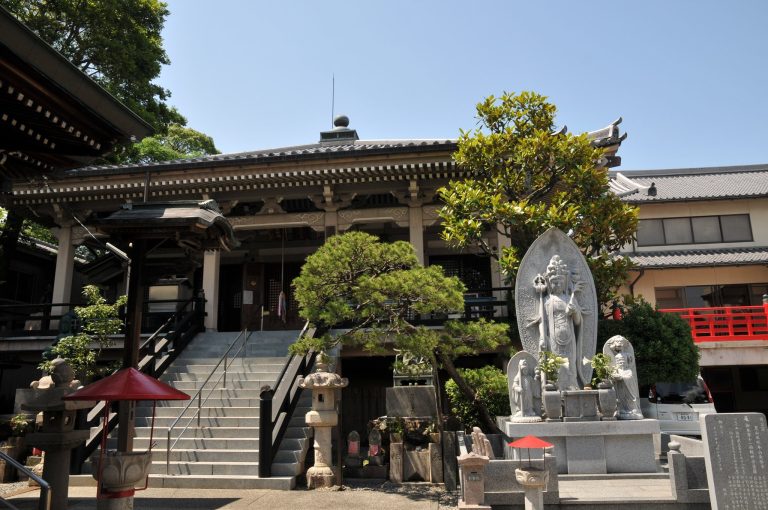
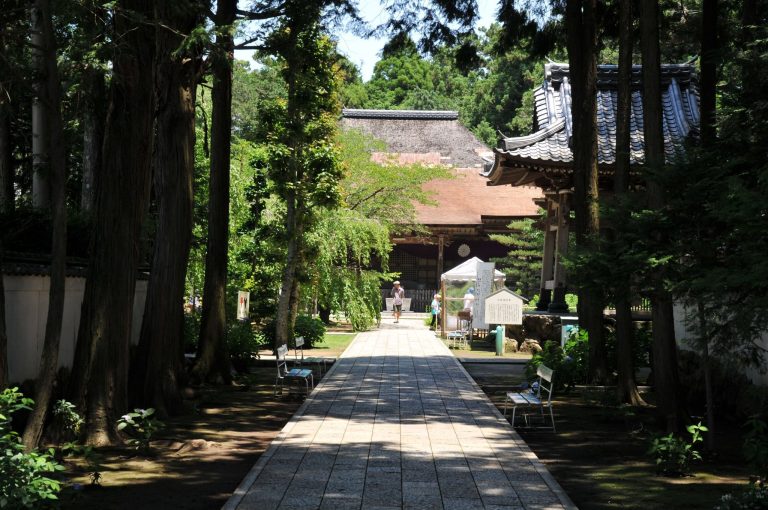
Shioe Tenmangū stands at the foot of Mount Fude, between the mountain and the right bank of the Kagami River. Its entrance lies on the eastern, downstream side, and the main sanctuary also faces east. The approach creates an S-shaped route through the grounds: it first runs west from the entrance, turns left at a right angle, passes through the gate tower, and then turns right at another right angle. Numerous old plum trees occupy the grounds, fitting the shrine’s identity as a Tenmangū dedicated to Tenjin.
Gate and natural feature
Gate tower
The gate tower was built in 1853 and repaired in 1887. It is a three-bay structure with a single entrance and a hip-and-gable roof, a form combining a central gable with sloping roof planes on the sides. The roof is covered with copper sheets. Its position along the bent approach makes it a principal element in the movement from the entrance toward the sanctuary.
Camphor tree
A large camphor tree stands on the Kagami River embankment at the left side of the grounds. It rises 25 metres and has a trunk circumference of 7.5 metres at breast height. The tree is estimated to be more than 300 years old and is protected as a Kōchi municipal natural monument.
Subsidiary religious facilities
White Tayu Shrine, Wakae Shrine, Sawara Shrine, Shimazaki Shrine, and Ōyamazumi Shrine stand within the grounds as subsidiary religious facilities. Their physical presence reflects the shrine’s accumulated network of associated worship. A dragon shrine stands beside the sacred pond and enshrines a dragon deity. Sawara Shrine’s movement from Tōjinmachi to Fujinami Shrine and then to Shioe Tenmangū forms part of the surviving history of this subsidiary religious landscape.