Engaku-ji Temple: A Rinzai Zen Head Temple in Kamakura, Japan


Site at a Glance
- Rating
- 4.4
- Popularity
- Medium
- Country
- Japan
- Primary era
- Medieval
- External website
- Open
- Eras represented
- Medieval, Early Modern, Modern
- Civilizations
- Ashikaga shogunate, Kamakura shogunate, Tokugawa
- Site type
- Religious
- Remains
- Monastery
On this page19 sections
History
Engaku-ji Temple is a Rinzai Zen head temple in Kamakura, Japan, founded during the Kamakura period in 1281 in the Chinese-influenced Zen architectural tradition. Its opening ceremony took place in 1282. Hōjō Tokimune, the eighth regent of the Kamakura shogunate, established the temple with the Chinese Zen monk Mugaku Sōgen as its founding abbot. Engaku-ji was created as a place of prayer for those killed in the Mongol invasions, including Japanese warriors and soldiers from the Mongol and Goryeo forces, a medieval Korean dynasty, without distinction.
Foundation under the Hōjō
Tokimune brought Mugaku Sōgen to Japan in 1279, following the death of his former Zen teacher Lanxi Daolong in 1278. The new temple began as a private Hōjō foundation, unlike Kenchō-ji, which had been founded by Tokimune’s father, Hōjō Tokiyori, with a more direct connection to the government. Establishing Engaku-ji may also have encouraged Mugaku Sōgen to remain in Japan rather than return to China.
Throughout the Kamakura period, the Hōjō family protected Engaku-ji. It became a prayer temple of the Hōjō Tokusō lineage, the hereditary branch whose head held dominant authority within the Kamakura shogunate. The temple’s name is linked to two foundation traditions. Engaku is said to derive from a copy of the Sutra of Perfect Enlightenment found in a stone chest during excavation of the site. Zuiroku, meaning “Auspicious Deer,” recalls the story that white deer appeared during Mugaku Sōgen’s opening sermon and listened to his teaching.
Fire, attack, and reconstruction
Engaku-ji was repeatedly damaged by fire from 1287 onward. Major losses followed the fire of 1374, an attack by the forces of Satomi Yoshitoyo in 1526, another fire in 1563, and the earthquake of 1703. The Great Kantō Earthquake of 1923 caused further destruction, including the collapse of the Butsuden.
The temple’s present form owes much to Seisetsu Shucho, also known as Daiyu Kokushi, an Edo-period Zen priest who reconstructed and consolidated the precinct toward the end of the eighteenth century. The rebuilding of 1785, associated with the traditional five-hundredth anniversary of the temple, was especially important. The Sanmon and other surviving structures reflect this period of renewal, while the Shariden preserves an earlier Muromachi-period form.
Zen instruction and continuing traditions
During the Meiji period, when imperial restoration and modernization transformed Japan, Engaku-ji became a principal center of Zen instruction in the Kantō region. The abbots Imakita Kōsen and Soyen Shaku served successively, and Daisetz Teitaro Suzuki studied under them. Zen monastic training continues at the temple, alongside public zazen, or seated Zen meditation, and lectures. Natsume Soseki, Shimazaki Toson, and Miki Kiyoshi are also recorded as having practiced Zen there.
The Great Bell remains connected with the Engaku-ji-Bentendo festival, held once every 60 years in cooperation with Enoshima Shrine. The most recent recorded festival took place on October 29, 2023. Each year, the Homotsu Kazeire exhibition displays selected treasures for approximately three days around November 3, including items from the founding-abbot chest collection.
Engaku-ji was designated a National Historic Site in 1967, while the Engaku-ji Garden received designation as a National Historic Site and Place of Scenic Beauty in 1932. The garden designation includes areas near White Egret Pond and Myōkō Pond. The temple also lies within Kanagawa Prefecture’s Special Preservation District for Historic Landscapes and became part of the Japan Heritage designation in 2016. The Shariden and Great Bell are National Treasures, and the Sanmon is a Kanagawa Prefecture Important Cultural Property.
At its height, Engaku-ji possessed 42 subtemples, smaller temples within or associated with the main grounds. Nineteen remain, including Butsunichian, Obai-in, and Keishō-an, although only some regularly open their grounds. Their survival preserves part of the institutional network that developed around the main temple.
Remains
The original precinct followed a straight Zen monastic axis. The main gate, Sanmon, Butsuden, lecture hall, and abbot’s quarters were arranged in sequence as the buildings rose along a wooded hillside. The principal historic structures use the Chinese-influenced Zen style associated with Rinzai monastic architecture. The entrance path runs beside a pond and crosses a small bridge, while railway tracks pass through the entrance area. White Egret Pond and Myōkō Pond form part of the designated temple-garden areas, and the White Deer Cave is traditionally identified as the opening through which the legendary deer emerged.
Main axis and central halls
Sanmon
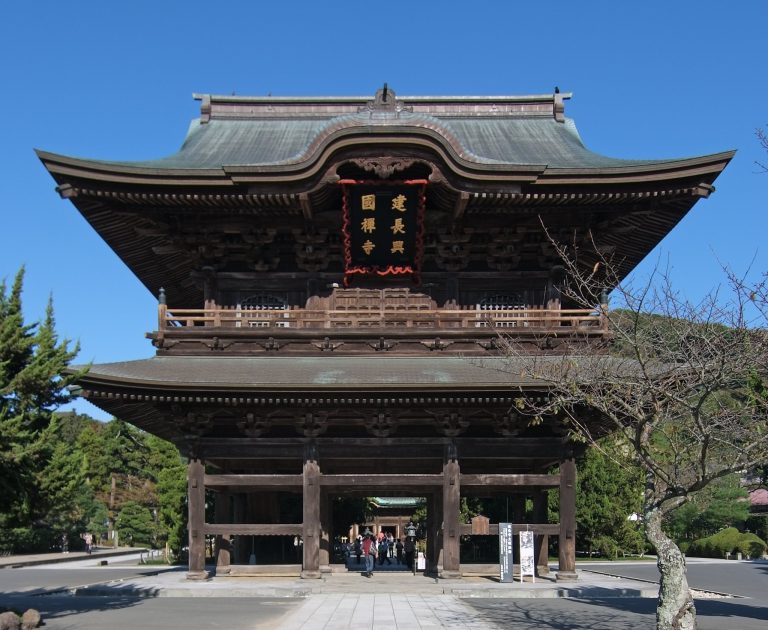
The two-story Sanmon, or main gate, was rebuilt in 1785 during Seisetsu Shucho’s reconstruction. Its copper-covered roof protects an upper level containing images of a bodhisattva, the Sixteen Arhats, and the Twelve Heavenly Generals. A wooden plaque bearing the name Engaku Koshō Zenji carries calligraphy by Emperor Fushimi.
Butsuden
The Butsuden is the modern main hall at the center of the complex. Rebuilt in 1964 after the 1923 earthquake, it closely follows a plan from 1573 and is surrounded by juniper trees. Inside is the seated wooden image of Hokan Shaka Nyorai, or Shakyamuni wearing a jeweled crown, a work of the late Kamakura period. Standing images of Bonten and Taishakuten date to 1692. The ceiling carries a dragon painting by Tadashi Moriya, produced under the supervision of Seison Maeda. Above the entrance, a plaque with calligraphy by Emperor Go-Kogon reads “Daikomyohoden.”
Sembutsudo and Kojirin
Sembutsudo is a thatched-roof hall built in 1699 for Zen meditation and the storage of sutras. It stands to the left of the Butsuden beside the Kojirin, a meditation hall for lay Zen trainees. Together, the buildings represent the continuing relationship between monastic practice, scripture, and lay instruction within the precinct.
Bell and reliquary buildings
Great Bell
The Great Bell, or Ogane, hangs in a belfry on elevated ground reached by stone steps east of the Butsuden. Mononobe Kunimitsu cast it in bronze in August 1301. The bell is approximately 259.1 centimeters high, with a mouth diameter of 142.4 centimeters, and is described as the largest temple bell in the Kantō region. Its inscription contains prayers for the emperor, ministers, favorable weather, and peace, as well as the names of Hōjō Sadatoki, Mononobe Kunimitsu, and the abbot.
Bentendo
Bentendo is dedicated to the Benzaiten shrine at Enoshima. A legend credits Benzaiten’s protection with the successful casting of the Great Bell and provides the religious basis for the 60-year ceremony shared by Engaku-ji and Enoshima Shrine.
Shariden
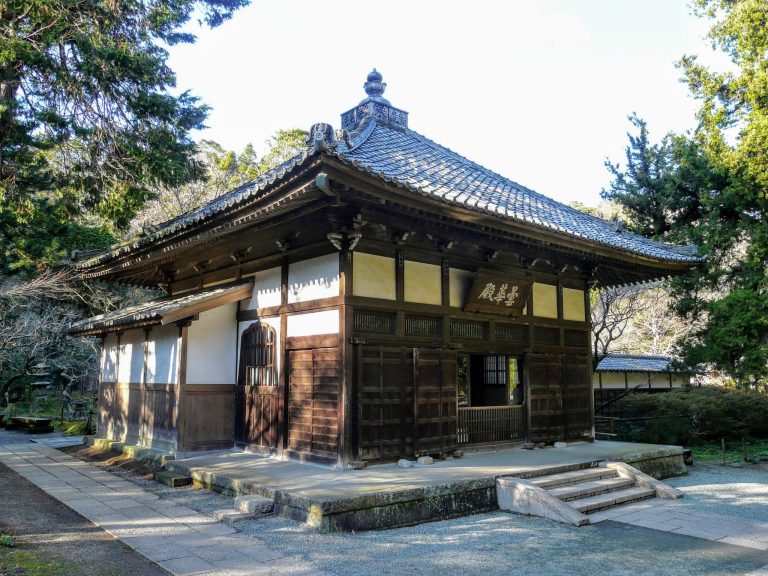
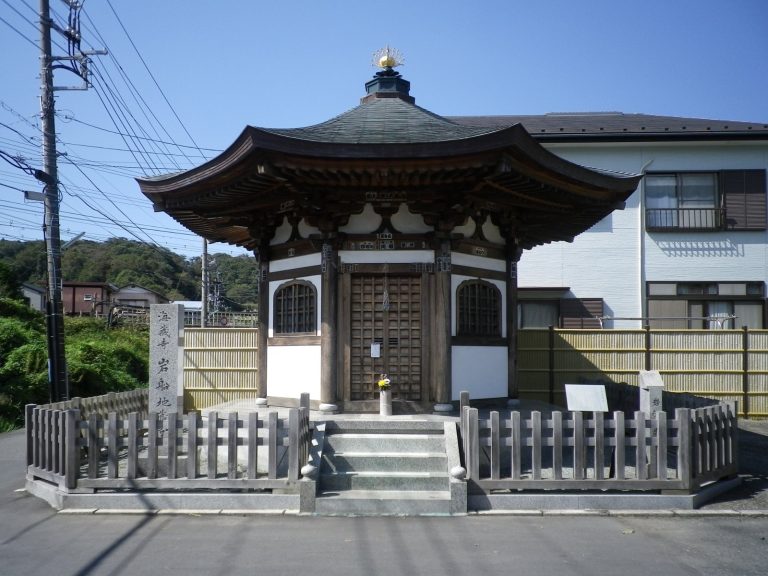
The Shariden is a single-story reliquary hall with a three-by-three-bay plan. Its irimoya roof combines a gabled upper section with sloping lower surfaces, and a pent-roof enclosure is covered with hinoki-cypress bark shingles. The building represents kara-yo, or Chinese-style Zen architecture, whose forms entered Japan from China during the Kamakura period and were closely related to Song-dynasty architecture.
The original Shariden was built in 1285 under Hōjō Sadatoki and destroyed in the fire of 1563. The present building dates from the Muromachi period and was transferred from the Taiheiji convent at Nishi-Mikado. It houses an object traditionally identified as a tooth of Shakyamuni, said to have been presented by the Chinese temple Noninji to Minamoto no Sanetomo.
Memorial buildings and subtemples
Kaikibyo and Shozoku-in
Kaikibyo is a mausoleum dedicated to Hōjō Tokimune and was erected in 1811. Shozoku-in contains the remains of Mugaku Sōgen and is used as a meditation hall, linking the founder and founding abbot to the religious spaces of the surviving temple.
Hojo and surviving subtemples
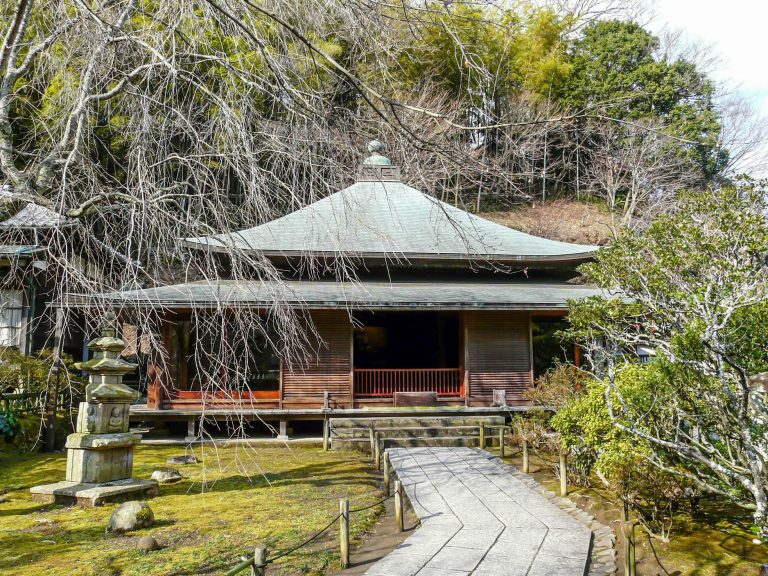
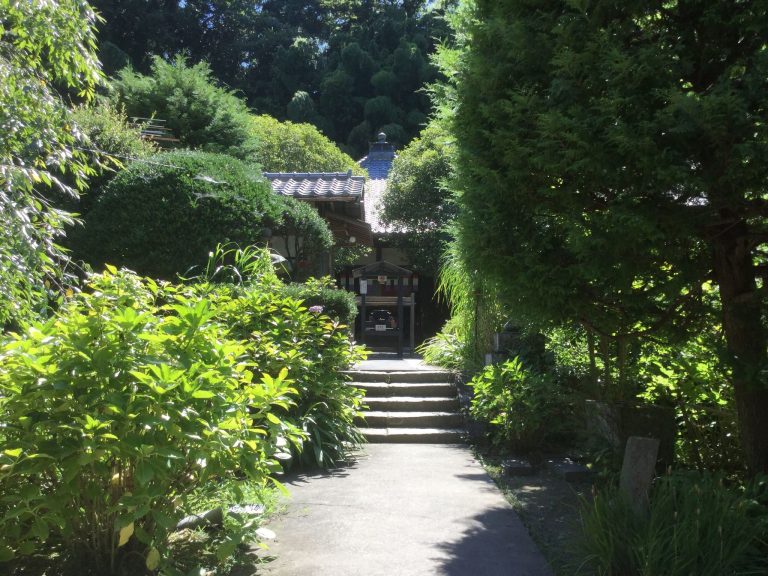
Hojo was formerly a residential area for the clergy and is now used for meditation sessions, lectures, and other functions. Butsunichian is a thatched subtemple and the burial place of Hōjō Tokimune. Obai-in is a small thatched subtemple containing an image of Kannon. The grave of the film director Yasujirō Ozu is marked with the character “mu,” meaning “nothingness.”
Collections and inherited objects
Temple furnishings and records
The precinct and its associated collections include Buddhist images, paintings, calligraphic plaques, ritual furnishings, textiles, documents, temple records, and an illustrated plan of the grounds. A waniguchi gong dated 1540 hangs in the bell tower. Other cultural-property holdings include a lacquered Buddhist altar and front table, a celadon incense burner, robes traditionally associated with several medieval Zen masters, medieval temple regulations and prohibitions, correspondence between Hōjō Tokimune and Mugaku Sōgen, temple documents, and a drawing for construction of the Butsuden.
Founding-abbot chest collection
The Engaku-ji Founding-Abbot Chest Collection contains Chinese and Japanese medieval textiles and other inherited items traditionally regarded by the temple as belongings of Mugaku Sōgen. The chest is normally sealed and opened for the annual Homotsu Kazeire exhibition. Its textiles provide evidence for the history of textile craftsmanship. Most of the temple’s Important Cultural Properties are deposited at the Kamakura Museum of National Treasures or another museum rather than routinely displayed in the temple. Two culturally designated objects were destroyed in a fire at Zokuto-an during the 1923 earthquake.