Meigetsu-in: A Rinzai Zen Temple in Kamakura, Japan


Site at a Glance
- Rating
- 4.3
- Popularity
- Medium
- Country
- Japan
- Primary era
- Medieval
- External website
- Open
- Eras represented
- Medieval
- Civilizations
- Ashikaga shogunate
- Site type
- Religious
- Remains
- Monastery
On this page8 sections
History
Meigetsu-in is a Rinzai Zen temple in Kamakura, Japan, belonging to the Kenchō-ji school and established as a medieval Japanese Buddhist institution before 1394. Its founder and principal patron was Uesugi Norikata, a powerful Uesugi official who served as Kantō kanrei, the chief military deputy responsible for administration in eastern Japan during the Muromachi period. The monk Misshitsu Shugan became its founding abbot. The temple’s name comes from Norikata’s posthumous name, Meigetsu.
Earlier Memorial Tradition
Temple tradition traces the site’s beginnings to 1160. In that year, Tsunetoshi, the son of Toshimichi of the Yamanouchi Sudō family, established a memorial hermitage called Meigetsu-an for his father, who had been killed during the Heiji Disturbance. Norikata is traditionally regarded as the restorer of this earlier foundation, although he is generally treated as Meigetsu-in’s actual founder. This tradition connects the temple with a place of memorial observance long before its later institutional form.
The Zenkō-ji Connection
Meigetsu-in originally formed part of the larger Zenkō-ji complex. Older records describe it as having consisted initially of guest rooms belonging to Zenkō-ji. That institution was linked to Hōjō Tokiyori, the fifth regent of the Kamakura shogunate. Tokiyori built a Buddhist hall at his private retreat, Saimyō-ji. After his death the hall fell into disuse, but his son Hōjō Tokimune revived it under Rankei Dōryū, a prominent Chinese-born Rinzai Zen monk, and gave it the name Zenkō-ji.
Zenkō-ji belonged to the Kantō Jissetsu, a medieval ranking of ten important Zen temples in the Kantō region beneath the Kamakura Five Mountains in the institutional hierarchy. The temple did not survive the anti-Buddhist policies that followed the Meiji Restoration. Its abolition in the early Meiji period left Meigetsu-in as the surviving institution of the former complex.
Worship and Later Recognition
Meigetsu-in’s principal object of worship is Shō Kannon, a Buddhist manifestation of Avalokiteshvara, the bodhisattva associated with compassion. The temple is also the thirtieth site on the Kamakura Kannon pilgrimage circuit.
The precinct became widely known as the “Temple of Hydrangeas” after hydrangeas were planted in the period following the Second World War. Shortages of materials and labor had left too few posts for marking and improving the approach path, so hydrangeas were used as substitutes because they were relatively easy to maintain. The planting later became the temple’s defining attraction. The entire precinct was designated a national historic site in 1984, and Meigetsu-in was recognized as a component cultural property of Japan Heritage in 2016.
Remains
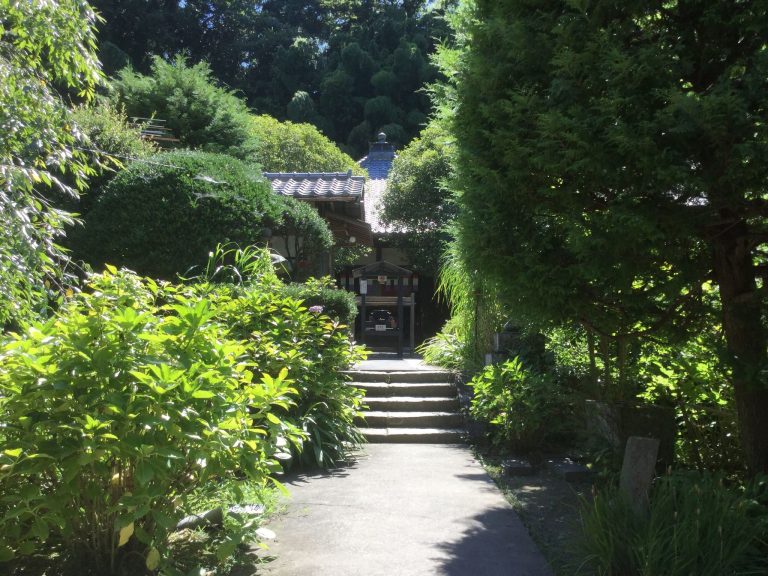
The precinct combines temple buildings, gardens, rock-cut memorial spaces, wells, graves, and surviving artworks. Several thousand pale blue hydrangeas, popularly called “Meigetsu-in Blue,” occupy the grounds alongside flowering plants associated with different seasons. Autumn foliage, wintersweet in winter, and plum and cherry blossoms in spring form part of the cultivated landscape.
Main Hall and Garden Views
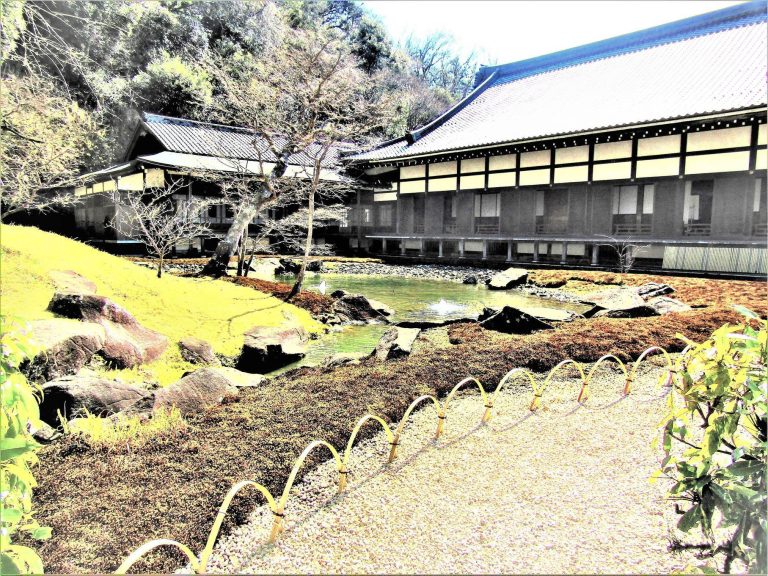
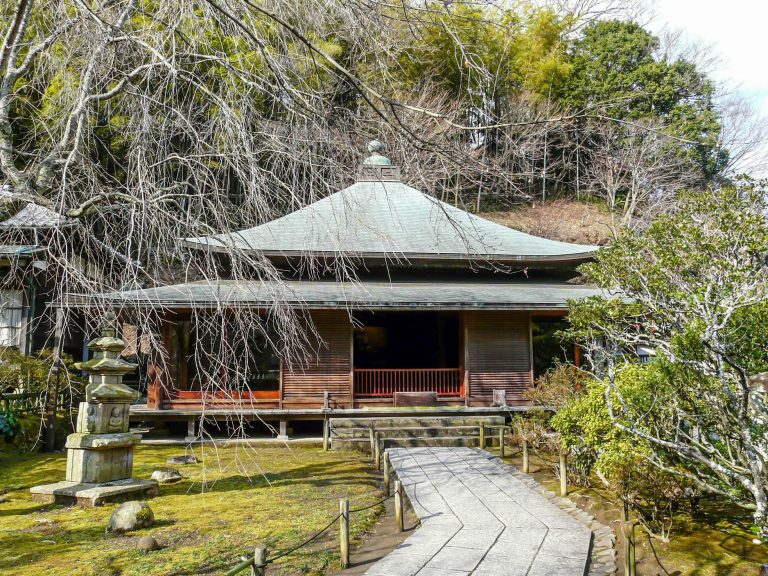
The Main Hall, also known as Hydrangea Hall, contains the circular “Window of Enlightenment.” Its round opening frames the garden and seasonal scenery as a composed view within the building. The grounds also include a karesansui dry landscape garden, in which raked sand, rocks, and plants represent the legendary Buddhist Mount Shumi.
Memorial Structures and Water Features
A yagura, a rock-cut funerary or memorial chamber characteristic of medieval Kamakura, is cut into a hillside within the precinct. It is described as the largest yagura in Kamakura, and a small tower at its center is thought to mark Uesugi Norikata’s tomb. The grounds also contain a mausoleum and grave traditionally identified with Hōjō Tokiyori, including a hōkyō-intō, a Japanese Buddhist memorial pagoda associated with funerary or merit-making practices.
Kame-no-I, or “Jar Well,” is one of the celebrated Ten Wells of Kamakura. Its presence forms part of the precinct’s surviving historic water features and connects the temple grounds with the city’s traditional group of notable wells.
Portrait Sculpture and Painted Record
A thirteenth-century seated wooden portrait of Uesugi Shigefusa, an ancestor of the Uesugi clan, survives in connection with the temple. Its form closely resembles the portrait sculpture of Hōjō Tokiyori at Kenchō-ji, and the statue is deposited at the Kamakura Museum of National Treasures.
A lightly colored paper painting of the Meigetsu-in precinct also survives from the Northern and Southern Courts period. The work bears the seal of Uesugi Mitsuuji, preserving a visual record associated with the temple’s medieval setting.