Tōkei-ji Temple: A Historic Rinzai Zen Nunnery in Kamakura


Site at a Glance
- Rating
- 4.2
- Popularity
- Medium
- Country
- Japan
- Primary era
- Early Modern
- External website
- Open
- Eras represented
- Early Modern, Modern
- Civilizations
- Japanese, Tokugawa
- Site type
- Religious
- Remains
- Monastery
On this page20 sections
History
Tōkei-ji Temple is a Rinzai Zen temple in Kamakura, Japan, founded in the Kamakura period and historically associated with the Hōjō family. Its formal name is Shōkōzan Tōkei Sōji Zen-ji, and its principal image is Shaka Nyorai. The temple is also known as Kakekomi-dera, a refuge temple where a woman could seek protection from her husband or household, and Enkiri-dera, or divorce temple. Its traditional foundation date is 1285.
Foundation and the Kamakura period
Temple tradition names Hōjō Sadatoki as founder and Kakusan-ni as founding abbess. Kakusan-ni was the wife of Hōjō Tokimune and the daughter of Adachi Yoshikage. In 1284, shortly before Tokimune’s death, she and her husband entered religious life under the guidance of Mugaku Sogen. Kakusan-ni’s role as founder belongs to a later foundation tradition, and the earliest surviving document identifying her in that role dates from around the Tenbun era of the sixteenth century.
The earliest secure evidence for Tōkei-ji during the Kamakura period is the inscription on its temple bell, completed in 1332. The inscription names Kakukai Enjo, the wife of Hōjō Sadatoki, as the principal donor. It also identifies the abbess Kaan Ryōdō and nuns who held the offices of head seat and administrator. These details show that the temple was already a substantial nunnery connected with the Hōjō family.
Another foundation tradition links the site with an earlier religious center established by Mino no Tsubone, described as an aunt of Minamoto no Yoritomo. According to this account, Kakusan-ni rebuilt or revived the earlier institution. Evidence from the Kamakura period does not confirm that tradition, while the bell inscription provides direct evidence for the established nunnery by 1332.
High-status convent in medieval Kamakura
During the Nanboku-chō period, Emperor Go-Daigo’s daughter Yōdō-ni was traditionally regarded as Tōkei-ji’s fifth abbess. She was said to have entered the temple to pray for her brother, Morinaga Shinnō, who had been killed by Ashikaga Tadayoshi. From Yōdō-ni’s time, Tōkei-ji became associated with the title Matsugaoka Gosho. A gosho was an honorific connected with an imperial or princely residence, and here it expressed the exceptional status attributed to the temple and its abbesses. The surviving evidence for Yōdō-ni’s association comes from early-modern records rather than contemporary documents.
In the Muromachi period, Tōkei-ji held the second rank among the Kamakura Amagozan, or Five Mountain nunneries. This was a medieval ranking system for important Buddhist convents in Kamakura. Its abbesses included daughters of the Kamakura, Koga, and Oyumi branches of the Kantō Ashikaga family. Support passed successively from the Hōjō family to the Kantō Ashikaga rulers and then to the Later Hōjō family.
A fire in 1515 destroyed most of Tōkei-ji’s earlier documents. The oldest surviving evidence for the title Gosho dates from several decades later, in a letter written by Hōjō Ujiyasu. The temple also maintained an important relationship with Taihei-ji, the first-ranked Kamakura nunnery. Tōkei-ji’s seventeenth abbess, Kyokuzan-ni, was a daughter of Ashikaga Yoshiaki, the Oyumi Kubo who died fighting the Later Hōjō family. Her sister, Seigaku-ni, was Taihei-ji’s abbess.
Seigaku-ni left Taihei-ji with its principal image and later married Satomi Yoshihiro. Taihei-ji subsequently ceased to exist. Hōjō Ujitsuna asked Inryōken, Tōkei-ji’s subtemple, and its abbess Yōzan-ni to negotiate for the return of the image. It was recovered and became associated with Tōkei-ji. The former Taihei-ji Buddhist hall was later transferred to Engaku-ji, where it survives as the Shariden.
Landholding and Tokugawa patronage
In the sixteenth century, Tōkei-ji held or administered land in several regions. Its documented holdings included territory around the temple, land in Nikaidō, Jūniso, and Gokurakuji, and property in Maioka and Noba. In 1591, Tokugawa Ieyasu confirmed holdings totaling approximately 112 kan, and these estates were retained during the Edo period.
After the Siege of Osaka in 1616, Tenshū-ni, the daughter of Toyotomi Hideyori, entered Tōkei-ji as the adopted daughter of Sen-hime. Sen-hime was the daughter of Tokugawa Hidetada and granddaughter of Tokugawa Ieyasu. Tenshū-ni later became the temple’s twentieth abbess, linking the convent closely with the Tokugawa ruling family. From this period, Tōkei-ji came under the direct authority of the shogunate’s magistrate for temples and shrines, who also controlled the appointment of abbesses.
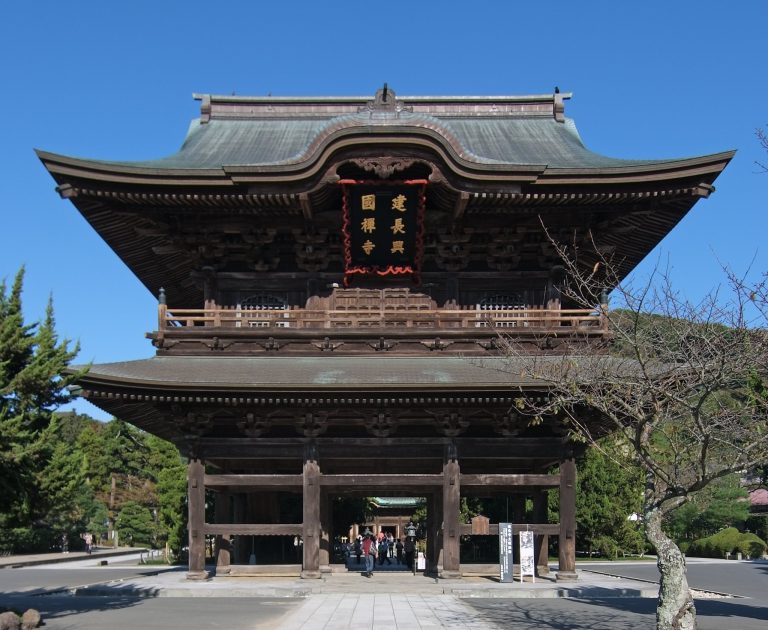
In 1634, the former residence of Tokugawa Tadanaga, known as the Suruga Dainagon, was dismantled and donated to Tōkei-ji. The transfer changed the appearance of the temple and reflected its relationship with the Tokugawa family through Sen-hime. The donation was probably facilitated by Kasuga no Tsubone. The former residence supplied the guest hall, abbatial quarters, main gate, and other components, while the Buddhist hall was probably built anew at Tōkei-ji in the same year.
Tenshū-ni became abbess sometime between 1634 and 1642. A bronze, cloud-shaped temple board cast in 1642 names her as abbess and records its production for memorial rites for her father, Toyotomi Hideyori. She died in 1645 at the age of thirty-seven.
A later anecdotal account connects Tenshū-ni with the punishment of Katō Akinari, lord of Aizu, after the wife and children of his retainer Hori Mondo sought refuge at Tōkei-ji. The claim that Tenshū-ni caused Akinari’s forfeiture is historically uncertain. Hori Mondo’s wife did enter the temple, however, and Tenshū-ni appealed through Sen-hime to secure her protection.
Deputy abbesses and temple administration
Tōkei-ji was without a formal abbess for about twenty-five years after Tenshū-ni’s death. The daughter of Kitsuregawa Takanobu entered the temple and became the twenty-first abbess, Eizan-ni, in 1669. After her death, the temple again remained without a formal abbess for about twenty-one years. The daughter of a former court noble entered in 1728 and became the twenty-second abbess, Gyokuen-ni, in 1737. Because of ill health, Gyokuen-ni soon returned to Kyoto. No further abbess formally served until the Meiji period, although nuns continued to live at Tōkei-ji.
During these periods, the head of Inryōken acted as deputy. Founded around 1521 to 1528 by Yōzan-ni, Inryōken became Tōkei-ji’s leading subtemple. Its abbesses managed temple affairs and negotiated with outside authorities. Because Tōkei-ji controlled a substantial estate, it also possessed an administrative office and temple officials.
A dispute over temple management and alleged embezzlement of revenue by officials connected with the Kitsuregawa domain led to a complaint in 1787 and the officials’ removal. Later disputes concerned illegal tree felling and the authority to administer the temple. In 1801, the Inryōken abbess Tangen-ni withdrew to her family and took Tōkei-ji’s vermilion-seal document to Engaku-ji. After a legal dispute in 1802, temple officials lost their attempt to control the document and were ordered to follow the deputy abbess and Engaku-ji.
In 1808, Hōshu-ni, a princess of the Mito domain, became head of Inryōken and deputy administrator. During her tenure, Tōkei-ji’s divorce procedures were systematized. An interest-lending office was also established, with a branch in Edo from 1836.
The divorce temple
Tōkei-ji was historically known as an Enkiri-dera, or divorce temple, together with Mantoku-ji in present-day Gunma. Women who could not obtain a divorce from their husbands could seek refuge at these institutions. The shogunate’s magistrate for temples and shrines supported or recognized this arrangement, and Tōkei-ji’s authority was treated as exceptional in relation to local jurisdiction.
An eighteenth-century statement says that Kakusan-ni obtained the privilege directly from Hōjō Sadatoki and secured imperial authorization. That foundation story is not historically confirmed, but by the middle of the Edo period it was accepted and used to justify the temple’s divorce practice.
The late Edo-period procedure normally began with temporary lodging at one of three authorized inns, rather than immediate admission to the temple. Temple officials investigated the woman’s circumstances, summoned her parents through the village headman, and encouraged reconciliation or a negotiated settlement. If settlement failed, the officials notified the husband’s village headman and could eventually issue a formal temple order requiring a divorce document.
Under the mature procedure, a woman formally admitted to Tōkei-ji stayed for a foot-counted three years, meaning twenty-four months. If her husband supplied a divorce document promptly, the period could be reduced to twelve months. She could then return to her family and remarry. Entering Tōkei-ji did not itself mean becoming a nun.
Women who remained at the temple performed assigned work and recited Buddhist texts. Regulations restricted their movements and meetings with men. Their work was arranged in three ranks, ranging from service near the deputy abbess and ceremonial responsibilities to cleaning, cooking, laundry, and gardening.
Surviving records represent 495 refuge cases in 993 documents. About 400 cases and 690 documents remain at Tōkei-ji, while the actual number of cases was probably several times larger. The women represented in the records averaged twenty-nine years of age, with ages ranging from twenty to fifty-four. Formal decisions averaged eleven days.
Between 1711 and 1807, the surviving records show five temple-law divorces and one negotiated divorce. From 1808 to 1830, there were seven of each. Between 1831 and 1870, negotiated divorces predominated, numbering 123 compared with four temple-law divorces. In 1866, thirty-eight recorded petitions sought divorce. Twenty-five ended in negotiated settlements, while two resulted in formal admission to the temple.
The final recorded woman to seek refuge at Tōkei-ji entered on February 9, 1871. The Meiji government abolished the temple’s special privileges that year, ending its divorce jurisdiction. In 1873, women gained a legal right to petition for divorce under the new civil system, making divorce a secular legal matter.
From nunnery to modern Zen temple
The Meiji Restoration ended Tōkei-ji’s temple estates as well as its divorce jurisdiction. After the death of the last deputy abbess, Junso-ni, in 1902, the centuries-old nunnery effectively came to an end. In 1903, Furukawa Gyōdō became the first male abbot, and Tōkei-ji subsequently became a male-monastic temple within the Engaku-ji branch.
Shaku Sōen served as abbot from 1905 until his death at Tōkei-ji in 1919. During his tenure, the temple was visited by the Buddhist scholar D. T. Suzuki and the novelist Natsume Sōseki. Sōen’s legacy later supported the establishment of the Matsugaoka Bunko library and the Matsugaoka Hōzō treasure hall.
The Great Kantō Earthquake of 1923 destroyed every temple building except the bell tower. The study hall was rebuilt at the end of the 1920s, and the main hall was rebuilt in 1935, the year in which the abbot Sato Zenchu died. During the postwar development of the temple, land formerly associated with Tōkei-ji, including the site of Eifuku-ji, was acquired by Kamakura. The proceeds helped finance construction of the Matsugaoka Hōzō. Tōkei-ji was recognized as a component cultural property of Japan Heritage in 2016.
Remains
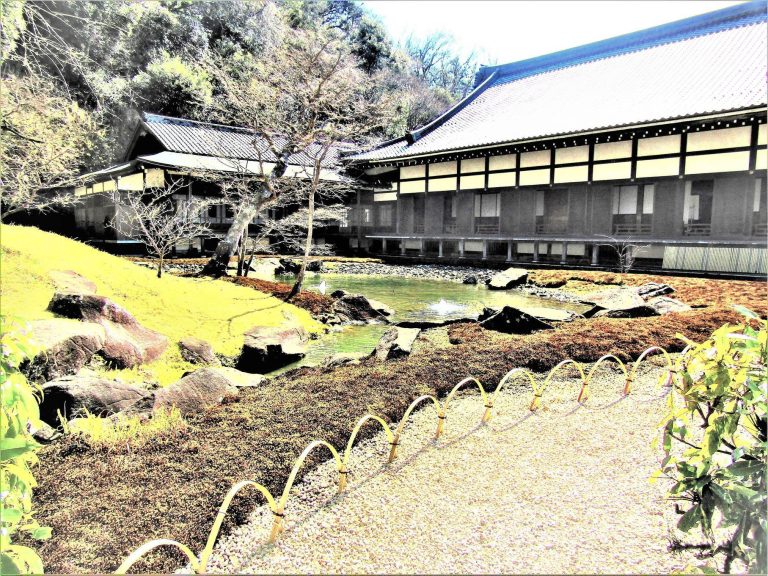
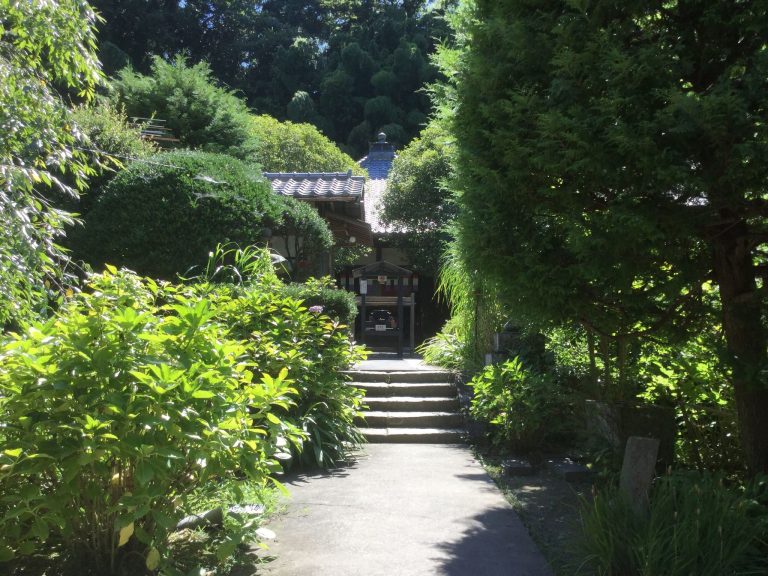
Tōkei-ji occupies a mountain-enclosed valley known as a yato. The grounds extend toward the surrounding ridges and include temple buildings, former subtemple sites, gardens, a cemetery, and wooded land. Surviving and documented components include the main gate, the former guest hall and abbatial quarters derived from Tokugawa Tadanaga’s residence, the study hall, Suigetsu-dō, the Matsugaoka Hōzō, and the cemetery. Many earlier structures were destroyed, dismantled, moved, or lost during the temple’s decline and the 1923 earthquake.
Temple buildings
Main hall
The present main hall contains the principal image of Shaka Nyorai together with images associated with Kakusan-ni and Yōdō-ni. It was rebuilt in 1935 after the Great Kantō Earthquake, when the earlier temple buildings were destroyed.
Former Buddhist hall
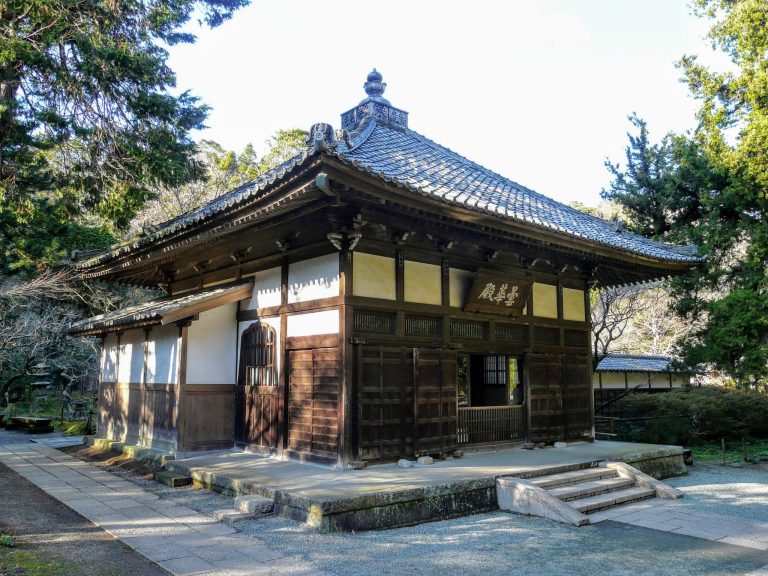
The former Tōkei-ji Buddhist hall was probably built in 1634 during the reconstruction associated with Sen-hime’s donation. Earlier interpretations assigned the building to the Muromachi period or regarded it as a rebuilt structure from 1515, but the 1634 date is now the established interpretation. Hara Tomitarō transferred the hall to Sankei-en in Yokohama in 1907, where it survives as an Important Cultural Property.
The building now has a hipped, thatched roof. An early nineteenth-century estate drawing shows it with a more formal gabled-hipped roof. The original roof form and the changes made later remain matters of architectural interpretation.
Bell tower and temple bell
The bell tower is the only major temple structure explicitly recorded as surviving the 1923 earthquake. The temple bell itself, cast in 1332, is now preserved at Honryū-ji in Nirayama, Shizuoka. Its inscription names the donor, abbess, and nuns who administered the medieval nunnery, making it an important record of Tōkei-ji’s Kamakura-period organization.
Suigetsu-dō and treasure hall
The Kannon hall, Suigetsu-dō, is associated with an image of Suigetsu Kannon and an image of Prince Shōtoku. The hall is only rarely opened to the public. The Matsugaoka Hōzō treasure hall preserves or displays objects connected with Tōkei-ji, including historical divorce documents and works of Buddhist sculpture and lacquer.
Images, lacquerwork, and documents
Buddhist images
A 135-centimeter wooden standing image of Shō Kannon has clay domon decoration characteristic of the late Kamakura period. It is traditionally identified as the principal image formerly belonging to Taihei-ji, although that identification depends on later evidence and remains cautious. The figure is a nationally designated Important Cultural Property.
The wooden seated image of Suigetsu Kannon is designated a tangible cultural property by Kanagawa Prefecture. The wooden seated image of Shaka Nyorai is designated by Kamakura City. These images are associated with the religious life of the temple and its halls.
Lacquer objects and temple board
The Hatsune Maki-e Hitorimo is a Muromachi-period, gourd-shaped incense container decorated with maki-e, a lacquer technique using sprinkled metallic powders. It is a nationally designated Important Cultural Property and was associated with Tenshū-ni.
The Budō Maki-e Raden Seibibako is a cylindrical container decorated with lacquer and raden, an inlay technique using mother-of-pearl. It is associated with Jesuit Eucharistic use and is a nationally designated Important Cultural Property connected with Tōkei-ji’s collections.
A bronze, cloud-shaped temple board bears an inscription dated 1642 and is designated a tangible cultural property by Kamakura City. Such boards were struck in Zen temples to signal meals and Buddhist observances.
Temple documents
The Tōkei-ji Documents comprise 777 documents, one document box, and one ritual striking board. They preserve evidence concerning the temple’s administration, estates, abbesses, and divorce procedures. The surviving divorce records include the cases and decisions that illuminate the regulated process by which women sought protection and negotiated changes to their marriages.
Abbesses’ cemetery and memorials
Medieval and early-modern graves
The cemetery of the abbesses lies beyond a flight of steps near a rock wall where iwata-bako plants grow. Yōdō-ni’s grave is enclosed and administered by the Imperial Household Agency. It lies in a yagura, a rock-cut chamber or cave used in medieval Kamakura for burials and memorial monuments.
Kakusan-ni’s site in the cemetery is a memorial monument rather than her burial place. She was buried beside Hōjō Tokimune at Engaku-ji’s Bujitsu-an. Tenshū-ni’s large, unadorned monument stands with a hōkyōintō, a Buddhist memorial pagoda associated with the commemoration of the dead, linked with a woman remembered as her attendant or benefactor.
The cemetery also contains the monument of Eizan-ni and the graves of the Inryōken deputy abbesses, including Junso-ni. These memorials preserve the institutional connection between Tōkei-ji and the subtemple that administered its affairs during long periods without a formal abbess.
Modern memorial features
The cemetery and grounds include memorial features connected with modern cultural figures. They include a memorial brush mound for the painter Maeda Seison and a monument commemorating the former First Higher School. The cemetery also contains the graves of cultural figures associated with modern Japanese intellectual and literary life, including D. T. Suzuki, Nishida Kitarō, Iwanami Shigeo, Watsuji Tetsurō, Abe Yoshishige, Kobayashi Hideo, Takami Jun, and Reginald Horace Blyth.