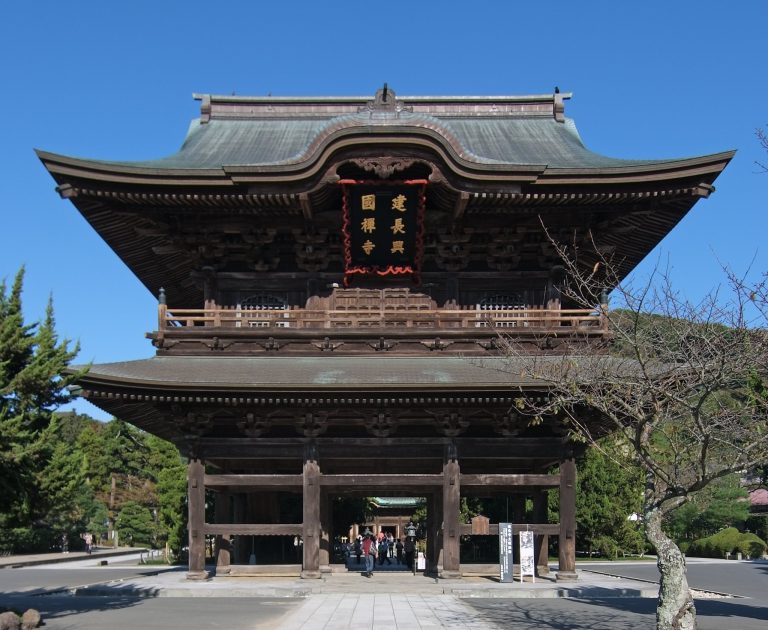
Jōchi-ji Temple: A Rinzai Zen Temple in Kamakura


Site at a Glance
- Rating
- 4.2
- Popularity
- Medium
- Country
- Japan
- Primary era
- Medieval
- External website
- Open
- Eras represented
- Medieval, Modern
- Civilizations
- Japanese, Kamakura shogunate
- Site type
- Religious
- Remains
- Monastery
On this page15 sections
History
Jōchi-ji Temple is a Rinzai Zen Buddhist temple in Kamakura, Japan, founded in the early 1280s and officially established in 1283. It belongs to the Engaku-ji branch of the Rinzai school, a major Japanese Zen tradition, and ranks fourth in the Five Mountains, the formal ranking system for Kamakura’s leading Zen temples. Chinese Zen monks advised its construction, which retained features of Song-dynasty architecture.
Foundation and Early Development
The temple was founded to commemorate Hōjō Munemasa, the third son of Hōjō Tokiyori, who served as the fifth shikken, or chief regent, of the Kamakura shogunate. Munemasa died in 1281. His son, Hōjō Morotoki, was named the founder, although he was only eight years old. The practical work of establishing and opening the temple was probably overseen by Munemasa’s widow and his younger brother, Hōjō Tokimune, both members of the Hōjō family that controlled the regency.
Jōchi-ji traditionally recognizes three founding priests. Nanshu Kōkai was invited to open the temple but considered himself too young for the responsibility, so he gave the role to his teacher, Daikyū Shōnen. Daikyū wished to honor his own teacher, Gottan Funei, who had returned to China in 1265 and died before the temple was completed. Nanshu was therefore recognized as a secondary founder, while Daikyū and Gottan were also honored as founders.
Medieval Power and Expansion
Jōchi-ji developed into a large and influential institution. High-ranking monks such as Kōhō Kennichi and Musō Soseki later served as abbots. At its height, the complex contained seven principal buildings and 11 sub-temples. A record of the 1323 memorial observance for Hōjō Sadatoki lists 224 participating monks from Jōchi-ji, while the total population, including non-monastic personnel, has been estimated at about 500. Archaeological traces extend deep into the valley toward the foot of Tenchū Pass, indicating that the medieval complex may have approached the scale of present-day Engaku-ji.
The temple remained powerful after the Kamakura shogunate fell. A fire destroyed its original buildings in 1356, but numerous halls and 11 sub-temples stood during the Muromachi period, the era of rule by the Ashikaga shoguns. Ashikaga Mochiuji stayed at Jōchi-ji for more than two months after returning to Kamakura in 1417. His son, the future Ashikaga Shigeuji, also stayed there when he entered Kamakura in 1449.
Decline, Reconstruction, and Heritage Status
From around the middle of the fifteenth century, Jōchi-ji gradually declined alongside Kamakura. Eight sub-temples still survived until the end of the Edo period, the era of Tokugawa rule, but most of the buildings collapsed in the Great Kantō Earthquake of 1923. The present complex was largely rebuilt during the Shōwa era, which began in 1926, and the shoin, a traditional reception or study room, was constructed in 1924.
The precinct was designated a national historic site in 1966. It also forms part of Kanagawa’s specially protected historic-landscape district and was recognized in 2016 as a component property of Japan Heritage.
Remains
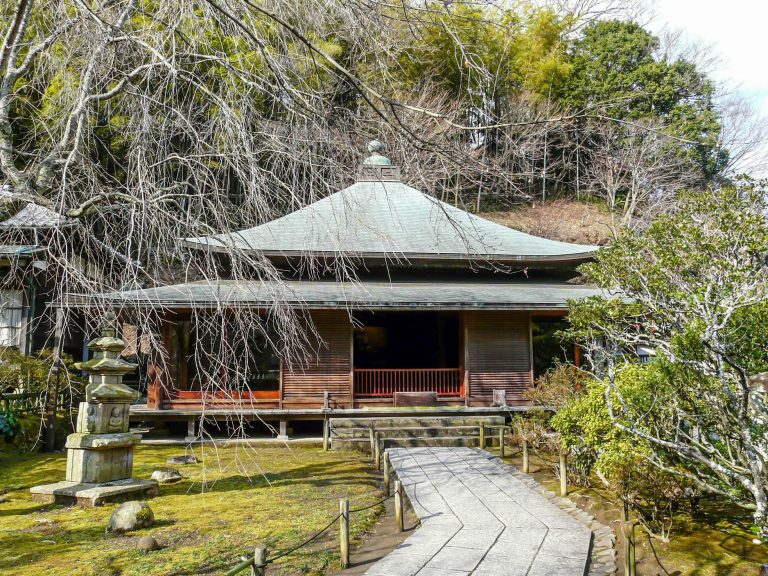
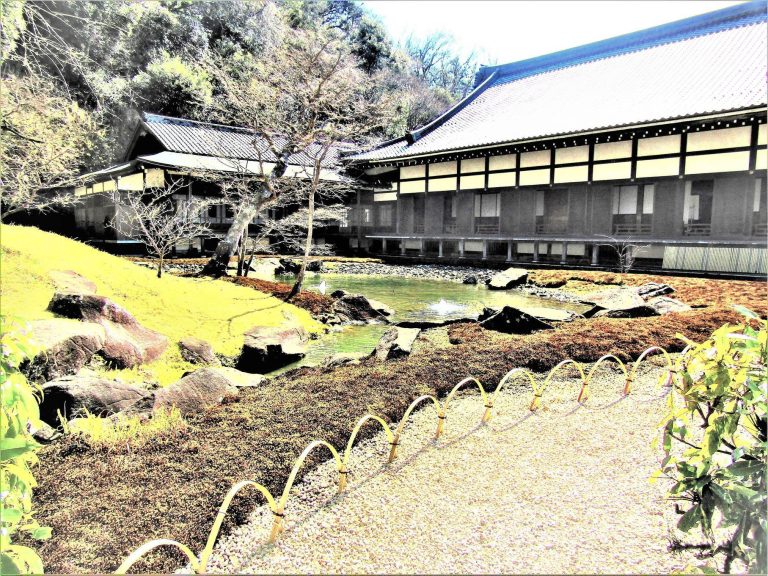
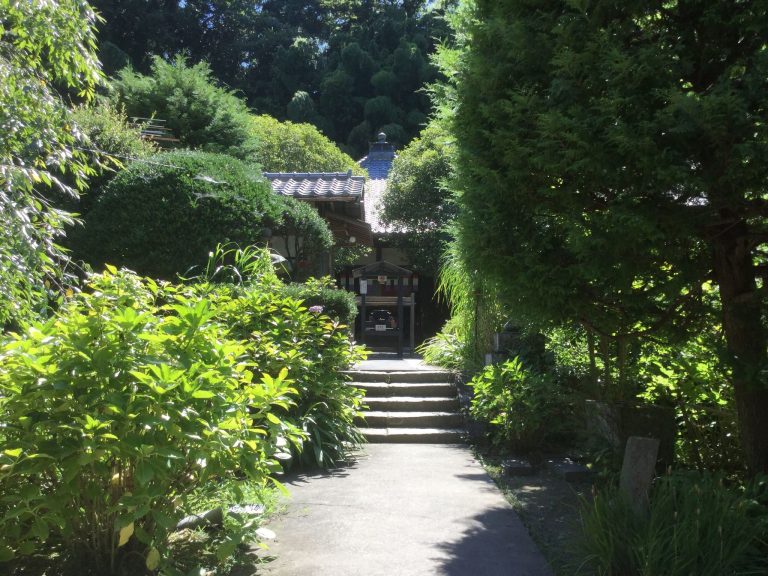
Jōchi-ji occupies a wooded, uneven valley south-west of Kenchō-ji and east of Tōkei-ji. Its precinct combines reconstructed temple buildings, a stone-paved approach, historic Buddhist images, rock-cut chambers, stone monuments, gardens, bamboo groves, and mature trees. The approach uses Kamakura stone, a local sandstone, and leads through an entrance sequence toward the main hall.
Entrance and Main Hall
Stone Approach and Sanmon
The entrance begins with a stone bridge and the spring known as the Well of Sweet Dew, counted among Kamakura’s traditionally recognized Ten Wells. The Sanmon, or entrance gate, carries the inscription “The treasure you seek is near.” The words are attributed to Mugaku Sogen, the founder of Engaku-ji.
Shōrōmon
The Shōrōmon is a two-storey gate that combines a gate tower with a bell tower. Its upper level has Chinese-style katōmado windows, a distinctive pointed window form associated with East Asian and Zen architecture. The level contains a bronze bell cast in 1340. The bell is a Kanagawa Prefectural tangible cultural property, and the gate was rebuilt in 2007.
Donge-den
Beyond the gate stands the main hall, known as the Donge-den. It houses three wooden seated Buddhas representing the past, present, and future: Amida Nyorai, the Buddha of the Pure Land tradition; Shaka Nyorai, the historical Buddha; and Miroku Nyorai, the Buddha expected to appear in the future. The Shaka image probably dates from around 1370, while the Amida and Miroku figures date to the middle of the fifteenth century. The group is a Kanagawa Prefectural cultural property.
The Three Ages group is flanked by a statue of Bodhidharma, traditionally regarded as the Indian founder of Chan Buddhism, the Chinese predecessor of Japanese Zen, and statues of Nanshu Kōkai and Daikyū Shōnen. A Kannon image, representing a bodhisattva associated with compassion, stands at the rear of the hall.
Rock-Cut Chambers and Buddhist Images
Yagura
Steep parts of the precinct contain numerous yagura, rock-cut chambers characteristic of medieval Kamakura and used for burials, memorials, or religious images. These chambers contain stone Buddhas, stone pagodas, memorial monuments, and figures including Ugajin, a deity associated with prosperity and good fortune, and Hotei, a popular Buddhist-associated deity of good fortune. One cave houses a Kannon image. The Hotei statue has smooth, worn areas on its belly, left earlobe, and index finger from repeated touching.
Additional Sculptures
A wooden seated Jizō from the late Kamakura period and a wooden standing Idaten from the fourteenth century belong to the temple and are currently on loan to the Kamakura Museum. Jizō is a bodhisattva traditionally linked with the protection of travelers and the dead, while Idaten is a Buddhist guardian associated with swift protection. Another wooden standing Kannon, made during the Northern and Southern Courts period, was formerly enshrined with 500 arhats, Buddhist disciples who attained spiritual liberation, in the upper level of the entrance gate.
Grounds and Later Buildings
Gardens and Trees
The wooded grounds include bamboo groves and flower gardens. Two old trees stand near the main hall: a kōya-maki reputed to be Kamakura’s largest, and a Hakuunboku whose flowers bloom for about one week in early May.
Cemetery and Shoin
A cemetery lies behind the main hall and contains the grave of the writer Shibusawa Tatsuhiko. His personal name was Tatsuo, but the inscription on the grave reads Tatsuhiko. The precinct also includes the shoin, built in 1924 with a thatched roof, and a tea room.