Kenchō-ji Temple: A Rinzai Zen Monastery in Kamakura


Site at a Glance
- Rating
- 4.4
- Popularity
- Medium
- Country
- Japan
- Primary era
- Early Modern
- External website
- Open
- Eras represented
- Medieval, Early Modern
- Civilizations
- Kamakura shogunate, Tokugawa
- Site type
- Religious
- Remains
- Monastery
On this page17 sections
History
Kenchō-ji Temple is a Rinzai Zen monastery in Kamakura, Japan, founded in 1253 during the Kamakura period. It was established under the patronage of Hōjō Tokiyori, the fifth regent of the Kamakura shogunate, and is ranked first among the Kamakura Five Great Zen Temples. The temple is also described as Japan’s oldest Zen training monastery.
Foundation in the Kamakura period
Kenchō-ji was created through the combined influence of religious devotion and shogunal administration. Tokiyori supported Zen personally, while the temple’s foundation also formed part of the political organization of the Kamakura Five Mountain system, a shogunate-backed hierarchy of leading Zen temples used for religious administration, government communication, and political oversight.
The temple stands at Yamanouchi, a strategic position at Kamakura’s northern entrance and a base of the Hōjō family. Its valley had formerly been called Jigokugaya, or Hell Valley. Before the temple was founded, the area served as an execution ground and contained Shinpei-ji, a temple whose principal image was Jizō, the Buddhist bodhisattva associated especially with travelers, children, and the dead.
The choice of Jizō as Kenchō-ji’s principal deity, rather than the Shaka image more commonly associated with Zen temples, is linked with the valley’s earlier use as an execution ground. A Jizō image traditionally identified as the former principal image of Shinpei-ji was transmitted to Kenchō-ji.
Preparations for construction probably began around 1249, although the Kamakura shogunate’s official record, the Azuma Kagami, places the start of construction in 1251. The dedication ceremony took place in 1253. The first abbot and founding Zen master was Rankei Doryū, a monk of the Song dynasty who is also known as Lanxi Daolong and Daigaku Zenji. After arriving in Japan in 1246, he lived for periods in Hakata and Kyoto, moved to Kamakura in 1248, and stayed at Jōraku-ji until Kenchō-ji was established. His successor as abbot was another Song monk, Gottan Funei.
Zen discipline and political influence
Rankei Doryū introduced a strict form of Zen discipline based on Song-period practice. Chinese was reportedly used for everyday communication within the monastery. He moved to Kennin-ji in Kyoto in 1262, returned to Kamakura and resumed the abbacy two years later, and was later sent temporarily to Kai Province during the Mongol invasion because he was suspected of being a Chinese spy. He returned to Kenchō-ji in 1278 and died there later that year at the age of 66.
Kenchō-ji and the other Five Mountain temples became important centers of learning under the patronage of their Zen teachers. Their scholars produced a distinctive body of writing known as Japanese Literature of the Five Mountains and exercised substantial influence on medieval domestic politics. In the late Kamakura period, the shogunate also authorized temple-financed trading ships to raise funds for repairs. These vessels became known as the Kenchō-ji ships.
Earthquakes, fires, and rebuilding
A major earthquake struck Kamakura on April 12, 1293. Most of Kenchō-ji’s buildings collapsed and burned, and the tenth abbot, the Chinese monk Issan Ichinei, was appointed to supervise reconstruction. Further fires in 1315 and 1416 destroyed much of the original architecture. By the end of the medieval period, the temple’s buildings had therefore undergone repeated rebuilding even though its institutional importance continued.
The Five Mountain system later declined after the fall of the Ashikaga shogunate. During the Edo period, however, the Tokugawa family supported new principal buildings and the relocation of structures from other sites. Kenchō-ji suffered another major disaster in the Great Kantō Earthquake of 1923, which damaged several of its buildings.
Modern revival and continuing traditions
Kenchō-ji experienced a revival in the nineteenth century under the Zen master Ōzora Kandō. In 1886, the temple established the Shūgakurin school for trainee monks. The school became the predecessor of Kamakura Gakuen Junior and Senior High School, whose management the temple continues to support. In 1890, Ōzora Kandō brought the tutelary spirit of Hōkō-ji in Shizuoka to Kenchō-ji and established the Hansōbō shrine.
The temple precincts were designated a national Historic Site in 1966. Its garden had already been designated a national Historic Site and Place of Scenic Beauty in 1932. Kenchō-ji was included among the component cultural properties of the Japan Heritage program in 2016, and the temple and its precincts form part of Kanagawa’s specially protected historic landscape district.
Kenchō-ji traditionally holds the Sanmon Kajiwara Segaki-e funerary ceremony on July 15 during Obon, the Japanese Buddhist observance honoring the dead. The segaki rite is performed for suffering or hungry spirits, and the ceremony is repeated for the spirit of Kajiwara Kagetoki, a Kamakura-period samurai who died amid the political turmoil following the death of Minamoto no Sanetomo. Tradition connects the rite with Rankei Doryū’s time through a story in which a ghost appeared after a ceremony and received a second ritual.
At its height, Kenchō-ji had 49 subtemples. A smaller group survives today, including outlying subtemples, with varying degrees of public access. The monastery remains associated with Zen training and with the long religious and institutional history of Kamakura.
Remains
The surviving compound preserves the characteristic organization of a Chinese-style Zen monastery. Its principal buildings follow a north-south axis in the sequence of the Sōmon, Sanmon, Butsuden, Hattō, and Hōjō. The approach between the outer and main gates runs diagonally because of the terrain. The original compound was a complete shichidō garan, the traditional arrangement of a Zen monastery’s principal buildings, and included 49 subtemples. Fires in the fourteenth and fifteenth centuries removed most of the original structures, but the present layout retains the aligned form of the earlier complex.
Gates and central halls
Sōmon and Sanmon
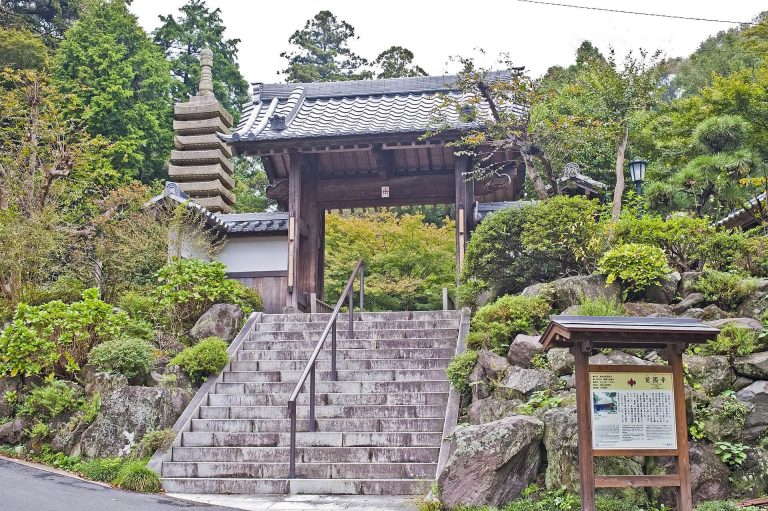
The Sōmon, or outer gate, was built in 1783 and transferred to Kenchō-ji from Hanju Zanmai-in in Kyoto in 1940. Its plaque bearing the name Kofukusan is traditionally attributed to Issan Ichinei. A small additional dot beneath the third stroke of the character meaning giant is said to give the character greater visual balance.
The Sanmon, also called the Three-Gate, is a two-story structure with three bays and a single central passage. It was built in 1775 by Kawachi Chōbei, a master carpenter of the Kenchō-ji carpenters. Its lower level is completely open and has no doors. Heavy structural members give the gate a powerful appearance that contrasts with the generally slender elements of Zen-style architecture. Rainbow beams extend from the two central pillars, with upright supports above them and a mirror ceiling beneath the upper level. A decorative karahafu gable, a cusped Japanese gable, occupies the center of the upper façade below the temple plaque.
The upper level contains a crowned image of Shaka, sixteen arhats, and a bronze group representing 500 arhats. It is not open to the public. The gate was designated an Important Cultural Property in 2005. Its upper roof was damaged in the 1923 earthquake, a result attributed to the replacement of the original shingle roof with heavy copper sheeting in the late Edo period, while the main structural members suffered comparatively little damage.
Butsuden
The Butsuden, or Buddha Hall, is a single-story building with a hipped roof and a surrounding mokoshi, a lean-to roof set below the main roof line. It is an Important Cultural Property. The building originally served as the mausoleum of Sōgen’in, the wife of Tokugawa Hidetada, at Zōjō-ji in Tokyo, and was moved to Kenchō-ji in 1647.
Its former mausoleum function explains architectural differences from a conventional Zen Buddha Hall. The building has a hipped roof rather than the more usual roof combining gabled and hipped sections, and its ceiling is a Japanese-style coffered ceiling rather than the flat mirror ceiling often decorated with a dragon in Zen halls.
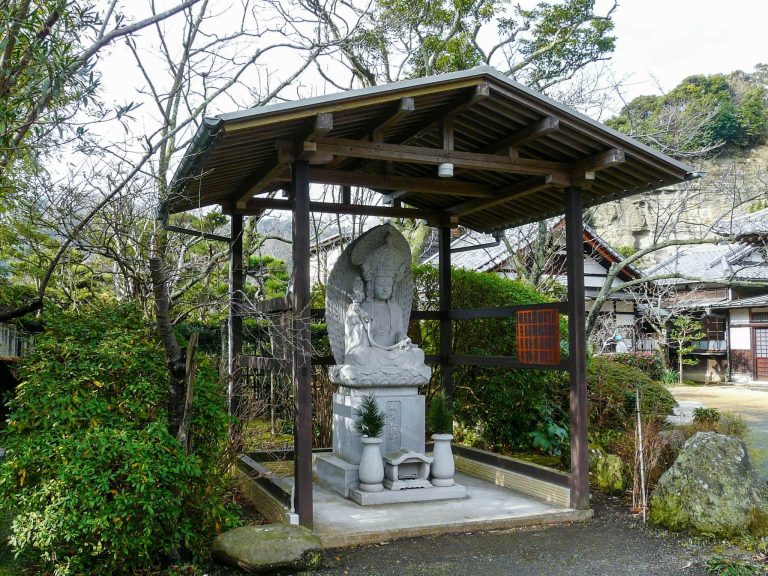
The hall houses the principal seated Jizō image, a Muromachi-period work approximately 2.4 metres high. It also contains the Jizō image traditionally associated with Shinpei-ji, a group of 1,000 standing Jizō images, a seated Senju Kannon, and guardian deities of the monastic compound. Seven old Chinese juniper trees stand before the building. Traditionally attributed to Rankei Doryū, they are estimated to be about 750 years old and are designated natural monuments.
Hattō
The Hattō, or Dharma Hall, is a large wooden building used for public ceremonies. It has an irimoya roof, which combines a gabled upper section with hipped lower slopes, a square three-bay plan, a surrounding mokoshi, and copper-sheet roofing. Its frame was raised in 1814 and the building was completed in 1825 under Kawachi Kyūemon, another master carpenter of the Kenchō-ji carpenters.
Inside, columns mark the boundary between the main structure and the lower roof but create no separate internal partitions. The floor is covered with diagonally set tiles. At the rear, a ceremonial platform rises more than two metres, with a seated Senju Kannon behind it. The Hattō is among the largest Buddhist wooden buildings in eastern Japan and was designated an Important Cultural Property in 2005.
The ceiling carries Koizumi Junsaku’s Cloud Dragon, a large modern painting by a Japanese artist known for monumental works. It was painted on a separately prepared surface and suspended from the ceiling rather than applied directly to a mirror ceiling. The hall also contains a replica of the Fasting Buddha from the Lahore Central Museum, donated by Pakistan after its display at the 2005 Aichi Expo.
Hōjō, garden, and monastic buildings
Karamon and Hōjō
The Karamon, or Grand Gate, forms the entrance to the Hōjō and is an Important Cultural Property. Like the Butsuden, it came from Sōgen’in’s mausoleum at Zōjō-ji. Major repairs after the 1923 earthquake were completed in May 2011, restoring the gate’s appearance at the time of its relocation.
The Hōjō serves as the head priest’s residential and ceremonial building. It was transferred from Hanju Zanmai-in in Kyoto. Behind it lies Shinji-ike, or Mind-Character Pond, a Zen garden traditionally attributed to the Zen master and garden designer Musō Soseki. The pond’s form resembles the Chinese character for mind.
Training and former structures
The monastery contains a Zen meditation hall, a kaisandō, or founder’s hall, and administrative offices. The meditation area is used for monks’ training and remains closed to the public. At the Kegon Tower site, a pagoda once rose more than 20 metres. It has been described either as a five-story pagoda or, under another interpretation, as a three-story pagoda. Construction of the approach road destroyed the remains, leaving a stone monument.
Hillside shrines and smaller temples
Hansōbō and the former Inner Sanctuary
Hansōbō stands on a hillside at the rear of the precinct and serves as Kenchō-ji’s tutelary Shinto shrine. It enshrines Hansōbō Daigongen, the protective spirit brought from Hōkō-ji in 1890. Statues of tengu, supernatural Japanese beings traditionally shown with human or birdlike traits, line the steep stairway to the shrine. The former Inner Sanctuary remains among the trees at the top of the hill beyond Hansōbō. Its area contains stones inscribed with the names of devotees belonging to more than 100 religious organizations, as well as an observation deck beside the sanctuary.
Kaishun-in
Kaishun-in is a small remote temple on a hill overlooking a pond at the end of the garden beside Hansōbō. Built in 1334, it houses a statue of Monju Bosatsu, the Japanese Buddhist form of Mañjuśrī, the bodhisattva of wisdom.
Memorials and graves
Beneath the largest Chinese juniper before the Butsuden stands a stone monument surrounded by chains. It commemorates Kamakura citizens who died during the Russo-Japanese War of 1904 to 1905. The grounds also contain the grave of Kawamura Zuiken, a wealthy merchant of the early Edo period, and a grave traditionally regarded as belonging to Oda Nagamasu, also known as Urakusai.