Tendai-ji Temple: A Historic Tendai Buddhist Temple in Japan
Site at a Glance
- Rating
- 4.2
- Popularity
- Low
- Country
- Japan
- Primary era
- Early Modern
- External website
- Open
- Eras represented
- Medieval, Early Modern
- Civilizations
- Tokugawa
- Site type
- Religious
- Remains
- Temple
On this page19 sections
History
Tendai-ji Temple is a Tendai Buddhist temple in Ninohe, Iwate Prefecture, Japan. Its formal name is Hachiyozan Tendai-ji, and tradition places its foundation in 728, when the monk Gyoki acted under the command of Emperor Shomu, named the mountain Hachiyozan, carved a Sacred Kannon from a large katsura tree, and established the temple. The exact foundation date remains unconfirmed, but the site had taken the form of an established temple by the middle of the tenth century.
Origins beside Katsura Spring
The temple developed from Katsura Spring, which rose beside the roots of a large katsura tree below the mountain path. The spring was revered as Katsura Spring Kannon and as the Kannon of Oyama. Kannon is a Buddhist form of Avalokiteshvara, the bodhisattva associated with compassion. The sacred spring and its image became the centre of what is regarded as Japan’s northernmost ancient Buddhist culture.
A 1980 investigation found the remains of a post-built structure east of the present Main Hall. Pottery and ash from the eruption of Mount Towada on August 17, 915, place the structure in the tenth century. The eruption severely damaged settlements in the Yoneshiro and Appi River valleys. Tendai-ji may then have been developed to protect agricultural communities that had been relocated after the disaster and to support the restoration of an important route linking Mutsu with Kazuno and Tsugaru.
The local Damburi Chōja tradition connects the temple with a childless couple who prayed to the Kannon of Katsura Spring and later had a daughter, Princess Katsura. According to the tradition, Dainichi shrines were subsequently established elsewhere in memory of the princess and her parents.
Medieval growth and Nanbu patronage
The name Tendai-ji first appears on a copper ritual gong dated 1363. A copper bell inscription traditionally dated to 1392 preserves the name Katsura Spring. By this period, the expanding Nanbu clan had begun to revere and protect the temple. The Nanbu were a medieval and early-modern warrior house that ruled much of northern Honshu, including the Morioka Domain. By the middle of the Muromachi period, Tendai-ji had become the first station of the Nukanohe Thirty-Three Kannon pilgrimage.
Nanbu Shigenao, lord of the Morioka Domain, revived the temple in 1658 and commissioned the present Main Hall. Nanbu Shigenobu carried out major repairs in 1690. The complex then included 27 subsidiary shrines and possessed more than 100 koku of temple land, with a koku being a historical measure of agricultural yield used to assess land and stipends. The chief priest, Keijuin, managed the mountain temple with the help of several affiliated monastic residences.
Meiji destruction and loss of the woodland complex
Tendai-ji suffered extensive damage after the Meiji government’s policy of separating Buddhism and Shinto developed into an anti-Buddhist movement. This campaign led in many areas to the destruction of Buddhist buildings, images, texts, and religious possessions. In 1871, a prefectural investigation treated only about one hectare around the temple as its precinct, although the complex extended across approximately 20 hectares and contained 27 subsidiary shrines. The subsidiary shrines were abolished, the surrounding woodland became government forest, and many Buddhist images, halls, the bell, and a manuscript copy of the Great Perfection of Wisdom Sutra were destroyed or burned.
Local worshippers concealed the principal image and other Buddhist images in the woodland, saving them from destruction. Other images were buried or left exposed and survived in poor condition. Apart from the Main Hall, Yakushi Hall, Bishamonten Hall, and Eleven-Headed Kannon Hall, most of the shrine buildings were nearly completely burned.
Twentieth-century decline and revival
Between 1953 and 1956, 1,666 large cedars in the temple grounds were illegally felled after the chief priest was deceived by timber dealers. Permission had initially been granted to cut about 30 trees to pay for repairs to the Main Hall roof, but the felling continued. The timber was falsely sold as natural Akita cedar for approximately 200 million yen, contributing to the temple’s further decline.
In 1960, surface rights were established over 18 of the temple’s approximately 20 hectares. A surface right permits the use or possession of structures or plantings on land owned by another party without transferring ownership of the land, and in this case it prevented reforestation. Temple parishioners began a civil lawsuit in the Morioka District Court in 1961. After 38 hearings through 1967, the case entered mediation, which involved about 14 substantive sessions. Around 1976, an agreement cancelled the surface rights except over three hectares.
In 1975, Kon Shuncho, also known by his literary name Ima Toko and then head priest of Chuson-ji, accepted appointment as Tendai-ji’s special chief priest. He formally entered the temple in April 1976 and began a revival program. This included plans for a new large standing Eleven-Headed Kannon to serve as the principal image, with the older Sacred Kannon placed before it as the front image.
Kon Shuncho died of sigmoid colon cancer in September 1977, but the revival continued. His widow, Ima Kiyo, donated 10 million yen, enabling construction of a repository for Important Cultural Properties and Buddhist and Shinto images damaged during the anti-Buddhist movement. A new bell, bell tower, and memorial pagoda for Kon Shuncho were completed in 1978. That autumn, a ceremony commemorating the temple’s 1,250th anniversary was held at Ima Kiyo’s initiative. Setouchi Jakucho became chief priest in 1987 and greatly advanced the revival, helping establish Tendai-ji as a prominent temple in Tohoku. The modern succession of chief priests also includes Sugano Chokaku in 1978, Sugano Chojun in 2005, and Sugano Kosho in 2021.
Tendai-ji is the 33rd station of the Oshu Kannon Pilgrimage. Its Main Hall, Niomon Gate, wooden standing Sacred Kannon, and wooden standing Eleven-Headed Kannon are designated Important Cultural Properties.
Remains
Tendai-ji occupies a mountain setting in Joboji, Ninohe. Its historic grounds covered approximately 20 hectares, with 27 subsidiary shrines distributed through the woodland before most were abolished during the anti-Buddhist persecutions. Surviving buildings, Buddhist images, sacred landscape features, and the modern repository preserve parts of this larger religious complex.
Seventeenth-century buildings
Main Hall
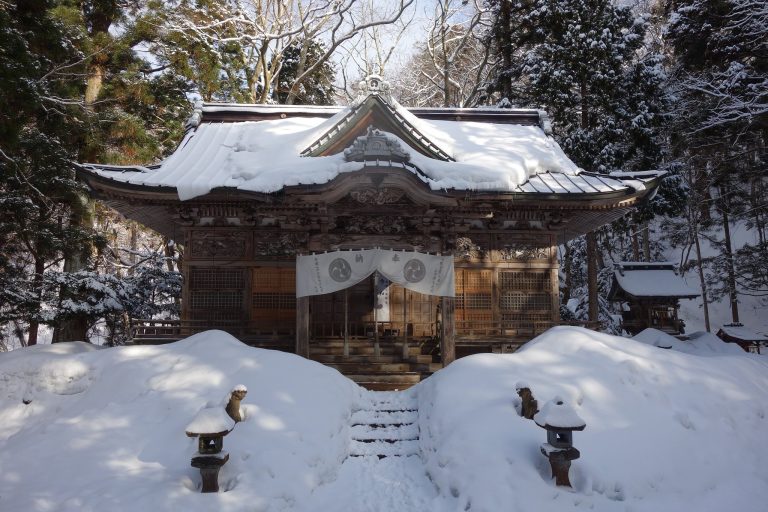
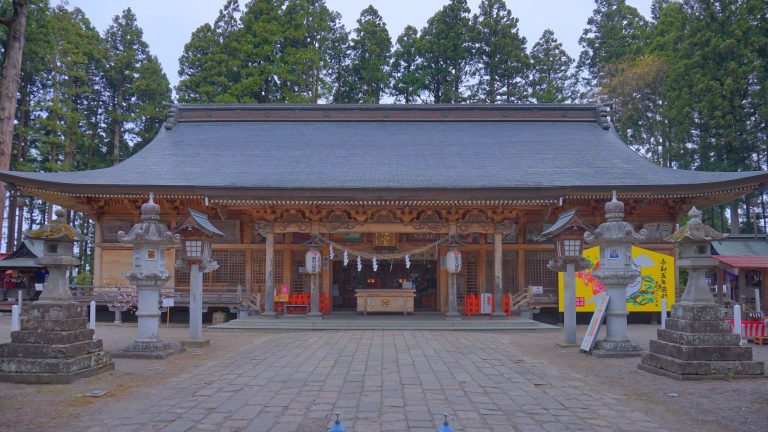
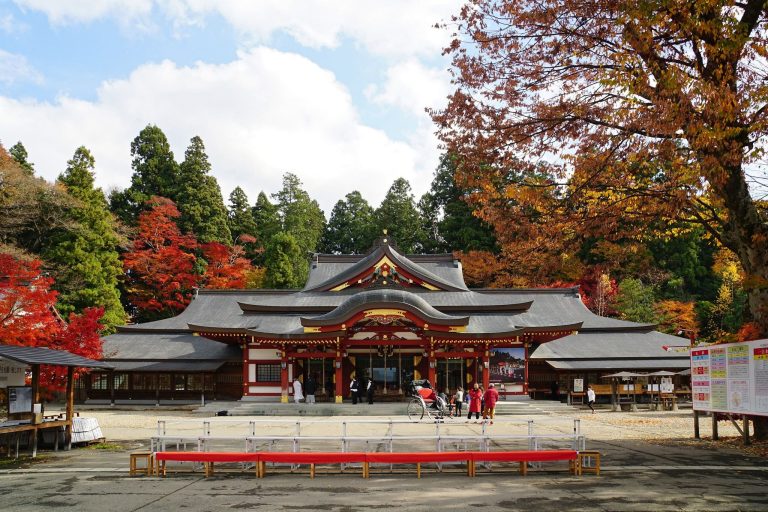
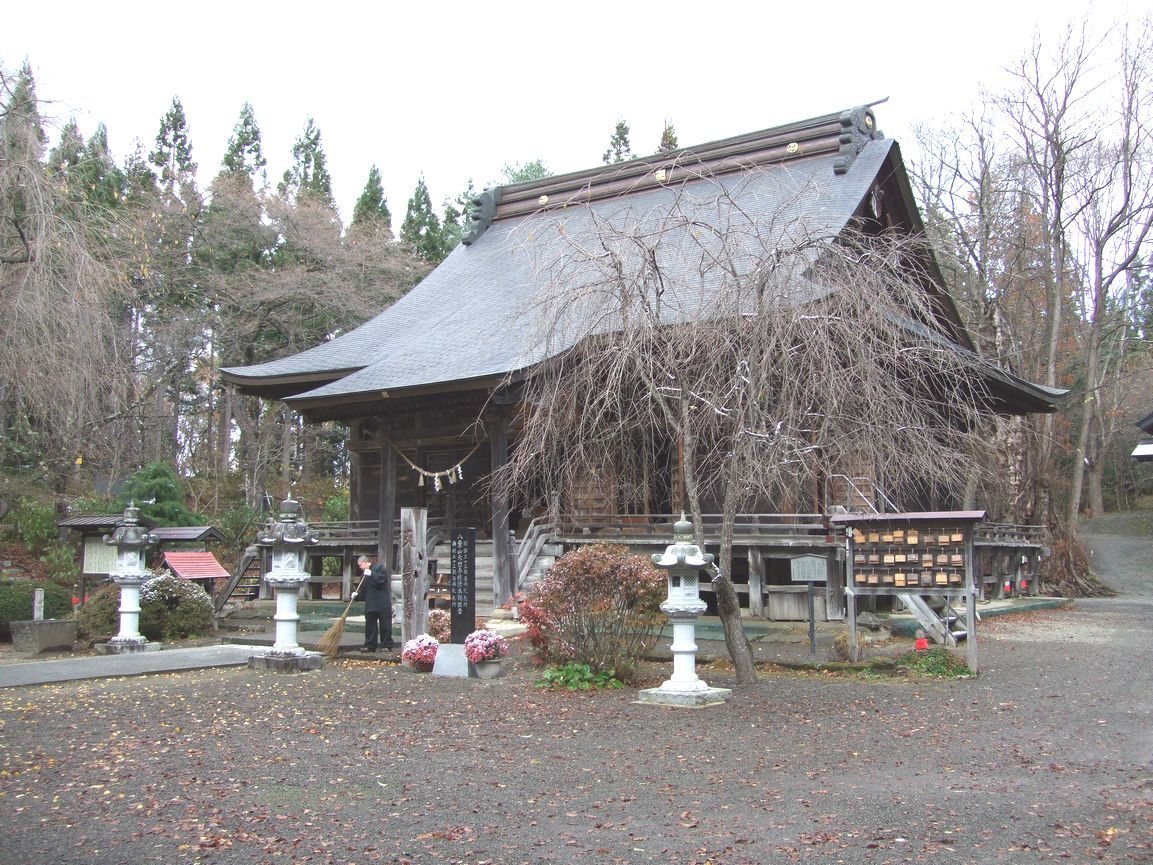
The Main Hall, also called the Kannon Hall, is an esoteric Buddhist hall built in 1658 during Nanbu Shigenao’s revival of the temple. Its copper-covered roof has an irimoya form, combining a hipped lower roof with gabled ends. A ridge plaque and construction records survive in association with the building. The hall is one of Tendai-ji’s designated Important Cultural Properties.
Niomon Gate
The Niomon Gate was built around the same period as the Main Hall, in 1657. It forms part of the surviving architectural group from the temple’s seventeenth-century rebuilding and is also designated an Important Cultural Property.
Wooden Buddhist images
Sacred Kannon
The principal Sacred Kannon, traditionally called the Kannon of Katsura Spring, is a wooden standing statue 118.2 centimetres high. Much of its surface retains regular chisel marks, giving the figure a deliberately rough-hewn appearance. These visible cuts are characteristic of the hatchet-carving technique, in which the sculptor leaves repeated tool marks rather than smoothing the surface completely. The statue is attributed to around the eleventh century and is designated an Important Cultural Property.
Eleven-Headed Kannon
A wooden standing Eleven-Headed Kannon is preserved among the temple’s principal Buddhist images. This form of Kannon represents varied aspects of compassionate response through its multiple heads. During the twentieth-century revival, a new large standing image of the deity was planned to serve as the principal image, while the older Sacred Kannon would stand before it as the front image.
Two Guardian Kings
The wooden standing Two Guardian Kings are traditionally identified as Virupaksa and Vaisravana. Each figure was carved from a single block of katsura wood and is thought to date from approximately the same period as the Sacred Kannon. Both wear a narrow belt beneath a broad waist belt, an unusual arrangement of armor found among a limited group of guardian figures from the ninth to eleventh centuries in the Tohoku region.
Sacred landscape and historic features
Katsura Spring
Katsura Spring rose beside the roots of the large katsura tree associated with the temple’s earliest sacred tradition. The spring provided the physical focus for the former names Katsura Spring Kannon and the Kannon of Oyama, linking the landscape to the temple’s principal devotional image.
Traditional tomb of Emperor Chokei
The traditional tomb of Emperor Chokei is included among the historic remains associated with Tendai-ji.
Ubasugi
Ubasugi is the large stump of a cedar traditionally regarded as the thickest tree at the site. Its circumference was approximately 15 metres, and popular description compared its area with eight tatami mats. The tree burned in 1903. The stump was reconstructed in 2001 on the basis of historical evidence and surveying.
Tsuchifumazu Hill
Tsuchifumazu Hill is a small rise with three mounds opposite Katsura Spring. Tradition interprets it either as a mound containing a sutra deposit or as a cemetery, and its function remains uncertain.
Repository
A repository constructed during the temple’s modern revival houses Important Cultural Properties together with Buddhist and Shinto images damaged during the nineteenth-century anti-Buddhist persecutions. The building preserves objects that survived the destruction and forms part of Tendai-ji’s modern effort to safeguard the remaining religious heritage of the mountain complex.