Tamayama Kofun: A Keyhole-Shaped Burial Mound in Japan
Site at a Glance
- Rating
- 5
- Popularity
- Very Low
- Country
- Japan
- Primary era
- Classical
- Eras represented
- Classical
- Civilizations
- Yamato
- Site type
- Burial
- Remains
- Burial Mound
On this page8 sections
History
Tamayama Kofun is an ancient Japanese burial mound in Iwaki, Fukushima, Japan, built around the middle of the fourth century during the later part of the Early Kofun period. A kofun was a monumental tomb constructed in Japan between roughly the third and sixth centuries. Tamayama belongs to the Tamayama Kofun Group in Yotsukura and is one of the largest burial mounds in the region, ranking third in Fukushima Prefecture and fourth in the Tohoku region by length.
Construction in the Early Kofun period
The mound was created at a time when large burial mounds were being built across southern Tohoku. Its scale, three-tiered rear section, and stone surfacing have led to the inference that the person buried there may have been connected with the Yamato polity, the early centralized power based in the Kinai region that extended its influence across parts of the Japanese archipelago. The same interpretation suggests that the occupant may have controlled the surrounding area, which was regarded as an important transportation hub. These conclusions are drawn from the mound’s size and form rather than from a known burial inscription.
At approximately 112 meters in length, Tamayama Kofun is comparable in scale with Aizu Otsukayama Kofun in Fukushima, which measures 114 meters, and Tomizuka Kofun in Miyagi, which measures 110 meters. The distribution of large burial mounds is described as having a gap between Bonten’yama Kofun in Ibaraki and Tamayama Kofun, placing the mound within a wider pattern of elite tomb construction in the region.
Later traditions and modern investigation
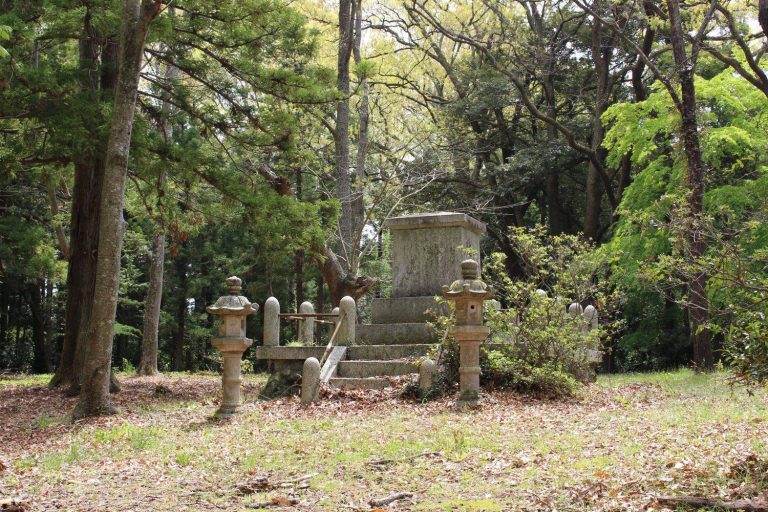
Tamayama Kofun is also known as Tamayama No. 1 Kofun. An eighteenth-century origin history of a nearby temple states that objects associated with its founding priest were buried on the temple’s northern hill. A memorial tower carrying an inscription dated 1763 stands on the mound, linking the later religious tradition to the site’s continuing use and interpretation.
The mound was introduced in 1940 and surveyed in 1979. Iwaki City Board of Education conducted range-confirmation surveys and excavations during fiscal years 2004 to 2007, with the results published in 2009. Tamayama Kofun became a Fukushima Prefectural Historic Site on March 28, 1980.
Remains
Keyhole-shaped mound
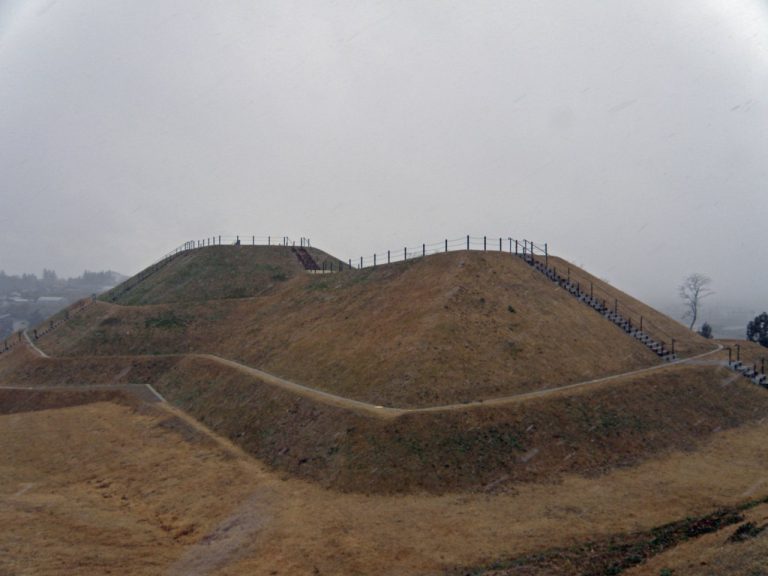
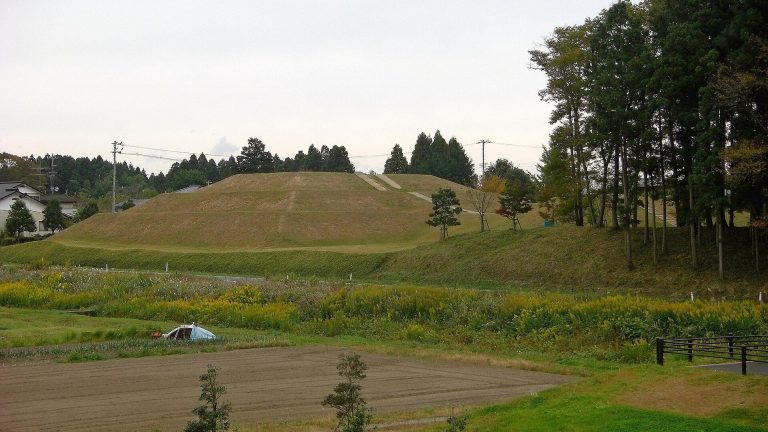
Tamayama Kofun is a keyhole-shaped mound built on level ground at the end of a spur extending from the foothills, on the north bank of the Niida River in eastern Fukushima’s Hamadori region. This form combines a circular rear section with a projecting rectangular front section and is particularly associated with elite burials in ancient Japan. The front section faces west, while the mound as a whole measures approximately 112 meters.
Rear section
The circular rear section is about 60 meters in diameter and 10 meters high. It rises in three tiers, and stones were laid over the exterior slopes as surfacing. The basal stones of this surfacing were located during excavation, leading to a revision of the formerly accepted length of 118 meters. The mound’s outer extent may continue beyond the surviving stones, so its total size could be greater than the revised measurement.
Front section
The projecting front section is approximately 54 meters long and 6 meters high. Its original terracing is difficult to determine because the northern side has been heavily modified, especially around this part of the mound. The southern side has also been substantially altered for use as a cemetery, affecting the surviving form of the monument.
Burial evidence and mortuary feature
The burial facility has not been examined, so its structure remains uncertain. Excavations recovered pottery fragments, including pieces of double-rimmed jars with perforated bases. At the foot of the mound, investigators found a building-like feature measuring one bay by two bays. It may have been a temporary mortuary structure used during mogari, a funerary practice involving the temporary treatment or holding of a deceased person’s body before final burial.