Morioka Hachimangū: Morioka’s Chief Tutelary Shinto Shrine


Site at a Glance
- Rating
- 4.4
- Popularity
- Medium
- Country
- Japan
- Primary era
- Modern
- External website
- Open
- Eras represented
- Early Modern, Modern
- Civilizations
- Japanese, Tokugawa
- Site type
- Religious
- Remains
- Sanctuary
On this page10 sections
History
Morioka Hachimangū is a Shinto shrine in Morioka, Iwate, Japan, established in 1062 during the late Heian period and dedicated principally to Hachiman. Hachiman is a major Shinto kami associated with the protection of warriors and military success. At this shrine, the deity is identified with a semi-legendary amalgamation of Emperor Ōjin and his mother, Empress Jingū. Kasuga and Hakusan deities are also enshrined, and Morioka Hachimangū is regarded as the city’s chief tutelary shrine.
Foundation and early worship
Tradition attributes the shrine’s foundation to Minamoto no Yoriyoshi, an eleventh-century Minamoto military commander who led campaigns in northern Japan. During the Former Nine Years War, an eleventh-century conflict between the Minamoto and Abe clans in northern Japan, Yoriyoshi is said to have brought a bunrei, or divided and transferred sacred spirit, from Iwashimizu Hachimangū in Kyoto. He established the spirit at the site while praying for victory over the Abe clan.
The shrine was originally called Hatomori Hachimangū and was traditionally venerated by a local clan. Its earliest arrangement placed a small sanctuary at the summit of Hachimanyama, establishing the elevated sacred focus that shaped the later precinct.
The Nanbu period
In 1593, the Nanbu clan rebuilt Hatomori Hachimangū as the protective shrine of Morioka Castle. The Nanbu were a powerful warrior family and domain-holding lineage in northern Japan, and their patronage connected the shrine directly with the political centre of the domain.
In 1680, Nanbu Shigenobu, a seventeenth-century lord of the Nanbu domain, brought the clan’s tutelary deity from Kushibiki Hachimangū in Aomori. He enshrined it at the temporary sanctuary of Hatomori Hachimangū in the present precinct. The institution then became known as New Hachiman, or Nanbu New Hachiman.
Modern institutional history
During the Meiji period, Hatomori Hachimangū was transferred to New Hachiman. Hakusan Shrine in Morioka was merged with the shrine in 1889. From 1871 to 1946, the State Shinto shrine-ranking system, a government framework regulating officially recognized shrines, designated Morioka Hachimangū as a prefectural shrine. The Association of Shinto Shrines now includes it among its Beppyo Shrines, a separate list of notable shrines.
A fire destroyed the Edo-period shrine buildings in 1884. The principal present structure was built in 2006. Iwate Gokoku Shrine was relocated from the Chabatake area of Higashinakano Village, Iwate District, into the precinct in 1906. A hall for enshrining the remains of war dead and other associated facilities continue to reflect the shrine’s wider institutional setting.
Ritual and civic associations
Morioka Hachimangū is associated with the Chagu Chagu Umakko horse procession, the Morioka Float Festival, and Nanbu-style yabusame, a ritual form of mounted archery. The annual festival takes place on September 15 and includes yabusame, while the Chagu Chagu Umakko ritual is held on the second Saturday of June. The procession was recognized as an Intangible Folk Cultural Property in 1978, and the sound of its bells was selected by Japan’s Ministry of the Environment in 1996 as one of the 100 Soundscapes of Japan.
The shrine also served as a celebration venue during the torch relay for the 2020 Tokyo Olympic Games. A bronze statue of Mitsumasa Yonai was erected in front of the shrine office in 1959 by the Mitsumasa Yonai Statue Construction Association.
Remains
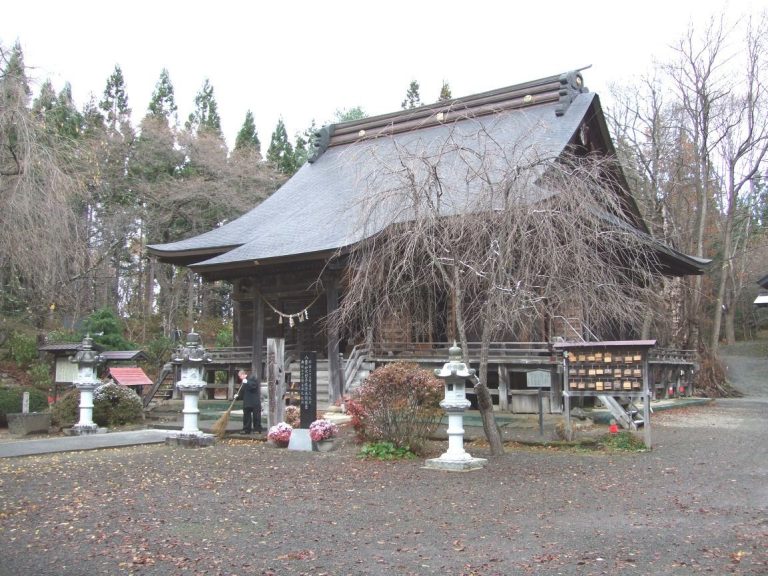
The precinct retains a mountain-and-foothill arrangement associated with its historical development. The original small sanctuary stood at the summit of Hachimanyama. A later main hall was built around that earlier sanctuary, while the worship hall occupies the foot of the mountain. The shrine is identified with Hachiman-zukuri, a building form organized around paired or connected sacred spaces that creates a distinctive lengthwise structure.
Entrances and principal buildings
Front torii
The front first torii, the gateway marking entry into a Shinto precinct, was rebuilt in 2002. Its predecessor had been constructed in 1763 by Nanbu Toshio, the eighth lord of the Nanbu domain, and was later relocated to another part of the precinct.
Principal shrine arrangement
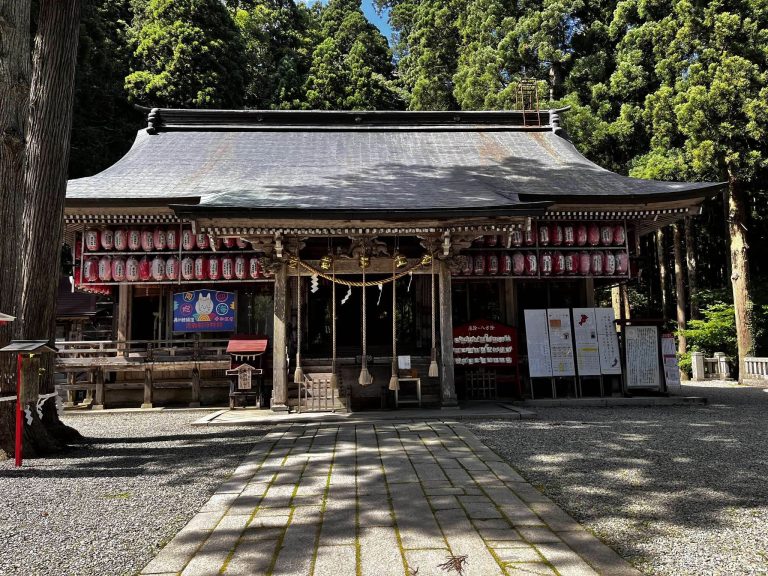
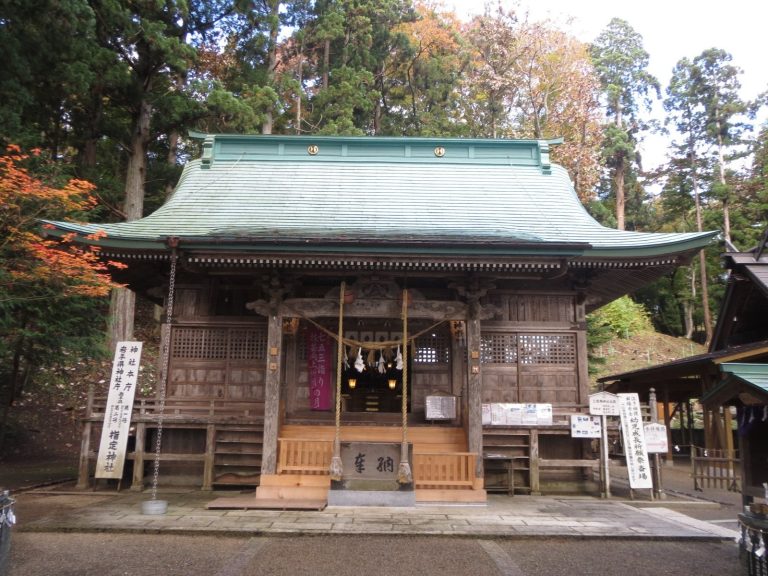
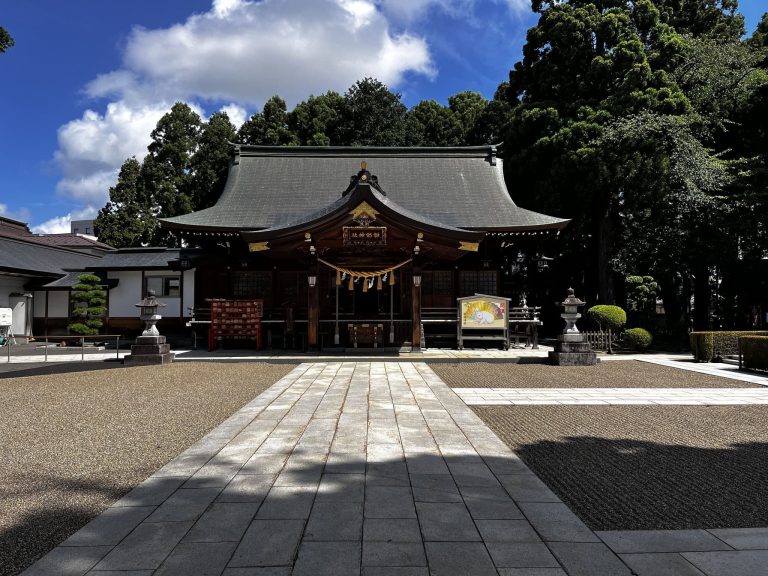
The principal shrine buildings express the layered plan that developed from the early summit sanctuary. The main hall surrounds the earlier sacred structure, and the worship hall stands below it at the mountain’s foot. The principal present structure dates from 2006, following the destruction of the Edo-period buildings by fire in 1884.
Affiliated shrines and precinct facilities
Several affiliated shrines occupy the precinct. Kasamori Inari Shrine originally stood within the grounds of Morioka Hachimangū. Shinmei Shrine is associated with the origin of the name Shinmei Town in Morioka, while Umemiya is associated with safe childbirth. Morioka Tenjin Shrine and individual shrines dedicated to the guardians of the twelve zodiac signs are also present.
Other facilities include the sacred treasure hall, Iwate Gokoku Shrine, a hall for enshrining spirit registers, a hall housing the remains of war dead, and the Iwate Prefecture Association of Shinto Shrines. Together, these structures form a precinct combining Hachiman worship with affiliated deities, commemorative functions, and the administrative institutions of Shinto in Iwate.