Kushihiki Hachimangū: A Historic Hachiman Shrine in Hachinohe


Site at a Glance
- Rating
- 4.4
- Popularity
- Medium
- Country
- Japan
- Primary era
- Early Modern
- External website
- Open
- Eras represented
- Early Modern, Modern
- Civilizations
- Tokugawa
- Site type
- Religious
- Remains
- Sanctuary
On this page24 sections
History
Kushihiki Hachimangū is a Shinto shrine in Hachinohe, Japan, whose traditional origins reach back to 1166 and whose surviving early Edo-period buildings include Nagare-zukuri sanctuaries with richly colored Momoyama-associated decoration. Shinto is Japan’s indigenous religious tradition, centered on reverence for kami, or sacred beings and forces. The shrine is dedicated to Hachiman, a kami associated with warfare, protection, and the imperial tradition, identified here with Homutawake no Mikoto, the divine name traditionally associated with Emperor Ōjin.
Origins and the Nanbu family
The foundation tradition begins in 1166, when Kagami no Tōmitsu enshrined Hachiman at the Nanbu estate in Kai Province and deposited a red-laced suit of armor there. After the Ōshū Campaign of 1189, Tōmitsu’s son Nanbu Mitsuyuki, regarded as the founder of the Nanbu family, received authority over five districts in the Nukabe region. In 1191 he established a shrine at Takin-ozawa in Rokunohe and transferred the Hachiman shrine from the Nanbu estate. The shrine moved again in 1222, reaching Kushihiki Village, where it remains.
The same tradition connects the shrine with a small Hachiman sanctuary said to have been founded at Kushihiki Village by Sakanoue no Tamuramaro during the Daidō era. This local sanctuary was merged with the shrine transferred from the Nanbu estate. The retainer Tsushima Heijirō was sent to Kai to arrange the move and built a temporary sanctuary at Takin-ozawa. His descendants, the Takizawa family, later served as ritual key keepers. Yūban, a monk who had administered the Hachiman shrine at the Nanbu estate, accompanied the transfer, settled in the area, founded Fumon-in, and served as the shrine’s associated Buddhist temple together with the Takizawa family.
Nanbu patronage and regional status
Kushihiki Hachimangū became the principal tutelary shrine of the Nanbu region and was also known as the “Nanbu Ichinomiya.” In this case, the title expressed the exceptional importance given to the shrine by the Nanbu family of Morioka, rather than identifying it as the historical first-ranked shrine of Mutsu Province. After the establishment of Hachinohe Domain, Kushihiki Hachimangū remained an enclave administered by Morioka Domain until the domain system was abolished.
During the Kenmu era, when the Sannohe branch of the Nanbu family declined, Nanbu Moriyuki came to the region as a deputy of the provincial governor and built Nejō. He revived the shrine and made it a Nanbu family prayer sanctuary. This renewed relationship with the ruling house shaped the shrine’s later ceremonies and its collection of military and ritual treasures.
Festivals and mounted archery
The autumn grand festival is held over three days, from the fourteenth through the sixteenth days of the eighth lunar month. Its program includes yabusame, a mounted archery ritual in which riders shoot at targets while galloping along a course, together with various performing arts. The spring grand festival takes place on the fifteenth day of the fourth lunar month. The May 14 Ohamairi ritual carries the portable shrine to Misaki Shrine in Konakano and is understood as a renewal of the deity’s sacred power.
Yabusame is traditionally associated with Moriyuki’s revival of the shrine and prayers for security within the domain, prosperity of descendants, and lasting military success. In 1411, Nanbu Mitsutsune of the Nejō branch prayed at the shrine before campaigning in Akita. After returning to Hachinohe, he dedicated two suits of armor, a sword by Osafune Yukimitsu, and two horses. A large mounted-archery ceremony was held that year, after which a black horse and a bay horse were prescribed for the rite.
Members of the Shichinohe Nanbu branch joined the riders from 1411. Until the end of the Edo period, the participants came from the Sannohe, Nejō-Hachinohe, and Shichinohe Nanbu houses. Earlier rules required riders approaching the shrine to wear high wooden clogs so that they would not tread on impurity, and ordinary worshippers entered only after the riders had completed their morning visit. The rite was discontinued after the Meiji period and revived on a newly established course before the shrine on November 7, 1984.
Early modern buildings and preservation
The main shrine, former worship hall, two subsidiary shrine buildings, and south gate were designated nationally as Important Cultural Properties on April 20, 1993. Together they preserve an early Edo-period group of shrine buildings. The main shrine, former worship hall, and south gate were built between 1645 and 1648 on the orders of Nanbu Shigenao, the second lord of Morioka Domain and the twenty-eighth head of the Nanbu family. Later repairs were undertaken directly by the domain.
The former Hachinohe Elementary School auditorium was moved into the shrine precinct in 1962 for preservation. It had earlier served as a school auditorium, provided imperial lodging during Emperor Meiji’s 1881 journey through Tōhoku, and later housed a city library. Reconstructed as the Meiji Memorial Hall, it preserves a building whose history links the shrine precinct with the changing civic uses of modern Hachinohe.
Remains
Sacred precinct and principal buildings
Precinct setting
The shrine precinct is known as Hachimanyama and contains rows of Japanese cedar trees said to be more than 100 years old. The principal approach passes through a torii and reaches the south gate, while the former worship hall and the present worship hall occupy positions within the central shrine complex.
Main shrine
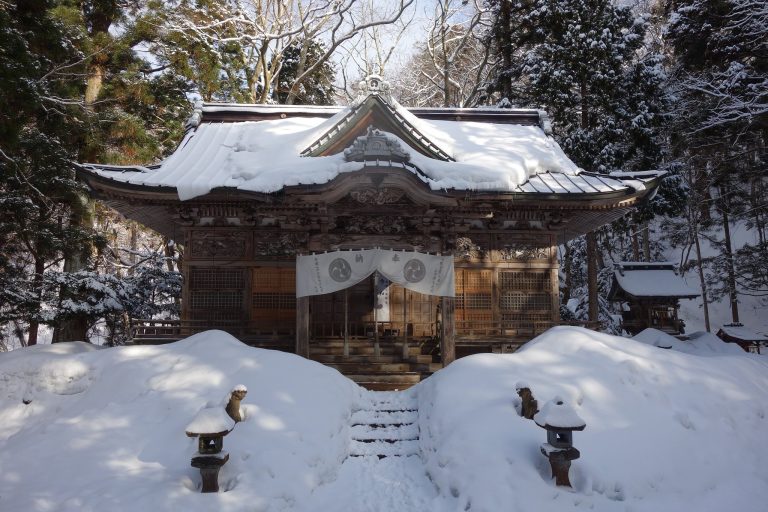
The main shrine is a three-bay Nagare-zukuri sanctuary with a copper-sheet roof. Nagare-zukuri is characterized by a front roof slope that projects forward to form a canopy over the entrance. Detailed carvings and vivid polychrome decoration retain features associated with the Momoyama period, a late sixteenth-century phase known for richly ornamented architecture.
South gate
The south main gate stands immediately beyond the torii. It is a gabled, copper-roofed, four-legged gate built with massive timber members, giving it a strongly monumental appearance.
Former worship hall
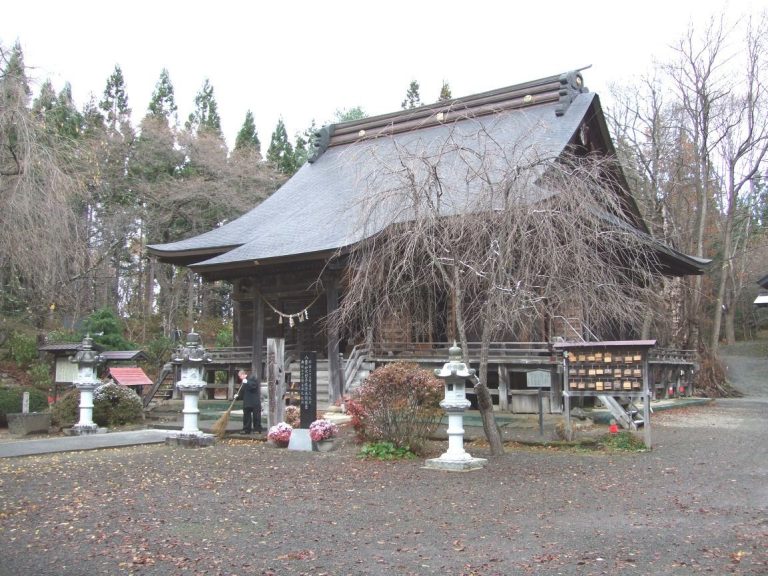
The former worship hall stands to the left after the main gate. It is seven bays wide and three bays deep, with a hipped-gabled plan entered along its long side and a copper-sheet roof. The building was moved to its present position when the current worship hall was constructed.
Current worship hall
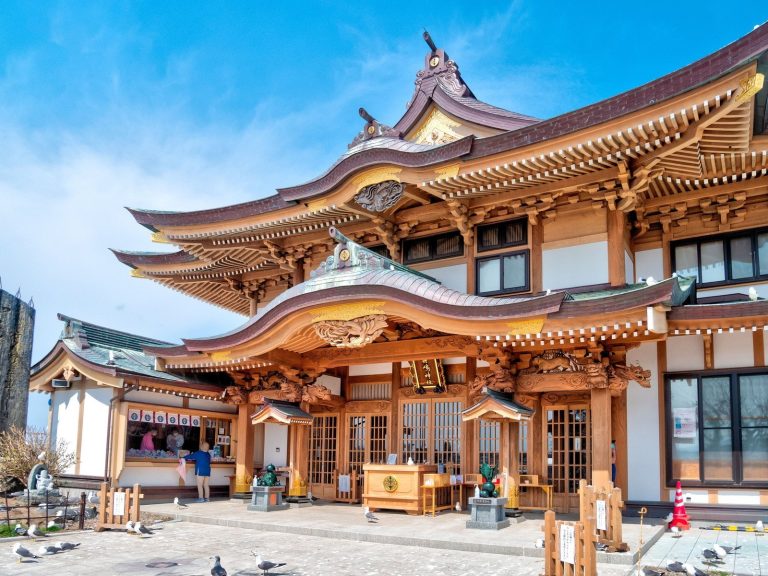
The current worship hall was completed in November 1984. It has a hipped-gabled, long-side entrance plan, a copper-sheet roof, and dimensions of fifteen bays by eight bays.
Subsidiary shrines and associated buildings
Shimmei Shrine
Shimmei Shrine stands to the right of the main worship hall. Traditionally founded and enshrined in 1739, it has a one-bay Nagare-zukuri main shrine with a copper-sheet roof. It enshrines Amaterasu Ōmikami.
Kasuga Shrine
Kasuga Shrine stands to the left of the main worship hall and was traditionally founded in 1739. Its one-bay main shrine follows the Kasuga-zukuri style, which combines a compact sanctuary with a projecting entrance canopy. This form is relatively uncommon in northeastern Japan. The shrine enshrines Ame no Koyane no Kami.
Other precinct structures
Other buildings include a hall for sixteen jointly enshrined kami, Monpai Inari Shrine, and an ancestral spirits hall. Their presence forms part of the wider religious arrangement surrounding the principal Hachiman sanctuary.
Meiji Memorial Hall
The Meiji Memorial Hall is a two-story wooden pseudo-Western building with a hipped roof. Its exterior has a Western appearance, while its structural framing and roof trusses use traditional Japanese methods. The local carpenter Sekino Taijirō designed it, and the master carpenter Aoki Motjirō built it in 1881. It was first erected in Horibatachō, moved near Hachinohe City Hall in 1929, and later reconstructed within the shrine precinct.
Bridge fittings and ritual objects
Bronze gong and finial
A bronze ritual gong cast in 1405 was formerly attached to the finial posts of the arched sacred bridge before the main gate. Its face is arranged in three concentric zones. A central striking boss carries a chrysanthemum-like design, while an outer band bears an inscription that appears to include a dedication by Nanbu Moriyuki. A bronze ornamental finial from the same bridge was donated in 1762 by Nanbu Toshikatsu, the eighth lord of Morioka Domain.
Red-Laced Armor
The shrine’s collection includes the National Treasure Red-Laced Armor with its helmet, large shoulder guards, and storage chest. This Kamakura-period suit of great armor uses red-dyed lacing and gilt fittings decorated with repeated chrysanthemum branches. Its star-shaped helmet has large horns. The chrysanthemum pattern and a single-character ornament on the shoulder guards gave the armor its name, “Chrysanthemum One-Character Armor.” Tradition says that Emperor Chōkei gave it to the shrine, while the geographer and travel writer Furukawa Koshoken described it in 1788 as the armor of Minamoto no Yoshimitsu.
White-Laced Corner-Patterned Armor
Another National Treasure is the White-Laced Corner-Patterned Armor, also preserved with its helmet, large shoulder guards, and storage chest. It dates from the Nanboku-chō period, a medieval era of competing imperial courts. White, purple, pale purple, yellow, light green, and crimson laces form the corner-patterned sections. Its star helmet has silver-plated, four-sided white metal plates. Tradition identifies it as one of the two suits dedicated by Nanbu Mitsutsune in 1411 and says that his father, Nobumitsu, originally received it from Emperor Go-Murakami.
Other armor and helmet
The Purple-Laced White-Shouldered Pale-Yellow Armor, with helmet and large shoulder guards, is attributed to the Nanboku-chō period and is thought to have been made around the same time as the White-Laced Corner-Patterned Armor. Its helmet has a star construction, five frontal ridges, gilt chrysanthemum fittings, and a large branch-chrysanthemum horn mount. The shoulder guards use white, pale-yellow, and purple lacing.
The White-Laced Red-Shouldered Domaru Armor dates from the late Nanboku-chō to early Muromachi periods. A domaru is a relatively light armor form that wraps around the torso. This example combines that lighter construction with elaborate decoration, including red lacing, gilt edging, chrysanthemum fittings, and five-petaled pink-flower arabesques. Its ridged helmet has fully gilt edging.
A separate Nanboku-chō-period helmet is preserved with pale-yellow-laced, red-shouldered guards. It has three frontal ridges and two rear ridges, fully gilt edging, a later-added horn mount, and a painted lion-and-peony leather covering on the side wings. Its seven-tiered shoulder guards are laced red through the upper two tiers and pale yellow below.
Yukimitsu sword
The prefecturally designated sword inscribed “Bishū Osafune Yukimitsu” is attributed to a Bizen Osafune swordsmith. Its blade follows the Shinogi-zukuri form, with a ridge along each side, an Iori-mune, or roof-shaped back, and a Chōji-midare, or clove-shaped irregular temper pattern. A date of 1382 on the reverse inscription identifies the maker as the earliest of several swordsmiths who used the name Yukimitsu. Tradition says Nanbu Mitsutsune dedicated the sword with the White-Laced Corner-Patterned Armor in 1411.
Bugaku masks
Nine masks associated with bugaku, Japan’s classical court dance and music tradition, are preserved at the shrine. They represent Nasori, Genshōraku, the old man and old woman of Ninomai, Kitoku, two Sante, Ryōō, and a ritual mask traditionally identified as Saishōrō. The Nasori and Genshōraku masks date from the late Kamakura period and are carved from Japanese cypress in a formal style associated with central Japan. Four others date from the late Kamakura to Nanboku-chō periods and have styles associated with northeastern Japan, while the remaining three belong to the Muromachi to Edo periods. Together, their transmission reflects the performance of masked court dance and music at the shrine across the medieval and early-modern eras.