Moulin Richard de Bas: A Historic Water-Powered Paper Mill in France


Site at a Glance
- Rating
- 4.6
- Popularity
- Medium
- Country
- France
- Primary era
- Medieval
- External website
- Open
- Eras represented
- Medieval
- Civilizations
- French
- Site type
- Economic
- Remains
- Production Complex
On this page14 sections
History
Moulin Richard de Bas is a historic water-powered paper mill and museum in Ambert, France, traditionally dated to around 1326. It belongs to the long papermaking history of the Livradois region, where paper production in the Ambert area dates to 1328, and is considered one of France’s oldest enterprises.
Origins and changing uses
The name Moulin Richard de Bas refers to the Richard family, a group of fifteenth-century papermakers. The word “Bas” distinguishes this mill geographically from six other buildings arranged around the millrace. The complex is also associated with Thomas Richard, described as a wealthy papermaker and former owner who was murdered at the Col de la Croix de l’Homme mort, on the boundary between the Loire and Puy-de-Dôme.
Between 1400 and 1850, the site was used for tanning animal hides. From 1850, rags became the raw material for its paper pulp. This change formed part of a wider regional tradition. The Dore valley was a major papermaking area, with as many as 400 rag-paper mills operating between Thiers and Ambert.
Revival during the twentieth century
After the death of its owner, Claude Chantelauze, the mill was abandoned. Marius Péraudeau bought it in 1940 from the newspaper Le Moniteur du Puy-de-Dôme. As a representative of the paper industry, he aimed to revive a craft that was already declining.
On 14 October 1940, Marshal Philippe Pétain visited the mill at Ambert after an invitation from Henri Pourrat, a French writer associated with Auvergne. Pétain was head of the French State during the Vichy regime, which governed France from 1940 to 1944. During the visit, he commissioned a ream of paper bearing his emblem as a watermark.
Péraudeau also founded the association La Feuille Blanche. It established a holiday camp for apprentices in the graphic arts, including papermakers, photogravers, printers, and bookbinders. The association further helped conceal members of the Resistance who were wanted by the Gestapo, the secret police of Nazi Germany.
In 1943, Péraudeau founded the Historical Paper Museum and became its curator. He began organizing visits to the mill in 1945 and worked with numerous artists and writers who produced works on its paper. Their names included Bernard Buffet, Salvador Dali, Jacques Prévert, Jean Cocteau, Jean Giono, Jean Jünger, Jean Guitton, Ernst Jünger, Daniel-Rops, Edmond Rostand, Michel Ciry, Albert Decaris, Ernst Fuchs, and Roger Lersy, among many others.
Recent ownership and protection
After further difficulties, activity at the mill resumed in 1997 under Emmanuel Kerbourc’h, Péraudeau’s grandson. In 2020, the company Moulins à papier du Val de Lagat received the French Living Heritage Company designation, a recognition for enterprises preserving distinctive traditional or craft-based expertise. The mill was offered for sale in 2022 and was purchased by Pascal Toupin in 2024.
The complex was partially designated as a Historic Monument in 1983. The protected elements include the façades and roofs, the machinery rooms on the ground floor, the living rooms on the first floor of the main building, the barn, and the drying shed.
Remains
Moulin Richard de Bas remains an operational paper mill as well as a museum of papermaking history. Six buildings are arranged around a millrace, and the museum is organized into three principal parts: the former living quarters, rooms devoted to papermaking history, and the working mill. The site’s water contains no lime, a quality that was advantageous for making paper.
Buildings and working spaces
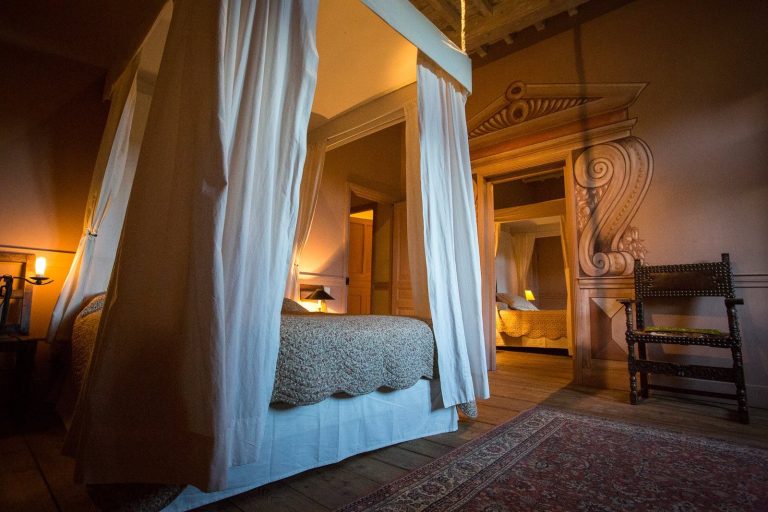
Living quarters
The living quarters present the way the mill owners once lived. They form part of the main building, whose first-floor living rooms are among the protected elements of the complex.
History rooms
Rooms devoted to papermaking history form the museum’s interpretive section. Together with the living quarters and the working mill, they connect domestic life, the history of the craft, and continuing production within the six-building complex.
Working mill
The working mill preserves the industrial function of the site. Water power drives the operation, while the mill continues to produce high-quality paper for the restoration of manuscripts and other written works, as well as for watercolours, lithographs, and related material.
Paper and notable works
Encyclopédie engravings
Paper from Moulin Richard de Bas was used for the engraved plates of Denis Diderot and Jean Le Rond d’Alembert’s eighteenth-century Encyclopédie, a major reference work of the European Enlightenment. The plates were printed exclusively on Auvergne paper, while the text used paper from various origins.
The Apocalypse of Saint John
The Apocalypse of Saint John was produced as a single copy over three years, from 1958 to 1960. At publication, it was described as the world’s heaviest book, with a weight of 210 kilograms and a price of two million francs.
Arbres
Arbres, published in 1967, contains copper engravings by Georges Ribemont-Dessaignes. The painter and engraver Raymond Haasen printed them in intaglio, a process in which ink is held in recessed lines or areas of a plate. The book was printed on Moulin Richard de Bas paper, uses a quarto format, contains 80 pages, and measures 36 by 46 centimetres.
Alchemy of the Philosophers
Salvador Dali’s Alchemy of the Philosophers, published in Paris in 1976, consists of two folio volumes and ten unbound plates. The ten original prints combine lithography, which prints from a prepared flat surface, screen printing, and intaglio engraving. The publication also includes six screen prints based on Dali’s drawings, mounted facsimiles of ancient alchemical texts and manuscripts, and a paper-pulp relief composition by Marius A. Péraudeau. The edition comprised 275 copies on Richard de Bas paper, including 225 with texts in French and English.
The mill’s paper was also used for the first copy of the Constitution of the Fifth Republic and for Nobel Prize diplomas, extending the surviving paper tradition of the mill into modern official and cultural works.