St. Mang’s Abbey: A Benedictine Monastery and Baroque Complex in Füssen


Site at a Glance
- Rating
- 4.6
- Popularity
- Low
- Country
- Germany
- Primary era
- Early Modern
- External website
- Open
- Eras represented
- Medieval, Early Modern
- Civilizations
- Duchy of Bavaria, Electorate of Bavaria, Holy Roman Empire
- Site type
- Religious
- Remains
- Monastery
On this page15 sections
History
St. Mang’s Abbey is a former Benedictine monastery in Füssen, Germany, founded in the first half of the ninth century within the Diocese of Augsburg. Its Baroque complex was rebuilt between 1696 and 1726. The abbey grew from the early Christian foundation associated with the hermit Magnus, or Saint Mang, and became a religious, cultural, and economic center for Füssen and the surrounding region.
Foundation and early religious tradition
Magnus established a cell and an oratory at the site before his death on September 6, although the year is not recorded and tradition places it around 772. His body was later found incorrupt, amid miracles associated with its discovery. Veneration of the saint formed the spiritual basis of the monastery. Abbey tradition regarded Magnus as its founder and Blessed Conrad as his successor, while no abbots are documented before 919.
In the first half of the ninth century, the Augsburg prince-bishops established St. Mang’s as a proprietary monastery, a religious house controlled and endowed by an ecclesiastical lord. Its foundation also served political and strategic purposes. The monastery stood near the Füssen Gap, where the Lech leaves the Alps, beside the Roman-era Via Claudia Augusta and the medieval route from Augsburg across the Alps to Upper Italy. Control of this location mattered to Augsburg’s bishops and to imperial policy.
Medieval reform and regional power
During the Middle Ages, the community repeatedly joined reform movements that sought to restore the principles of Benedictine life governed by the Rule of Saint Benedict. These phases generally brought spiritual, economic, and demographic growth, followed by new construction and artistic commissions. Although St. Mang never obtained imperial immediacy, the status of being subject directly to the Holy Roman Emperor rather than to an intermediate territorial lord, it developed into an important lordship and economic center as well as a focus of religious and cultural life.
Baroque rebuilding
The Counter-Reformation, the Catholic reform movement that followed the Protestant Reformation, encouraged renewed church building and elaborate religious art in southern Germany. At St. Mang, it led to the construction of the large Baroque abbey complex between 1696 and 1726. Abbot Gerhard Oberleitner, who governed from 1696 to 1714, commissioned the rebuilding with the ambition of creating work that would impress leading art connoisseurs. Together with Füssen’s High Castle, the new complex became a defining element of the town.
Johann Jakob Herkomer reorganized the irregular medieval premises into a symmetrical Baroque design. The project involved Anton Sturm, Franz Georg Hermann, Jakob Hiebeler, and Paul Zeiller, whose surviving oil paintings are in the chapter hall. The rebuilding also expressed the abbey’s political aspirations, especially its desire to secure imperial immediacy.
Late monastic activity and dissolution
In the second half of the eighteenth century, the monks increasingly devoted themselves to pastoral care, scientific work, music, and education. In 1790, under Abbot Aemilian Hafner, the abbey founded a grammar school directed by Joseph Maria Helmschrott. The community’s educational and cultural work continued until the secularization associated with the Napoleonic Wars and the Peace of Lunéville. Secularization transferred ecclesiastical institutions and property to secular authorities.
On December 11, 1802, the princely house of Oettingen-Wallerstein took possession of the abbey and its lands. On January 15, 1803, Princess Wilhelmine ordered Abbot Hafner to dissolve the community and clear the abbey by March 1. The former abbey church was donated to the parish of Füssen in 1837 and became the town parish church. In 1839, the Bavarian chamberlain Christoph Friedrich Freiherr von Ponickau acquired the remaining lordship of St. Mang, dividing the former abbey between the parish and the owner of the remaining estate.
Civic and cultural uses
Füssen acquired the Ponickau estate and the former abbey buildings, apart from the church, in 1909. The north wing became the town hall, while the south wing became the Füssen Town Museum. The museum presents the history of the abbey and town, including Füssen’s traditional manufacture of lutes and violins. The former complex also houses the Füssen Town Library in the ground floor of the south wing.
The abbey church retained a connection with local religious life. In 1819, the future Blessed Franz Xaver Seelos was baptized there. The former monastery therefore continued to serve parish, civic, educational, and cultural purposes after the Benedictine community had disappeared.
Remains
The surviving complex combines the former abbey church with the symmetrically arranged Baroque buildings created between 1696 and 1726. Herkomer’s plan organized the monastery around a central axis running from the entrance through the Imperial Hall toward the church. The south front contains the oval library at its center, with the refectory below, while the former chapel survives within the town museum.
The chapel and abbey church
Ninth-century chapel
The original ninth-century chapel was the abbey’s first church. It later served chiefly as a burial chapel for the knights of Freyberg-Eisenberg and is now incorporated into the town museum. Its interior includes numerous sixteenth- and seventeenth-century epitaphs, funerary inscriptions or monuments, and memorial shields associated with deceased people. A late Gothic sculpture represents Saint Anne with the Virgin Mary and the Christ Child.
In 1602, Jakob Hiebeler produced the monumental Füssen Dance of Death for the chapel at the commission of Abbot Matthias Schober. The cycle comprises twenty scenes on ten wooden panels. Death leads figures representing the social roles of early-modern society under the motto, “Say yes, say no, dance there must be.” The sequence begins with the pope and emperor and also includes a witch, presenting the Dance of Death tradition’s theme of mortality across social ranks.
Abbey church
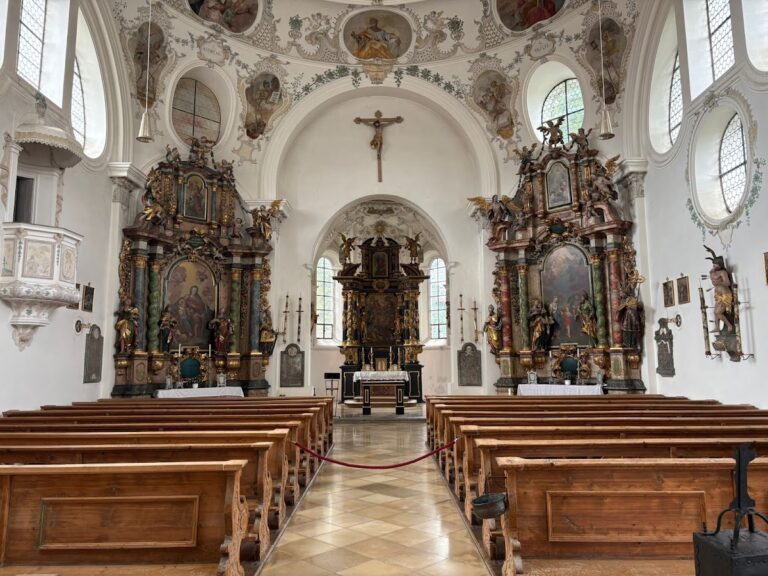
The abbey church began as a Romanesque basilica in the tenth century. During the eighteenth-century rebuilding, it was transformed into a Baroque church influenced by Venetian models. Its fresco cycle recounts the life of Saint Magnus, and the building was conceived as a monumental reliquary for the saint.
Central ceremonial rooms
Imperial Hall
The Imperial Hall, also called the Princes’ Hall, occupies the central axis between the entrance and the abbey church. Herkomer designed the rectangular colonnaded hall, which was completed in 1721 to 1723. Its architecture and decoration gave physical form to the abbey’s political aspirations. Carlo Andrea Maini designed the interior for Abbot Dominikus Dierling, following the so-called imperial style associated with Emperor Charles VI. Franz Georg Hermann painted the ceiling frescoes, whose subject is the polarity of Church and World.
The hall’s decoration follows a numerical progression of 2, 4, 8, 16, and 32. Four stucco figures embody the cardinal virtues: Prudence holds a mirror, Fortitude a sword, Justice scales, and Temperance a unicorn. Four additional figures represent Africa, Europe, Asia, and America. Eight columns and sixteen pilasters divide the walls, while a thirty-two-point compass rose forms the center of the ceiling painting.
Library
The library occupies an oval building at the center of the south front. Designed by Herkomer and completed in 1719, it has a high dome and a large oval opening through which the monks could see the refectory below. The opening expressed the unity of spiritual and physical nourishment. In winter it could be closed by a cover painted in oil.
Franz Anton Zeiller painted the cover in 1781, showing Benedict, founder of the Benedictine order, in a triumphal chariot drawn by the four continents. The dome fresco, painted by Francesco Bernardini in 1719, presents female allegories of Divine Wisdom, Prudence, Truth, and Knowledge. Anton Sturm’s putti on the library gallery represent the liberal arts, the traditional fields of broad learning in the medieval and early modern West.
Refectory
The refectory lies beneath the library and contains a fountain sculpture of Saint Magnus by Anton Sturm. Historical descriptions mention music played from the library during festive meals, and a musical automaton stood in the library toward the end of the eighteenth century.
Paintings and books
Paul Zeiller’s surviving oil paintings are preserved in the chapter hall, the monastery’s meeting room for administrative business and readings from its rule. The abbey’s book collection was removed during Bavarian secularization after 1803 and transported down the Lech on rafts to the Oettingen-Wallerstein family. Most of the collection is now held by the Oettingen-Wallerstein Library, largely in the University Library of Augsburg, while a small group of valuable manuscripts was given to the Augsburg Diocesan Archives.