Hohenschwangau Castle: A Neo-Gothic Royal Residence in Germany


Site at a Glance
- Rating
- 4.6
- Popularity
- Very High
- Country
- Germany
- Primary era
- Modern
- External website
- Open
- Eras represented
- Medieval, Early Modern, Modern
- Civilizations
- German, Holy Roman Empire
- Site type
- Domestic
- Remains
- Palace
On this page21 sections
History
Hohenschwangau Castle is a Neo-Gothic residence in Hohenschwangau, Germany, near Füssen in Bavaria, directly opposite Neuschwanstein Castle. Its present form was created between 1833 and 1837 as a romantic medieval-style residence, but the building incorporates the walls of the sixteenth-century Schwanstein fortress. It later became a summer residence of the Bavarian royal family and the childhood home of Kings Ludwig II and Otto.
Medieval Schwangau and the changing castle names
A fortress known as Castrum Swangowe appears in records from 1090. It consisted of the older double castle of Vorderhohenschwangau and Hinterhohenschwangau, which served as the residence of the knights of Schwangau. The family first held the surrounding territory as Welf ministerials, medieval service nobles who held office and land under a higher lord, and later as an imperial fief, territory held directly from the Holy Roman Emperor. The Schwangau line became extinct in 1536.
The older double castle stood on the site later occupied by Neuschwanstein. A separate and more accessible fortress, Schwanstein, was built lower down on a hill above Lake Alpsee and was first mentioned in 1397. The names of the two sites were exchanged during their later history. Schwanstein became known as Hohenschwangau, while Vorderhohenschwangau and Hinterhohenschwangau became associated with Neuschwanstein.
Transfer to Bavarian rule
After Ulrich von Schwangau divided the lordship among his four sons in 1428, poor management and inheritance disputes weakened the family’s position. Georg von Schwangau sold the Hohenschwangau castles and Frauenstein, together with their jurisdiction, to Duke Albrecht III of Bavaria-Munich in 1440. Members of the family continued to serve locally as ducal administrators.
In 1521, Emperor Charles V again granted Heinrich and Georg von Schwangau their possessions as an imperial fief. In 1535, however, they sold the territory for 35,000 florins to Wolf Haller von Hallerstein, who acted for the Augsburg patrician Johann Paumgartner. The last two Schwangau brothers died in 1536.
Paumgartner, an imperial councillor and financier of Charles V, was ennobled in 1537. He restored the neglected Schwanstein and made it the center of his lordship. After passing through his indebted sons and the Margrave of Brandenburg-Ansbach-Kulmbach, the estate came under the Bavarian dukes and electors. It became part of the Electorate of Bavaria in 1803 and the Kingdom of Bavaria in 1805.
Decline, military use, and preservation
The castle served several purposes over the centuries. It was used for bear hunting, housed younger Wittelsbach princes, and became the seat of the district court. Its condition declined during the Thirty Years’ War, a major European conflict fought from 1618 to 1648, and Austrian forces plundered it in 1743. After a new administrative building was erected in 1786, the old castle deteriorated further.
During the coalition wars of 1800 to 1809, French and Austrian troops used the castle as quarters. A brief and inconclusive French bombardment and siege preceded King Maximilian I of Bavaria’s sale of the property for demolition in 1820 for 200 gulden. Prince Ludwig of Oettingen-Wallerstein bought it in 1821 for 225 gulden and undertook repairs and protective work. He sold it again in 1823. The next owner, the surveyor Johann Adolph Sommer, planned a flax-spinning mill, but the project did not proceed.
Maximilian II and the Neo-Gothic residence
Crown Prince Maximilian of Bavaria encountered the castle during a walking tour in 1829. After three years of negotiations, he bought the ruins in 1832, changed the name Schwanstein to Hohenschwangau, and commissioned its transformation into a romantic medieval-style residence.
Domenico Quaglio directed the rebuilding from 1833 to 1837, assisted by Georg Friedrich Ziebland and Ferdinand Jodl. Quaglio died shortly before the work was finished, and Joseph Daniel Ohlmüller continued it. New rooms and subsidiary buildings were added after Maximilian married Princess Marie of Prussia in 1842. When Maximilian became King Maximilian II in 1848, further court buildings followed, culminating in the Cavalier Building in 1855. A Cavalier Building was a service or residential structure associated with a courtly estate.
Hohenschwangau became the royal family’s summer residence. It was also the childhood home of the future kings Ludwig II and Otto. Queen Marie often took her sons on mountain walks to the ruins of Vorderhohenschwangau, Hinterhohenschwangau, and Frauenstein. After Maximilian II died in 1864, she continued to spend several summer months at Hohenschwangau and died there in 1889.
Ludwig II and the Wittelsbach estate
Ludwig II inherited Hohenschwangau in 1864 and frequently used it while Neuschwanstein was being built nearby from 1869 to 1884. Neuschwanstein was officially called the New Castle of Hohenschwangau until 1886. Ludwig received the German composer Richard Wagner at Hohenschwangau, linking the residence to the cultural world associated with the Bavarian king.
Ludwig altered relatively little of the castle apart from his bedroom. In 1864, he installed a rock formation with a flowing waterfall, a device producing an artificial rainbow, and a simulated night sky with moon and stars. Queen Marie restored the room after Ludwig’s death in 1886.
Since 1923, Hohenschwangau has belonged to the Wittelsbach Compensation Fund and has operated as a museum. Members of the Wittelsbach family, the Bavarian ruling dynasty, retained occasional rights to stay there or hold celebrations. From 1933 to 1939, Crown Prince Rupprecht of Bavaria and his family used the castle as a summer residence. In 1941, Prince Adalbert of Bavaria moved there after dismissal from the Wehrmacht under the Nazi “Princes’ Decree,” which classified him as unfit for military service. In 2024, Hohenschwangau was submitted as a candidate for inclusion, together with Ludwig II’s castles, on the UNESCO World Heritage List.
Remains
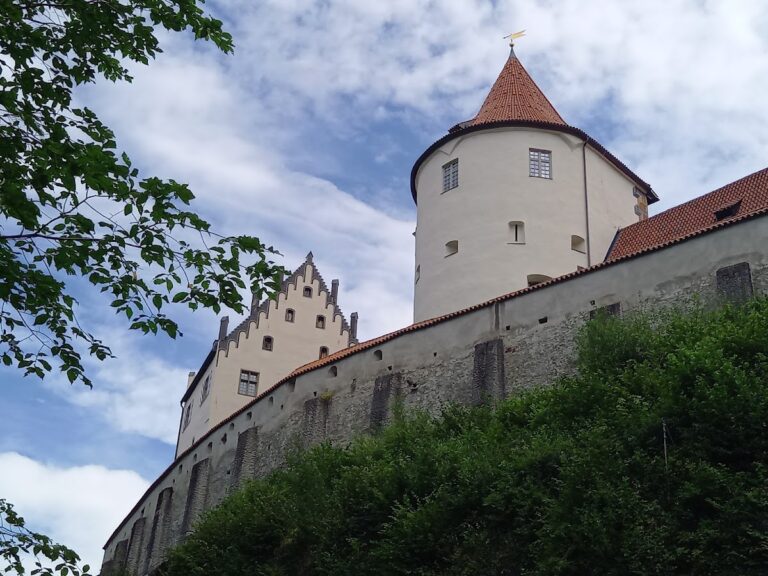
Hohenschwangau is a four-storey residential castle with yellow facades, three round towers topped by polygonal upper structures, and a three-storey gate building. The present building occupies the fortified site of Schwanstein, retaining parts of the earlier outer walls, including battlements and towers. The sixteenth-century residence was arranged around a continuous central passage, with three parallel sequences of rooms on each side of every floor. A ring of bastions, projecting defensive works incorporated into a fortification, surrounded the residence.
The castle building and interiors
Sixteenth-century structure
The residential building was constructed between 1537 and 1547 within partially preserved outer walls of the fourteenth-century fortress. The earlier defensive fabric was retained while the interior was reorganized for contemporary domestic use. Lucio di Spazzi created the regular plan, and the ring of bastions gave the residence a fortified perimeter.
Neo-Gothic form and museum rooms
The exterior and interior acquired their Neo-Gothic appearance during the rebuilding of 1833 to 1837. The main building now houses a museum, while its Biedermeier interiors and nineteenth-century furnishings survive in an unchanged arrangement. Biedermeier was a restrained domestic style that developed in the period after the Napoleonic Wars.
Wall paintings and royal apartments
Historical and legendary cycles
More than ninety wall paintings were produced in 1835 and 1836 from designs by Moritz von Schwind and Ludwig Lindenschmit the Elder. The artists depicted the history of the castle and Schwangau, medieval heroic legends, the Swan Knight tradition of Loherangrin, the Nibelung tradition, and subjects from the Edda, a group of medieval Icelandic works preserving Norse mythological and heroic traditions. One fresco presents the local tradition that Christoph von Langenmantel brought Martin Luther from Augsburg to Hohenschwangau for protection in 1518.
Swan Knight Hall
The former dining room, called the Swan Knight Hall, contains a cycle devoted to the Loherangrin legend. Christian Ruben designed the paintings, which Michael Neher and Lorenzo Quaglio executed in 1835. The cycle was created before Richard Wagner’s later opera Lohengrin and was not made as an illustration of that work.
Queen Marie Drawing Room
The Queen Marie Drawing Room contains historical scenes connected with the old fortress and its inhabitants. The paintings include Hiltbolt von Schwangau, a medieval Minnesinger or courtly lyric poet; Prince Conradin, the last heir of the Hohenstaufen dynasty; Martin Luther; and former ordinary inhabitants associated with the castle’s history.
Hall of Heroes
The Hall of Heroes is decorated with scenes from the Welkin legend, part of the epic tradition of Dietrich von Bern. Moritz von Schwind and Ludwig Lindenschmit the Elder prepared the designs. Wilhelm Lindenschmit the Elder, Franz Xaver Glinck, Gissmann, Michael Neher, and Adam executed the paintings.
Hohenstaufen Room and royal chapel
The Hohenstaufen Room contains paintings devoted to the Hohenstaufen dynasty. It also holds a maple piano known as the “Wagner piano,” played by Ludwig II and Richard Wagner. Ludwig arranged the domestic chapel in the projecting bay, or oriel, himself.
Queen’s bedroom
The Queen’s bedroom combines romantic furnishings with Turkish motifs associated with Maximilian’s visit to Turkey in 1833. A Turkish sofa was presented to the Bavarian crown prince by a Turkish sultan.
Estate buildings and landscape
Schwanseepark
Schwanseepark lies on the valley floor north of the castle and originally formed part of the estate. Peter Joseph Lenné, a nineteenth-century Prussian landscape designer, prepared its layout. The park is now heavily overgrown.
Grand Hotel Alpenrose
The nineteenth-century Grand Hotel Alpenrose occupies the site of the administrative building erected in 1786 below the castle. Since 2011, it has housed the Museum of the Bavarian Kings. Its approximately 160 exhibits cover the period from the Middle Ages to the present, with particular attention to Maximilian II and Ludwig II.
Former orangery chapel
The former orangery on the southern slope below the castle was converted into a Catholic chapel in 2014.