Frauenstein: A Medieval Hilltop Castle near Schwangau, Germany
Site at a Glance
- Rating
- 4.6
- Popularity
- Very Low
- Country
- Germany
- Primary era
- Medieval
- Eras represented
- Medieval, Modern
- Civilizations
- Holy Roman Empire, Kingdom of Bavaria
- Site type
- Military
- Remains
- Castle
On this page7 sections
History
Frauenstein was a high- to late-medieval hilltop castle near Schwangau in Germany, first recorded in 1290 as castrum Frawenstein. Built by the Lords of Schwangau, it was the westernmost of four neighboring castles held by the family. The Schwangau lords had risen to the rank of imperial ministeriales, medieval officials and warriors who served powerful rulers and could enter the lower nobility, while supporting the Welfs and the Staufers, two major ruling dynasties of medieval Europe.
Origins amid Regional Conflict
Frauenstein probably began as an additional Schwangau strongpoint during conflicts over the Staufer inheritance in the Allgäu. The Counts of Tyrol, the bishops of Augsburg, and the dukes of Bavaria contested this inheritance, while the Lords of Hohenegg opposed Tyrolean expansion. The Lords of Schwangau supported Tyrol, which had the backing of the Augsburg bishopric. These political and military tensions help explain the development of another fortified residence within the Schwangau family’s holdings.
The four branches of the Schwangau family did not always live peacefully alongside one another. Inheritance disputes and other conflicts led to a castle peace in the fifteenth century, followed by further agreements. These settlements indicate that the aristocratic residences served both to protect their inhabitants and to express the family’s power and status.
Destruction and Dismantling
During the late Middle Ages, some Schwangau nobles are said to have supplemented their income by attacking merchant convoys. Frauenstein may have been destroyed during a punitive expedition by the Augsburg bishopric, and it was probably not rebuilt afterward. The castle continued to appear in records until 1487, although it had apparently lost its practical purpose by the late fifteenth century.
Its building materials were probably taken for the expansion of the Sinwell Tower at the lower Castle Schwanstein, and Frauenstein was dismantled. A report from 1523 described the site as completely ruined and neglected.
Memorial and Heritage Record
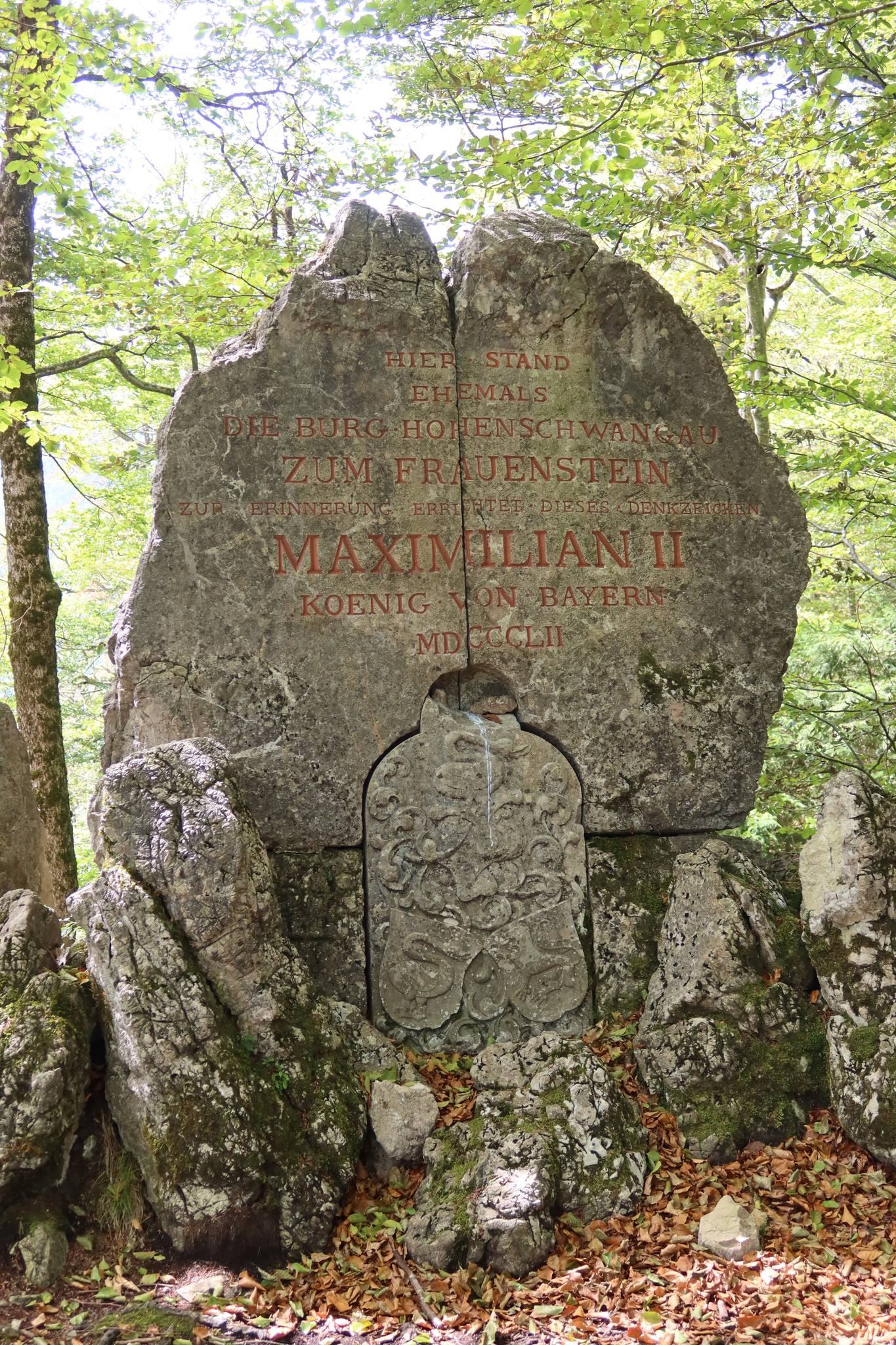
Around 1850, King Maximilian II of Bavaria commissioned a memorial to Frauenstein and had the main castle area converted into a lookout point. The surviving memorial preserves the memory of the former castle, although dense woodland now severely restricts the views once associated with the lookout. The Bavarian State Office for Monument Protection lists Frauenstein as a medieval archaeological castle site under monument number D-7-8430-0026.
Remains
Frauenstein occupied the eastern spur of the Perzen- or Berzenkopf, on a rocky outcrop above the Alpsee at approximately 892 metres above sea level. The abandoned castle survives mainly through foundation remains and limited traces in the terrain. Castle Schwanstein lay immediately below the site and was expanded into Hohenschwangau Palace during the nineteenth century.
Core Castle and Defensive Approach
The core castle was separated from the broad mountain plateau by a neck ditch, a defensive ditch cut across a narrow ridge approach, measuring up to four metres deep. A broad, rampart-like landform lies before the ditch, and several prominent rocky ridges rise along the ridge. Together, these features define the approach and the elevated position of the castle remains.
Residential Tower and Additional Foundations
Foundation traces on the summit of the core castle indicate a rectangular residential tower, or palas, the principal living and representative building of a medieval castle. No surrounding curtain wall has been identified, and clear topographical evidence for an outer bailey, an enclosure outside the main fortified core, cannot be documented.
About 250 metres south of the core castle, foundations of a rectangular building remain visible on a raised area. Their connection with Frauenstein is uncertain. The site’s surviving memorial commemorates the former castle, while the former lookout’s views toward the two royal palaces and the Alpsee are now severely restricted by woodland.