Burg Hopfen: A High-Medieval Hilltop Castle in Germany


Site at a Glance
- Rating
- 4.6
- Popularity
- Low
- Country
- Germany
- Primary era
- Medieval
- Eras represented
- Medieval
- Civilizations
- Holy Roman Empire
- Site type
- Military
- Remains
- Castle
On this page6 sections
History
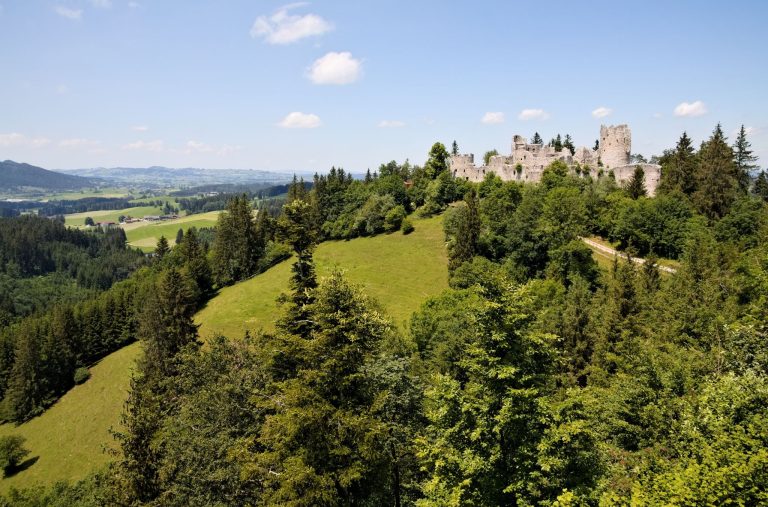
Burg Hopfen is a high-medieval hilltop castle in Germany, above Hopfen am See near Füssen. Its origins are uncertain, but it may have been the fortified castle where Wigolt, a rival claimant to the bishopric of Augsburg, took refuge in 1078 during the Investiture Controversy, a medieval struggle between secular rulers and the papacy over the appointment of church officials.
Welf ownership and Augsburg administration
Between 1172 and 1191, a Welf ministerial family held the castle and adopted its name. The Welfs were a prominent ruling dynasty whose ministerial families served them in administrative and military roles. Burg Hopfen later passed to the Augsburg High Diocese, the ecclesiastical territory governed by the bishop of Augsburg. Until 1322, it served as the administrative seat of the provost of Füssen, a senior cleric responsible for administering a collegiate church or related institution.
Decline and archaeological conservation
The construction of the High Castle in Füssen during the fifteenth century appears to have made Burg Hopfen redundant. The castle then began to decay. At the beginning of the eighteenth century, its ruins were quarried for stone during renovation work at St. Mang Monastery in Füssen.
In 1999, the city of Füssen began archaeological clearance and conservation of the site under the specialist guidance of the medieval archaeologist Joachim Zeune. Over the following ten years, the Hopfen am See tourism association and many volunteers worked on weekends to clear and preserve the remains. Detailed records of the excavated evidence and finds eventually allowed the castle’s form and building history to be reconstructed.
Remains
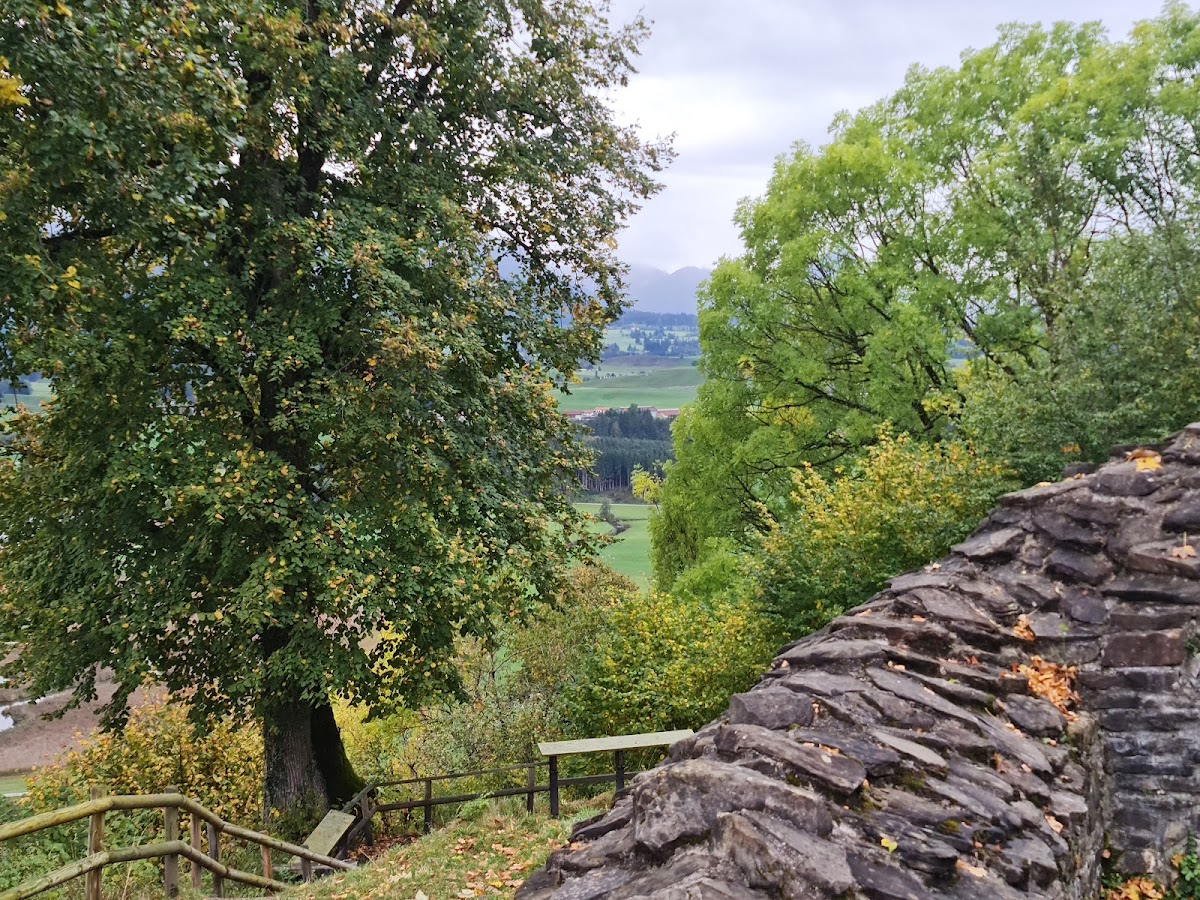
Burg Hopfen occupies a projecting ridge, or spur, above Hopfen am See in Bavaria’s Ostallgäu district. The ruin stands at an elevation of 897.7 metres. Its position used the steep slopes around the hill for protection, while defensive earthworks strengthened the more accessible approach.
Defenses and castle layout
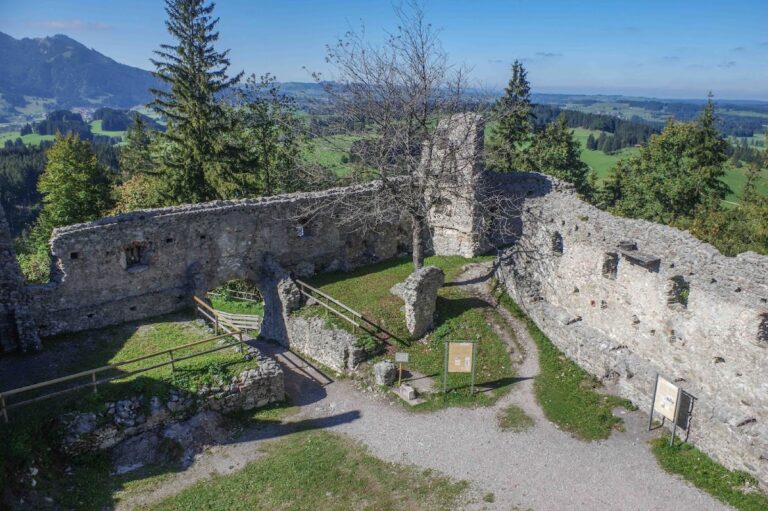
The castle’s layout is now clearly visible. The slightly higher inner castle formed the core of the complex, while a large outer courtyard extended to the east. Two section ditches and an outer bailey lay to the northeast, creating additional protection. The main enclosure was formed by a simple enceinte, or continuous defensive ring wall, that was not reinforced with towers or projecting gun platforms.
Buildings and surviving masonry
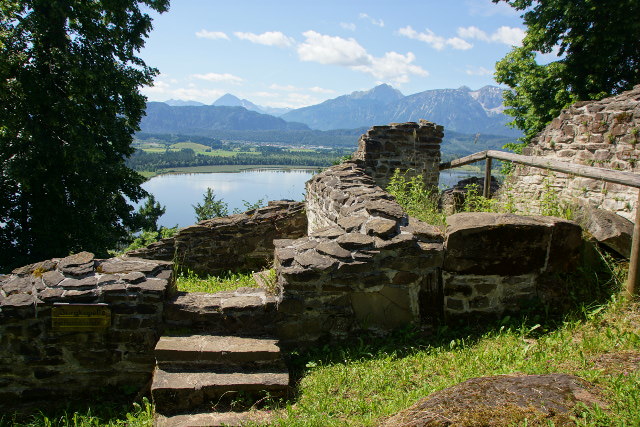
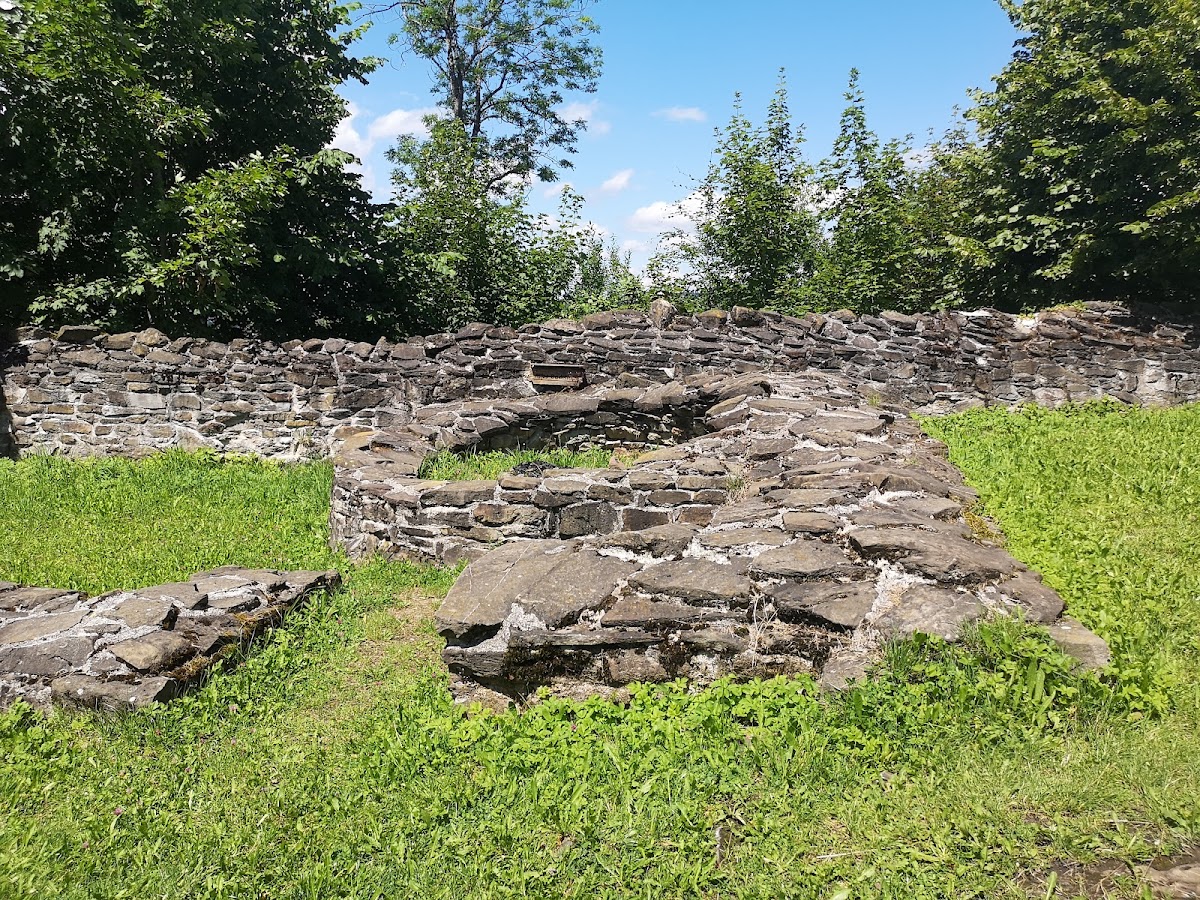
The inner castle contained a tower-like main building, or residential tower, together with a chapel. During conservation, layers of rubble as much as a metre thick were removed from the site, exposing masonry that was then preserved. The surviving walls reach up to three metres in height, and some breaches were rebuilt to stabilize the structure. Burg Hopfen is regarded as the earliest stone castle in the Allgäu and remains important for the study of castle development.