Zumelle Castle: A Roman-Era Stronghold in Italy


Site at a Glance
- Rating
- 4.4
- Popularity
- Medium
- Country
- Italy
- Primary era
- Medieval
- External website
- Open
- Eras represented
- Classical, Medieval
- Civilizations
- Byzantine, Holy Roman Empire, Ostrogothic, Roman
- Site type
- Military
- Remains
- Castle
On this page12 sections
History
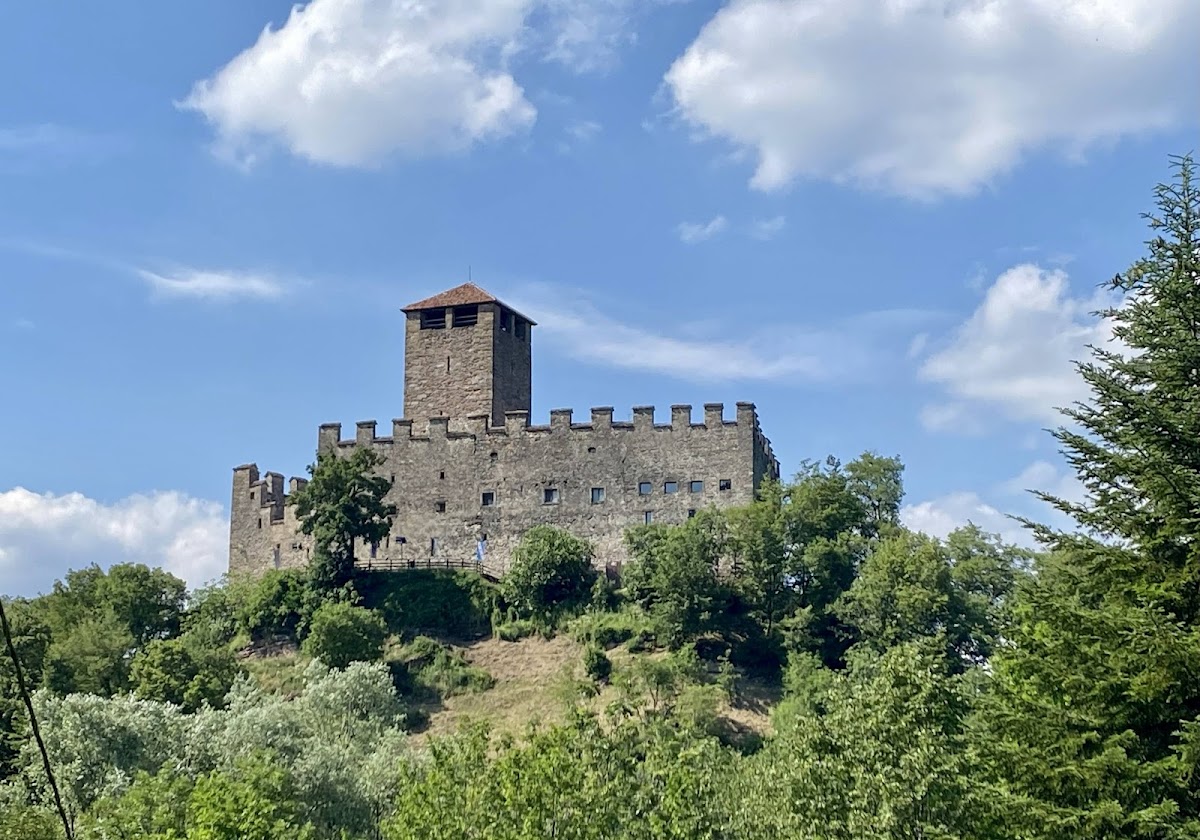
Zumelle Castle is a fortified site near Tiago in Borgo Valbelluna, Italy, whose earliest structure was a Roman watchtower completed around 46 to 47 CE. Built while Rome was consolidating control over the Valbelluna, conquered during the first century BCE, it watched the road leading from the plain through the Praderadego Pass. This route has been identified as the Via Claudia Augusta Altinate, or more probably as a branch of that Roman road system. The castle later became the principal stronghold of the area and is regarded as a symbol of the Zumellese region and the best-preserved castle in the Valbelluna.
Roman and Early Medieval Origins
During the invasions that affected Italy and the period after the fall of the Western Roman Empire, Zumelle assumed a wider defensive role. Its position helped protect communications between Feltre and Ceneda, making the site an important local base during a time of political and military change.
A local tradition connects the ruined fortification with Genseric, described as a trusted man of Amalasuntha, the Ostrogothic queen who ruled in Italy during the sixth century. According to the legend, Genseric rebuilt the fortress and settled there with his wife, Eudosia, after Amalasuntha was assassinated. Their twin children were traditionally said to have given Zumelle its name, derived from the Italian word for “twins.”
Lombard and Feudal Rule
Zumelle entered a documented early medieval dispute in 737, when Liutprand, king of the Lombards, granted Valentino, bishop of Ceneda, lordship over Zumelle and several surrounding estates. The grant included Valmarino, Serravalle, Fregona, Reganzuolo, Cordignano, Cavolano, and Formica. It challenged the authority of John, count-bishop of Belluno, who already controlled the territory. A count-bishop combined episcopal office with secular rule over a territory. The conflict ended in 750 after the intervention of Aistulf, another Lombard king.
In 963, Emperor Otto I granted the county of Zumelle to the bishops of Belluno. During the eleventh century, the county was assigned to the baron Abelfred. After his death without male heirs, it passed to his daughter Adelheit. Her marriage connected the estate with Wilfred of Colfosco, and their daughter Sofia later married Guecellone II da Camino, transferring Zumelle to the Caminesi, a powerful noble family of the medieval Veneto.
Rizzardo IV da Camino rebuilt the castle in 1311 on the orders of Emperor Henry VII. Rizzardo was then lord of Treviso, Belluno, and Feltre. This rebuilding established the medieval form of the stronghold that continued to shape the site in later centuries.
Venetian and Noble Ownership
After the Republic of Venice conquered Zumelle, the castle lost much of its strategic importance. Imperial troops sacked it during the War of the League of Cambrai, an early sixteenth-century conflict in which Venice faced a European coalition and suffered attacks across its territories. The castle was later restored.
Venice granted the castle and its surrounding county to the patrician Zorzi family in exchange for the islands of Meleda and Curzola, which Venice had lost in 1358. The grant covered nineteen villages. The Zorzi were required to provide two annual torches weighing ten pounds each for the basilica, maintain a vicar, administer justice, and keep four paid personnel at the castle.
Ownership passed from the Zorzi to the Gritti counts in 1720. The castle was subsequently abandoned and fell into ruin. After the fall of the Venetian Republic, it came under the Austrian Empire. In 1872, the commune of Mel acquired it at public auction for rural use. Zumelle is now municipally owned by Borgo Valbelluna.
Legends and Modern Preservation
A second local legend, recorded by the Bellunese historian Giorgio Piloni, concerns Murcimiro, count of Zumelle. Murcimiro abducted Atleta, the daughter of Count Tucherio of Casteldardo and the betrothed of Azzone, count of Feltre. During the ambush he killed Atleta’s brother Orleo and took her to Zumelle. Tucherio strengthened his forces and besieged the castle, but could not capture Murcimiro. He devastated the settlements of Tiago and Villa before launching another unsuccessful attack.
Atleta eventually married Murcimiro and had a son, Adelardo. After a period of peace, Murcimiro reduced the castle’s defenses and dismissed many of his men. Three years later, guided by a former Zumelle soldier, Tucherio attacked again, destroyed the defenses, killed Murcimiro, and burned the fortress. Atleta and Adelardo were taken to Casteldardo, and Atleta was later married to Azzone.
The people of Zumelle then made Adelardo count and demanded the castle’s restoration. Tucherio accepted their terms, supplied twenty-five silver marks for the work, and returned Adelardo to Zumelle under the guardianship of Ermenfredo. After spending many years in France, Murcimiro’s brother Bellerofonte returned and urged the fifteen-year-old Adelardo to attack Casteldardo and kill Tucherio. Bellerofonte later died of fever.
Azzone, who had settled in an ancient castle on Mount Garda near the Piave, sent his son Giovannino to demand the return of Casteldardo and the goods taken by Adelardo. Adelardo destroyed Azzone’s castle and later killed him during a hunting expedition. The killing brought the Feltrini and Bellunesi into the conflict. Adelardo sought help from his uncle Orso, duke of Ceneda, and his brother Pietro, duke of Friuli.
According to the legend, King Astolfo ordered the dispute to be settled by a duel at Pavia, the capital of the Lombard kingdom. Ziergen Filistin, a relative of Adelardo, defeated Giovannino. An inscription once set into one of Zumelle’s towers commemorated the victory with the words, “Ziergen Philistin defeated Giovannino, son of Azzone, to God’s praise.”
Restoration campaigns from the 1960s through the 1990s helped preserve the castle. Zumelle was regarded as the only one of about twenty castles in the Valbelluna to have remained almost intact rather than being destroyed or substantially rebuilt during the Venetian period. Since 2014, a public tender has placed its management with the Tuscan association Sestiere Castellare of Pescia. The complex now includes reconstructed and interpretive medieval environments, a reuse that draws attention to the castle’s place in the early medieval history of northeastern Veneto. It is recognized as Italian national heritage.
Remains
Zumelle Castle occupies a rocky outcrop above the Terche stream, where the terrain provided a naturally defensible position overlooking the route through the Praderadego Pass. A rock-cut moat surrounds the complex. The surviving remains combine the early fortified site with a medieval keep and later buildings, while restored and interpretive spaces represent aspects of life and work within the castle.
Fortifications and Castle Buildings
Watchtower and Keep
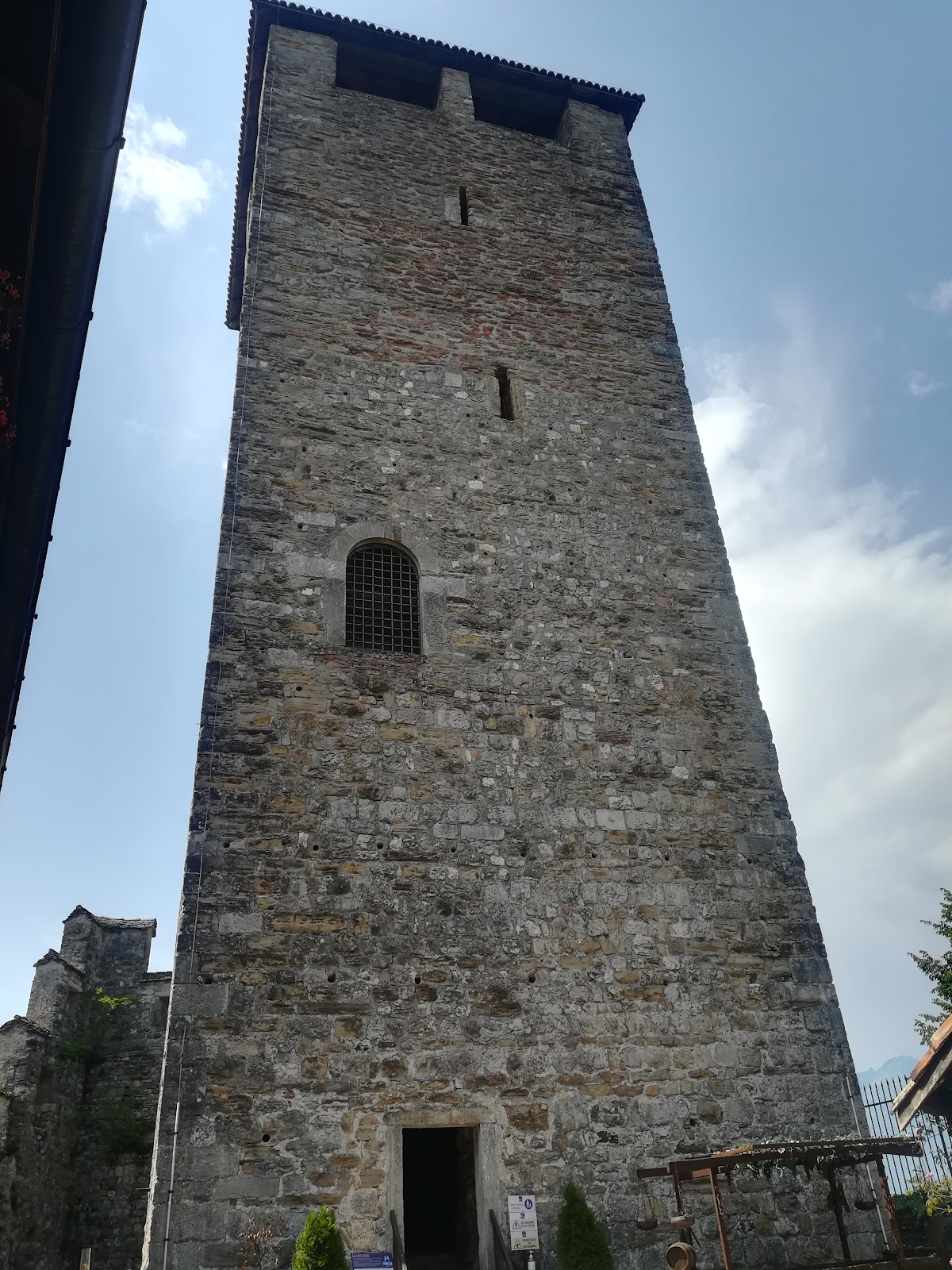
The first fortification was a watchtower, constructed around 46 to 47 CE as part of the Roman control of the route through the pass. The present complex includes an eleventh-century keep, the principal fortified tower of the castle. Together with the rocky setting and the moat cut into the stone, these elements express the defensive development of the site from a Roman lookout into a medieval stronghold.
Medieval Village and Reconstructed Rooms
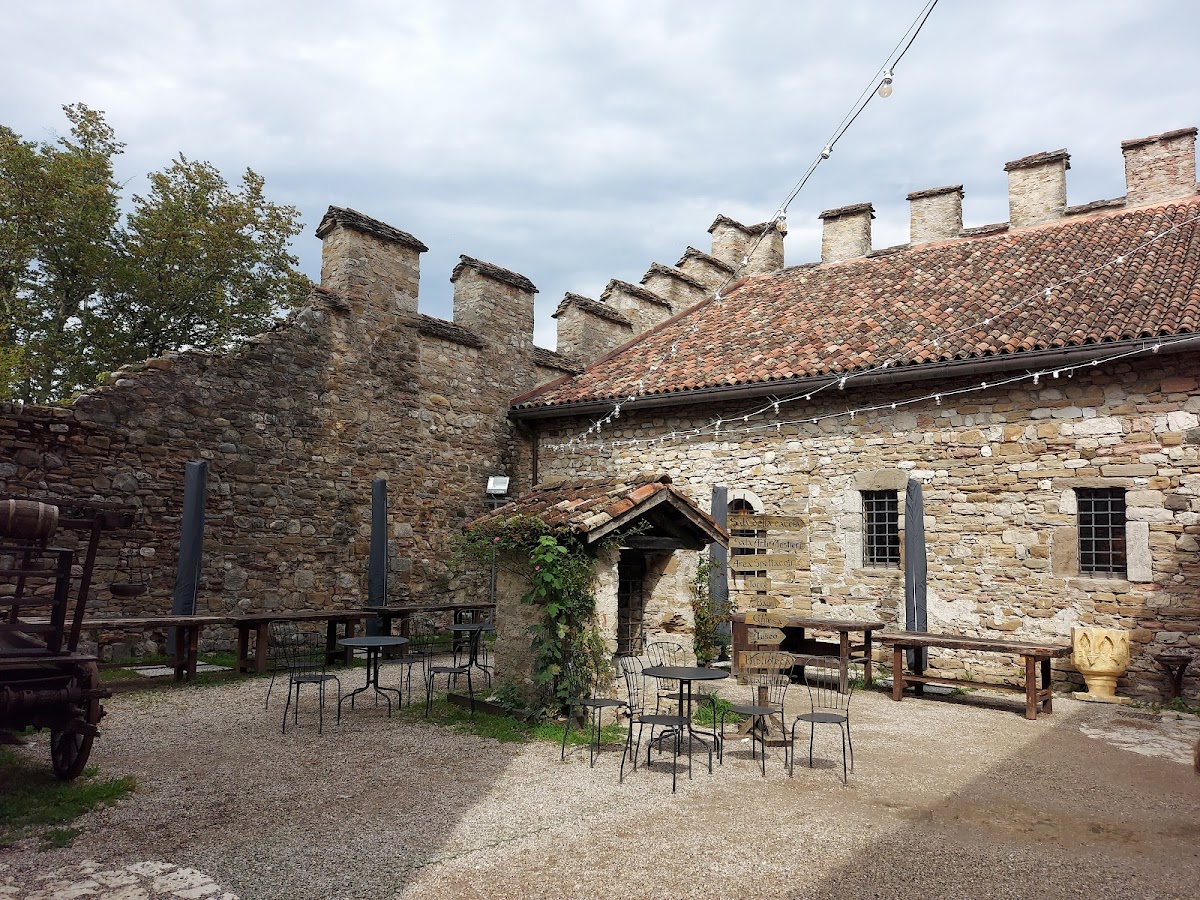
The complex includes a medieval village and a tower house, along with reconstructed or interpretive environments. These spaces include an apothecary’s workshop, a medieval bedroom, a banquet room, a kitchen, and a scriptorium, a room associated with the production and copying of manuscripts. A museum area and a military storage building are also part of the present complex.
Religious Buildings
Chapel of San Lorenzo
The Chapel of San Lorenzo was built over an earlier Byzantine sacellum, a small shrine or sacred enclosure. A sarcophagus and burials are associated with the chapel. The building therefore preserves evidence of religious use connected with earlier sacred activity at the fortified site.
Church of San Donato
The nearby Church of San Donato is an early medieval building associated with Lombard religious traditions. It has a single-plan layout with three apses, or projecting rounded ends, and contains one eighteenth-century altar. Fragments of Gothic frescoes survive within the church. Continuing water infiltration has weakened its structure, and the building is closed to the public.
Nearby sites