Belluno Cathedral San Martino: The Cathedral Basilica of Belluno, Italy
Site at a Glance
- Rating
- 4.6
- Popularity
- Low
- Country
- Italy
- Primary era
- Early Modern
- Eras represented
- Medieval, Early Modern, Modern
- Civilizations
- Italian, Venetian
- Site type
- Religious
- Remains
- Cathedral
On this page18 sections
History
Belluno Cathedral San Martino, also known as the Cathedral Basilica of Saint Martin, is the principal Catholic church of Belluno, Italy, and the mother church of the Diocese of Belluno-Feltre. Dedicated to Saint Martin of Tours, it occupies a site used for Christian worship since the sixth century and contains a Renaissance cathedral shaped by later Baroque additions, earthquakes, and restoration.
Early Christian and Medieval Cathedral
In 547, Bishop Felice dedicated Belluno’s first early Christian cathedral to Saint Martin of Tours in gratitude for a miracle. Architectural elements from the ninth and tenth centuries, found during later restoration, attest to an early church on the site. A later church dedicated to Saint Martin was built around 850.
A bell tower with four bells stood at the cathedral by 1191. Its bells called the faithful to religious services and summoned citizens to arms during extreme emergencies, including sieges and disasters. By the medieval period, the cathedral had become a large three-aisled church with several altars, a cemetery, and the baptistery of Saint John the Baptist. A cemetery on its southern side is recorded in 1030.
The medieval church faced in the opposite direction from the present cathedral. Its apse, the curved end of the church, stood toward the main square to the east, while its facade faced west toward the Piave River. Between the late fourteenth and early fifteenth centuries, the building underwent extensive renewal and decoration as its condition deteriorated. Bishop Enrico Scarampi reconsecrated it in 1426. Further work from 1449 to 1461 enlarged the apse and involved citizens, clergy, confraternities, and civic institutions.
Renaissance Reconstruction
A serious fire in 1471, probably caused by a candle left burning in the sacristy, destroyed part of the medieval church. Construction of the present cathedral began in 1517 under the Venetian Renaissance architect and sculptor Tullio Lombardo, who retained portions of earlier structures. Financial difficulties slowed the project, while the plan introduced a decisive change in orientation. The new apse faced the Piave and the facade faced the square, giving the square greater prominence and space. The adjacent cemetery was removed.
Bishop Giulio Contarini demolished the old choir in 1555. A replacement choir was built two years later at the level of the earlier cathedral, and the foundation stone of the new apse was laid in 1557 on the steep slope descending toward the Piave. Construction and interior decoration continued during the episcopate of Bishop Luigi Lollino, who served from 1596 to 1625 and left 1,500 ducats toward completion of the main facade.
The main altar was consecrated in 1624, marking the completion of the principal building phase. The lateral portals were added in 1684 by Bishop Giulio Berlendis. The cathedral’s Renaissance structure consequently acquired important seventeenth-century furnishings and decoration while its facade continued toward its present form.
Baroque Additions and Completion
Bishop Gaetano Zuanelli began a new campanile, or bell tower, in 1732. Its design by Filippo Juvarra was based on an improved and proportionally adapted version of the campanile of Turin Cathedral. Work stopped in 1735 because of insufficient funds and resumed to completion on 16 July 1747. During the interruption, Zuanelli had the fourteenth-century funerary ark of Federico degli Azzoni built into the tower wall to mark the level reached by the unfinished work. The tower received its copper-covered cusp and angel in 1743, and the cathedral cupola was completed in 1756.
Zuanelli also commissioned new Baroque side altars and colored-glass windows. These works added a strong eighteenth-century character to the interior while preserving the principal Renaissance arrangement. The cathedral’s main architectural phases thus extended over more than two centuries, from Lombardo’s project in 1517 through the completion of the cupola and bell tower.
Earthquakes and Modern Restoration
An earthquake in 1873 caused severe structural damage. The cupola collapsed through the choir floor, and the crypt below also failed. The high altar and wooden choir stalls survived, while the Avoscano ark, an ancient reliquary, was lost in the disaster. The cathedral fabric office entrusted rebuilding and general restoration to the Feltre architect Giuseppe Segusini. The work ended in 1878, when Bishop Salvatore Bolognesi reconsecrated the cathedral.
A competition held in 1903 and 1904 addressed the completion of the facade, but the building continued with its facade unfinished. The earthquake of 1936 damaged vulnerable parts of the church and opened serious cracks in the apse and cupola. Engineer Adriano Barcelloni Corte, assisted by architect Alberto Alpago Novello, directed structural consolidation, especially around the drum and cupola. The intervention included eight elongated windows that increased light in the presbytery, the sanctuary area around the main altar. Alpago Novello also created the choir loft on the counterfacade.
Pope John Paul II elevated the cathedral to the rank of minor basilica on 18 June 1980. This is an honorary title granted by the pope to churches of particular religious or historical significance, and it did not alter the cathedral’s role as the diocesan church. In 1983, the sculptor Angelo Canevari made new bronze portals in memory of Albino Luciani, the Belluno-area pope who took the name John Paul I.
From 2019, Bishop Renato Marangoni promoted the renewal and rearrangement of the liturgical furnishings in accordance with the principles of the Second Vatican Council, the Catholic council held from 1962 to 1965 whose reforms influenced church interiors. The work concluded in 2025 with the consecration of the altar, which contains a relic of Blessed Albino Luciani, and the blessing of the other furnishings. The cathedral is also an Italian national monument.
Remains
Plan and Exterior
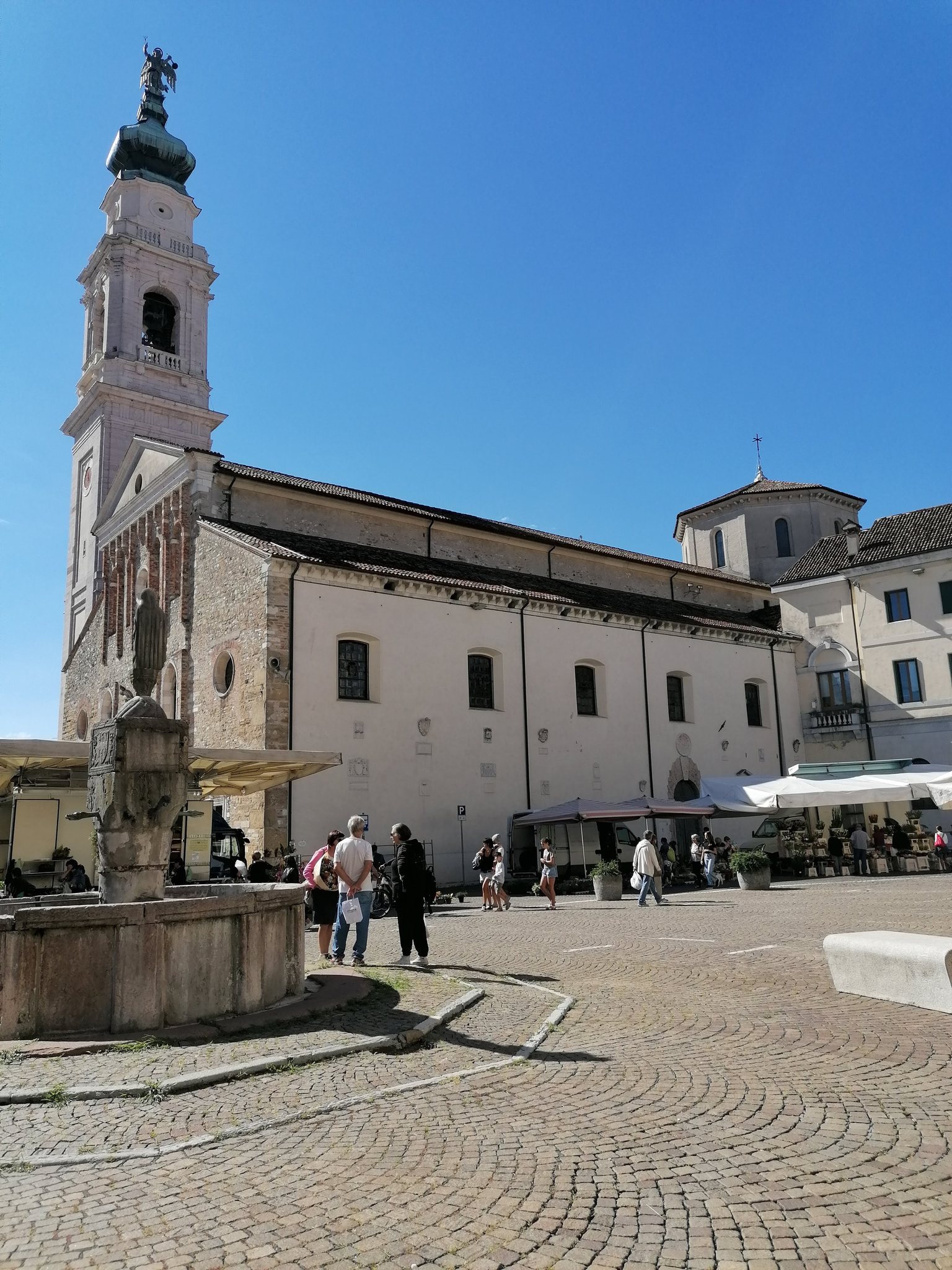
The cathedral stands in Piazza Duomo in Belluno’s historic centre. Its Renaissance building is approximately 68 metres long and 27 metres wide. Three aisles are divided transversely into seven bays, creating a broad interior plan beneath a structure that combines Renaissance organization with the vertical emphasis associated with Gothic churches.
Facade and Portals
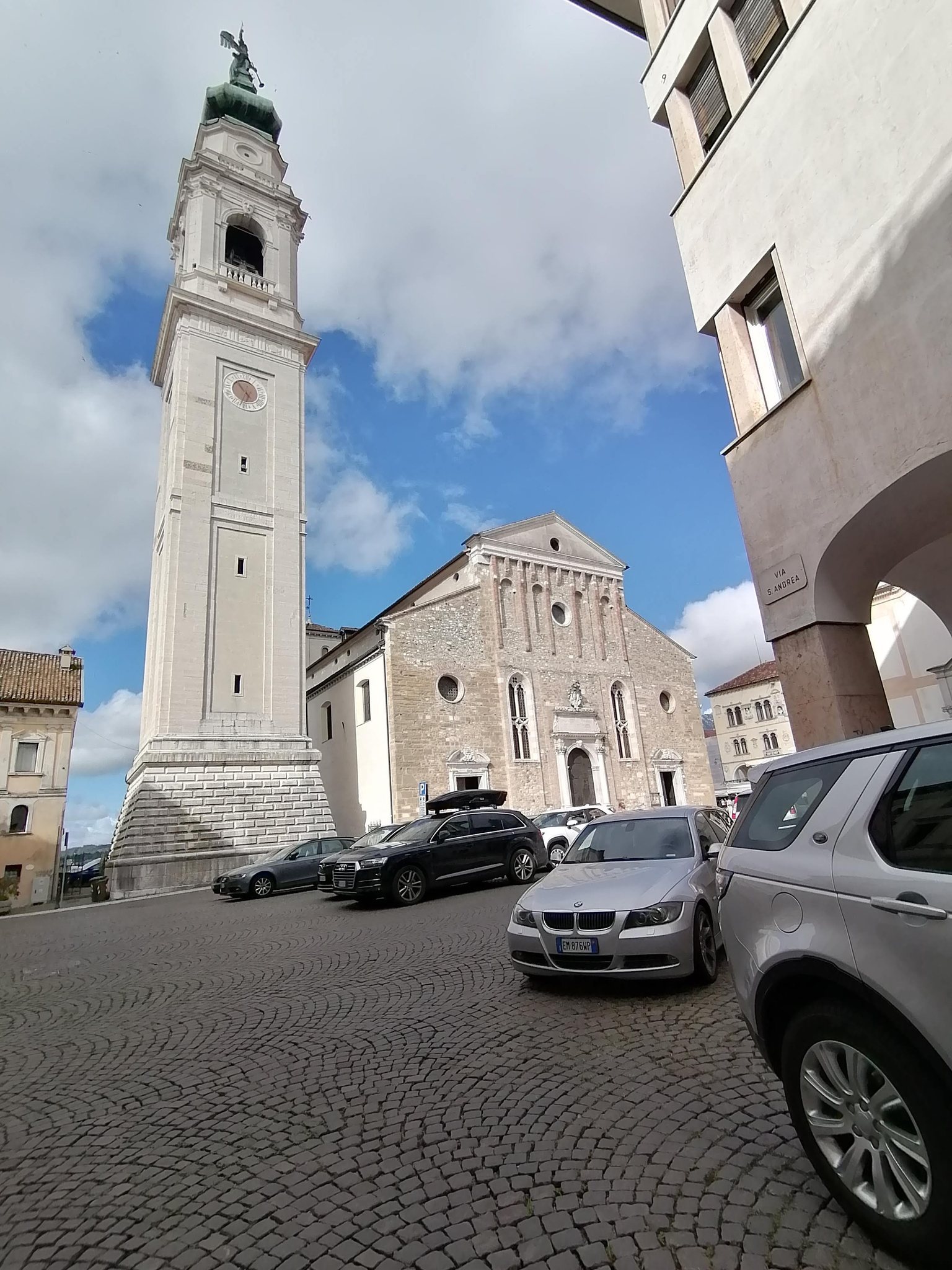
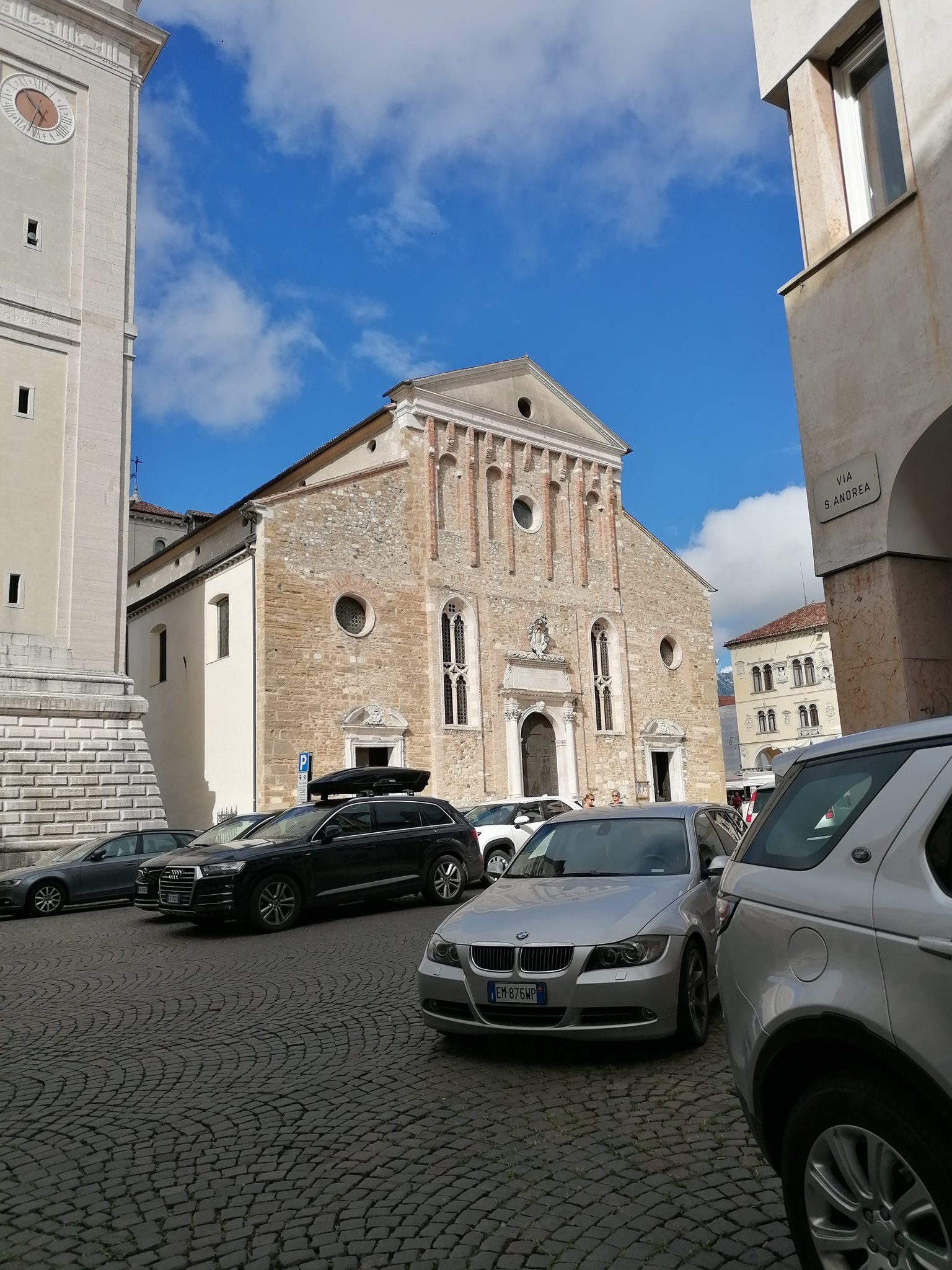
The exposed-stone facade is divided vertically into three sections, with lower lateral sections. Although it belongs to the Renaissance building campaign, its overall appearance is broadly Romanesque. A reused Romanesque panel with vegetal decoration forms part of the composition. The lower and middle levels contain a richly decorated Baroque central portal and two Gothic windows.
The upper section ends in a tympanum set on an entablature supported by pilasters and contains a central rose window. Its glazing depicts Saints Gioatà, Lucanus, and Martin. Above the central portal, a commemorative inscription accompanies the coat of arms of Bishop Luigi Lollino.
Bronze Doors
Angelo Canevari’s bronze portals of 1983 commemorate Albino Luciani. The central door presents episodes from Luciani’s historical and supernatural life. The left leaf recalls the history of the cathedral, while the right leaf uses alternating diamonds and circles to express the transience of human life.
Interior and Presbytery
Inside, massive piers of Castellavazzo stone rise through the three-aisled plan. A barrel vault spans the central aisle and is divided by seven semicircular stone arches corresponding to the piers. The broad semicircular presbytery opens beyond the last major arch and contains rows of wooden choir stalls. Above it, an airy cupola with eight windows illuminates the choir.
Altars and Apse
The presbytery altar is made of Castellavazzo stone and stands directly beneath the cupola. Behind it, at the centre of the apse, is the monumental seventeenth-century high altar in fine white marble. Its 1672 altarpiece by Pietro Muttoni represents the glorification of Saint Martin with Saint Francis of Assisi and Saint Blaise, with the Coronation of Mary above. The canon Amico Fulcis, who commissioned the work, appears kneeling before Saint Martin. The apse also contains Antonio Ermolao Paoletti’s large fresco of the Assumption of Mary among angels, painted in 1898.
Each aisle contains four eighteenth-century side altars in a matching Baroque design. Broken pediments rest on imposing columns of variegated marble, while marble statues of angels, saints, and allegorical figures enrich the compositions. Two white-marble statues of saints stand beside each altar.
Right Aisle and Blessed Sacrament Chapel
In the right aisle, the altars begin at the rear with the altar of Saint Bernardino of Siena, which includes Saints Jerome and John the Baptist and a work by Andrea Schiavone. Farther forward, an altarpiece by Cesare Vecellio shows Belluno’s podestà, Giovanni Loredan, supplicating the Virgin and Saints Fabian and Sebastian to remove plague from the city. The next altar displays Jacopo Bassano’s Martyrdom of Saint Lawrence, followed by Palma the Younger’s Descent from the Cross.
The Chapel of the Blessed Sacrament occupies the rear of the right aisle. Its 1673 tabernacle, made of polychrome marble by Giovanni de’ Grassi, stands on an altar between two wooden stalls and is separated from the aisle by a red-marble balustrade. A colored-glass window illuminates the chapel. Nearby, a nineteenth-century bust of Pope Gregory XVI stands in an iron-balustraded niche, while the tomb of Bishop Giosuè Cattarossi lies at the foot of the chapel steps.
Left Aisle and Chapel of the Holy Thorn
The first altar in the left aisle is dedicated to Our Lady of Grace. A small painting by Gaspare Diziani stands between statuettes of Saints Gioatà and Lucanus dating from the first half of the eighteenth century. The altar of Saint Anne contains Egidio Dall’Oglio’s Holy Family with Saints Joachim, Anne, and John the Baptist. At the altar of Saint Charles Borromeo, Diziani depicts the saint praying with Saints Francis de Sales, Louis Gonzaga, and Valentine. The altar beside the sacristy door contains a 1731 Conversion of Saint Paul attributed to Diziani.
The Chapel of the Holy Thorn occupies the rear of the left aisle, opposite the Chapel of the Blessed Sacrament. Its marble altar preserves a thorn from Christ’s crown, donated by Bishop Mosè Buffarello in 1471, within a tabernacle. The sixteenth-century ensemble includes a large polychrome crucifix above the tabernacle, painted statues of the Mourning Virgin and Saint John the Evangelist, and stone statues of Saint George and Saint John Nepomuk. A red-marble balustrade encloses the chapel.
Liturgical Furnishings and Light
Near the pillar separating the Chapel of the Holy Thorn from the presbytery stands the bishop’s chair, raised on three circular steps. The ambo is placed around the last pillar before the presbytery and has a double staircase. Both furnishings are made of Castellavazzo stone.
The counterfacade contains the choir loft between two Gothic windows. It houses the Mascioni organ, made in 1945 and 1946, with 43 stops distributed across three manuals and pedal and operated by electric action. Rectangular colored-glass windows light the side aisles and bear the heraldic arms of noble Belluno families. Two enormous paired-arched windows in the presbytery walls, together with the cupola windows, illuminate the sanctuary. The central aisle also receives light through the Gothic windows and a small rose window depicting Saints Gioatà, Lucanus, and Martin. The floor is laid in a checkerboard pattern of white and red Castellavazzo stone.
Crypt and Reliquaries
The crypt is reached from the sacristy vestibule by two flights of stairs beside the altar of the Holy Thorn. It has two aisles, three transverse piers forming three bays, and a double cross vault. Its dimensions correspond exactly to those of the presbytery above, and its piers support the upper floor.
Major Sacristy
Wooden cupboards with seats run around the crypt’s perimeter. They store vestments and also serve as choir stalls for the clergy, giving the chamber a dual function as the major sacristy and a place of worship. Portraits of former Belluno bishops hang above them. A large stone lavabo with two mascarons once supplied water for priests’ ritual ablutions before Mass.
Avoscano Ark and Saint Martin Polyptych
Four large colored-glass windows illuminate the crypt and face toward the Piave. At its apsidal end, the altar incorporates what survives of the Avoscano funerary ark, which dated to about 1340 before its destruction in the 1873 earthquake. The oldest surviving part is the fourteenth-century frontal with a high relief of the Madonna and Child; its corner sculptures date from the fifteenth century. The marble ark served, and continues to serve, as a reliquary for relics venerated in the cathedral since the Middle Ages.
Above the crypt altar is a fifteenth-century polyptych, a multi-panel altarpiece, with scenes from the life of Saint Martin. Its nine painted panels include the saint giving his cloak to a beggar. The work is by an unknown artist and is sometimes attributed to the Belluno painter Simon da Cusighe. Four predella panels show episodes from the life of Saint John the Baptist, while the tympanum represents God the Father. The predella and tympanum are attributed to Nicolò de Stefani and date approximately from the second half of the sixteenth century.
Campanile
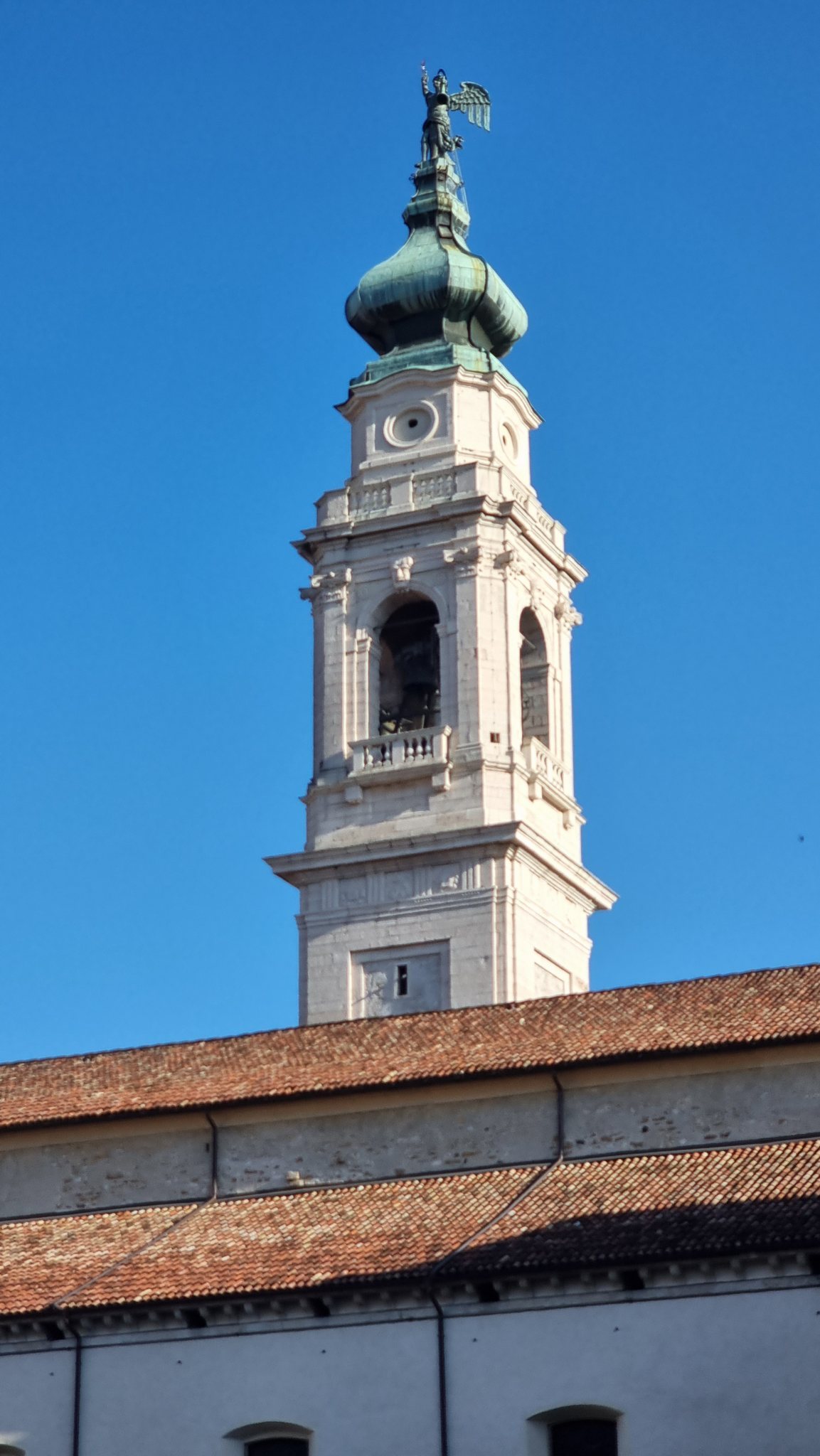
The Baroque campanile stands at the exit from the sacristy and is built of Castellavazzo stone and other materials. Including the angel at its summit, it reaches 71.98 metres. The wooden angel, designed by the Belluno sculptor and woodcarver Andrea Brustolon and covered in copper, is 4.63 metres high. An inscription associated with Filippo Juvarra appears on the side facing the Piave, and a clock made by a firm from Carnia was installed in 1790.
The tower contains a set of bells cast in 1934 by the Premiata Fonderia De Poli of Revine Lago. Five principal bells are mounted for swinging, together with a smaller bell mounted in the same way. The principal bells are the Campanone, Ave Maria, the Agony or Dead bell, the Chapter bell, and the Mass bell dedicated to Saint Lucanus. An inscription recalls that the bells were melted down by the Austrians during the First World War and recast from enemy bronze. The full peal sounds on the most important occasions.