Castel Brando: A Roman Fortress and Medieval Castle in Italy


Site at a Glance
- Rating
- 4.5
- Popularity
- Medium
- Country
- Italy
- Primary era
- Medieval
- External website
- Open
- Eras represented
- Classical, Medieval, Early Modern
- Civilizations
- Holy Roman Empire, Roman, Venetian
- Site type
- Domestic
- Remains
- Castle
On this page16 sections
History
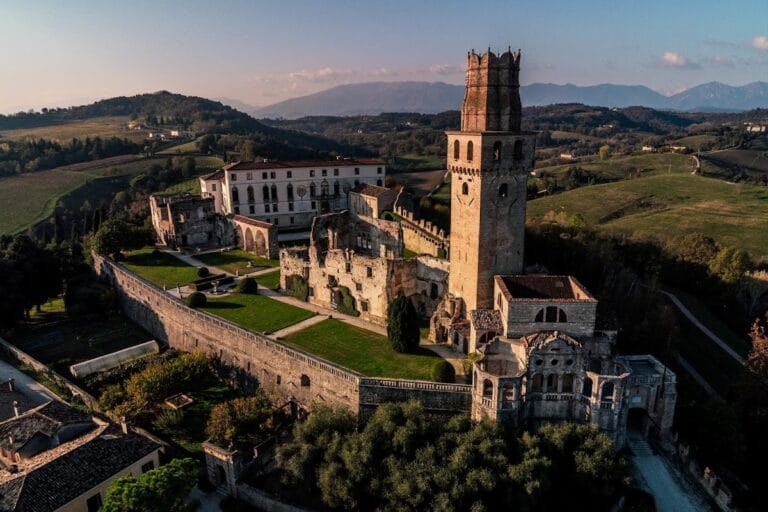
Castel Brando is a historic castle in Italy overlooking Cison di Valmarino and Valmareno. Built around AD 46 by the Romans as a fortified military settlement, it occupied a strategic position on the northern Italian approaches to the Alps and later became a medieval fortress, Venetian noble residence, religious institution, and restored hotel and museum complex.
Roman and Early Medieval Origins
The rocky site was frequented during the Paleovenetian period and continued to host settlements in the Roman, Ostrogothic, and Lombard periods. Around AD 46, the Romans established a castrum, a fortified settlement or military camp, to protect communications between northern Italy and the Alpine region.
The Roman garrison controlled the territory between the Piave and Livenza rivers and helped secure the pre-Alpine section of the Via Claudia Augusta. This Roman road linked the Po Valley with Rhaetia, an Alpine region corresponding broadly to parts of modern Austria and the surrounding area. The fortress therefore formed part of a wider defensive and communications system.
During the Migration Period, the Roman defensive position continued to serve as a place of protection against invading groups. A more substantial medieval fortification was later raised on the Roman foundations, probably during the first half of the tenth century, when Hungarian invasions affected northern Italy.
Ecclesiastical Fief and the da Camino Family
In 962, Emperor Otto I granted comital prerogatives over Valmareno to Sicardo, bishop of Ceneda. The fortress consequently became the seat of a small ecclesiastical fief, meaning territory held under the authority of a church institution and administered through its vassals. The bishops of Ceneda granted the castle to successive noble holders.
A later tradition, not confirmed by the evidence, states that the fortress was granted to the da Porcia family around the year 1000 and then passed to the Colfosco family. In 1154, Sofia of Colfosco brought the fief to Guecellone III da Camino as her marriage dowry. It remained with the descendants of the da Camino family until 1335, when the family became extinct with Rizzardo III da Camino.
The da Camino family occupied the castle from 1233 to 1335 and substantially enlarged it. Gherardo III da Camino, an Italian feudal lord and military leader, was born there in 1240. The thirteenth-century works gave the medieval stronghold much of its more imposing defensive character.
Venetian Control
After the extinction of the main da Camino line, the castle became the subject of a dispute involving Bishop Francesco Ramponi and the da Camino relatives Gherardo V and Rizzardo IV. Venetian mediation assigned it to the Caminesi, but in 1349 Rizzardo IV transferred the castle to Marino Faliero in exchange for a loan from the Republic of Venice.
Faliero was executed in 1355, and the castle then became the seat of a Venetian podestà, a civic official appointed to administer a town or territory on behalf of a ruling power. It remained under this arrangement until 1436, although control was repeatedly contested by the Carraresi, the Patriarchate of Aquileia, and Venice itself.
In 1411, a coalition of Carraresi, Scaligeri, Caminesi, and Hungarians attacked the fortress under the leadership of Pippo Spano. The castle was subsequently subjected to Ercole da Camino, while Venice confirmed its sovereignty through an agreement. After Ercole’s death, Venice resumed full possession.
In 1436, Venice granted the castle to the condottieri Brandolino IV Brandolini and Erasmo da Narni, known as Gattamelata. A condottiero was a professional military commander who led troops under contract. After Gattamelata received a military promotion, he transferred his entire share to Brandolino IV, leaving the castle in the hands of the Brandolini family of Forlì.
From Fortress to Noble Residence
Venetian rule brought a long period of peace, and the castle’s military role gradually ended. Between the sixteenth and eighteenth centuries, the Brandolini family adapted the fortress to residential needs and transformed it into a noble palace influenced by Venetian villa architecture.
During the first half of the sixteenth century, Antonio Maria Brandolini commissioned engineers to enlarge the central section in the architectural language associated with Jacopo Sansovino. Around 1700, the family commissioned Ottavio Scotti, an architect and Count of Treviso, to design and construct a southern extension. This work included the chapel known as the Church of San Martino.
War, Restoration, and Later Uses
During the First World War, Imperial Austrian forces invaded the castle and used it as a military hospital. The Brandolini family abandoned the residence and withdrew to their villa at Solighetto near Pieve di Soligo.
Count Girolamo IV Brandolini financed ten years of restoration, after which the castle reopened as a residence in 1929. In 1959, the Brandolini family sold it to the Salesians, a Catholic religious order founded by John Bosco. The Salesians adapted the complex for use as a monastery, seminary, retreat facility, and center for spiritual studies.
In 1997, the Salesians sold Castel Brando to entrepreneur Massimo Colomban and Quaternario Investimenti SpA. Extensive renovation converted the property into a hotel and museum complex, with a theatre and restaurant also occupying the restored site. The name CastelBrando is the commercial name associated with the Brandolini family.
Remains
Castel Brando stands on a dolomite-limestone rock at approximately 370 metres above sea level, on the slopes of Monte Castello. Its position overlooks the villages of Cison di Valmarino and Valmareno. The present complex combines visible Roman remains, medieval defensive elements, Renaissance alterations, and an eighteenth-century residential extension.
Roman Foundations and Water System
Roman Fortress
The original Roman castrum, established around AD 46, remains visible within the castle complex. Excavation revealed a bread oven approximately three metres in diameter dating from the same period. The discovery provides physical evidence of the military settlement’s facilities and daily operation.
Baths and Aqueduct
Other excavated Roman installations include baths and the original aqueduct pipes. The aqueduct was supplied by three nearby natural springs, which continue to provide water for the castle. These surviving elements connect the present complex with the infrastructure of its Roman phase.
Medieval Defensive Structures
Battlements and Central Tower
The medieval fortification incorporated imposing Guelph-Ghibelline-style battlements and a central tower. Guelph and Ghibelline were opposing political alignments in medieval Italy, broadly associated with support for the papacy and the Holy Roman Empire. The battlements and tower formed part of the major thirteenth-century expansion carried out under the da Camino family.
Renaissance and Eighteenth-Century Architecture
Central Palace
The sixteenth-century enlargement of the central section introduced Venetian Gothic double and triple mullioned windows. These windows, divided by slender vertical supports, belong to the transformation that gave the former fortress the character of a Venetian-influenced residence.
Church of San Martino
The southern extension designed by Ottavio Scotti around 1700 incorporated the chapel known as the Church of San Martino. Its interior received eighteenth-century frescoes by Egidio Dall’Oglio. The chapel forms part of the residential expansion that reshaped the southern side of the medieval complex.
Restored Complex
The later residential transformation introduced the architectural language of Venetian villas and included a heating system described as innovative for its period. The castle is now in restored condition and accommodates a four-star hotel, a museum, and a theatre. The museum displays carriages, weapons, costumes, and musical instruments within the historic complex.
Nearby sites