Zōjō-ji Temple: A Jōdo-shū Buddhist Main Temple in Tokyo


Site at a Glance
- Rating
- 4.5
- Popularity
- High
- Country
- Japan
- Primary era
- Modern
- External website
- Open
- Eras represented
- Early Modern, Modern
- Civilizations
- Japanese, Tokugawa
- Site type
- Religious
- Remains
- Monastery
On this page18 sections
History
Zōjō-ji is a Jōdo-shū Buddhist temple in Tokyo, Japan, whose institutional history took shape in the Muromachi period through its conversion to the Pure Land school in 1393. Formally known as San’en-zan Kōdo-in Zōjō-ji, it belongs to the Chinzei branch, the principal Jōdo-shū tradition associated with the Kantō region. The temple became a main temple of Jōdo-shū and the leading institution among the Kantō Eighteen Danrin, a group of eighteen temples devoted to Buddhist learning and clerical training.
From Kōmyō-ji to Zōjō-ji
Temple tradition traces Zōjō-ji to a ninth-century predecessor called Kōmyō-ji, founded at Kaizuka in Musashi Province by Shūei, a disciple of Kūkai. This early institution was associated with Shingon Buddhism. In 1393, Yūyo Shōsō led its conversion to Jōdo-shū and gave it the name Zōjō-ji. Shōsō is regarded as the temple’s substantive founder and is recognized as the eighth patriarch of Jōdo-shū.
Shōsō established a hermitage at Koishikawa in 1396 and invited his teacher, Ryōyo Shōkei, to join him there. That institution later became Denzū-in. Zōjō-ji’s medieval lineage was also connected through abbots and affiliated temples with the Chiba, Edo, Ōta, Uesugi, Matsudaira, and Tokugawa families. The temple’s early history before Tokugawa patronage remains partly unclear, although its abbots were traditionally linked with the Chiba family and were successively supported by the Chiba, Edo, and Ōta families.
Warfare, reconstruction, and new patronage
During the Kyōtoku conflict, Ashikaga Shigeuji, the Kamakura kubō, established a camp at Zōjō-ji in 1455 while pursuing Nagao Kagenaka. A Kamakura kubō was the military governor who represented the Ashikaga shogunate in the Kantō region. Warfare is said to have destroyed the temple in 1481.
In 1563, Kanyo Sontei became the tenth abbot. He strengthened Zōjō-ji’s relationship with the Later Hōjō family, promoted its reconstruction, and sought stricter monastic discipline. His successor, Un’yo En’ya, had previously been given Daichō-ji and was a trusted disciple. These efforts helped prepare the institution for the change in status that followed its association with the Tokugawa family.
Tokugawa Ieyasu, founder of the Tokugawa shogunate, encountered the temple’s twelfth abbot, Gen’yo Son’ō, in 1590. Zōjō-ji was moved from Kaizuka to Hibiya and then transferred to its present site at Shiba in 1598 as Edo Castle expanded. Its position as a Tokugawa family temple, combined with its leadership among the Kantō Danrin, gave it considerable religious, political, and economic importance.
Under Tokugawa support, Zōjō-ji attained a status comparable to that of Chion-in in Kyoto. Its holdings exceeded 10,000 koku, a unit used to measure land and agricultural yield, and its territory included 48 subtemples. More than 100 dormitories supported its educational activities. Gen’yo Son’ō received the court title Fūkō Kanchi Kokushi and the privilege of wearing the constant purple robe.
Incidents and literary associations
A ceremony held at Zōjō-ji for the fourth shogun, Tokugawa Ietsuna, in 1680 led to the event known as the Shiba Zōjō-ji Incident. During the ceremony, the magistrate Naitō Tadakatsu attacked and killed the fellow magistrate Nagai Naonaga.
A later literary anecdote connected the temple with the 1701 attack by Asano Naganori on Kira Yoshinaka. In the story, Kira failed to tell Asano that the temple’s tatami mats needed replacement before an imperial envoy’s visit. The historical basis of this detail is uncertain, and it remains an anecdotal association rather than an established explanation of the attack.
Meiji transformation and twentieth-century destruction
Immediately after the Meiji Restoration, Zōjō-ji became the headquarters of the Great Teaching Institute, a government-supported center for training religious propagators in the combined teaching of Shinto and Buddhism. A Shinto-style torii was erected along the approach. Anti-Buddhist activists attacked and set fire to the temple in 1874 and 1909. The anti-Buddhist movement, the official separation of Shinto and Buddhism, and the confiscation of temple lands greatly reduced the institution, while much of its former grounds became Shiba Park.
Zōjō-ji was designated a Jōdo-shū main temple in 1875 and entered a period of revival and rebuilding. The Great Kantō Earthquake of 1923 seriously damaged the former main gate. It was dismantled and moved to Eko-in Temple in Ryōgoku, while a concrete structure based on its earlier design was rebuilt as Daimon in 1937.
Air raids during the Pacific War, especially the Tokyo bombings of April and May 1945, destroyed most of the temple’s historic buildings. The Tokugawa mausoleums, the five-story pagoda, the former Founder’s Hall, and much of the prewar reconstruction were lost. During the war, Zōjō-ji also temporarily housed relics of Xuanzang, the seventh-century Chinese Buddhist monk and translator. The relics were evacuated to Jion-ji Temple in Iwatsuki, Saitama, and later divided among Jion-ji, Yakushi-ji in Nara, and Xuanzang Temple at Sun Moon Lake in Taiwan.
Rebuilding and continuing associations
A temporary main hall was established in 1952, followed by construction of a new main hall between 1971 and 1974. The remains of the former Tokugawa mausoleums were investigated and excavated in 1958, cremated at Kirigaya Crematorium, and reinterred in the present Tokugawa cemetery behind Ankokuden. Six of the fifteen Tokugawa shoguns are buried there: Hidetada, Ienobu, Ietsugu, Ieshige, Ieyoshi, and Iemochi.
The mausoleum areas were consolidated after the 1945 destruction. Parts of the former grounds are now occupied by the Tokyo Prince Hotel and The Prince Park Tower Tokyo. One section of the former Sūgen’in memorial hall had already been moved to Kenchō-ji in Kamakura in 1647. Zōjō-ji also provided part of its cemetery land for the construction of Tokyo Tower. The names Shibadaimon and Daimon station preserve the memory of the former main gate.
The adjacent Shiba Tōshō-gū was formerly Ankokuden, a powerful subsidiary institution of Zōjō-ji dedicated to Tokugawa Ieyasu. It became an independent Shinto shrine during the Meiji separation of Shinto and Buddhism, despite opposition from the temple. A Treasure Gallery opened beneath the Great Hall in 2015. Daimon underwent seismic investigation, reinforcement, and exterior repair in 2017. In 2025, the temple’s three collections of Buddhist scriptures were registered in UNESCO’s Memory of the World programme, an initiative for preserving and promoting access to documentary heritage of outstanding historical importance.
Remains
Zōjō-ji’s surviving grounds combine a rebuilt central temple complex, the oldest surviving wooden temple building in Tokyo, relocated mausoleum elements, cemetery monuments, and preserved documentary and artistic collections. The temple’s principal image is Amida Buddha. Its grounds once contained more than 120 buildings, while the present architectural landscape reflects repeated fire, natural disaster, anti-Buddhist violence, wartime destruction, relocation, and postwar rebuilding.
Gate and central temple buildings
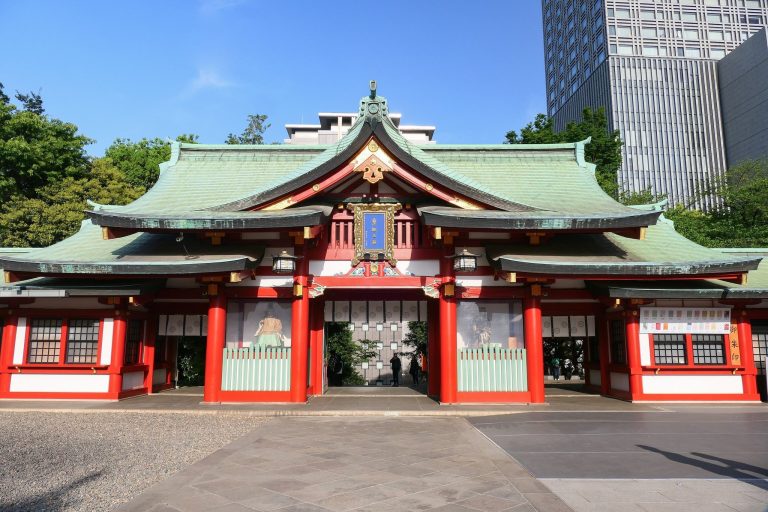
Sangedatsumon
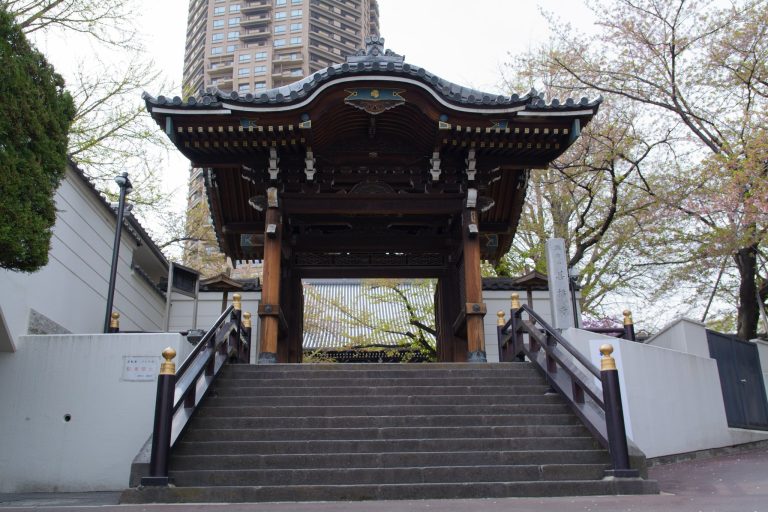
Sangedatsumon, the main gate, was built in 1622. It is a two-story, five-bay gate with three openings, an irimoya roof, a roof form combining sloping sides and gabled ends, and tile covering. Its name means “Gate of the Three Liberations,” referring to freedom from greed, hatred, and foolishness in Buddhist teaching. The upper story contains a central image of Gautama Buddha with two attendants and sculptures of the Sixteen Arhats, Buddhist disciples who have reached a high level of spiritual realization. Designated an Important Cultural Property, it is the only original temple structure to have survived the Second World War.
Great Hall
The Great Hall was rebuilt in 1974. It houses a Muromachi-period image of Amida Buddha accompanied by images of Hōnen and Shandao. Beneath the hall, the Treasure Gallery contains a one-tenth-scale model of the former Taitoku-in Mausoleum and paintings of the 500 Arhats by Kanō Kazunobu. The Arhat Hall was destroyed during the war, but all 100 scrolls of Kazunobu’s 500 Arhats survived.
Ankokuden
Ankokuden houses the “Black Honzon,” a hidden standing image of Amida Buddha attributed to Eshin Sōzu and dated to the Muromachi period. Originally gilded and approximately 80 centimetres high, the image became dark through years of exposure to incense smoke. Tokugawa Ieyasu revered it and traditionally carried it as a personal Buddhist image during military campaigns. The hall also contains an image of Ieyasu, memorial tablets for former shoguns, and an image of Princess Kazunomiya. The Black Honzon is publicly unveiled on January 15, May 15, and September 15.
Later halls and facilities
Kōshōden, completed in 2000, serves as an assembly hall and training facility. Its first floor contains an assembly hall, while its third-floor large hall has ceilings decorated with painted panels. Zōjō-ji Kaikan, built in 1999 to replace a deteriorated former hall, contains temple offices, a large dining hall, Japanese- and Western-style private rooms, and spaces used for worship, memorial services, training, and religious retreats.
Jiunkaku, also called the Founder’s Hall, was built in 1989 to replace the hall destroyed during the war. Its second floor contains an image of Yūyo Shōsō flanked by images of his teacher Shōkei and Sōkan Chikoku. Other facilities include the Sutra Repository, Enkō Daishi Hall, Teikyō-an, Kumano Shrine, the West-facing Sacred Kannon, the Sentai Kosodate Jizō garden, and the Sacred Scissors Kannon.
Tokugawa cemetery and relocated mausoleum remains
Cemetery entrance and shogunal monuments
The entrance to the Tokugawa cemetery is marked by a bronze gate that formerly served as the middle gate of the inner precinct of the Bunshō-in Mausoleum. Within the cemetery, relocated and consolidated monuments commemorate Tokugawa shoguns and members of their families. The former Sūgen’in and Taitoku-in tomb monument is a stone tower for Hidetada and his wife Sūgen’in. Hidetada’s original tower was destroyed during the war, so the couple are jointly commemorated in Sūgen’in’s former tower.
The former Bunshō-in tomb monument is a bronze tower for Ienobu and his wife Ten’ei-in. Other stone towers commemorate Ietsugu at Yūshō-in, Ieshige at Juntoku-in, Ieyoshi at Shintoku-in, and Iemochi at Shōtoku-in. A bronze tower commemorates Iemochi’s wife, Princess Kazunomiya, whose posthumous title was Seikan-in.
Joint tomb
A stone joint tomb contains Tsunashige, the father of Ienobu; Keishō-in, the mother of Tsunayoshi; the wives and concubines of later shoguns; and 35 other members of the Tokugawa shogunal family. The present joint tomb was originally the tower of Gekkō-in.
Surviving gates
Surviving mausoleum structures include the four gates of the former Taitoku-in Mausoleum, the Nitenmon of the Yūshō-in Mausoleum, and the inner gate of the Bunshō-in Mausoleum. The Taitoku-in Chokugakumon, Teijimon, and Onarimon were moved to Sayama Fudōson in Tokorozawa, Saitama. The Taitoku-in main gate and the Yūshō-in Nitenmon remain in the Shiba Park area, and the Nitenmon underwent major conservation work beginning in 2015 for approximately three years.
Collections and surviving objects
Zōjō-ji’s Important Cultural Properties include Sangedatsumon, a two-volume illustrated biography of Hōnen deposited at the Tokyo National Museum, the Song, Yuan, and Goryeo editions of the Buddhist canon, and the upper catalogue of Emperor Hanazono’s personal diary. The canon comprises 5,356 Song volumes, 5,386 Yuan volumes, and 1,259 Goryeo books, together totaling approximately 12,000 items.
Tokyo-designated tangible cultural properties include the Sutra Repository, a wooden seated Amida Buddha, the wooden Black Honzon, wooden images of Shakyamuni and two attendants in Sangedatsumon, the wooden Sixteen Arhats in the gate, and wooden standing images of the Heavenly Kings.
Former Lotus Pond
The former Lotus Pond stood behind the main hall. It began as a deep pool in a local river that later became part of the temple grounds. Tradition associated the pond with a woman who drowned herself during the Tenshō era. It was also known as Sayo Pond and Fuyō Pond.