Hamarikyu Gardens: A Shogunal Garden in Tokyo


Site at a Glance
- Rating
- 4.4
- Popularity
- High
- Country
- Japan
- Primary era
- Early Modern
- External website
- Open
- Eras represented
- Early Modern, Modern
- Civilizations
- Japanese, Tokugawa
- Site type
- Civic
- Remains
- Park
On this page20 sections
History
Hamarikyu Gardens in Japan occupies about 25 hectares at the mouth of the Sumida River in Tokyo Bay. The Tokugawa ruling house developed the former marshland and tidal shallows into a residence and garden during the Edo period, when the Tokugawa shogunate, Japan’s military government from 1603 to 1868, controlled the country.
From tidal shallows to Kofu Beach Pavilion
The site originally consisted of marshland and tidal water, with two huts used for duck hunting. In 1654, Tsunashige Matsudaira, the younger brother of shogun Tokugawa Ietsuna and lord of the Kofu domain, partially filled the shallows. He established a residence and garden there for receiving daimyo, the powerful territorial lords who governed domains under the shogunate. The estate became known as Kofu Hama-yashiki, meaning “Kofu Beach Pavilion.”
In 1707, the grounds were extensively renovated. A formal garden was laid out, the large tidal pond Shioiri was created, and it was supplied with seawater. A bridge, tea house, Kannon temple, and main gate were also built. Kannon is a Buddhist bodhisattva associated with compassion.
Shogunal residence and changing uses
After Tsunashige’s son, Tokugawa Ienobu, became the sixth shogun, the residence came under the direct control of the Tokugawa shogunate. It was renamed Hama Goten, or “Beach Palace.” For approximately 160 years, the estate served the ruling clan and received daimyo and aristocrats visiting Edo, the city now known as Tokyo.
A fire in 1725 destroyed the main building and severely damaged other structures. Successive shoguns restored and altered the garden, which reached its definitive form under the eleventh shogun, Tokugawa Ienari. Ienari used the grounds for falconry, while his wife fished in the pond during a visit in 1826. The estate also accommodated plant cultivation, horse riding, military exercises, scientific research, pottery, and weaving. Ienari’s interest in falconry led to a rustic falconry tea house and additional tea houses being built.
The hunting grounds were associated with the capture of wild ducks using domesticated ducks as decoys. This practice remained part of the estate’s historical identity, and falconry demonstrations continue annually in January.
Transfer after the shogunate
Shortly before the fall of the shogunate, work began on a naval training facility at the site, but the project was not completed. In 1867, the estate was transferred to the Ministry of the Navy. After the Meiji Restoration, the political transformation beginning in 1868 that ended the shogunate and restored governing authority to the imperial institution, it passed to the Ministry of Foreign Affairs.
The foreign ministry completed the Enryokan in 1869. It served as Japan’s first residence for prominent foreign guests and was the country’s first Western-style stone building. Alfred, Duke of Edinburgh, became the first European prince received there in the same year. Deterioration led to the building’s demolition in 1889.
Former United States president Ulysses S. Grant stayed at the estate for two months during his 1879 visit to Japan. At Nakajima-no-ochaya, he held a major conversation with Emperor Meiji about Japan’s future. The estate later came under the direct control of the Imperial Household.
Damage, public opening, and protection
The Great Kanto Earthquake of 1923 and bombing during the Second World War caused extensive damage. In November 1945, the Imperial family transferred the garden to the City of Tokyo. It opened to the public on 1 April 1946, after which the park was rebuilt and progressively modernized.
On 22 November 1952, Hamarikyu Gardens was designated both a Place of Scenic Beauty and a Special Historic Site under Japan’s cultural-property protection law. It is also counted among Japan’s sites of exceptional scenic beauty. Tea ceremonies are regularly held at the central tea house, continuing a cultural use rooted in the garden’s shogunal history.
Remains
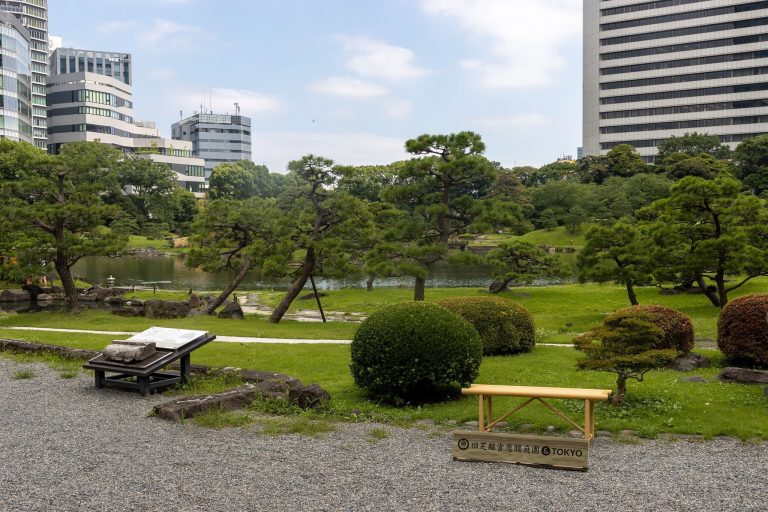
Hamarikyu Gardens is a strolling-style Japanese garden organized around the artificial Shioiri-no-ike lagoon. A strolling garden, or kaiyushiki garden, is designed to be experienced along a planned walking route. The grounds contain an older southern section centered on the former daimyo garden and a newer northern section laid out during the Meiji era. A ditch or moat on three sides is filled with seawater from Tokyo Bay, preserving the site’s direct relationship with the coast.
Lagoon and bridges
Shioiri-no-ike and the tidal sluice
Shioiri-no-ike is regulated by a tidal sluice, a controllable barrier used to manage water levels, and receives seawater from Tokyo Bay. Tidal movement raises and lowers the lagoon, changing its water level and appearance. Marine fish, including mullet, gobies, and eels, live in the water.
Naka-jima and O-tsutai-bashi
The lagoon’s central island, Naka-jima, is linked to the shore by three wooden bridges. O-tsutai-bashi extends for 118 metres and is made of hinoki cypress, a traditional Japanese cypress timber valued in construction. Its wisteria-covered structure is described as resembling a crane with outstretched wings.
Duck-hunting grounds
Koshin-do kamoba and Shizen-za kamoba
Two duck-hunting areas, Koshin-do kamoba and Shizen-za kamoba, were established in 1778 and in 1791 or 1795 respectively. Each has a central nesting island, branching waterways, dense protective vegetation, and camouflaged observation huts called Hikibori. Ducks were formerly caught with nets, using the carefully arranged waterways and cover of the hunting grounds.
Kamozuka
Kamozuka is a funerary monument erected in 1935 to console the spirits of ducks killed in the hunting grounds. It preserves the memory of an activity that shaped the estate’s landscape and its historic use.
Tea houses and coastal structures
Nakajima-no-ochaya
Nakajima-no-ochaya is a tea pavilion on Naka-jima. Built in 1707 as a place of relaxation for Edo’s aristocracy, it offered views toward the sea. Fire and war damage did not end its history: the pavilion was destroyed in 1724 and again in 1944, then reconstructed in its original form in 1983. It remains an operating tea house, where sweets served during tea ceremonies are also sold.
Matsu-no-ochaya and Tsubame-no-ochaya
Matsu-no-ochaya, or “Pine Tea House,” stood on the northern shore of the lagoon. Its name derives either from nearby pine trees or from pine designs on its entrance screen. Bombing in November 1944 destroyed the building, which was reconstructed in 2010 with thousand-year-old cryptomeria from Yakushima and traditional paper-making and lacquer-finishing techniques.
Tsubame-no-ochaya, or “Swallow Tea House,” was also destroyed during the war and reconstructed in 2015. Umite chaya stood near the coast, where it provided views of the sea, boats, and fishermen. The 1923 earthquake destroyed that tea house.
Shogun O-agariba
Shogun O-agariba is a landing place formerly used by the shogun. Tokugawa Yoshinobu, the last shogun, landed there in 1868 after his defeat at the Battle of Fushimi-Toba. The landing structure was damaged by a typhoon in 1949.
Trees, flowers, shrine, and bay-side features
Sanhyakunen-no-matsu
Sanhyakunen-no-matsu, or “Three-Hundred-Year Pine,” was planted in 1709 during Tokugawa Ienobu’s shogunate. Its planting is attributed to Ienobu and commemorated improvements he made to the garden. The black pine is described as Tokyo’s largest.
Flower grounds and Kyu Inabu-jinja
The grounds include a flower garden with seasonal blooms, a peony field containing about 800 plant varieties, including 60 peony varieties, and areas planted with cherry trees. The cherry-tree area is specially illuminated after dark for hanami, the Japanese custom of viewing flowering trees, especially cherry blossoms.
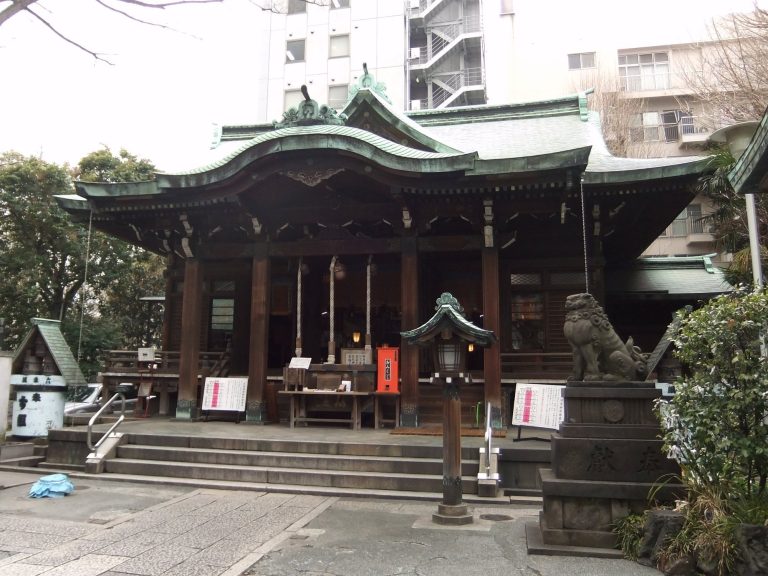
Kyu Inabu-jinja, the former Inabu Shrine, was built in 1895 on the site of an Edo-period shrine destroyed by an earthquake in 1894. It was renovated in 2005.
Shin Hinokuchi-yama and the shore-side hut
Shin Hinokuchi-yama is a mound facing Tokyo Bay from which the Rainbow Bridge can be seen. Other surviving physical features include the shore-side Hikibori hunting hut and the tidal sluice installation, which continues to express the garden’s connection to the bay’s changing waters.