Hie Shrine: A Shinto Guardian Shrine of Edo and Tokyo


Site at a Glance
- Rating
- 4.4
- Popularity
- High
- Country
- Japan
- Primary era
- Early Modern
- External website
- Open
- Eras represented
- Early Modern
- Civilizations
- Tokugawa
- Site type
- Religious
On this page10 sections
History
Hie Shrine is a Shinto shrine in Japan, located in Tokyo’s Chiyoda City and associated with Sanno belief, a tradition centered on a mountain deity and protective kami. Its main deity is Oyamakui no Kami, a guardian figure associated with Mount Hie, while Kunitokotachi no Kami, Izanami no Kami, and Tarashinakatsuhiko no Mikoto are also enshrined. The shrine’s origins are uncertain, but its later history is closely connected with the political center of Edo and with the Tokugawa shogunate.
Origins and the 1478 Enshrinement
One tradition places the shrine’s beginnings in the Kamakura period, when the Edo clan worshipped a Sanno shrine. A more direct historical association begins in 1478, when Ota Dokan, the warrior and castle builder linked with the construction of Edo Castle, enshrined the deity from Senba Hie Shrine in Kawagoe. At that time, Senba Hie Shrine served as the guardian shrine of the Muryojuji temple complex. Another interpretation connects Hie Shrine with a Sanno Shrine mentioned in a 1362 record of Kumano Nachi Taisha.
Tokugawa Relocations
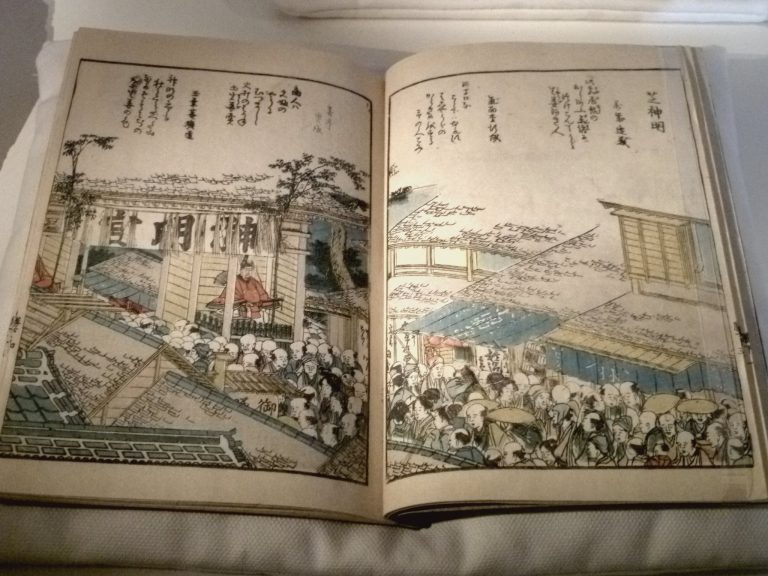
When Tokugawa Ieyasu was transferred to Edo, he moved the shrine to Momijiyama within Edo Castle and appointed it the castle’s guardian shrine. During Tokugawa Hidetada’s reconstruction of the castle, which began in 1604, the shrine was moved outside the castle to Kojimachi Hayabusa. This relocation made the shrine accessible to ordinary worshippers.
The shrine’s land endowment grew under successive Tokugawa rulers. Ieyasu granted it five koku, a historical measure of rice-based land revenue and stipends. Hidetada increased the endowment to 100 koku in 1617, and Tokugawa Iemitsu added another 400 koku in 1635.
Fire, Reconstruction, and State Status
The Great Fire of Meireki destroyed the shrine buildings in 1657. In 1659, Tokugawa Ietsuna requisitioned the estate of Matsudaira Tadafusa overlooking the Tameike and transferred Hie Shrine to its present site. The location occupied the ura-kimon, or southwest position regarded in onmyodo as the reverse demon gate, in relation to Edo Castle. Onmyodo was a historical system of cosmological and divinatory ideas used to assess auspicious and inauspicious directions.
In November 1868, during the transfer of the imperial capital to Tokyo, Hie Shrine was designated a quasi-imperial shrine and became one of the Tokyo Ten Shrines. Its administration passed from the Jingikan to Tokyo Prefecture in 1871. After it was excluded from the 1873 selection of government-supported shrines, it became a Tokyo Prefectural shrine.
Hirayama Seisai, who served as chief priest of Hikawa Shrine and as a shrine official at Hie Shrine, advocated for a higher classification. On January 9, 1882, Hie Shrine became a Kanpei-chusha, a middle rank in Japan’s former state-supported shrine system. It was elevated to Kanpei-taisha, the system’s highest classification, in 1912. This official status continued until the system was abolished in 1946.
War Damage and Continuing Festival Tradition
The shrine buildings were destroyed again in the 1945 bombing of Tokyo during the Second World War. Reconstruction was completed in 1958, with a financial contribution from the Imperial household and offerings connected with the main-hall relocation ceremony.
Hie Shrine’s annual Sanno Matsuri takes place in June, with June 15 as its principal festival date. The festival is one of the three major festivals associated with Edo and Tokyo. In even-numbered years, its full form alternates with the full Kanda Matsuri, continuing for more than a week and including a procession through central Tokyo that begins and ends at Hie Shrine. During the procession, the chief priest enters the Imperial Palace to pray for peace, happiness, and prosperity for the Imperial family. This privilege is unique among shrines in Japan.
Remains
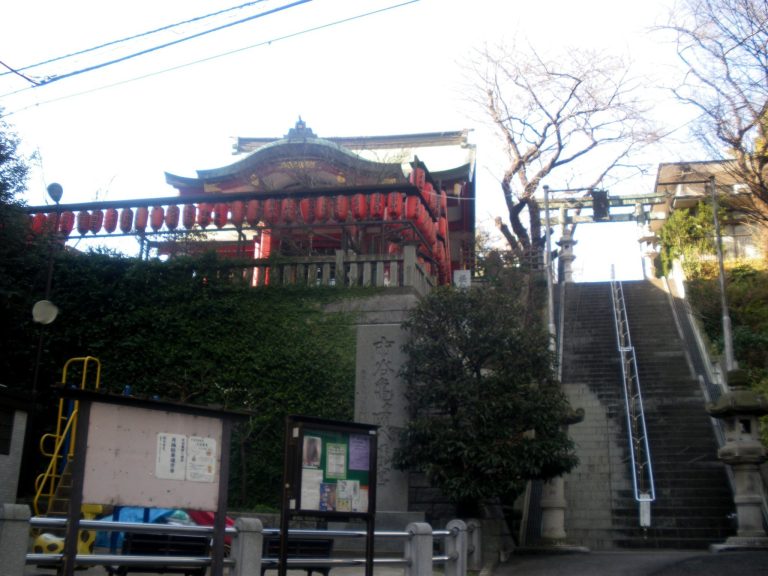
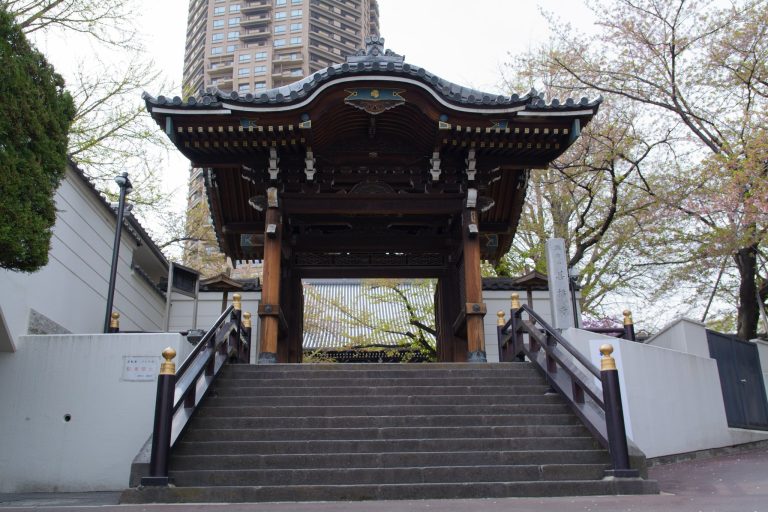
Hie Shrine occupies a hill in Nagatacho, southwest of the former Edo Castle. Its principal buildings face east, while the main approach, Sanno-zaka, runs eastward toward the National Diet Building. A large torii and two rear approaches lie toward the southwest along Sotobori-dori in the direction of Akasaka. The southern approach, known as the Sanno Bridge approach, includes escalators that negotiate the steep hill.
Principal Shrine Buildings
Main Sanctuary and Worship Hall
The precinct contains a main sanctuary and a worship hall within an inner enclosure. The buildings reconstructed at the present site in 1659 followed the gongen-zukuri arrangement, in which the main sanctuary and worship hall are joined by an intervening structure to form a continuous complex. Their richly ornamented design was exceptionally elaborate. These buildings were formerly recognized as National Treasures before they were destroyed in the 1945 bombing. The present buildings date from the reconstruction completed in 1958.
Romon Gate and Corridors
The historic complex also included a Romon tower gate and connecting corridors. The earlier structures were destroyed in the Great Fire of Meireki in 1657 and rebuilt at the new site in 1659. The present shrine complex retains the principal sanctuary, worship hall, shrine gate, and inner enclosure as its main architectural components.
Torii and Prayer Facility
A large series of torii forms part of the shrine precinct, alongside a prayer facility known as Sanno Yume Goten. These features belong to the present arrangement of the shrine, whose buildings date from the 1958 reconstruction.