Kyu Shiba Rikyu Garden: An Edo-Period Clan and Imperial Garden in Tokyo


Site at a Glance
- Rating
- 4.3
- Popularity
- Medium
- Country
- Japan
- Primary era
- Early Modern
- External website
- Open
- Eras represented
- Early Modern
- Civilizations
- Tokugawa
- Site type
- Civic
- Remains
- Park
On this page8 sections
History
Kyu Shiba Rikyu Garden is a historic Japanese garden and former imperial garden in Tokyo, Japan, whose origins lie in land reclaimed from Tokyo Bay between 1655 and 1658. It became a samurai-style residence garden during the Edo period, when the Tokugawa shogunate, Japan’s hereditary military government from 1603 to 1868, ruled the country.
From reclaimed land to clan residence
In 1678, the site became the official residence of the Okubo clan, an important family associated with the Tokugawa shogunate. Garden designers from the Odawara Domain created the residence garden, then known as Rakujuen. The property later changed hands several times. Around 1860 it belonged to the Kishu family of the Tokugawa clan, and in 1871 it passed to the Arisugawa-no-miya clan, an imperial princely house.
Imperial villa and destruction
The Imperial Household Agency, the institution responsible for Japan’s imperial household and its properties, acquired the site in 1875. It established the Shiba Detached Imperial Villa, where a European-style guest house was built in 1891 for receiving foreign guests.
The Great Kanto earthquake on September 1, 1923, and the fire that followed destroyed every building and tree on the site. In January 1924, the damaged property was donated to Tokyo City as part of preparations for celebrations marking the beginning of the Showa period. The garden was rebuilt and opened to the public on April 20, 1924. Its area was later reduced to make room for railway tracks along the northern side.
Historic garden in modern Tokyo
In 1979, the Government of Japan designated Kyu Shiba Rikyu Garden as a place of scenic beauty and a site of special historic interest. It remains one of the surviving Edo-period clan gardens in modern Tokyo and has been regarded as one of the city’s most beautifully designed gardens. Earlier descriptions even called it the most beautiful scene in Japan.
Remains
Central pond and islands
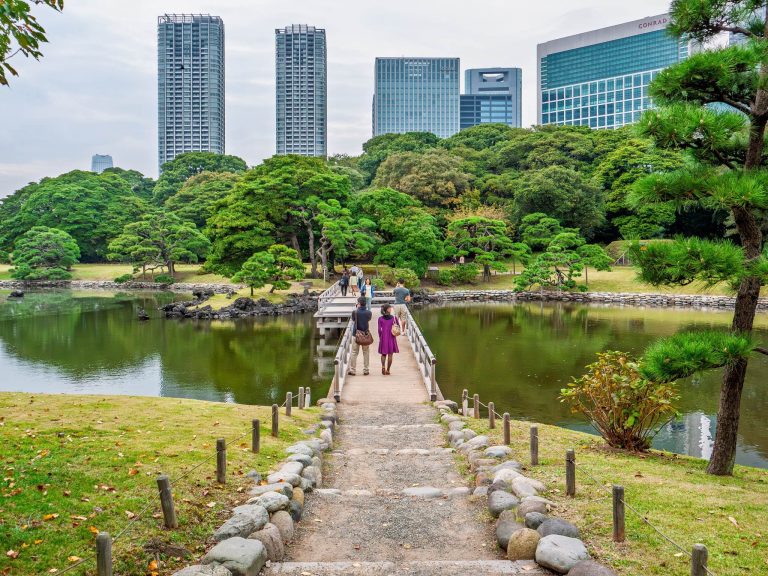
The garden covers approximately 4.3 hectares and is arranged around Sensui Pond, which occupies about 9,000 square metres. A circular path follows the pond’s edge. Originally a saltwater pond connected with Tokyo Bay, Sensui Pond became freshwater after the surrounding land was reclaimed. A remaining ocean-water inlet is not used.
Four islands occupy the pond: Nakajima, meaning central island, together with the smaller Ukishima, Oshima, and Yukimi-toro. Two bridges cross the water by way of Nakajima, while Oshima lies near the shore and can also be crossed. The island arrangement draws on West Lake at Hangzhou, and the rocks on Nakajima represent the mountains associated with that landscape.
Shoreline and hill features
A sandy beach area called Suhama occupies one corner of the pond. Oyama forms the garden’s highest point, with Karetaki, a dry waterfall, descending from the hill. This type of garden composition represents falling water through stones and a dry arrangement rather than a flowing stream. A stone lantern, or toro, serves as a traditional garden feature and is traditionally regarded as a good place from which to view snow.
Plantings and present grounds
A Japanese wisteria trellis stands in the picnic area and is especially notable when the wisteria blooms in early May. Other recorded plants include Japanese black pine, camphor, azalea, Persea, Japanese iris, Platycodon grandiflorus, Crinum latifolium, leopard plant, and spider lily. The grounds also contain a garden office, a Japanese archery practice area, and a children’s playground. Little egrets, eastern spot-billed ducks, carp, and seasonal tufted ducks, northern pintails, and common pochards are among the recorded wildlife. High-rise buildings and skyscrapers surround the garden.